
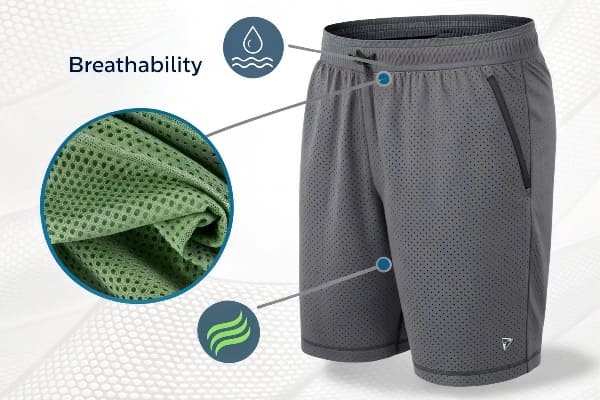
Nylon shorts are everywhere—from gym racks to hiking trails. They’re light, quick-drying, and stylish. But if you’re planning to sweat, one question matters: are they actually breathable?
Nylon shorts offer limited breathability on their own, but when blended with other fibers or designed with mesh panels, they can perform well. Pure nylon isn’t as breathable as cotton, but it excels at moisture wicking and fast drying.
I’ve sourced and tested nylon fabrics for athletic and outdoor brands. Nylon isn’t naturally breathable like cotton—but that doesn’t mean you’ll overheat, especially with the right design[^1].
Table of Contents
- How breathable is nylon compared to other fabrics?
- What makes nylon shorts feel more breathable?
- When are nylon shorts most comfortable?
- Are nylon shorts good for hot weather?
- Conclusion
How breathable is nylon compared to other fabrics?
Breathability is all about airflow—and nylon isn’t known for that.
Compared to cotton or modal, nylon is less breathable. But it beats fabrics like polyester in stretch and comfort. Modern performance shorts use nylon blends to add airflow and reduce heat buildup.

Fabric breathability comparison
| Fabric Type | Breathability Score (1–10) | Notes |
|---|---|---|
| Cotton | 9 | Excellent airflow, poor moisture wicking |
| Nylon (plain) | 5 | Low airflow, dries quickly |
| Nylon-Spandex | 6 | Better comfort, stretch, still limited airflow |
| Mesh Nylon | 7 | Great ventilation, good for sports |
| Polyester | 4 | Wicks moisture, but traps heat |
Studies from Textile School and Outdoor Gear Lab show that fabric construction often matters more than fiber content[^2].
What makes nylon shorts feel more breathable?
It’s not just the fabric—it’s how the shorts are built.
Features like mesh linings, side vents, gussets, and loose fits improve the airflow in nylon shorts. Thin, lightweight weaves also allow better heat escape than dense or coated fabrics.
Design factors for breathability
- Mesh lining: Adds ventilation and prevents cling
- Loose fit: Allows air to circulate around the body
- Side slits: Improve airflow during movement
- Lightweight weaves: Reduce insulation
- Perforated panels: Found in high-performance styles
Look for keywords like “quick-dry,” “tech fabric,” or “aeroready”—seen in products by brands like Nike, Patagonia, and Lululemon.
When are nylon shorts most comfortable?
Nylon shines in warm, humid, and high-output situations—if the fit and design are right.
Nylon shorts are most comfortable during workouts, runs, hikes, and humid weather—especially if paired with moisture-wicking liners. For casual lounging, cotton may feel softer and cooler.
Use case comfort chart
| Activity | Nylon Shorts Suitability |
|---|---|
| Running | ✅ Excellent (light, fast-dry) |
| Hiking | ✅ Excellent (abrasion-resistant) |
| Gym Training | ✅ Great with mesh panels |
| Lounging | ⚠️ Fair (can feel “plastic”) |
| Sleepwear | ❌ Not ideal (low softness) |
Many modern nylon shorts feature sustainable and stretch-infused fabrics, making them more versatile.
Are nylon shorts good for hot weather?
They can be—but choose wisely.
In hot climates, nylon shorts work best when made from thin, loose fabrics with added ventilation. Tight-fitting or double-layered nylon can trap heat if not designed for airflow.
Hot weather do’s and don’ts
| ✅ Do | ❌ Don’t |
|---|---|
| Choose lightweight nylon | Wear coated or water-resistant versions |
| Look for mesh side panels | Wear tight unlined nylon in heat |
| Pair with wicking underwear | Wear synthetic boxers underneath |
You’ll often find well-ventilated nylon shorts in hiking and running gear from Arc'teryx, Columbia, and The North Face.
Conclusion
Nylon shorts aren’t the most breathable by nature, but when designed with lightweight weaves, mesh panels, and moisture-wicking liners, they perform well in workouts and hot weather. Choose smart construction over fabric alone.
[^1]: Nylon is a synthetic fiber invented in 1935 by DuPont, designed for strength and resilience.
[^2]: See fabric comparison studies via OutdoorGearLab and Textile School.