
Ordering bulk T-shirts sounds simple—until you realize you’ve got too many Smalls and not enough Larges. Misjudging size distribution can cost you both money and customers.
To order bulk T-shirt sizes smartly, use a size ratio based on your target market’s average demand—like 1:2:2:1 for S:M:L:XL—and adjust based on past sales, customer profiles, or region-specific data. Always confirm sizing charts with your supplier.[^1]
I’ve worked with brands that lost thousands because they overstocked uncommon sizes. After that, I made sure to always use data-backed size breakdowns—no more guessing.
Table of Contents
- What’s the best size ratio for bulk T-shirt orders?
- How do I adjust sizing by region or customer type?
- What if I don’t have past sales data?
- Should I include plus sizes or XS?
- Conclusion
What’s the best size ratio for bulk T-shirt orders?
You won’t need equal quantities of each size. Smart brands use a proven ratio based on real customer behavior.
A common size ratio for adult unisex T-shirts is 1:2:2:1 (S:M:L:XL). This means Medium and Large usually sell the most. Adjust the ratio based on your market's age, gender, and region.[^2]
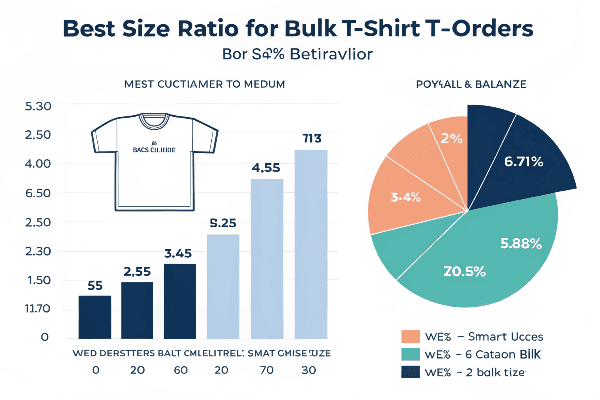
Size ratio examples
| Target Group | Suggested Size Ratio (S:M:L:XL:XXL) |
|---|---|
| General Unisex | 1:2:2:1:0.5 |
| U.S. Market (Men) | 1:2:3:2:1 |
| Women-Focused Brand | 2:3:2:1:0.5 |
| Streetwear Brand | 0.5:2:3:2:1 |
| Kids (Age 6–12) | 2:2:2:1:0 |
Use past sales data if you have it. If not, start with a standard ratio and adjust after your first few batches[^3].
How do I adjust sizing by region or customer type?
Different regions have different size norms. U.S. buyers tend to wear looser fits. Asian markets may lean toward slimmer cuts.
Check your target market's typical fit preference. Use customer data, e-commerce trends, or distributor feedback to tweak your size ratio by country or age group.[^4]
Regional considerations
U.S. and Canada
- Preference for relaxed or oversized fit
- M, L, and XL sell best
- Consider including XXL
Europe
- Closer fits, more evenly distributed
- M and L most popular
Asia
- Slimmer sizing, smaller frames
- S and M dominate
Youth/Gen Z
- Oversized is trendy
- More L/XL even for average builds
What if I don’t have past sales data?
That’s common for first orders. In that case, use basic demographics and the product’s intended use to decide.
If you’re starting from scratch, follow the standard 1:2:2:1 ratio and ask your supplier if they have order data for similar markets. You can also survey your potential customers.[^5]
First-order hacks
- ✅ Run a poll on your social media asking for preferred sizes
- ✅ Order sample packs with 1–2 of each size and track customer feedback
- ✅ Ask the supplier what their top clients order
- ✅ Start with fewer XS or XXL unless you know there’s demand
Should I include plus sizes or XS?
It depends on your brand positioning. But ignoring extended sizes can alienate part of your customer base.
Include at least a small percentage of XS and XXL if your brand supports inclusivity or if your market is size-diverse. Keep them to 5–10% of your total quantity.[^6]
When to add more size variety
| Factor | Add XS/XXL? |
|---|---|
| Sports/Gym Brand | Yes (XXL often needed) |
| Streetwear Brand | Yes (oversized fits) |
| Fashion Label | Maybe (if aesthetic matters more) |
| School/Event Merch | No (unless specified) |
XS and XXL tend to move slower, so don’t overstock—but don’t ignore them either.
Conclusion
Use a data-driven size ratio like 1:2:2:1, adjust based on your market, and always start with a plan—even for your first bulk T-shirt order. Keep reviewing and updating size distribution after every production run to reduce inventory waste and improve profitability.
[^1]: Bulk T-Shirt Size Guide – Printful
[^2]: Best Practices for Size Distribution – ShirtSpace
[^3]: T-Shirt Sizing Tips – T-Shirt Magazine
[^4]: How Culture Affects Clothing Fit – FashionUnited
[^5]: How to Use Customer Data for Fashion Decisions – Shopify
[^6]: Why Size Inclusivity Matters – Business of Fashion