
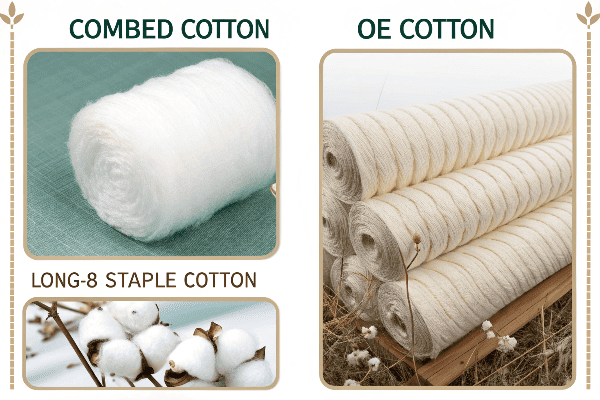
If you're sourcing fabric for T-shirts, hoodies, or loungewear, understanding cotton types is essential. The terms combed cotton, OE cotton, and long-staple cotton come up frequently—but many buyers don’t know what they really mean.
Combed cotton is smoother and more refined, OE (open-end) cotton is basic and affordable, while long-staple cotton refers to the fiber length—often found in premium cotton types like Pima or Egyptian. Each has different effects on softness, durability, and price.
I’ve helped dozens of clients choose the right cotton for their target market. Once, a startup used OE cotton for their “luxury” tee line—it looked cheap after two washes. Fabric knowledge matters.
Table of Contents
- What is combed cotton?
- What is OE (open-end) cotton?
- What is long-staple cotton?
- How do these cotton types compare?
- Conclusion
What is combed cotton?
Combed cotton is soft, clean, and upscale.
Combed cotton is made by removing short fibers and impurities through a fine-toothed combing process, resulting in smoother, stronger yarn with minimal pilling.
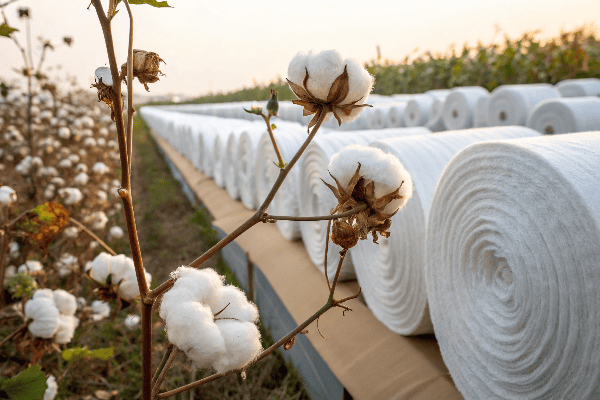
Benefits of combed cotton
| Feature | Impact |
|---|---|
| Short fibers removed | Less pilling, smoother fabric feel |
| Stronger yarn | Better wash durability |
| Clean surface | Ideal for screen and DTG printing |
| Mid–High cost | Justified by higher quality look/feel |
Read more from CottonWorks by Cotton Inc. on how combed cotton is processed and used in fashion apparel.
Combed cotton is widely used in mid-to-high-end T-shirts, babywear, and print-focused apparel.
What is OE (open-end) cotton?
OE cotton is budget-friendly but less refined.
Open-end cotton skips the combing process. It uses short and long fibers together, resulting in a rougher texture and lower production cost—but also reduced softness and print clarity.
Pros and cons of OE cotton
| Feature | Impact |
|---|---|
| No combing | Lower cost, more impurities |
| Short fibers remain | Increased pilling risk |
| Coarser yarn | Rougher touch, duller appearance |
| High output speed | Preferred for basic, mass-market items |
Textile Exchange lists OE cotton as standard for commodity basics where price takes precedence over performance.
OE cotton is often used in promo tees, workwear, or low-cost basics where price trumps softness.
What is long-staple cotton?
It’s all about fiber length—and quality.
Long-staple cotton refers to cotton with longer individual fibers (typically 1.1–1.4 inches or more). This includes premium varieties like Pima and Egyptian cotton, known for exceptional softness and durability.
Why fiber length matters
| Fiber Length | Yarn Result | Fabric Feel |
|---|---|---|
| Short staple (≤ 1") | Weak, uneven yarn | Rough, prone to pilling |
| Long staple (>1.1") | Strong, consistent yarn | Smooth, durable, soft |
| Extra-long staple | Lustrous, luxurious yarn | Ultra-soft, wrinkle-resistant |
Learn more about Supima cotton—a trademarked form of American-grown extra-long staple cotton.
Long-staple cotton can be combed for even better results—many luxury shirts use long-staple + combed cotton together.
How do these cotton types compare?
Let’s line them up side by side.
| Cotton Type | Fiber Length | Processing | Texture | Cost Level | Best For |
|---|---|---|---|---|---|
| OE Cotton | Mixed (short/long) | Carded only | Coarse | ★ | Budget tees, promo wear |
| Combed Cotton | Typically medium | Combed + carded | Smooth | ★★–★★★ | Retail T-shirts, basics |
| Long-Staple Cotton | Long (1.1" +) | Can be combed | Silky, soft | ★★★–★★★★ | Luxury knits, premium basics |
For more comparisons, see Printful's fabric guide for apparel brands.
Choosing the right cotton depends on your price point, customer expectations, and printing needs.
Conclusion
The difference between combed cotton, OE cotton, and long-staple cotton lies in fiber length, processing, and end quality. For softness and durability, choose combed or long-staple cotton. For price-conscious bulk orders, OE cotton may be enough—but it comes with trade-offs.
- Combed cotton removes up to 15% of short fibers to achieve smoother yarn, ideal for direct-to-garment (DTG) printing.
- OE (open-end) spinning is a high-speed method that produces lower-cost but lower-quality yarn.
- Long-staple cotton includes Pima (USA), Giza (Egypt), and other extra-long staple (ELS) varieties prized for softness and strength.
- Fiber length directly affects yarn uniformity, which impacts how fabric behaves during sewing, printing, and washing.
- Many premium brands use long-staple and combed cotton together for maximum performance and feel.