
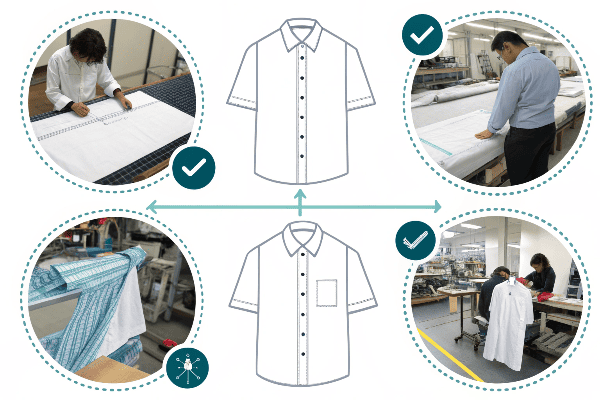
If you’ve ever wondered why custom shirt orders take days—or even weeks—to arrive, the answer lies in the steps behind the scenes. Shirt manufacturing isn’t just stitching fabric together. It involves design, sampling, sourcing, cutting, sewing, finishing, and quality control.
Manufacturing a shirt typically takes 7 to 30 days, depending on the order size, shirt complexity, fabric availability, and whether it’s custom-made or mass-produced.
In our factory, a basic cotton T-shirt can be produced within 7–10 days, while customized or branded shirts with embroidery, labels, and packaging might take 20–30 days.
Table of Contents
- What are the main steps in shirt manufacturing?
- How does shirt type affect production time?
- What other factors can delay production?
- Conclusion
What are the main steps in shirt manufacturing?
Each stage adds time—but also ensures quality.
The process includes fabric sourcing, cutting, stitching, decoration (like printing or embroidery), washing, and packaging. Delays in any stage can affect the final delivery.
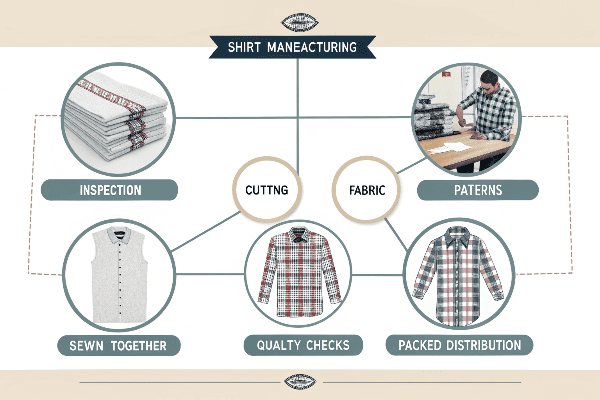
Typical shirt production timeline
| Stage | Time Required | Notes |
|---|---|---|
| Fabric Sourcing | 1–5 days (if in stock) | Longer if fabric needs to be dyed or woven |
| Pattern Making & Cutting | 1–3 days | Depends on shirt style complexity |
| Sewing / Assembly | 2–5 days | Faster for simple T-shirts |
| Printing / Embroidery | 2–7 days | Varies based on design and technique |
| Washing & Finishing | 1–2 days | Optional, based on style |
| Packaging & Inspection | 1–2 days | Includes folding, labeling, tagging |
For a deeper understanding of shirt production stages, Common Objective offers a great breakdown【^1】.
How does shirt type affect production time?
Not all shirts take the same time to make.
Basic T-shirts are the quickest, while polo shirts, button-downs, or styles with multiple panels, trims, or custom labels take longer.
Comparison by shirt style
| Shirt Type | Typical Production Time |
|---|---|
| Basic T-shirt | 7–10 days |
| Polo Shirt | 10–14 days |
| Button-Down Shirt | 15–20 days |
| Custom Embroidered Shirt | 20–30 days |
Curious how polo shirts differ in production time? MasterClass explains what makes polos more complex to manufacture【^2】.
What other factors can delay production?
Customization, materials, and even seasons matter.
Delays often come from custom prints, label sourcing, fabric shortages, or peak seasons like back-to-school or holidays.
Common production slowdowns
- Fabric not in stock: Dyeing and knitting can add 5–10 days.
- Custom printing or embroidery: Needs sample approval before mass production.
- Holiday shutdowns: Factory closures during major festivals (like Chinese New Year) can cause delays.
- Order revisions: Changes after sample approval usually push back timelines.
For best practices in managing apparel lead time, Fashion-Incubator provides excellent industry advice【^3】.
To keep things on schedule, we always recommend locking in fabric and design choices early.
Conclusion
The time it takes to manufacture a shirt depends on many moving parts—from fabric sourcing to decoration. For most custom shirts, expect 1–4 weeks. If you're ordering in bulk or adding unique features, plan ahead to stay on track.
Want to learn about global lead times by region? Fibre2Fashion offers insights into how location can affect turnaround【^4】.
[^1]: Common Objective – The Clothing Production Process
[^2]: MasterClass – What Is a Polo Shirt?
[^3]: Fashion-Incubator – Managing Sewing Production Lead Times
[^4]: Fibre2Fashion – Garment Manufacturing Process Overview