Thinking of launching your own product line without building a factory or designing everything from scratch? That’s where private labeling comes in. But not all private labels are created equal.
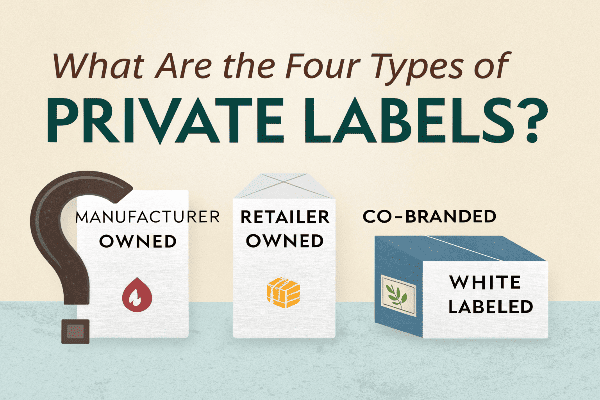
The four main types of private labels are: generic/private label, exclusive/co-branded private label, store brands, and copycat private label products. Each type serves a unique market strategy.
When I first helped a client start a fitness brand, they had no idea there were different private label models. Once we picked the right one, everything—from supplier choice to marketing—fell into place.
Table of Contents
- What is a generic or standard private label?
- What is an exclusive or co-branded private label?
- What are store brands?
- What are copycat private labels?
- Conclusion
What is a generic or standard private label?
This is the most common entry point for beginners. You choose a ready-made product and put your logo on it.
Generic private labels involve branding existing factory products with your own name, usually with minimal customization and quick turnaround.
Pros and use cases
| Feature | Description |
|---|---|
| Cost-effective | No need for mold/design investment |
| Low MOQ | Ideal for testing small batches |
| Fast to market | Often ready to ship after relabeling |
| Example | Alibaba T-shirts with custom logo[^1] |
This is best for dropshippers, Amazon sellers, or early-stage fashion brands.
What is an exclusive or co-branded private label?
Here, the product is made by a supplier but sold under an exclusive deal with one brand. Sometimes, both names appear.
Exclusive private labels involve a manufacturer and brand working together to create something unique—often with shared branding or distribution rights.
Examples and benefits
- Retailer + brand collaboration: e.g., Target x Levi’s[^2]
- Designer + factory partnership: e.g., influencer-designed activewear
- Benefit: Adds credibility, reduces design costs, and creates buzz
This model is ideal for brands that want to offer unique products but don’t have internal manufacturing.
What are store brands?
These are private label products created by and sold exclusively through a particular retail chain.
Store brand private labels are owned by a retailer and often compete with national brands at a lower price point.
Major examples
| Retailer | Store Brand Example |
|---|---|
| Walmart | Great Value[^3] |
| Costco | Kirkland Signature[^4] |
| Target | Up & Up[^5] |
These brands are strong in groceries, household essentials, and basic clothing.
What are copycat private labels?
These mimic the appearance and function of national brands—but are sold under a retailer’s name at a lower price.
Copycat private labels closely imitate name-brand products to attract budget-conscious shoppers.
Is it legal?
- Legal if not infringing trademarks or patents[^6]
- Often uses similar color schemes, packaging, or layout
- Seen frequently in supermarket chains and beauty stores
Retailers use this strategy to undercut national brands on price while leveraging similar product appearance.
Conclusion
The four types of private labels—generic, exclusive, store brand, and copycat—serve different purposes. Choose the one that fits your brand’s goals, budget, and growth strategy.
If you’re just starting out, generic private labeling might be your best bet. But for long-term growth and differentiation, consider exclusive partnerships or even developing a strong store brand strategy.
[^1]: Alibaba – Private Label T-Shirt Options: https://www.alibaba.com/showroom/private-label-t-shirt.html
[^2]: Target x Levi’s Collaboration: https://www.target.com/c/levi-s/-/N-4ynj6
[^3]: Walmart’s Great Value Brand: https://www.walmart.com/cp/great-value/1071964
[^4]: Costco’s Kirkland Signature: https://www.costco.com/kirkland-signature.html
[^5]: Target’s Up & Up Brand: https://www.target.com/b/up-up/-/N-56h5e
[^6]: Legal Considerations in Copycat Branding – Harvard Law Review: https://harvardlawreview.org/