
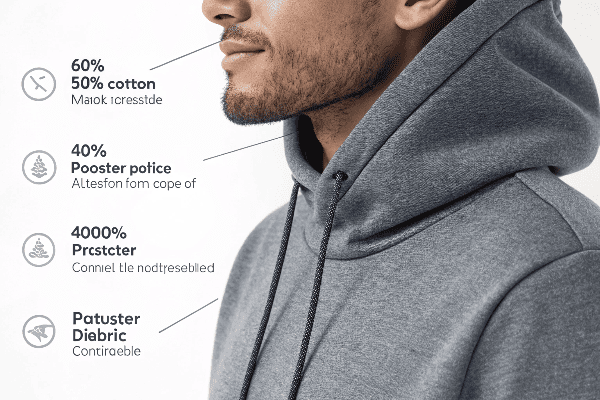
When choosing a hoodie fabric, balance is key. A 60% cotton, 40% polyester blend has become one of the most popular fabric choices in the hoodie market—but is it actually a good option?
Yes, a 60% cotton and 40% polyester blend is excellent for hoodies. It combines the softness and breathability of cotton with the durability and wrinkle-resistance of polyester, making it a balanced, comfortable, and long-lasting fabric choice.
I’ve produced thousands of hoodies using this blend. It’s the go-to fabric for many streetwear and sportswear brands because it performs well, feels great, and holds up to daily wear.
Table of contents
- What are the advantages of 60/40 cotton-poly hoodies?
- How does 60/40 compare to other blends?
- Is 60/40 good for printing and branding?
- Who should use 60/40 hoodies?
- Conclusion
What are the advantages of 60/40 cotton-poly hoodies?
This specific blend offers the best of both worlds.
60/40 hoodies are soft like cotton, but they don’t shrink or wrinkle as easily because of the polyester content. They’re comfortable, durable, and suitable for everyday use or light physical activity.
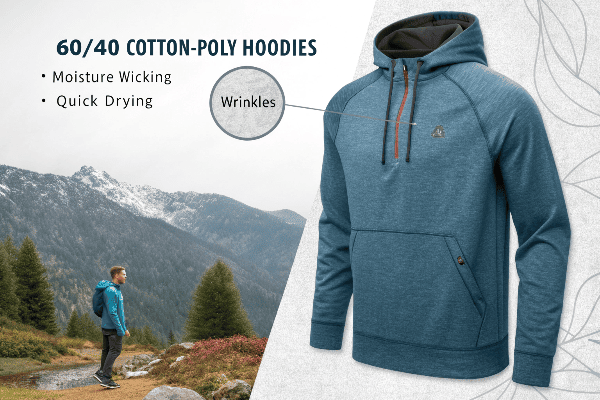
Key benefits of 60/40 blend
| Benefit | Why It Matters |
|---|---|
| Soft feel | Cotton provides natural, breathable comfort |
| Durability | Polyester helps resist stretching or tearing |
| Reduced shrinkage | Polyester minimizes post-wash size changes |
| Wrinkle resistance | Holds shape better than 100% cotton |
| Cost-effective | More affordable than 100% cotton or high-tech fabrics |
Source: CottonWorks™ on blended fabrics^[1]
This blend is also easier to print on than full polyester, making it popular for screen printing and branding.
How does 60/40 compare to other blends?
Understanding how different fabric ratios affect hoodie performance can help you make the right choice.
A 60/40 blend offers more comfort than a 50/50 blend and more durability than an 80/20 blend. It’s a true middle ground.
Comparison of hoodie fabric blends
| Blend Ratio | Feel | Durability | Breathability | Best Use Case |
|---|---|---|---|---|
| 100% Cotton | Very soft | Moderate | Excellent | Loungewear, casual wear |
| 80/20 Cotton/Poly | Soft | Good | Good | Retail apparel, lightweight comfort |
| 60/40 Cotton/Poly | Soft + sturdy | Very good | Good | Streetwear, daily fashion, uniforms |
| 50/50 Cotton/Poly | Balanced | Very good | Fair | School/team apparel, budget production |
| 100% Polyester | Synthetic feel | Excellent | Moderate | Sportswear, technical clothing |
See more comparisons from Bella+Canvas^[2]
Is 60/40 good for printing and branding?
Yes—and it’s often the preferred fabric for graphic hoodies.
A 60/40 cotton-poly blend takes screen printing and embroidery well while maintaining shape and color through multiple washes.
Decoration compatibility
| Decoration Type | 60/40 Compatibility |
|---|---|
| Screen Printing | ✅ Excellent |
| Heat Transfer Vinyl | ✅ Good |
| Embroidery | ✅ Stable Surface |
| DTG (Direct to Garment) | ⚠️ Acceptable, but less vibrant than 100% cotton |
Pro tip: Pre-treating the garment improves DTG printing even on blended fabrics^[3].
Who should use 60/40 hoodies?
Whether you're a fashion brand or ordering for a school team, 60/40 is a versatile pick.
60/40 hoodies are ideal for startups, merch lines, streetwear labels, and promotional giveaways because they’re durable, comfortable, and easy to produce in bulk.
This fabric is also favored by:
- Print-on-demand stores
- Sports and school apparel companies
- Corporate gift merchandisers
- Ethical brands seeking balance between cost and comfort
Conclusion
The 60% cotton and 40% polyester blend is one of the most balanced, high-performing fabrics for hoodies. It gives you softness, breathability, and durability without the downsides of 100% cotton or full polyester. Whether you're a brand owner or just shopping for a quality hoodie, this blend is a smart choice.
^[1]: CottonWorks™ on blended fabrics – Detailed industry guide on blending natural and synthetic fibers.
^[2]: Bella+Canvas Blog – Fabric Blends – Real-world applications in fashion production.
^[3]: Printful Guide to DTG – DTG performance across different fabric compositions.