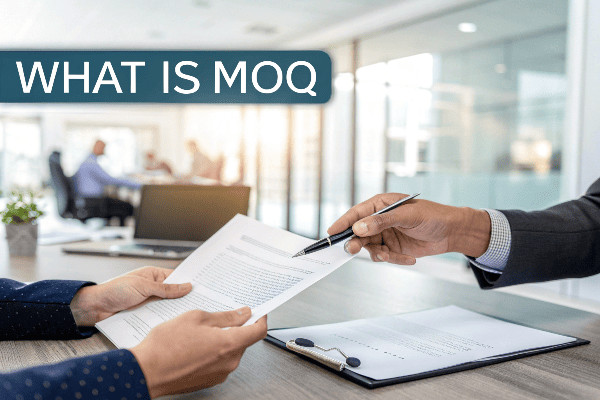
If you’re sourcing products from a manufacturer, you’ll often hear the term MOQ—but what does it really mean for your business?
MOQ stands for Minimum Order Quantity. It’s the smallest number of units a supplier is willing to produce or sell in a single order. It affects your pricing, production, and inventory strategy.
When I started working with factories, understanding MOQ helped me avoid over-ordering and negotiate better terms. Whether you’re launching a brand or scaling up, you need to know how it works.
Table of Contents
- Why do suppliers set an MOQ?
- What’s a typical MOQ in clothing manufacturing?
- How does MOQ impact your cost?
- Can you negotiate MOQ?
- Conclusion
Why do suppliers set an MOQ?
It’s not just about volume—it’s about economics.
Suppliers set MOQs to ensure production is cost-effective. Manufacturing has fixed setup costs, and small orders often don’t justify the labor, machine time, or material waste.
| Reason for MOQ | Explanation |
|---|---|
| Setup Costs | Pattern cutting, sampling, and machine setup |
| Material Waste | Fabric rolls and trims come in bulk |
| Labor Allocation | Production lines are reserved per order |
| Profit Margin | Small batches cost more per unit |
Without a reasonable MOQ, a factory might lose money on small custom runs.
What’s a typical MOQ in clothing manufacturing?
It varies by product and production method.
For custom apparel, MOQs usually range from 50 to 300 pieces per design, depending on style complexity, fabric sourcing, and printing method.
| Product Type | Typical MOQ |
|---|---|
| Basic T-shirts | 50–100 pieces |
| Hoodies (custom) | 100–200 pieces |
| Yoga leggings | 100–300 pieces |
| Fully sublimated sets | 200–500 pieces |
Factories like DeCheng Garment^[1] often allow low MOQs (50 pcs per style) to support new brands.
How does MOQ impact your cost?
Higher MOQ = lower unit price.
Most manufacturers offer better pricing as order quantities go up, because it spreads fixed costs and reduces waste per unit.
Cost vs MOQ Example
| Quantity Ordered | Unit Price (USD) | Total Cost |
|---|---|---|
| 50 pcs | $10.50 | $525 |
| 100 pcs | $8.00 | $800 |
| 300 pcs | $6.00 | $1,800 |
Ordering more lowers the per-piece cost, but ties up more capital and inventory risk.
Can you negotiate MOQ?
Yes—but it depends on leverage.
You can negotiate MOQs by simplifying the design, using available fabrics, or committing to long-term orders. But every negotiation must respect the factory’s cost base.
Tips to Lower MOQ:
- Ask if they offer a sample run^[2]
- Offer to reorder regularly
- Use fewer colorways or sizes
- Bundle similar styles for shared production
At DeCheng Garment^[1], we work with emerging brands to balance MOQ and flexibility.
Conclusion
MOQ stands for Minimum Order Quantity—it’s how manufacturers ensure production is profitable. Understanding it helps you plan your budget, negotiate terms, and launch your clothing line with confidence.
^[1]: DeCheng Garment – OEM/ODM Clothing Manufacturer in China
^[2]: Shopify: How Product Samples Work