

Amazon FBA Clothing Manufacturer: How Do You Make Apparel That Is Ready to Sell on Amazon?
Your first Amazon clothing order is finally finished.
The garments look good.
The cartons are packed.
The shipment reaches the fulfillment network.
Then the problems begin.
One size has the wrong barcode.
A medium hoodie is packed under the large SKU.
Several units are not prepared according to Amazon's current apparel requirements.
Customers begin leaving comments such as:
“Runs small.”
“Different from my last order.”
“Wrong size received.”
The manufacturing quality may be acceptable.
But the Amazon program is not.
That is why developing apparel for Amazon FBA requires more than:
making the garment.
Amazon-ready clothing needs controlled sizing, correct variation identification, compliant unit preparation, accurate barcodes, reliable QC, clear carton information, and a shipping plan that matches the current Seller Central requirements. Since Amazon changed several FBA prep and barcode rules in 2026, sellers should confirm the current Send to Amazon instructions before every shipment rather than relying on an old packing guide.
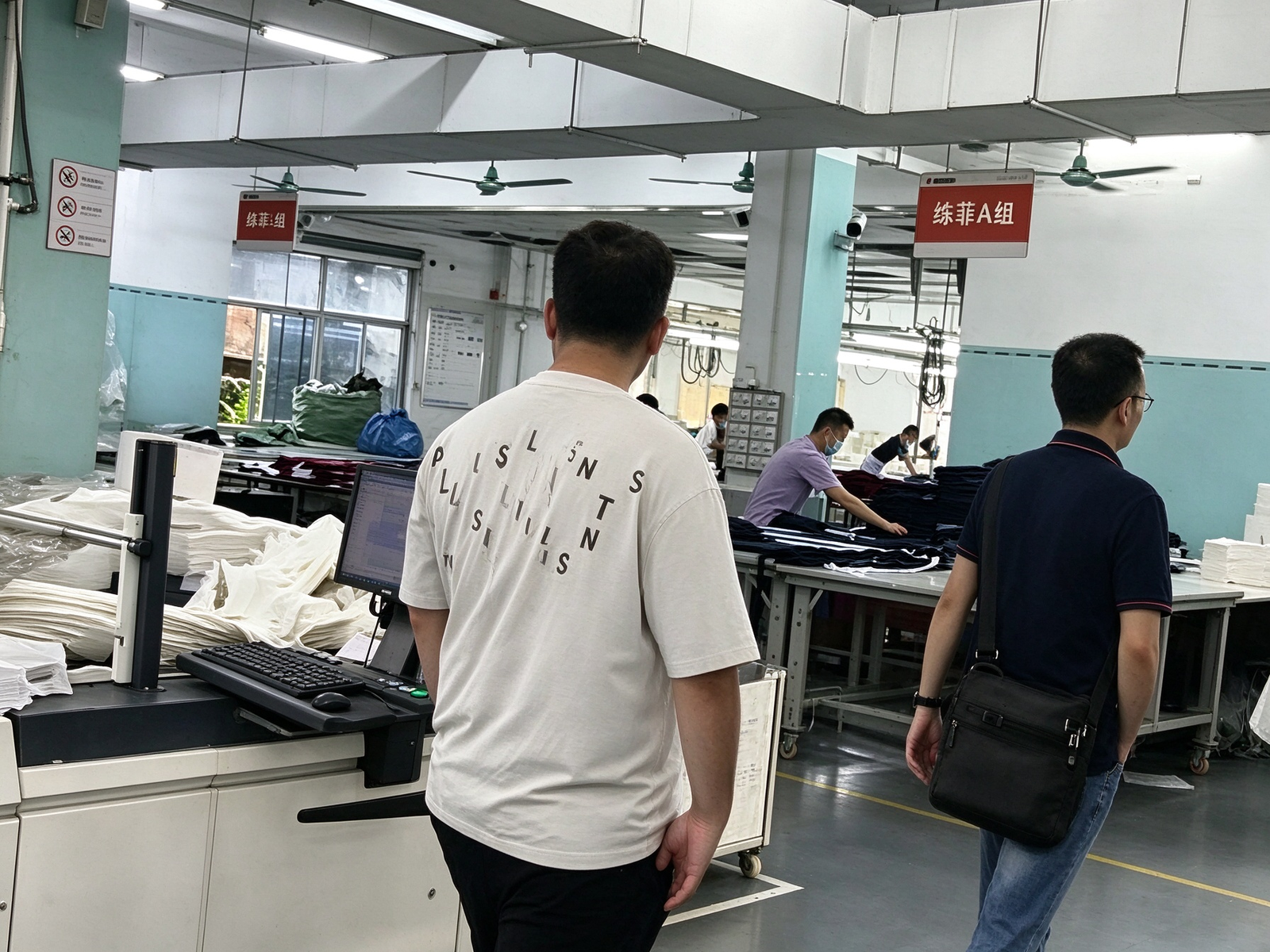
For a normal wholesale order, a packing mistake may affect:
one customer.
For an FBA program, the same repeated mistake can affect:
hundreds of units.
So the factory needs to understand not only:
what garment to make,
but also:
how each sellable variation needs to arrive.
Table of Contents
- Why Is Selling Clothing on Amazon Different?
- Which Clothing Products Work Best on Amazon?
- How Do You Reduce Size Returns Before Production?
- How Should Clothing Be Labeled and Packed for FBA?
- How Do You Ship Clothing From China to Amazon Warehouses?
- What MOQ, Cost, and Timing Should You Expect?
- Conclusion
Why Is Selling Clothing on Amazon Different?
Amazon clothing production combines:
apparel manufacturing
with:
inventory-control requirements.
Each sellable size and color combination needs to be correctly connected to its Amazon variation, inventory identifier, unit preparation, and shipment plan. A garment can be perfectly sewn and still create an FBA problem if the wrong barcode, size, color, or packaging is applied.
Size and Color Variations
Amazon allows apparel products to use:
parent-child variation relationships.
For clothing, common variation themes include:
- Size
- Color
- Size/Color
Amazon's Product Variations Overview[^1] explains that the parent ASIN is not itself a physical sellable item.
The individual:
size/color combinations
are child products.
For example:
Black / Small
Black / Medium
Black / Large
Grey / Small
Grey / Medium
Grey / Large
are individual sellable variations within the family.
That is why manufacturing and packing data needs to distinguish:
every variation clearly.
Do All Apparel Units Need an FNSKU?
No.
This is one of the biggest changes to understand in 2026.
Amazon's current FBA Barcode Requirements[^2] state that every unit sent to FBA needs a barcode for tracking.
But that barcode may be either:
- An eligible manufacturer barcode such as UPC or EAN
- An Amazon barcode such as an FNSKU
depending on the product and seller.
March 31, 2026 Barcode Change
As of:
March 31, 2026,
Amazon changed its FBA barcode requirements.
Brand owners can continue using eligible manufacturer barcodes without additional stickers when Amazon's requirements are met.
Resellers are required to use:
Amazon barcodes
even when a manufacturer barcode exists.[^2]
So the factory should not assume:
“Every Amazon order needs FNSKU.”
The seller should confirm:
which barcode type Seller Central requires
for the actual ASIN and shipment.
Then send the correct files to the factory.
Amazon Stopped FBA Prep and Labeling Services in 2026
This is especially important for new Amazon sellers.
Amazon's FBA Prep Service notice[^3] states that beginning:
January 1, 2026,
Amazon stopped offering prep and item-labeling services for FBA shipments in the U.S. store.
That means products need to arrive:
properly prepared and labeled.
The work can be completed by:
- The seller
- The manufacturer
- A third-party prep provider
For a clothing brand manufacturing in China, it often makes sense to complete much of this work:
before the cartons leave the factory.
That can include:
- Folding
- Unit packaging
- Size identification
- Barcode application
- Carton sorting
provided the seller supplies the correct Amazon requirements and label files.
Why This Matters for the Factory
Previously, some sellers assumed:
Amazon could fix prep problems after arrival.
That is no longer a good operating model.
Amazon states that shipments created after the 2026 change must arrive:
prepared and labeled
before entering its facilities.[^3]
So the factory packing stage has become even more important.
Which Clothing Products Work Best on Amazon?
There is no universal clothing category that:
“works best.”
Amazon demand depends on:
- Price
- Competition
- Brand
- Reviews
- Advertising
- Product quality
- Listing quality
But from a manufacturing perspective, some products can be:
easier to standardize.
Products with clear size systems, repeatable construction, stable fabrics, and straightforward customer expectations are usually easier to manage as FBA inventory than highly individualized or difficult-fit garments.
Hoodies
Hoodies can work well because the fit often has:
some ease.
But define:
- Chest
- Length
- Sleeve
- Shoulder
clearly.
Do not rely only on:
S / M / L.
Sweatpants and Joggers
Important measurements include:
- Waist
- Hip
- Rise
- Inseam
- Leg opening
Post-wash length is especially important.
T-Shirts
T-shirts are simple structurally.
But customers still notice:
- Fabric weight
- Length
- Width
- Shrinkage
- Neck shape
Shorts
Specify:
inseam
and:
rise
clearly.
A customer expecting:
5-inch shorts
will not be happy with:
8-inch shorts.
Leggings
Fit is more sensitive.
Important factors include:
- Waist tension
- Hip fit
- Rise
- Inseam
- Opacity
- Fabric recovery
Do not advertise:
“squat-proof”
only from GSM or fabric composition.
Matching Sets
Sets can be attractive because they create:
a complete outfit.
But you now have to control:
top size + bottom size + color + packaging.
If the set is sold as:
one unit,
make sure both pieces are physically packed together and that the barcode identifies:
the complete sellable set.
Relaxed Fits
Relaxed products may tolerate more:
body-shape variation
than highly tailored products.
But this does not mean:
oversized = fewer returns.
An oversized garment can still receive complaints if:
- Length is unexpected
- Sleeve is too long
- The listing is unclear
Accurate product information still matters.
How Do You Reduce Size Returns Before Production?
Fit-related returns are one of the biggest operational risks in:
online apparel.
Customers cannot try the garment on before ordering.
So your manufacturing data and listing information need to agree.
The goal is not simply to make the garment “true to size.” There is no universal true-to-size measurement. The goal is to create a defined size standard, manufacture consistently to it, explain that fit accurately to customers, and maintain the same approved pattern across production and reorders.
Start With a Base Size
For example:
Medium.
Approve the actual:
- Chest
- Length
- Shoulder
- Sleeve
or:
- Waist
- Hip
- Rise
- Inseam
depending on the product.
Then grade from:
the approved base.
Body Measurements vs Garment Measurements
These are not:
the same thing.
Body measurement
describes the customer.
Garment measurement
describes the finished clothing.
For example:
Customer chest: 100 cm
Garment chest circumference: 118 cm
The difference creates:
ease.
So the listing should make clear what:
the chart represents.
Fit Samples
Fit the sample on:
a real person
where practical.
For bottoms:
- Walk
- Sit
- Squat
For tops:
- Raise arms
- Bend
- Layer if relevant
Shrinkage
A garment that fits correctly:
before washing
but becomes noticeably shorter after washing can still create:
returns and bad reviews.
So check:
post-care measurements.
Reorders
Use the approved:
- Pattern
- Measurement chart
- Fabric specification
- Construction
- Shrinkage standard
as the reorder reference.
But do not assume:
a reorder is automatically identical.
New:
fabric lots,
trims,
or production conditions
still need QC.
What Does AQL 2.5 Actually Mean?
The original draft said:
“Our QC team checks measurements during final inspection to AQL 2.5.”
That mixes two different concepts.
AQL is primarily:
an acceptance-sampling system.
The current ISO 2859-1:2026[^4] provides sampling schemes indexed by:
Acceptance Quality Limit
for lot-by-lot inspection.
The 2026 edition replaced the old 1999 edition.
AQL 2.5 Does Not Mean
“2.5% defects are allowed.”
That is a common misunderstanding.
An AQL-based inspection needs other decisions, including:
- Lot size
- Inspection level
- Sample size
- Defect classification
- Acceptance/rejection numbers
Measurements Are Separate
Measurement checks should compare selected garments against:
the approved measurement chart and tolerances.
For example:
Chest: ±1 cm
Length: ±1 cm
if those are the agreed project tolerances.
So QC can use:
AQL-based attribute sampling
for relevant defects
and:
measurement inspection
against agreed specifications.
They are related quality tools.
They are not:
the same thing.
How Should Clothing Be Labeled and Packed for FBA?
This is where factory organization matters.
Before packing begins, the seller should provide the final variation list, barcode type, barcode files, Amazon shipment requirements, and any additional brand or retail labeling instructions.
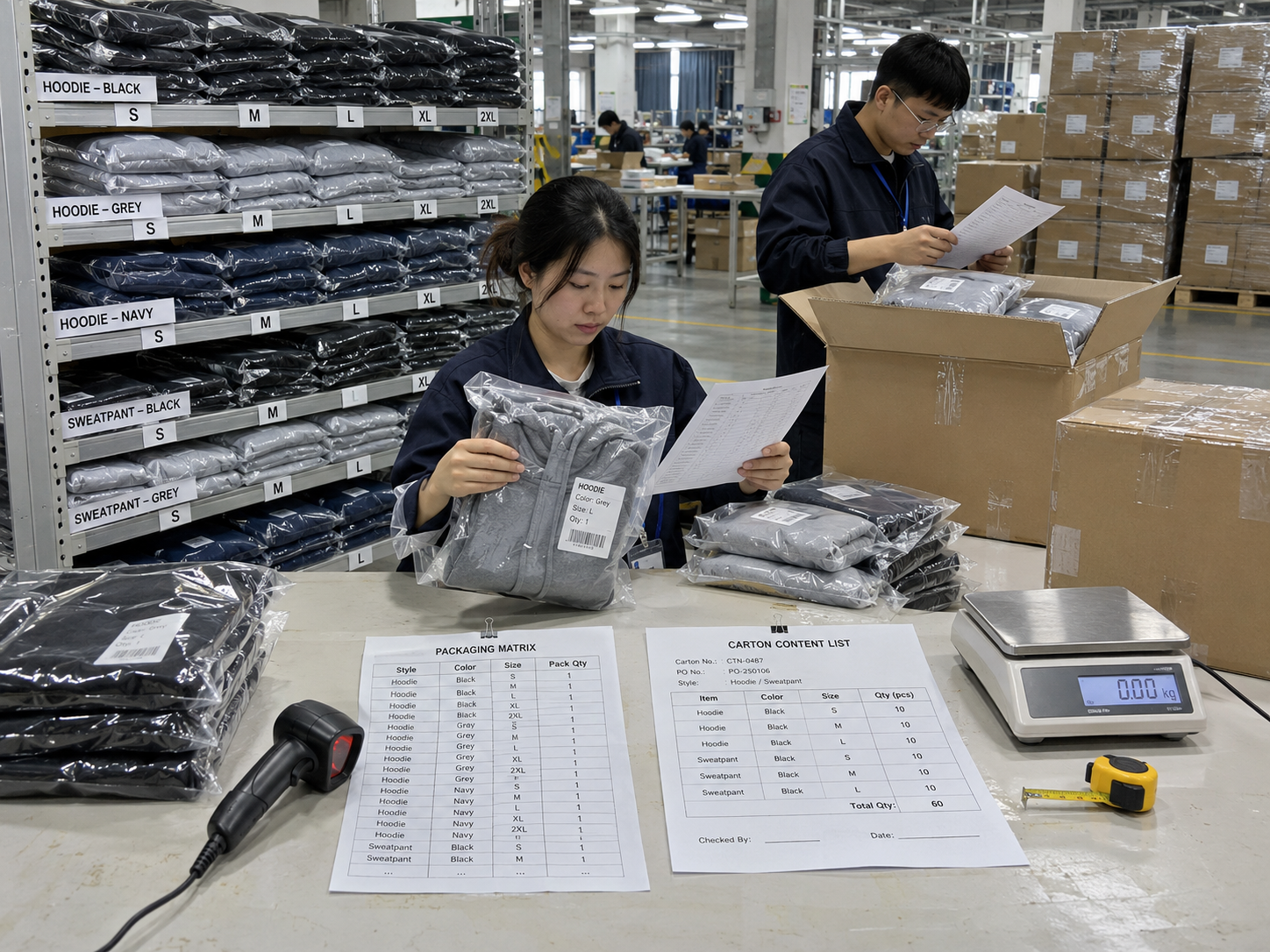
Build a Packing Matrix
For example:
| Color | Size | Seller SKU | Barcode file | Qty |
|---|---|---|---|---|
| Black | S | HD-BLK-S | File A | 20 |
| Black | M | HD-BLK-M | File B | 40 |
| Black | L | HD-BLK-L | File C | 40 |
| Grey | S | HD-GRY-S | File D | 20 |
| Grey | M | HD-GRY-M | File E | 40 |
| Grey | L | HD-GRY-L | File F | 40 |
That gives the packing team:
one master reference.
Scan Instead of Guessing
If possible:
scan the unit barcode.
Do not rely only on:
visual label recognition.
Black M
and:
Black L
may look almost identical once folded.
What Are Amazon's Current Apparel Prep Requirements?
Amazon's current Prep Guidance[^5] includes specific guidance for apparel and textile products.
For apparel requiring this prep, Amazon directs sellers to use protective packaging such as:
transparent polybags
or appropriate shrink wrapping,
with the unit:
- Properly secured
- Protected from dirt or damage
- Carrying the required warning where applicable under the current prep guidance
- Having a barcode that remains scannable
The exact prep instruction for a SKU should still be checked in:
Send to Amazon.
Amazon's own guidance states that sellers remain responsible for determining the preparation needed for their products.
Why You Should Not Copy an Old Polybag Specification
Amazon requirements can change.
So do not permanently print:
millions of bags
based only on an old blog article.
Before production:
check the current Seller Central requirement.
Barcode Position
The barcode needs to remain:
scannable
after final preparation.
That means the factory needs to think about:
the complete unit packaging,
not only:
the garment label.
Branded Packaging
You can still have:
brand identity.
For example:
- Printed bag
- Branded sticker
- Hangtag
But the package still needs to meet:
Amazon's functional requirements.
What About Main Labels and Care Labels?
Amazon preparation does not replace:
normal apparel labeling requirements.
Depending on the destination market, clothing may still need legally required information relating to:
- Fiber content
- Country of origin
- Responsible company
- Care
The factory should distinguish:
Amazon inventory labels
from:
garment compliance labels.
They solve:
different problems.
Should Every Color and Size Be Packed in a Separate Carton?
Not necessarily.
Operationally, separating SKUs can sometimes simplify:
counting and receiving.
But there is no universal rule that:
one size/color must always equal one carton.
Follow the:
current shipment plan.
If mixed-SKU cartons are permitted for the shipment:
the packing information needs to be accurate.
Carton Control
Each carton should have a factory packing record showing:
- Carton number
- SKU
- Color
- Size
- Quantity
If mixed:
list every SKU accurately.
This gives the seller another way to investigate:
receiving differences.
What Are Amazon's Current FBA Carton Limits?
For standard inbound FBA shipments, Amazon's current box guidance states that boxes generally must not exceed:
36 × 25 × 25 inches
and:
50 lb total weight,
unless the box contains an individual oversized item that itself exceeds those limits.[^6]
Amazon documents these requirements in its FBA box requirements[^6].
That is another reason the factory should receive:
the current shipment instructions
before final carton packing.
Do Not Build Cartons From Memory
Amazon can update:
- Packing rules
- Shipment workflows
- Label requirements
- Placement options
So final cartonization should follow:
the actual shipment created in Seller Central.
How Do You Ship Clothing From China to Amazon Warehouses?
There are several possible flows.
Option 1: Factory → Amazon FBA
The factory completes:
- Production
- QC
- Unit prep
- Barcode application
- Carton packing
Then the freight provider collects:
the shipment
and delivers according to:
the Amazon shipment plan.
Option 2: Factory → U.S. 3PL → Amazon
This gives the seller:
more control.
The 3PL can:
- Receive bulk stock
- Inspect
- Re-label if needed
- Repack
- Send smaller replenishments to Amazon
This can reduce the risk of putting:
all inventory
into FBA at once.
Option 3: Factory → Seller Warehouse → Amazon
Some brands first receive the stock themselves.
This provides:
maximum physical control
but adds:
another domestic handling stage.
What Is the Manufacturer's Role?
The factory can prepare:
the physical goods.
For example:
- Correct garment
- Correct size
- Correct color
- Correct unit packaging
- Correct supplied barcode label
- Correct carton content
But the seller controls:
the Amazon seller account.
That means the seller normally needs to provide:
- Seller SKU information
- Barcode selection
- Amazon-generated labels
- Shipment-plan instructions
- Destination details
The factory should not guess these.
EXW and FOB Are Not FBA Delivery Services
This distinction matters.
Under Incoterms®:
EXW
or:
FOB
describes part of the commercial delivery arrangement between buyer and seller.
It does not automatically mean:
the goods are delivered into Amazon inventory.
The ICC Incoterms® 2020 rules[^7] define delivery obligations, allocation of costs, and transfer of risk between seller and buyer.
For example:
FOB Shenzhen, Incoterms® 2020
and:
delivery to a U.S. Amazon fulfillment center
are not the same service.
The full FBA logistics chain may still involve:
- Freight forwarder
- Export
- Import customs clearance
- Duties
- Domestic transportation
- Amazon receiving requirements
If DDP or another door-delivery service is quoted:
define exactly what is included.
Air or Sea Freight?
Air Freight
Useful for:
- Launch inventory
- Small quantities
- Urgent restocks
Advantages:
faster transit.
Disadvantage:
higher freight cost.
Express
Can work for:
samples
or:
small urgent replenishments.
But sending commercial inventory by courier can become:
expensive.
Sea Freight
Useful for:
larger planned orders.
Advantages:
lower freight cost per unit in many cases.
Disadvantages:
- Longer transit
- More planning
Sea to 3PL, Then Amazon
This can be useful when the seller wants to:
control FBA inventory levels.
Rather than shipping:
2,000 garments
directly into Amazon,
the brand may keep part at:
a 3PL
and replenish gradually.
What MOQ, Cost, and Timing Should You Expect?
Amazon does not change:
our garment manufacturing MOQ
by itself.
The MOQ comes from:
the product and material.
Typical Starting Points
| Product | Typical starting point |
|---|---|
| Hoodie | Around 50 pcs/color |
| Sweatshirt | Around 50 pcs/color |
| Matching set | Around 50 sets/color |
| Jacket | Around 50 pcs/color |
| T-shirt | Around 100 pcs/style |
| Shorts | Around 100 pcs/style |
| Leggings | Around 150 pcs/style |
These are:
our practical starting points.
They are not Amazon rules.
Size Distribution
If you order:
100 pieces,
do not automatically divide:
20 / 20 / 20 / 20 / 20.
Use expected demand.
For example:
S — 10
M — 30
L — 35
XL — 20
2XL — 5
may be more realistic for one brand.
Another brand may be completely different.
Use:
your own sales data
once available.
Unit Prep Cost
FBA-related preparation may add cost for:
- Barcode application
- Special bags
- Size stickers
- Additional sorting
- Carton sorting
- Scanning
- Custom packing requirements
Quote these from:
the actual prep plan.
Do not assume:
one fixed FBA surcharge.
Packaging
A standard factory polybag may already satisfy the required program.
Or the project may require:
different packaging.
Check first.
Barcode Changes
If the seller sends new barcode files:
after packing begins,
the factory may need to:
- Reopen bags
- Remove labels
- Re-label
- Repack
That creates:
labor
and:
risk.
So lock barcode data before:
mass packing.
Sample and Bulk Timing
For standard garment programs:
Sampling: approximately 5–14 days
is a normal range for us.
Standard bulk production is generally:
approximately 20–30 days
after:
- Final sample approval
- Deposit
- Materials ready
Custom:
- Fabric
- Washing
- Special decoration
- Packaging
may extend the timeline.
Amazon Lead Time Is Longer Than Factory Lead Time
Do not confuse:
production complete
with:
inventory available for sale.
After production you may still have:
- Final QC
- Packing
- International freight
- Customs
- Domestic delivery
- FBA receiving
So the complete replenishment cycle can be:
much longer
than the garment-production time alone.
Do Not Wait Until Inventory Hits Zero
Suppose your product sells:
10 units per day.
You have:
200 units left.
That sounds like:
20 days of stock.
But if your complete manufacturing and replenishment cycle is longer than:
20 days,
you are already late.
A better reorder system considers:
- Daily sales
- Existing inventory
- Factory lead time
- Freight
- Amazon receiving
- Safety stock
before the product reaches:
zero.
What Should You Check Before the Final FBA Shipment?
Use a final checklist.
Product
- Correct style
- Correct color
- Correct size
- Correct measurements
- Correct branding
Legal Garment Labels
- Main label
- Size
- Fiber / origin information as applicable
- Care information as applicable
Amazon Identification
- Correct child variation
- Correct barcode type
- Correct barcode file
- Barcode scans
Unit Prep
- Correct bag or packaging
- Bag properly closed
- Required warning present where applicable
- Barcode remains scannable
Cartons
- Correct quantity
- Correct SKU content
- Correct box labels
- Correct carton weight
- Correct carton dimensions
Documents
- Packing list
- Commercial invoice
- Freight instructions
Then seal:
the cartons.
Green Flags and Red Flags
| Green flag | Red flag |
|---|---|
| Asks for your final variation/SKU matrix | Packs from garment names only |
| Confirms barcode type before labeling | Assumes every item always uses FNSKU |
| Knows Amazon changed prep rules in 2026 | Assumes Amazon will prep units after arrival |
| Scans barcode labels | Checks labels only visually |
| Separates size measurement QC from AQL sampling | Says AQL 2.5 means 2.5% defects are acceptable |
| Keeps approved patterns for reorders | Recreates sizing from memory |
| Tests shrinkage before bulk approval | Checks measurements only before washing |
| Packs according to current Seller Central instructions | Uses an old FBA packing checklist forever |
| Tracks carton contents accurately | Mixes SKUs without documentation |
| Checks carton weight and dimensions | Packs every export carton the same |
| Explains EXW/FOB separately from FBA delivery | Says FOB means delivered to Amazon |
| Plans reorder lead time | Waits until FBA inventory reaches zero |
Conclusion
Selling apparel through Amazon FBA starts:
before the goods reach Amazon.
It starts:
during product development.
First:
build the size system.
Define:
- Fit
- Measurements
- Tolerances
- Shrinkage expectations
Then approve:
the sample.
Next:
build the variation structure.
Every sellable:
size/color combination
needs to correspond correctly to:
the Amazon inventory data.
Then confirm:
the barcode.
Do not automatically tell your manufacturer:
“Put FNSKU on everything.”
In 2026, Amazon's barcode rules depend on:
the seller
and:
product eligibility.
Brand owners may be able to use:
eligible manufacturer barcodes.
Other products or sellers may require:
Amazon barcodes.
Follow what Seller Central requires for:
the actual shipment.
Then prepare:
the physical unit.
Since January 1, 2026:
Amazon no longer offers FBA prep and item-labeling services in the U.S. store.
That makes factory-side preparation even more important.
Fold the garment correctly.
Package it correctly.
Make sure the:
barcode scans.
Make sure:
Black / M
is not packed as:
Black / L.
Then inspect:
the garment.
Use approved:
measurements
for measurement QC.
If you use an AQL-based acceptance-sampling plan:
use it correctly.
AQL 2.5 does not simply mean 2.5% defects are allowed.
Then build:
the cartons
from the current Amazon shipment requirements.
Check:
dimensions.
Check:
weight.
Check:
contents.
Finally:
plan the full logistics cycle.
Factory production may take:
20–30 days.
But your inventory still needs:
international transport,
customs,
domestic delivery,
and:
Amazon receiving.
That is why successful FBA apparel brands do not only ask:
“How fast can the factory make my next order?”
They ask:
“When do I need to place the next order so the inventory is available before I run out?”
The best Amazon FBA clothing program connects:
product development + sizing + QC + labeling + packing + shipping + reorder planning.
When those systems work together:
the factory is not simply making clothing.
It is preparing:
inventory that is ready for the next stage of Amazon fulfillment.
Footnotes & References
[^1]: Amazon Seller Central — Product Variations Overview. Amazon explains parent and child ASIN relationships and notes that clothing products may use variation themes such as size and color. Each sellable size/color combination can exist as an individual child product within the variation family.
https://sellercentral.amazon.com/help/hub/reference/external/GH3RMVV3ZDYRRQ5S
[^2]: Amazon Seller Central — FBA Barcode Requirements. Amazon requires a barcode for every unit sent to an FBA fulfillment center. As of March 31, 2026, eligible brand owners can continue using manufacturer barcodes under Amazon's requirements, while resellers are required to use Amazon barcodes.
https://sellercentral.amazon.com/help/hub/reference/external/G201100910
https://sellercentral.amazon.com/gp/help/external/G200141480
[^3]: Amazon Seller Central — FBA Prep Service. Amazon discontinued FBA prep and item-labeling services in the U.S. store beginning January 1, 2026. Products now need to be prepared and labeled before being sent into FBA through the seller, manufacturer, or another service provider.
https://sellercentral.amazon.com/help/hub/reference/external/G201023020
[^4]: International Organization for Standardization — ISO 2859-1:2026, Sampling Procedures for Inspection by Attributes — Part 1: Sampling Schemes Indexed by Acceptance Quality Limit (AQL) for Lot-by-Lot Inspection. The third edition was published in January 2026 and replaced the 1999 edition. It defines AQL-indexed acceptance-sampling schemes and should not be interpreted as a simple percentage of allowable defects in a shipment.
https://www.iso.org/standard/2859-1
[^5]: Amazon Seller Central — Prep Guidance / Prepare Your Products for FBA Shipping. Amazon provides product-specific preparation guidance for FBA inventory, including apparel and textile products, and states that the seller remains responsible for adequate and compliant product preparation and barcode visibility.
https://sellercentral.amazon.com/help/hub/reference/external/F4G7547KSLDX2KC
https://sellercentral.amazon.com/gp/help/external/G201021850
[^6]: Amazon Seller Central — FBA Box Requirements. Amazon's current inbound-box guidance generally limits standard FBA cartons to 36 × 25 × 25 inches and 50 lb total weight, except where an individual oversize item itself exceeds those limits. Sellers should still follow the instructions generated for the actual shipment.
https://sellercentral.amazon.com/help/hub/reference/external/200141510
[^7]: International Chamber of Commerce — Incoterms® 2020. ICC's Incoterms rules define delivery obligations, allocation of costs, and transfer of risk between buyers and sellers. EXW or FOB does not by itself mean delivery into an Amazon fulfillment center.
https://iccwbo.org/business-solutions/incoterms-rules/incoterms-2020/