Lightweight Hoodie Manufacturer: How Do You Make a Hoodie Customers Can Wear in Spring, Summer, and Warm Climates?
Your heavyweight hoodie is one of your best sellers.
It works perfectly in:
autumn,
winter,
and cold-weather drops.
Then spring arrives.
Customers still like the hoodie design.
They just do not want:
the same heavy garment.
The problem becomes even clearer if part of your market is in:
- Southeast Asia
- The Middle East
- Australia
- Southern U.S. states
- Other mild or warm climates
A 380–500 GSM hoodie may still have a place in those markets.
But it is not the only hoodie you should consider.
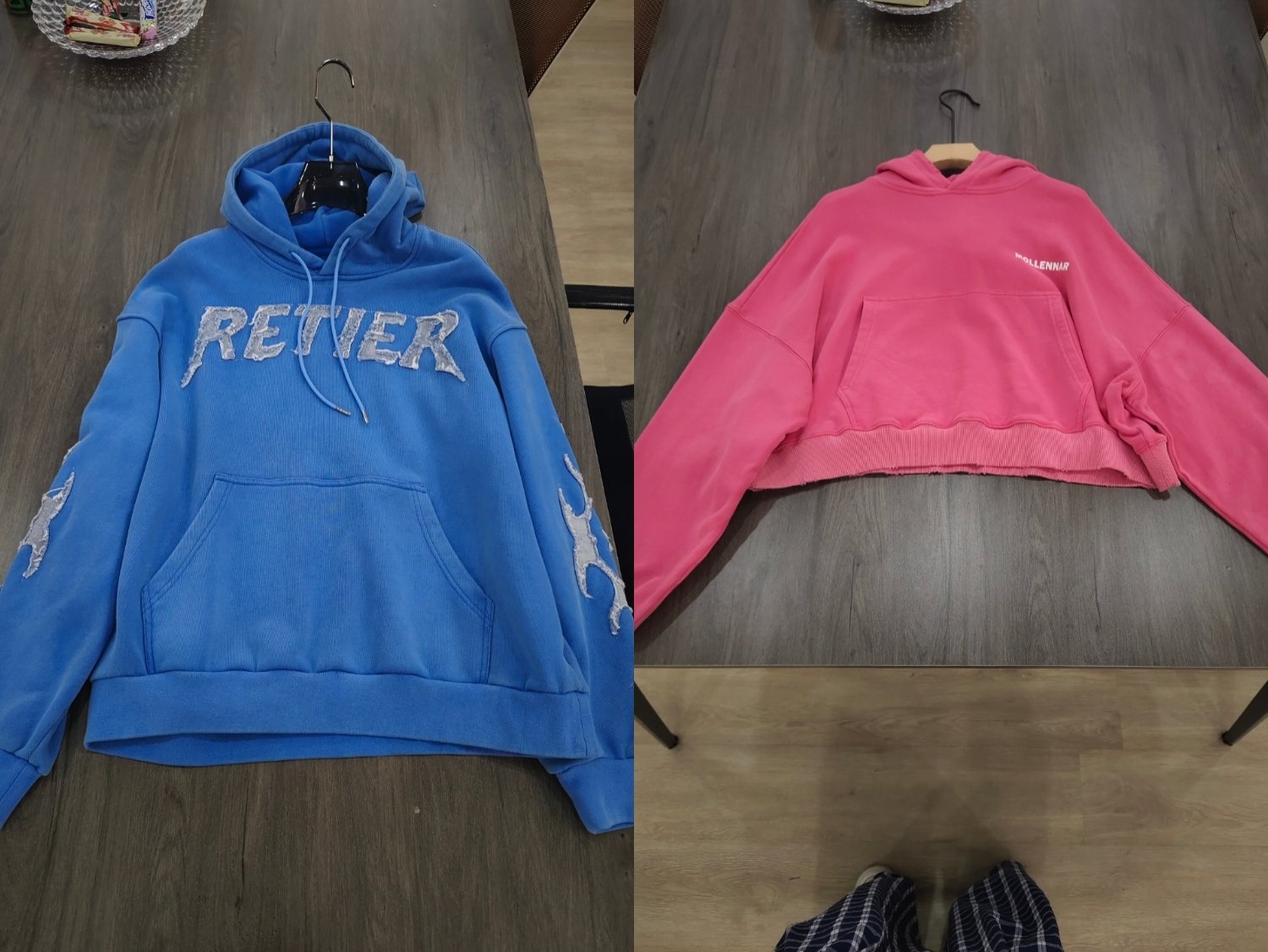
A lightweight hoodie is not simply a heavyweight hoodie made from thinner fabric. The fabric weight, knit structure, hood, rib, pockets, seams, decoration, fit, and post-wash behavior all need to be reconsidered. Around 260–300 GSM French terry can be a useful development range for many lightweight hoodie programs, but there is no universal GSM that automatically makes a hoodie suitable for spring, summer, or warm climates.
The goal should not be:
“Make the same hoodie lighter.”
The better question is:
“What should this hoodie feel and look like in warmer conditions?”
That changes the development process.
Table of Contents
- Why Do Brands Need a Lightweight Hoodie?
- Which Fabric Weight Should You Choose?
- Which Lightweight Hoodie Styles Work Best?
- How Do You Change Construction for a Lighter Fabric?
- How Do Prints and Embroidery Work on Lighter Fabric?
- What MOQ, Cost, and Timing Should You Expect?
- Conclusion
Why Do Brands Need a Lightweight Hoodie?
A heavyweight hoodie and a lightweight hoodie serve:
different wearing conditions.
A lightweight hoodie can extend a hoodie program into transitional seasons, travel, indoor layering, cool evenings, and warmer markets. It can complement a heavyweight bestseller rather than replace it.
Spring and Transitional Weather
A lighter hoodie can work when customers want:
- Long sleeves
- A hood
- Light layering
without the bulk of:
winter fleece.
Summer Evenings
“Summer hoodie” does not mean:
comfortable at noon in extreme heat.
It may instead mean:
- Evening wear
- Air-conditioned indoor environments
- Coastal weather
- Travel
That is a more realistic product positioning.
Warm-Climate Markets
In warmer markets, customers may still buy hoodies for:
- Indoor use
- Travel
- Style
- Nighttime
- Mild-season weather
But fabric weight and construction need to reflect:
how the garment will actually be worn.
Travel
A lighter hoodie can be easier to:
- Pack
- Carry
- Layer
than a heavy streetwear hoodie.
Layering
A lightweight hoodie may fit more easily under:
- Windbreaker
- Denim jacket
- Lightweight outerwear
because it adds less bulk.
Matching Summer Sets
A lightweight hoodie can also pair with:
- Sweat shorts
- Lightweight joggers
for a coordinated warm-season set.
Do You Need to Replace the Heavyweight Hoodie?
No.
For many brands, both products can make sense.
For example:
Heavyweight hoodie: winter / streetwear hero
Lightweight hoodie: transitional / travel / warm-weather layer
That creates two products with:
different reasons to buy.
Which Fabric Weight Should You Choose?
This is where brands often focus too heavily on:
one number.
GSM tells you the mass of fabric per unit area. It does not by itself tell you whether the fabric is breathable, cool, soft, structured, premium, durable, or suitable for summer.
The current ASTM D3776/D3776M-20(2025)[^1] covers measurement of fabric mass per unit area.
That is what GSM is fundamentally describing:
fabric weight.
Is 280 GSM a Lightweight Hoodie?
It can be.
For many of our hoodie-development programs, approximately:
260–300 GSM French terry
can be a useful lighter-weight range.
But this is:
a development reference,
not an international definition.
One brand may call:
280 GSM lightweight.
Another may call:
280 GSM midweight.
Possible Hoodie Weight Directions
| Fabric direction | Possible positioning | What to check |
|---|---|---|
| 240–260 GSM knit | Very light hoodie direction | Opacity, stability, hood structure |
| 260–300 GSM French terry | Lightweight / transitional | Drape, shrinkage, rib balance |
| 300–340 GSM French terry | Midweight | Structure, season, hand |
| 360–400 GSM French terry | Heavyweight direction | Weight, drape, warmth |
| Brushed fleece | Cooler-season direction | Loft, warmth, pilling |
These are:
practical development directions.
They are not universal classifications.
Why French Terry Works Well
French terry has:
looped yarns on the inner face
rather than a fully brushed fleece surface.
That can make it a useful choice for:
lighter sweat products.
But do not automatically write:
French terry is breathable
or:
French terry keeps you cool.
Actual thermal and air behavior depends on:
- Yarn
- Knit density
- GSM
- Composition
- Finish
What About Brushed Fleece?
Fleece can also be made in:
different weights.
But the raised interior generally creates a different:
hand and thermal feel
from loopback French terry.
For a hoodie deliberately positioned for:
warm conditions,
French terry is often the more natural starting direction.
That does not mean:
every fleece is unsuitable.
Composition Matters Too
Possible lightweight hoodie compositions include:
- 100% cotton
- Cotton/polyester
- Other blends
depending on the brand.
Do not assume:
100% cotton = cooler
or:
polyester blend = hotter.
The textile structure matters.
Lighter Does Not Automatically Mean Cooler
This is important.
A lighter but very dense fabric can behave differently from:
a slightly heavier, more open construction.
Customer comfort also depends on:
- Fit
- Air movement
- Humidity
- Activity
- Layering
So the product page should avoid promises such as:
“280 GSM keeps you cool in summer.”
A better description is:
“a lighter-weight French-terry hoodie developed for transitional weather, layering, travel, and mild climates.”
Does a Lighter Hoodie Drape Differently?
Usually:
yes.
Changing fabric changes:
the silhouette.
A lighter textile may have:
- Softer fall
- Less body
- More visible movement
than a dense heavyweight knit.
But do not assume:
lighter = more drapey
in every case.
Fabric stiffness and structure matter too.
Boxy Fit
A very structured heavyweight boxy hoodie may rely partly on:
the fabric holding its shape.
If you switch that same pattern to a softer light fabric:
the silhouette can look different.
That does not mean:
the pattern is wrong.
It means:
the fabric/pattern relationship changed.
Oversized Fit
Lightweight fabric can work well in:
an oversized silhouette.
But excessive fabric may also create:
more movement
and:
less structure.
Regular Fit
A regular relaxed block may be ideal for:
travel and layering.
Again:
fit should match the intended use.
Which Lightweight Hoodie Styles Work Best?
Lighter materials open up different design directions.
Useful lightweight hoodie programs include classic pullovers, zip-up hoodies, cropped styles, short-sleeve hoodies, sleeveless hoodies, and hoodie-and-shorts sets. The right style depends on the customer and climate rather than a universal seasonal trend.
Pullover Hoodie
The simplest direction.
It can use:
- Kangaroo pocket
- No drawcord
- Drawcord hood
depending on the design.
Zip-Up Hoodie
A zip hoodie can work particularly well as:
a layer.
The wearer can adjust:
the front opening
rather than removing the entire garment.
But the zipper changes:
- Weight
- Front stability
- Cost
Short-Sleeve Hoodie
This is more:
fashion-oriented.
It may suit:
- Streetwear
- Gym-inspired collections
- Warm-market programs
But it should be designed intentionally.
Do not simply:
cut the sleeves off a long-sleeve hoodie pattern.
Sleeveless Hoodie
This can work for:
- Training
- Lifestyle
- Streetwear
The armhole needs:
its own shape and finish.
Cropped Hoodie
A cropped body changes the relationship between:
- Hem
- Sleeve volume
- Hood size
especially when the fabric is lighter.
Hoodie and Shorts Set
This is a natural warm-season direction.
The hoodie and shorts may use:
the same fabric specification
when appropriate.
This can simplify:
material purchasing
and:
shade control.
But:
same fabric does not guarantee every finished piece will be visually identical.
Normal production shade tolerance still needs:
control.
How Do You Change Construction for a Lighter Fabric?
This is where a lightweight hoodie becomes:
a real development project.
A lighter body fabric may require changes to hood construction, rib, pockets, trims, seam reinforcement, and pattern balance. Do not automatically copy every component from a 400 GSM hoodie.
Hood Construction
A hood has a lot of visual influence.
With lighter fabric, possible options include:
- Single-layer hood
- Double-layer self-fabric hood
- Hood with separate lining
Is a Double-Layer Hood Always Better?
No.
A double layer can provide:
more body
and:
clean internal finishing.
But it also adds:
- Fabric
- Weight
- Warmth
If the goal is:
a genuinely light hoodie,
a carefully developed single-layer hood may be suitable.
The decision depends on:
- Fabric stability
- Design
- Intended hood shape
Three-Panel vs Two-Panel Hood
Both can work.
A three-panel hood may help create:
a particular shape.
But it is not automatically:
more premium.
Choose the construction from:
the design.
Rib
The rib needs to work with:
the body fabric.
A heavy rib on a soft light body can create:
- Pulling
- Excess weight
- Uneven shrinkage
But there is also no rule that rib must have:
the exact same GSM
as the body.
What matters is:
- Recovery
- Weight balance
- Shrinkage compatibility
- Appearance
Cuff
Check whether the cuff:
pulls the sleeve inward
too strongly.
A lightweight sleeve can react more visibly to:
tight rib tension.
Hem
The same applies to:
the bottom rib.
A very firm hem can change:
the intended relaxed silhouette.
Kangaroo Pocket
A large front pocket adds:
another layer of fabric
over the body.
On a light hoodie, this can create visible differences in:
- Thickness
- Drape
- Shrinkage
So test:
the full garment.
Pocket Corners
Pocket corners are stress points.
Possible reinforcement includes:
- Bartack
- Appropriate seam reinforcement
- Construction changes
But bartacks are not mandatory on:
every hoodie.
Use reinforcement where:
the design needs it.
Drawcord
A very heavy cord can look visually out of proportion on:
a delicate light hoodie.
But “lighter cord” is:
a design recommendation,
not a technical rule.
Eyelets
Metal eyelets need suitable reinforcement.
Otherwise, lighter material may distort around:
the hole.
Alternatives include:
- Sewn buttonholes
- Embroidered eyelets
depending on the look.
Do You Need Drawcords at All?
No.
Many modern hoodie programs remove:
drawcords completely.
A clean hood without a drawcord can work particularly well for:
minimal designs.
How Do You Control Shrinkage in Lightweight Hoodies?
Light fabric can shrink.
Heavy fabric can shrink.
GSM does not remove:
dimensional-change risk.
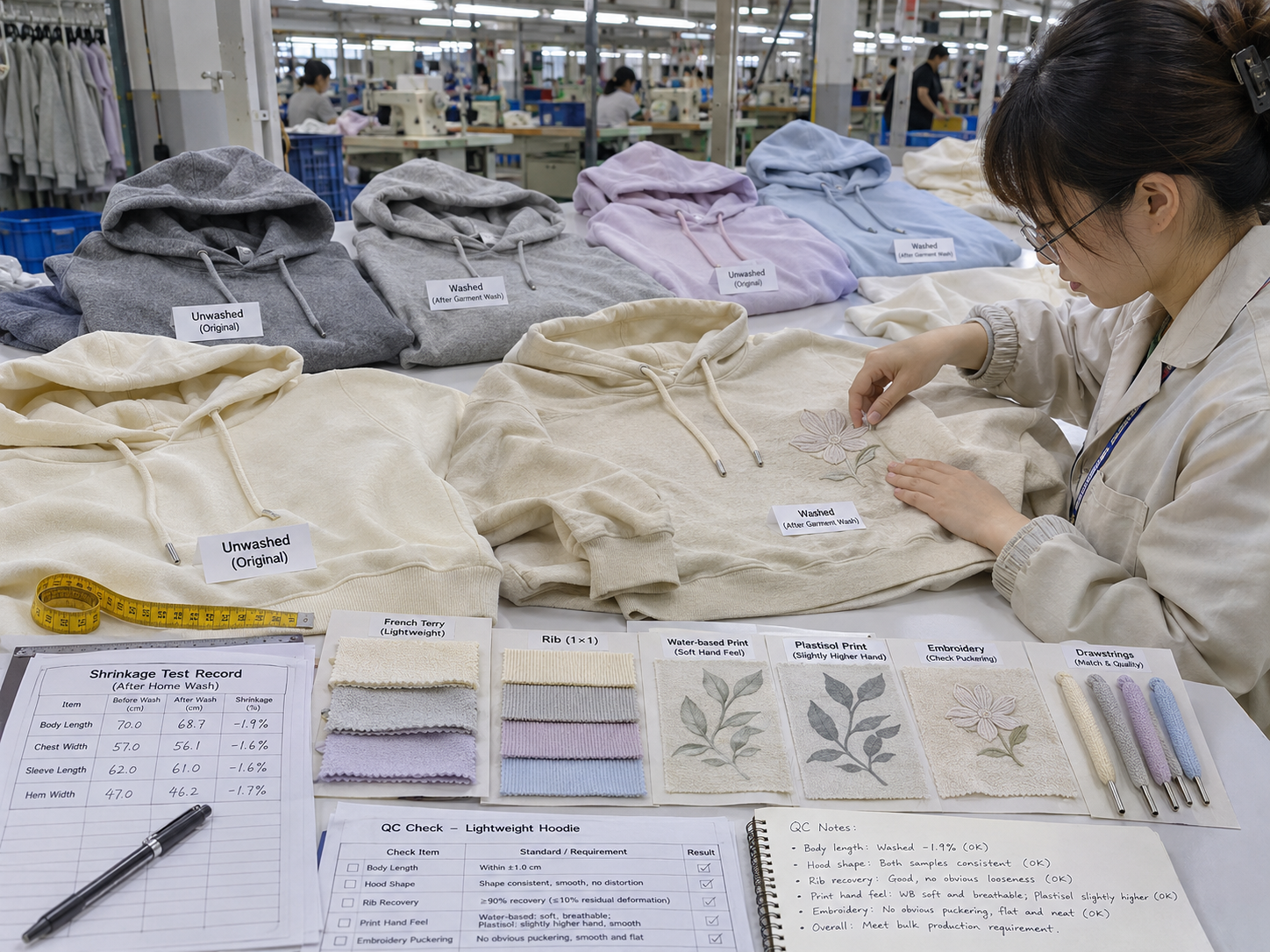
Shrinkage should be evaluated under defined washing and drying conditions, and the complete garment should be checked because body fabric, rib, pocket, thread, and decoration can respond differently.
ISO 5077:2007[^2] specifies a method for determining dimensional change after specified washing and drying procedures.
ISO last reviewed and confirmed this edition in:
2022,
so it remains current.[^2]
Test Conditions Matter
ISO 6330:2021[^3] provides standardized domestic washing and drying procedures for textile testing.
Different:
- Washing machines
- Detergents
- Drying methods
can affect results.[^3]
So:
“shrinkage 3%”
without a test condition is incomplete.
Pre-Shrunk Does Not Mean Zero Shrinkage
A stabilization process can reduce:
later dimensional change.
It does not guarantee:
zero.
The goal should be:
an agreed tolerance.
Check Length and Width
Do not only measure:
body length.
Also check:
- Chest
- Sleeve
- Hood
- Rib
- Pocket alignment
after laundering.
Rib vs Body Shrinkage
This is especially important.
If:
body shrinks 3%
and:
rib behaves differently,
the finished garment can distort.
Evaluate them:
together.
How Do Prints and Embroidery Work on Lighter Fabric?
Decoration can change the feel of a lightweight hoodie more noticeably than:
on a very heavy garment.
Choose decoration according to fabric weight, surface, artwork coverage, stretch, heat sensitivity, and desired hand. Test the real artwork on the real hoodie fabric before bulk.
Water-Based Screen Printing
Water-based systems can produce:
a softer-feeling result
on some suitable fabrics.
But do not write:
water-based print is always breathable.
A large print still changes:
the surface of the garment.
Final hand depends on:
- Ink
- Coverage
- Fabric
- Curing
- Number of layers
Discharge Printing
Discharge printing can create:
a soft result
on suitable dyed cotton fabrics.
But it is:
conditional.
It depends on:
- Dye type
- Fabric
- Color
- Ink chemistry
Not every dark cotton fabric is:
discharge-compatible.
Test it.
Plastisol
Plastisol can work perfectly well on:
lightweight hoodies.
The concern is not simply:
“plastisol is bad.”
The important variables include:
- Artwork coverage
- Ink deposit
- Placement
- Desired hand
A small clean plastisol logo may work well.
A huge heavy print can change:
the garment feel.
Puff Print
Puff can add:
dimension.
But a large puff print may affect:
drape
on a lightweight body.
Sample it before approving:
the artwork.
Embroidery
Embroidery adds:
thread mass
and:
stitch tension.
A dense design on a lightweight knit can create:
- Puckering
- Distortion
- Stiffness
Possible solutions include:
- Lower stitch density
- Smaller artwork
- Suitable backing
- Appliqué or patch approach
depending on the design.
Do Not Simply Shrink the Artwork
Sometimes the customer wants:
the same bold branding
as the heavyweight hoodie.
That can still be possible.
Instead of automatically reducing:
the artwork size,
adjust:
the decoration technique.
For example:
a large dense embroidery may become:
an appliqué
or:
another print technique.
The design intent can remain:
large.
How Do You Check Pilling?
A lighter hoodie still experiences:
- Underarm friction
- Side-body friction
- Washing
- Bag contact
Pilling is influenced by:
fiber,
yarn,
construction,
finish,
and wear.
ISO 12945-2:2020[^4] specifies a modified Martindale method for assessing:
- Pilling
- Fuzzing
- Matting
of textile fabrics.
As of 2026, this edition remains published, although ISO's review process indicates that it is due to be revised.[^4]
So do not assume:
lighter fabric pills more
or:
100% cotton pills less.
Test the actual material.
What About Care Labels?
If you change from:
a heavyweight hoodie
to:
a lightweight hoodie,
do not automatically copy the old care label.
The complete product may now use:
- Different body fabric
- Different rib
- Different print
- Different embroidery
- Different zipper
For U.S. apparel, the FTC Care Labeling Rule[^5] requires covered manufacturers and importers to provide regular-care instructions and have a reasonable basis for them.
That means the care instructions should be based on:
the actual garment.
Not simply:
brand habit.
What MOQ, Cost, and Timing Should You Expect?
A lightweight hoodie still uses:
the same general manufacturing system
as other hoodies.
But cost can change.
Unit price depends on fabric specification, garment consumption, hood construction, zipper, rib, trims, decoration, wash process, colors, and quantity. A lower GSM may reduce fabric weight consumption, but it does not automatically guarantee a cheaper finished hoodie.
Typical Starting MOQ
For our standard hoodie programs:
around 50 pcs per color
can be a practical starting point.
The final MOQ depends on:
- Fabric availability
- Color
- Trims
- Decoration
Size Breakdown
For a small 50-piece program:
up to around four sizes
is often practical.
A wider size range can work better with:
a higher quantity.
That is our production planning approach.
It is not a universal industry rule.
Fabric Availability
If the desired lightweight French terry is:
available in the required color,
sampling can start more quickly.
If the brand needs:
custom knitting
or:
custom dyeing,
material MOQ and lead time may increase.
Does 280 GSM Always Cost Less Than 380 GSM?
No.
Lower GSM often means:
less fabric mass
for the same garment area.
But final fabric and garment price also depends on:
- Yarn
- Composition
- Width
- Finish
- Dyeing
- Supplier
- Order quantity
A specialty 280 GSM fabric can cost more per kilogram than:
a basic heavier fabric.
Double-Layer Hood
A double-layer hood adds:
extra fabric consumption.
If the goal is a lower-cost and lighter garment:
compare it with:
a single-layer option.
Zip-Up Style
A zip hoodie adds:
- Zipper
- Front sewing
- Zipper installation
so it should not be priced exactly like:
a pullover.
Decoration
Print and embroidery cost depends on:
- Artwork
- Size
- Number of colors
- Technique
Garment Washing
Processes such as:
- Acid wash
- Garment dye
- Vintage wash
add:
another production stage.
They may also change:
- Hand
- Shade
- Dimensions
so post-wash measurements need review.
Colors
Splitting a small order across:
many custom colors
can make material purchasing inefficient.
For a first lightweight hoodie program, a focused palette may be easier.
But do not assume:
cream,
sage,
sky blue,
or pastel shades
are universally the “best-selling summer colors.”
That depends on:
the brand and customer.
Sample and Bulk Timing
For standard hoodie projects using available materials:
Sampling: approximately 5–14 days
is a normal working range for us.
Custom:
- Fabric
- Dye
- Wash
- Embroidery
- Trim
may extend development.
Standard bulk production is generally:
approximately 20–30 days
after:
- Final sample approval
- Deposit
- Materials ready
Payment
For new bulk orders, our normal structure is:
50% before production + 50% before shipment.
How Should You Develop Your First Lightweight Hoodie?
Start with:
the use case.
Not:
the GSM.
Option 1: Transitional Streetwear Hoodie
Possible direction:
- 280–320 GSM French terry
- Relaxed fit
- Full-length sleeve
- Structured hood
Option 2: Warm-Climate Hoodie
Possible direction:
- Lighter French terry
- Relaxed body
- Minimal trims
- No unnecessary lining
Option 3: Travel Zip Hoodie
Possible direction:
- Lightweight French terry
- Full zipper
- Clean pockets
- Easy layering fit
Option 4: Summer Set
Possible direction:
- Lightweight hoodie
- Matching sweat short
- Coordinated fabric and color
Then make the sample.
Test the Sample Before Bulk
Do not approve a lightweight hoodie only because:
it weighs less.
1. Wear It
Check:
- Drape
- Hood
- Sleeve
- Body movement
2. Layer It
If the product is meant for travel or spring:
put a jacket over it.
3. Wash It
Measure:
- Length
- Chest
- Sleeve
- Rib
before and after.
4. Check Decoration
Does the print change:
the hand too much?
Does embroidery create:
puckering?
5. Check the Hood
Does it sit:
the way the design requires?
Do not assume:
double layer
is automatically the answer.
6. Check Pale Colors
If using:
- White
- Cream
- Light grey
- Pastels
look at:
opacity
and:
visible sweat areas
during real wear.
Green Flags and Red Flags
| Green flag | Red flag |
|---|---|
| Selects GSM from the intended use | Says 280 GSM is the universal summer standard |
| Explains GSM as fabric mass | Says GSM alone proves quality |
| Compares actual French-terry constructions | Says all French terry is breathable |
| Adjusts the pattern for the selected fabric | Copies a 400 GSM pattern without testing |
| Chooses hood construction by design | Says every light hoodie needs double-layer hood |
| Matches rib behavior to the body | Matches rib only by GSM number |
| Tests shrinkage under defined conditions | Says pre-shrunk means zero shrinkage |
| Samples decoration on actual fabric | Uses the same print setup for every GSM |
| Tests discharge compatibility | Says discharge works on every dark cotton hoodie |
| Controls embroidery density and backing | Places dense embroidery blindly on light knit |
| Quotes cost from actual material and consumption | Says lighter GSM is always cheaper |
| Uses actual MOQ and color planning | Treats 50 pcs/color as an industry rule |
Conclusion
A lightweight hoodie should not be:
a thinner copy
of your heavyweight hoodie.
Start with:
the reason the product exists.
Do you want:
- A spring layer?
- A summer-evening hoodie?
- A warm-climate product?
- A travel hoodie?
- A matching shorts set?
Then choose:
the fabric.
Around:
260–300 GSM French terry
can be a useful starting range for many lightweight hoodie developments.
But do not build the product around:
one GSM number.
GSM tells you:
how much the fabric weighs per unit area.
It does not tell you:
- How breathable it is
- How cool it feels
- How well it drapes
- How much it shrinks
- Whether it pills
- Whether it is premium
Touch the fabric.
Wear it.
Wash it.
Then develop:
the pattern.
A lighter fabric may fall differently from:
a 400 GSM streetwear knit.
So check:
- Body width
- Length
- Sleeve
- Hood
- Rib
as one garment.
Then decide:
the hood construction.
A double layer may give:
more structure.
A single layer may keep:
the product lighter.
Neither is automatically correct.
Then develop:
the decoration.
Water-based print can work.
Plastisol can work.
Discharge can work on:
suitable fabrics.
Embroidery can work.
What matters is:
the actual artwork + actual textile + actual process.
Then test:
shrinkage,
pilling,
and care.
Do not assume the lighter hoodie needs:
the same care label
as the heavyweight version.
Finally:
compare the product to the reason you created it.
If the goal was:
a lighter layer,
does it actually feel easier to wear?
If the goal was:
travel,
does it pack well?
If the goal was:
warm-climate use,
did you reduce unnecessary bulk?
That is what makes the difference between:
a hoodie made from lighter fabric
and:
a lightweight hoodie that was actually developed for lighter wear.
Footnotes & References
[^1]: ASTM International — ASTM D3776/D3776M-20(2025), Standard Test Methods for Mass Per Unit Area (Weight) of Fabric. Covers measurement of fabric mass per unit area, commonly referred to as fabric weight. The current active edition was last updated in August 2025. Fabric mass is only one textile specification and does not by itself establish properties such as breathability, drape, durability, or comfort.
https://store.astm.org/d3776_d3776m-20r25.html
[^2]: International Organization for Standardization — ISO 5077:2007, Textiles — Determination of Dimensional Change in Washing and Drying. Specifies a method for determining dimensional change of fabrics, garments, and other textile articles after specified washing and drying procedures. ISO reviewed and confirmed this edition in 2022.
https://www.iso.org/standard/41877.html
[^3]: International Organization for Standardization — ISO 6330:2021, Textiles — Domestic Washing and Drying Procedures for Textile Testing. Specifies standardized domestic washing and drying procedures used in textile testing. ISO notes that factors including washing-machine type, detergent, and drying procedure can affect test results.
https://www.iso.org/standard/75934.html
[^4]: International Organization for Standardization — ISO 12945-2:2020, Textiles — Determination of Fabric Propensity to Surface Pilling, Fuzzing or Matting — Part 2: Modified Martindale Method. Specifies a modified Martindale method for evaluating resistance to pilling, fuzzing, and matting. The 2020 edition remains published as of 2026, with ISO indicating that it is due to be revised following review.
https://www.iso.org/standard/75375.html
[^5]: U.S. Federal Trade Commission — Care Labeling Rule, 16 CFR Part 423. Requires covered manufacturers and importers of textile wearing apparel to provide regular-care instructions and possess a reasonable basis supporting those instructions before sale.
https://www.ftc.gov/legal-library/browse/rules/care-labeling-textile-wearing-apparel-certain-piece-goods