Sweatpants and Joggers Manufacturer: How Do You Make Sweatpants People Wear Every Day?
Your hoodie sells well.
So the next product feels obvious:
matching sweatpants.
The first sample looks good.
The fabric feels heavy.
The waistband looks clean.
The fit photographs well.
Then customers start living in them.
After a few washes, the length changes.
The waistband starts twisting.
The knees stay stretched after sitting.
The drawcord disappears inside the waistband.
The surface begins to pill in high-friction areas.
Sweatpants look simple because there are not many visible components.
But customers may wear them:
all day, several days a week.
That exposes every weakness.
Good sweatpants depend on fabric structure, dimensional stability, stretch and recovery, waistband construction, rise, thigh and knee shape, pocket construction, trims, laundering, and finishing. Heavy GSM can create a certain look, but weight alone does not prove quality, drape, durability, recovery, or resistance to pilling.
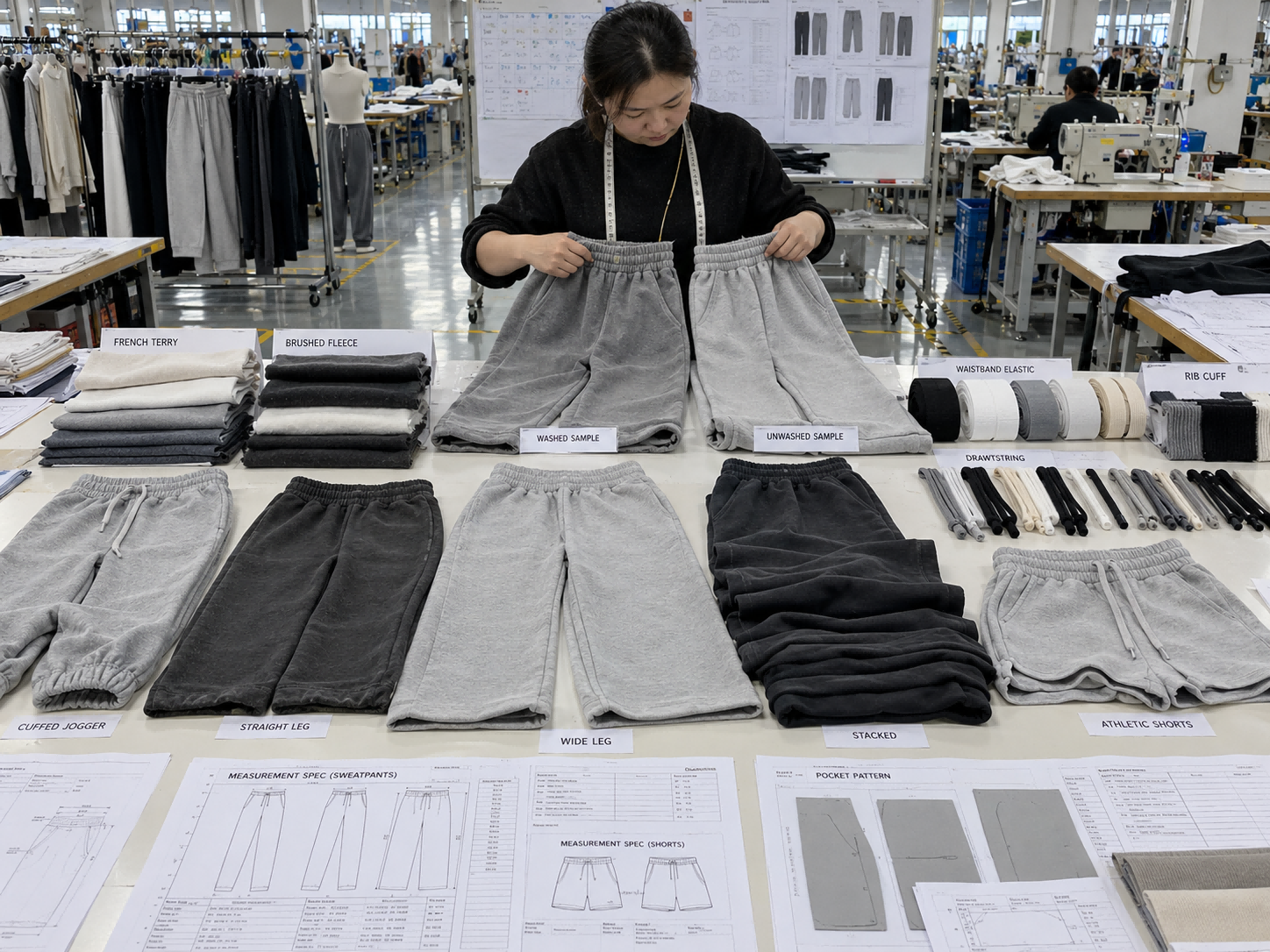
When we develop sweatpants, I normally look at five things first:
- Fabric
- Rise
- Thigh and leg shape
- Waistband
- Post-wash behavior
Because if those five are wrong:
the rest of the details will not save the product.
Table of Contents
- What Does a Sweatpants and Joggers Manufacturer Make?
- Which Fabrics Work Best for Sweatpants?
- Which Fits Are Popular for Sweatpants?
- Which Details Make Sweatpants Feel Premium?
- How Do You Stop Shrinking, Pilling, and Baggy Knees?
- What MOQ, Cost, and Timing Should You Expect?
- Conclusion
What Does a Sweatpants and Joggers Manufacturer Make?
Sweatpants are no longer one silhouette.
A sweatpants manufacturer may produce cuffed joggers, open-hem straight-leg pants, wide-leg and baggy styles, stacked pants, flared sweatpants, cargo sweatpants, and sweat shorts. They can be sold individually or developed as coordinated bottoms for hoodies, crewnecks, and other matching sets.
Cuffed Joggers
This is the classic sweatpant.
Typical features include:
- Rib or elastic cuff
- Tapered leg
- Drawcord waist
- Side pockets
It works for:
- Athleisure
- Gym-to-lifestyle
- Basic sweat sets
Straight-Leg Sweatpants
A straight-leg style normally has:
- Open hem
- Less taper
- Cleaner line from knee to ankle
This can create a more:
streetwear
or:
everyday lifestyle
appearance.
Wide-Leg Sweatpants
Wide-leg styles use:
more volume through the thigh and leg.
But:
wide-leg does not automatically mean oversized everywhere.
The waist and rise still need:
controlled fit.
Baggy Sweatpants
Baggy styles may add more room through:
- Seat
- Thigh
- Knee
- Leg opening
They can create a strong streetwear silhouette.
But too much volume without enough structure can make the garment look:
uncontrolled.
Stacked Sweatpants
Stacked styles use:
extra leg length
so fabric gathers around:
the ankle or shoe.
The exact effect depends on:
- Inseam
- Leg opening
- Fabric weight
- Fabric recovery
Flared Sweatpants
Flared sweatpants are shaped more closely through:
the upper leg
before opening at:
the lower leg.
This is a pattern decision.
It is not simply:
a wide leg with a smaller thigh.
Cargo Sweatpants
Cargo styles add:
- Patch pockets
- Flap pockets
- Zippers
- Snaps
depending on the design.
These details increase:
- Fabric pieces
- Sewing operations
- Garment weight
Sweat Shorts
Sweat shorts may use the same:
French terry
or:
fleece
as the matching hoodie.
They work well for:
summer drops
and:
matching sets.
Our Production Approach
We manufacture knit products including:
- Sweatpants
- Joggers
- Hoodies
- Crewnecks
- T-shirts
- Sweat shorts
through our garment-production operation.
This allows us to coordinate:
fabric, color, fit, and branding
across a complete set.
Specialist washing, printing, and embroidery may be completed through long-term partner workshops that we coordinate directly.
Which Fabrics Work Best for Sweatpants?
Fabric determines:
the hand,
silhouette,
warmth,
and much of the post-wash behavior.
French terry and brushed fleece are two common sweatpant fabric directions, but neither is automatically better. Choose according to season, weight, structure, inside surface, shrinkage, recovery, hand feel, and the intended silhouette.
French Terry
French terry normally has:
loops on the inside
rather than a brushed fleece surface.
It can work for:
- Sweatpants
- Hoodies
- Shorts
- Crewnecks
depending on the weight.
Possible advantages include:
- Cleaner inside surface
- Less fluffy appearance
- Broad seasonal use
But do not automatically describe French terry as:
more breathable.
Actual air and moisture behavior depends on:
the fabric construction.
Brushed Fleece
Brushed fleece has a raised inner surface.
That can create:
- Softer inside hand
- More loft
- Warmer sensation
But brushing can also affect:
- Surface behavior
- Dimensional stability
- Pilling
depending on the fabric.
100% Cotton
Cotton-rich sweat fabrics can create:
a familiar natural hand.
But:
100% cotton does not automatically mean premium.
It can still have problems such as:
- Shrinkage
- Knee growth
- Pilling
- Poor recovery
if the fabric construction is not appropriate.
Cotton/Polyester Blends
A cotton/polyester blend can be useful when the product needs a different balance of:
- Hand
- Dimensional stability
- Recovery
- Cost
But:
polyester does not automatically make a fabric more durable.
Again:
test the actual material.
Common Fabric Directions
For some of our programs, possible fabric options include:
- 340 GSM French terry
- 380 GSM French terry
- Around 375 GSM brushed fleece
But those are:
our sourcing examples.
They are not universal industry definitions of:
premium sweatpants.
Does 380 GSM Automatically Make Better Sweatpants?
No.
This is important.
GSM measures mass per unit area. It does not directly measure fabric quality, recovery, pilling resistance, drape, softness, or durability.
A 380 GSM fabric can feel:
dense and structured.
Another 380 GSM fabric can feel:
stiff and unstable.
A well-developed 320 GSM fabric may perform better than:
a poorly constructed 420 GSM fabric.
What Heavier Fabric Can Change
Increasing fabric weight may change:
- Body
- Warmth
- Drape
- Garment weight
depending on the construction.
But do not turn that into:
higher GSM = more premium.
Wide-Leg Sweatpants
A heavier fabric can sometimes support:
a more substantial wide-leg silhouette.
But a lighter fabric may be exactly right if the brand wants:
- Softer drape
- Summer weight
- More fluid movement
Choose from:
the silhouette.
Not from a rule.
Which Fits Are Popular for Sweatpants?
There is no single current “winning” fit.
Different customer groups want:
different silhouettes.
Relaxed, straight-leg, wide-leg, cuffed, stacked, and flared sweatpants can all be commercially relevant. The important part is developing rise, seat, thigh, knee, inseam, and leg opening as one silhouette rather than changing only one measurement.
Cuffed Jogger
Typical direction:
- Regular rise
- Relaxed thigh
- Tapered lower leg
- Rib cuff
But the taper should not create:
excess pulling at the calf.
Straight Leg
A straight leg depends heavily on:
knee width
and:
leg opening.
If the knee is too narrow:
the pant may still look tapered.
Wide Leg
A wide-leg fit may need:
- Wider thigh
- Wider knee
- Wider opening
But simply increasing every horizontal measurement can make:
the hip and crotch bulky.
Baggy Fit
Baggy fit involves:
volume distribution.
The pattern maker needs to decide:
where the extra volume sits.
Stacked Fit
Stacking is affected by:
inseam + leg opening + fabric.
A long inseam with a very wide opening may simply:
drag on the floor.
Flared Fit
A flare needs controlled shaping through:
- Thigh
- Knee
- Hem
The flare should begin at:
an intentional position.
What Measurements Matter Most?
Important points include:
- Waist
- Hip
- Front rise
- Back rise
- Thigh
- Knee
- Inseam
- Leg opening
These measurements interact.
For example:
adding rise
changes more than:
waist height.
It can also change:
crotch balance
and:
seat comfort.
Fit-Test With Movement
Ask the wearer to:
- Sit
- Walk
- Squat
- Climb stairs
Check:
- Crotch pulling
- Waist movement
- Knee restriction
- Hem behavior
Do not approve sweatpants only:
standing straight.
Should Men's, Women's, and Unisex Sweatpants Use the Same Pattern?
Not necessarily.
A unisex product can work.
But it is still:
one specific fit decision.
Depending on the target customer, women's-focused patterns may need different relationships between:
- Waist
- Hip
- Rise
than a men's block.
Some brands also offer:
- Short inseam
- Regular inseam
- Long inseam
instead of trying to solve every body difference through:
one size chart.
The best approach depends on:
the customer.
Which Details Make Sweatpants Feel Premium?
Premium is not created by:
adding more components.
Premium feel usually comes from controlled proportions, stable waist construction, well-made pockets, suitable trims, clean sewing, appropriate finishing, and details that remain functional after repeated wear and washing.
Waistband
The waistband is one of the most important areas.
Possible constructions include:
- Enclosed elastic
- Rib waistband with elastic
- Exposed elastic
Check:
- Elastic recovery
- Waist tension
- Waistband height
- Twisting
Is a Wider Waistband Always Better?
No.
A wide waistband can distribute pressure over:
a larger area.
But if the elastic is too strong:
it can still feel uncomfortable.
Drawcord
Possible options include:
- Flat cord
- Round cord
- Braided cord
The cord needs to work with:
- Eyelet
- Buttonhole
- Cord tip
Does the Drawcord Have to Be Fixed at Center Back?
No.
Securing the drawcord can help prevent:
complete pull-through.
But there are several construction solutions.
Some brands intentionally want:
a removable or free-moving cord.
So:
center-back bartack is an option, not a universal rule.
If it is used:
make sure the stitching does not create:
an uncomfortable hard point.
Cord Tips
Possible options include:
- Metal
- Silicone
- Plastic
- Heat-sealed
- Knotted
The right option depends on:
the brand.
Do not assume metal automatically feels:
more premium.
Side Pockets
Possible constructions include:
- Slant
- Seam
- Welt
- Zip
The pocket needs enough:
depth and width
for real use.
Back Pockets
Options include:
- Patch
- Welt
- Zip welt
Placement matters visually.
A back pocket that sits:
too low
can make the pant look unbalanced.
Crotch Gusset
A gusset can provide:
another construction option
for movement.
But sweatpants do not automatically need:
a gusset.
A good standard crotch pattern can work perfectly well.
Seams
Flatlock, coverstitch, overlock, and other seam types can all have a place.
Do not write:
flatlock = premium.
Use the seam that suits:
the location and design.
Branding
Possible options include:
- Embroidery
- Screen print
- Heat transfer
- Woven label
- Appliqué
For matching sets:
branding should coordinate with:
the hoodie or crewneck.
How Do You Stop Sweatpants From Shrinking?
The first step is understanding:
what actually changed.
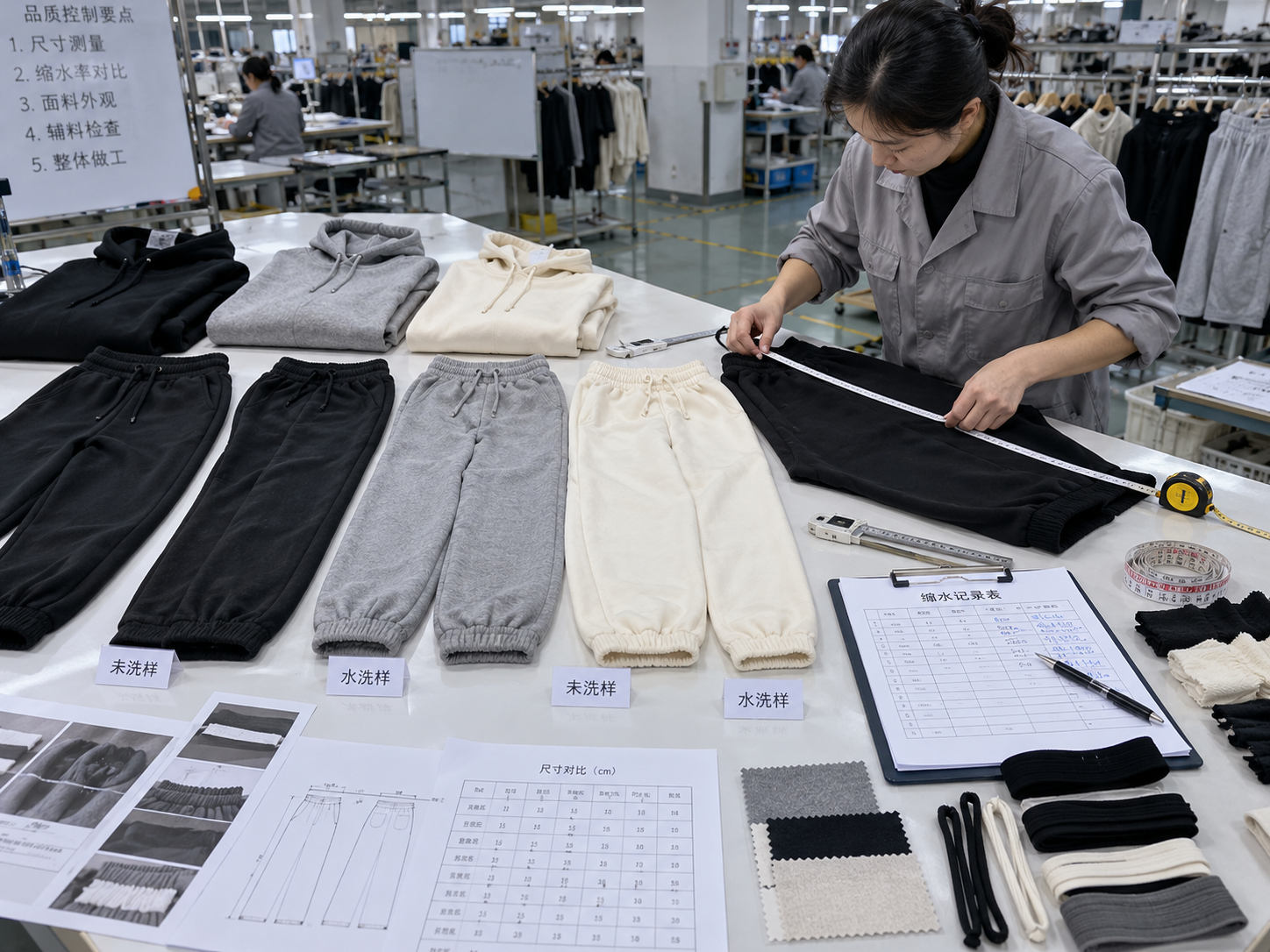
Shrinkage should be measured under defined washing and drying conditions. A fabric can change in both length and width, and the finished garment may also combine body fabric, rib, elastic, prints, and trims that behave differently.
ISO 5077:2007[^1] specifies a method for determining dimensional change in:
- Fabrics
- Garments
- Other textile articles
after specified washing and drying procedures.
ISO reviewed and confirmed the standard in 2022, so this edition remains current.[^1]
Washing Conditions Matter
ISO 6330:2021[^2] provides standardized domestic washing and drying procedures used for textile testing.
So simply writing:
“shrinkage 3%”
is incomplete.
You also need to know:
the test procedure.
Pre-Shrunk Does Not Mean Zero Shrinkage
A stabilization or pre-shrink process may reduce:
remaining dimensional change.
It does not guarantee:
zero shrinkage.
The correct goal is:
an agreed dimensional-change tolerance.
Pants Show Length Change Quickly
Sweatpants are especially sensitive because:
a few centimeters of inseam change
can move the cuff or hem visibly.
Measure:
before and after care testing.
Body + Rib
If cuffed joggers use:
rib cuffs,
check the body and rib together.
Differential shrinkage can affect:
- Cuff shape
- Leg length
- Appearance
How Do You Reduce Pilling?
Pilling is not simply caused by:
“bad cotton.”
It is a surface phenomenon influenced by:
- Fiber
- Yarn
- Fabric construction
- Finish
- Friction
- Wear
Cotton-rich fabric is not automatically more pilling-resistant, and polyester content is not automatically the cause of pilling. Test the actual textile.
ISO 12945-2:2020[^3] specifies a modified Martindale method for evaluating:
- Pilling
- Fuzzing
- Matting
of textile fabrics.
As of 2026, the 2020 edition remains published, although ISO's systematic review process has indicated that a revision is planned.[^3]
Where Sweatpants Pill
Common high-friction areas include:
- Inner thighs
- Seat
- Pocket area
depending on how the garment is worn.
Brushed Fleece
Brushing can create:
softness
but also changes the fiber surface.
That is one reason fleece should be:
evaluated after wear and laundering.
Why Do Sweatpants Get Baggy Knees?
This is one of the most misunderstood problems.
The answer is not simply:
fabric too light.
Knee bagging can be influenced by:
- Fabric elasticity
- Recovery
- Knit structure
- Yarn
- Garment ease
- Repeated sitting
- Knee shaping
Stretch vs Recovery
A fabric can stretch easily
and recover poorly.
ISO 20932-1:2018[^4] describes methods for measuring elasticity and related properties of fabrics.
ISO reviewed and confirmed the standard in 2024, so it remains current.[^4]
That is much more useful than asking only:
“How much spandex does it have?”
Does Heavier Fabric Prevent Baggy Knees?
Not automatically.
A heavy 100% cotton knit can still:
grow at the knee.
A lighter fabric with better recovery can sometimes:
retain its shape better.
So evaluate:
recovery,
not only:
GSM.
Pattern Ease Matters
If the knee is too tight:
the fabric is repeatedly stretched when sitting.
That may make bagging more visible.
Giving the garment the correct:
knee and thigh ease
can reduce unnecessary strain.
Why Does a Waistband Roll?
Possible causes include:
- Elastic too soft
- Elastic too narrow for the construction
- Waistband height
- Elastic twisting inside casing
- Poor attachment
- Incorrect tension
The solution is not always:
use stronger elastic.
A much firmer elastic can create:
another problem:
discomfort.
Test the complete waistband.
How Do You Keep Hoodie and Sweatpants Colors Matching?
Matching sets need controlled color management.
If the hoodie and sweatpants use:
the same fabric specification,
planning them from the same controlled fabric production can simplify shade control.
But do not promise:
same dye lot = mathematically identical every piece.
Production still has:
normal variation.
Keep Physical References
For reorders, keep:
- Approved fabric swatch
- Bulk reference
- Dye-lot record
Then evaluate new material against:
the approved standard.
Different Fabrics
If the hoodie and sweatpants intentionally use:
different materials,
they may reflect color differently even when aimed at:
the same Pantone target.
Approve them:
side by side.
How Should Sweatpants Be Wash-Tested?
Test:
the complete garment.
Not only:
the raw fabric.
After the intended care process, inspect:
- Inseam
- Waist
- Hip
- Leg opening
- Rib cuff
- Waistband
- Drawcord
- Embroidery
- Surface pilling
Care Labels
For garments sold in the U.S., the FTC Care Labeling Rule[^5] requires covered manufacturers and importers to provide care instructions and have a reasonable basis for those instructions.
That means:
Machine Wash Cold / Tumble Dry Low
should not simply be copied onto every sweatpant.
The instructions should be appropriate for:
the complete garment.
The FTC rule specifically requires reliable support for the care information given to consumers.[^5]
What MOQ, Cost, and Timing Should You Expect?
Sweatpants use fewer components than:
technical outerwear.
But fabric consumption can be high.
Typical Starting MOQ
For our normal programs:
around 50 pcs/style
can be a practical starting point for:
- Sweatpants
- Joggers
- Hoodies
- Matching sweat sets
The exact MOQ depends on:
- Fabric
- Color
- Size range
- Wash
- Decoration
Size Split
For a small 50-piece program:
up to around four sizes
is often more practical.
A wider size range may work better with:
a higher total quantity.
This is our practical production approach.
It is not an industry rule.
Fabric Weight
A heavier fabric normally uses:
more material by weight.
But fabric price is also affected by:
- Composition
- Yarn
- Width
- Finish
So:
380 GSM = fixed price increase
is not accurate.
Wide-Leg Fits
Wide and baggy patterns often increase:
fabric consumption
because of:
larger garment dimensions.
But cost should be based on:
actual marker consumption.
Pockets
Zip and welt pockets add:
- Components
- Sewing
- Labor
Washing
Garment dye, acid wash, vintage wash, and similar processes add:
another production stage.
Decoration
Embroidery, printing, appliqué, and other details have:
their own cost.
Drawcords and Hardware
Custom cords and tips may have:
supplier MOQs.
For small programs:
stock components
may be more practical.
Colors
A small order split across:
many custom colors
can create inefficient material purchasing.
A few strong core colors are often easier for:
a first run.
Full Roll vs Small Cut
Small fabric quantities may cost more per unit than:
full-roll purchasing.
But do not publish:
loose cut is always twice the price.
That varies by supplier.
Sample and Bulk Timing
For standard projects using available fabrics:
Sampling: approximately 5–14 days
For standard bulk:
approximately 20–30 days
after:
- Final sample approval
- Deposit
- Materials ready
Special:
- Custom knitting
- Dyeing
- Washing
- Embroidery
- Trims
can extend the timeline.
Payment
For new bulk orders, our normal structure is:
50% before production + 50% before shipment.
How Should a Brand Develop Its First Sweatpant?
Start with:
the silhouette.
Do not start with:
GSM.
Option 1: Classic Sweat Set
- Cuffed jogger
- Relaxed hoodie
- French terry or fleece
Option 2: Streetwear Set
- Straight or wide-leg sweatpant
- Boxy hoodie or crewneck
- Heavier structured knit
Option 3: Summer Set
- Sweat short
- Tee
- Lighter French terry or jersey direction
Then choose the fabric that creates:
that silhouette.
Wash the Sample Before Approval
Compare:
before
and:
after.
Measure:
- Waist
- Inseam
- Thigh
- Leg opening
Then wear it.
Sit for:
an extended period.
Look at:
the knees.
Wear it again.
That gives much more information than:
holding the fabric in your hand.
Green Flags and Red Flags
| Green flag | Red flag |
|---|---|
| Recommends fabric from the intended silhouette | Says 380 GSM automatically means premium |
| Measures dimensional change after washing | Says pre-shrunk means zero shrinkage |
| Tests pilling on the actual fabric | Says cotton-rich never pills |
| Checks stretch and recovery | Chooses fabric from GSM only |
| Wear-tests knee recovery | Says heavier fabric always prevents knee bagging |
| Develops waistband tension as a system | Simply uses stronger elastic |
| Secures drawcord only when the design requires it | Says every drawcord must be stitched at center back |
| Approves hoodie and pants side by side | Assumes same Pantone always looks identical |
| Keeps physical shade references | Promises every reorder is exactly identical |
| Tests complete garment care | Tests only raw fabric |
| Uses marker consumption for wide-leg cost | Quotes fit cost from a generic rule |
| Explains small-order fabric economics clearly | Claims small-cut fabric is always double |
Conclusion
Great sweatpants do not start with:
380 GSM.
They start with:
the product you want to build.
Is the silhouette:
- Cuffed?
- Straight?
- Wide?
- Baggy?
- Stacked?
- Flared?
Then choose a fabric that supports:
that silhouette.
A heavier fabric may help create:
a substantial streetwear look.
But weight alone does not prove:
quality.
Next:
develop the pattern.
Control:
- Rise
- Seat
- Thigh
- Knee
- Inseam
- Leg opening
as one system.
Then build the waistband.
Choose elastic based on:
recovery and comfort,
not simply:
maximum strength.
Add the drawcord in a way that works with:
the intended design.
Then test the fabric.
Measure:
dimensional change.
Check:
pilling.
Evaluate:
elasticity and recovery.
Wear the sample long enough to see:
what happens at the knees.
Because:
baggy knees are not only a GSM problem.
And:
pilling is not only a fiber-content problem.
Then wash the complete garment.
Check whether:
the inseam changed.
Check whether:
the waistband twisted.
Check whether:
the cuff and body changed differently.
Check whether:
the decoration survived.
For matching sets:
compare the hoodie and sweatpants:
side by side.
The customer does not care that both garments were technically dyed to:
the same target.
They care whether:
they look like a set.
Finally:
wear the sweatpants.
Sit.
Walk.
Squat.
Wash them.
Wear them again.
Because sweatpants are not judged for:
five minutes in a showroom.
Customers live in them.
That is why the best sweatpants are not simply:
heavy.
They are:
stable, comfortable, well-proportioned, and developed to keep their shape through real everyday wear.
Footnotes & References
[^1]: International Organization for Standardization — ISO 5077:2007, Textiles — Determination of Dimensional Change in Washing and Drying. Specifies a method for determining dimensional change of fabrics, garments, and other textile articles after specified washing and drying procedures. ISO reviewed and confirmed this edition in 2022, so it remains current.
https://www.iso.org/standard/41877.html
[^2]: International Organization for Standardization — ISO 6330:2021, Textiles — Domestic Washing and Drying Procedures for Textile Testing. Specifies standardized domestic washing and drying procedures used when evaluating textile products. Test conditions such as washing procedure and drying method can affect dimensional-change results.
https://www.iso.org/standard/75934.html
[^3]: International Organization for Standardization — ISO 12945-2:2020, Textiles — Determination of Fabric Propensity to Surface Pilling, Fuzzing or Matting — Part 2: Modified Martindale Method. Specifies a modified Martindale method for evaluating resistance to pilling, fuzzing, and matting. The 2020 edition remains published as of 2026, with ISO indicating that a revision is planned following systematic review.
https://www.iso.org/standard/75375.html
[^4]: International Organization for Standardization — ISO 20932-1:2018, Textiles — Determination of the Elasticity of Fabrics — Part 1: Strip Tests. Describes methods for measuring elasticity and related properties of textile fabrics. ISO reviewed and confirmed the standard in 2024, so this version remains current.
https://www.iso.org/standard/69489.html
[^5]: U.S. Federal Trade Commission — Care Labeling Rule, 16 CFR Part 423. Requires covered manufacturers and importers of textile wearing apparel to provide regular-care instructions and to possess a reasonable basis for the care information supplied to consumers.
https://www.ftc.gov/legal-library/browse/rules/care-labeling-textile-wearing-apparel-certain-piece-goods