

Swimwear Manufacturer: How Do You Make Swimwear That Survives Chlorine, Salt, and Sun?
Your first swimwear drop looks great when it launches.
The red is bright.
The white bikini looks clean.
The elastic sits flat around the leg.
The fit photographs well.
Then customers start using the products.
After repeated pool sessions, one color looks different.
The white bottom becomes more revealing when wet than expected.
The leg opening starts waving.
A strap feels looser after several wears.
Another customer notices color transfer onto a light towel.
Swimwear is a small garment exposed to:
a lot of stress.
It deals with:
- Chlorinated pool water
- Sea water
- Sunlight
- Stretch
- Repeated wet/dry cycles
- Sunscreen and body products
- Frequent washing
Good swimwear therefore needs more than soft stretch fabric. The body fabric, lining, elastic, thread, seams, hardware, fit, colorfastness, opacity, care instructions, and any UPF or recycled-content claims all need to be developed as one system. Nylon/elastane, polyester/elastane, PBT-containing fabrics, and other swim textiles can all work, but fiber content alone does not prove chlorine resistance, colorfastness, UV protection, or long-term recovery.
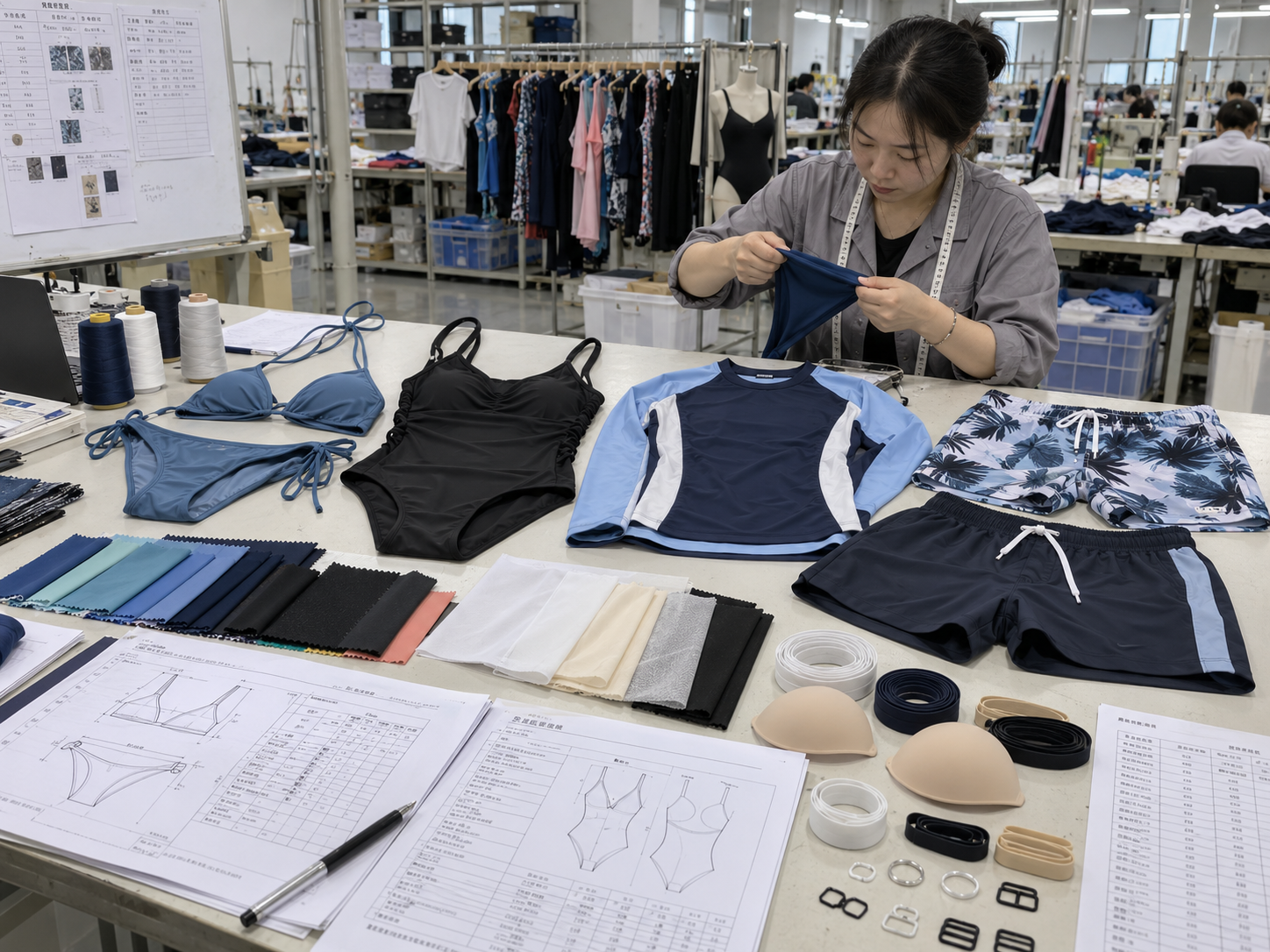
Swimwear development should begin with one question:
Where and how will the customer actually wear it?
A fashion bikini used mainly at:
the beach
may have different priorities from:
a training swimsuit used in a chlorinated pool several times every week.
Table of Contents
- What Does a Swimwear Manufacturer Make?
- Which Fabrics Work Best for Swimwear?
- Why Do Lining, Elastic, and Thread Matter So Much?
- How Do You Get Swimwear Fit and Support Right?
- How Do You Test Swimwear Before Bulk?
- What MOQ, Cost, and Timing Should You Expect?
- Conclusion
What Does a Swimwear Manufacturer Make?
Swimwear includes far more than:
bikinis.
A swimwear manufacturer may produce bikini tops and bottoms, one-piece swimsuits, tankinis, rash guards, swim leggings, modest swimwear, men's swim shorts, board shorts, and related beachwear. Each category needs its own fabric, lining, support, fit, and performance specification.
Bikini Tops
Possible constructions include:
- Triangle
- Bandeau
- Halter
- Adjustable strap
- Underband styles
- Removable cup styles
The main development questions include:
- Strap stability
- Underband tension
- Coverage
- Cup shape
- Movement in water
Bikini Bottoms
Coverage may be:
- Full
- Moderate
- Cheeky
- High waist
- High leg
But the pattern needs to control:
both appearance
and:
leg-opening tension.
One-Piece Swimsuits
A one-piece introduces an important additional measurement:
torso length.
A suit can fit the:
bust and hip
while still being too short through:
the body.
Tankinis
Tankinis combine:
more coverage
with:
two-piece flexibility.
The top needs to be checked for:
movement and floating
once in water.
Rash Guards
Rash guards sit between:
swimwear
and:
performance activewear.
Possible priorities include:
- Body coverage
- Stretch
- Sun-protection claims
- Low-friction seams
Swim Leggings
These can be used for:
- Training
- Surf
- Modest swim
- Sun coverage
They need:
- Waist stability
- Recovery
- Wet fit
- Opacity
Modest Swimwear
A modest swim set may combine:
- Long-sleeve top
- Legging
- Tunic-length outer piece
- Head covering
depending on the brand.
The important issue is controlling:
fabric movement in water.
An excessively loose garment can behave very differently:
once submerged.
Men's Swim Shorts
These may use:
- Lightweight woven polyester
- Stretch woven
- Other quick-drying woven directions
Possible inner constructions include:
- Mesh brief
- Stretch liner
- No liner
Structured Swim Tops
Highly structured styles involving:
- Underwire
- Cup sizing
- Molded components
require more specialized bra/swim construction.
For those projects, specialist production capability may be used depending on the design.
Our Production Approach
We manufacture stretch apparel and woven garments through our garment-production operation, including:
- Stretch swimwear
- Rash guards
- Swim leggings
- Swim shorts
- Board shorts
depending on the project.
Highly specialized structured swim constructions may involve:
specialist partner production.
Printing and other specialist processes can also be coordinated through long-term partner workshops.
Which Fabrics Work Best for Swimwear?
Swim fabric needs to perform:
dry
and:
wet.
The correct swim fabric depends on stretch, recovery, chlorine exposure, salt-water exposure, colorfastness, opacity, hand feel, weight, intended use, and care. Nylon/elastane and polyester-based fabrics can both work, but neither should be selected from fiber name alone.
Nylon/Elastane
Nylon/elastane is commonly used for:
fashion swimwear.
Some constructions provide:
- Smooth hand
- Soft surface
- High stretch
It can work well for:
- Bikinis
- Fashion one-pieces
- Resort swim
But:
nylon = premium
is not a reliable technical rule.
The final result depends on:
- Yarn
- Knit
- Elastane
- Dyeing
- Finish
Polyester/Elastane
Polyester-based stretch fabrics can work well for:
- Pool swim
- Printed swimwear
- Training-oriented products
Some are specifically engineered for:
better resistance to repeated pool exposure.
But do not write:
polyester is chlorine-proof.
Chlorine resistance needs to be evaluated on:
the actual textile.
PBT-Containing Swim Fabrics
PBT-containing polyester fabrics are commonly used in:
training swimwear.
They can be developed for:
strong recovery
and:
repeated pool use.
But:
PBT = guaranteed chlorine resistance
is still too absolute.
The actual fabric needs:
testing and supplier documentation.
Recycled Nylon and Polyester
Recycled fibers can be used in:
swim programs.
But recycled content and performance are:
different questions.
A recycled nylon/elastane fabric still needs to meet:
the swimwear performance specification.
Textured and Ribbed Swim Fabrics
These can add:
visual interest.
But rib texture can change:
- Stretch
- Opacity
- Water retention
- Recovery
compared with a smooth fabric.
Test the actual style.
Swim Shorts Fabric
Woven swim shorts may use:
- Polyester woven
- Stretch woven
- Nylon woven
depending on the product.
Again:
woven polyester = quick-dry
should not be treated as an automatic claim.
Drying depends on:
the actual fabric.
Which Fabric Is Best for Chlorinated Pools?
There is no single universal answer.
For frequent pool use, choose fabrics developed for repeated chlorine exposure and verify performance using an appropriate test method rather than assuming chlorine resistance from polyester, PBT, or another fiber name.
ISO 105-E03:2010[^1] specifies a method for determining textile color resistance to:
chlorinated swimming-pool water.
The standard was reviewed and confirmed again in:
2026,
so it remains current.[^1]
Importantly, ISO includes test conditions using active chlorine concentrations of:
50 mg/L and 100 mg/L specifically for swimwear.
That gives a much stronger technical basis than saying:
“This fabric is chlorine resistant because it contains PBT.”
Chlorine Can Affect More Than Color
Pool exposure may affect:
- Color
- Elastane
- Elastic
- Surface
- Fit
depending on the materials.
So colorfastness is only:
one part
of swim durability.
What About Sea Water?
Beach swimwear needs its own consideration.
ISO 105-E02:2013[^2] specifies a method for determining:
colour fastness to sea water.
ISO reviewed and confirmed this standard in 2023.[^2]
That is useful when evaluating:
- Bikinis
- Board shorts
- Resort swimwear
- Surf products
especially when the product uses:
strong or contrasting colors.
Contrast Colors Need Extra Attention
Imagine:
Red body
White binding
or:
Black body
Cream lining.
A fabric may appear stable on its own but still create:
staining or transfer concerns
when combined with a lighter component.
Test the:
complete color combination.
What About Sun Fading?
Swimwear spends long periods in:
direct sunlight.
ISO 105-B02:2014[^3] provides a xenon-arc method for evaluating textile colorfastness to:
artificial light representative of daylight.
ISO reviewed and confirmed the 2014 edition in:
2025,
and it remains the published current standard while a future revision is under development.[^3]
That matters especially for:
- Bright red
- Neon shades
- Deep fashion colors
- Prints
where visible fading can quickly generate:
customer complaints.
Why Do Lining, Elastic, and Thread Matter So Much?
Swimwear has very little fabric hiding:
construction mistakes.
The lining, elastic, thread, seams, hardware, and pad system need to work with the shell fabric through stretch, water exposure, washing, and recovery. There is no single universal material called “swim-grade” that guarantees performance; each component should be selected and tested for the intended environment.
Lining
Lining can help with:
- Opacity
- Support
- Comfort
- Shape
Possible approaches include:
- Front lining
- Partial lining
- Full lining
Does Full Lining Guarantee Wet Opacity?
No.
This is important.
Wet opacity depends on:
- Shell color
- Shell density
- Stretch
- Lining color
- Lining opacity
- Fit
A white swimsuit can still become:
too revealing
if both shell and lining become transparent under:
water + stretch.
So test:
the actual finished sample wet.
Light Colors
White, cream, nude, and pastel colors usually deserve:
extra attention.
Possible solutions include:
- Denser shell
- Appropriate lining
- Double layer
- Different lining shade
depending on the design.
Elastic
Elastic controls:
- Leg openings
- Neckline
- Underband
- Straps
The key properties include:
- Extension
- Recovery
- Resistance to repeated exposure
- Width
- Tension
Do not simply ask the supplier for:
“swim-grade elastic.”
Ask what material it is
and whether it is appropriate for:
the intended pool / beach program.
Elastic Tension
The elastic length relative to:
the fabric opening
needs to be developed carefully.
Too tight:
- Digs into skin
- Distorts fabric
Too loose:
- Gapes
- Waves
- Loses security
Thread
Swimwear seams need to stretch with:
the garment.
But there is no rule that every seam must use:
one special “swim thread.”
Thread selection depends on:
- Seam
- Machine
- Fabric
- Stretch requirement
Stitching
Possible constructions include:
- Overlock
- Coverstitch
- Zigzag
- Other stretch-compatible constructions
The best seam is:
the seam appropriate to that position.
Hardware
Possible hardware includes:
- Rings
- Sliders
- Clasps
- Hooks
Avoid writing:
rust-proof
unless the material and testing support that claim.
A better requirement is:
appropriate corrosion-resistant hardware for the intended swim environment.
Metal components should be evaluated for:
- Corrosion
- Discoloration
- Surface damage
- Staining
Plastic components may avoid some corrosion concerns but still need:
- Strength
- Heat resistance
- UV stability
depending on the application.
Removable Pads
Pads can add:
- Coverage
- Shaping
But check whether they:
- Fold
- Move
- Trap water
- Distort after washing
The pad pocket also needs to be:
easy enough for the customer to use.
How Do You Get Swimwear Fit and Support Right?
Swimwear fit is different from:
ordinary clothing fit.
The garment is close to the body and exposed to:
water
and:
stretch.
Fit should be evaluated both dry and wet. Key points include torso length, coverage, leg opening, strap tension, underband stability, bust support, lining behavior, and how the garment changes once saturated with water.
Start With a Clear Size Chart
Do not simply scale:
activewear
into swimwear.
Important body measurements may include:
- Bust
- Underbust
- Waist
- Hip
- Torso
depending on the style.
One-Piece Torso Length
This is one of the most important measurements.
If the body is too short:
the suit may pull at:
- Shoulder
- Crotch
If it is too long:
the garment may:
- Wrinkle
- Sag
Leg Opening
The leg opening should:
lie cleanly
without:
- Digging
- Gaping
Check it while:
standing,
walking,
and:
sitting.
Bikini Coverage
Do not rely only on terms such as:
cheeky
or:
full coverage.
Define the actual garment dimensions.
Different brands interpret these words:
differently.
Straps
Straps need enough tension to:
stay in place.
Too much tension can:
dig.
Too little can:
slip.
Adjustable hardware can increase:
fit flexibility.
Bust Support
Support may come from:
- Pattern
- Underband
- Lining
- Cup
- Strap
- Underwire
depending on the style.
Do not treat:
larger cup support
as simply:
“add more fabric.”
It is a construction problem.
Wet Fit
Wet testing is extremely useful.
But:
“fabric always relaxes slightly when wet”
is too broad.
Different textiles respond differently.
Instead:
put the actual sample in water
and observe what changes.
Check:
- Sagging
- Strap movement
- Coverage
- Lining
- Waist stability
Movement Testing
Ask the fit model to:
- Walk
- Raise arms
- Bend
- Sit
- Move through swimming-like positions
A suit that looks perfect standing still may:
shift during movement.
How Do You Test Swimwear Before Bulk?
Testing is where the product specification becomes:
evidence.
Separate practical wear tests from laboratory performance tests. Wet fit and opacity can be evaluated on actual samples, while colorfastness, UV-protection claims, and other measurable properties may require standardized testing.
1. Wet Opacity Test
This is a practical product-development test.
Wet the complete garment.
Then inspect it:
- Relaxed
- Stretched
- Under realistic light
especially for:
white and light colors.
Do not evaluate:
fabric swatch only.
2. Wet Fit Test
Put the garment:
in water.
Then check:
- Leg opening
- Waist
- Straps
- Bust
- Torso
after the fabric becomes saturated.
3. Chlorinated-Water Colorfastness
For pool-focused products, ISO 105-E03[^1] gives a standardized approach to evaluating textile color resistance to chlorinated swimming-pool water.
4. Sea-Water Colorfastness
For beach and ocean use, ISO 105-E02[^2] evaluates textile color resistance to immersion in sea water.
5. Light Fastness
ISO 105-B02[^3] can be used to assess textile color response to artificial daylight exposure.
6. Seam and Elastic Evaluation
Stretch:
the finished seam.
Then inspect after:
- Repeated extension
- Wetting
- Washing
Check whether:
- Stitch pops
- Elastic waves
- Edge loses recovery
7. Color Transfer
Contrasting colors should be evaluated carefully.
A dark swimsuit that stains:
a white lining
or:
light cover-up
can create a quality complaint even if the garment itself still looks acceptable.
What About UPF Claims?
Rash guards, long-sleeve swim tops, and modest swimwear often use:
UPF
as a selling point.
But:
UPF is not automatically created by polyester, dark color, or long sleeves.
ASTM D6603-19[^4] is the current active ASTM specification covering labeling of UV-protective textiles.
The labeling framework is based on:
instrumental UV-protection data.[^4]
So if a brand wants to say:
UPF 50+
use:
appropriate test evidence
for the actual product/material program.
Stretch Matters
A fabric can become:
more open
when stretched.
That can influence:
UV transmission.
For a close-fitting rash guard or swimsuit:
evaluate the real use condition.
What About Recycled Swimwear Claims?
Recycled nylon and recycled polyester are common requests.
But:
recycled fiber content
and:
certified recycled claim
are different things.
The Textile Exchange Recycled Claim Standard and Global Recycled Standard[^5] provide third-party systems for:
- Recycled-content verification
- Chain of custody
Textile Exchange released:
RCS 3.0 and GRS 5.0 on July 1, 2026.
The updated versions become mandatory on:
December 31, 2026.[^5]
So if the brand wants to use:
- RCS
- GRS
- Certification marks
- Certified recycled-content claims
confirm the applicable:
certification and claims requirements
before production.
Buying fabric from:
a certified supplier
does not automatically mean:
the finished swimsuit can use every certification claim or logo.
What About Care Instructions?
The original draft said:
rinse after every use, hand wash, dry in shade.
That may be good care advice for some swimsuits.
But it should not automatically become:
the care label for every product.
For U.S. apparel, the FTC Care Labeling Rule[^6] requires covered manufacturers and importers to:
- Provide regular-care instructions
- Provide warnings where needed
- Have a reasonable basis for the instructions
So care should be developed from:
the actual garment.
That means considering:
- Shell fabric
- Lining
- Elastic
- Padding
- Hardware
- Decoration
together.
Rinsing Advice
For some swim products, advising customers to rinse away:
chlorine,
salt,
and other residues
can be useful.
But separate:
customer-use advice
from:
the legally required care-label instruction.
What MOQ, Cost, and Timing Should You Expect?
Swimwear may use small pieces of fabric.
That does not necessarily make:
production simple.
Cost depends on body fabric, lining, elastic, cups, hardware, print, construction, testing, colors, and order quantity.
Typical Starting MOQ
For our normal programs:
| Product | Typical starting point |
|---|---|
| Stretch swimwear | Around 150 pcs/style |
| Rash guard | Around 100–150 pcs/style depending on program |
| Swim leggings | Around 150 pcs/style |
| Swim shorts | Around 100 pcs/style |
| Board shorts | Around 100 pcs/style |
The final MOQ depends on:
- Fabric
- Colors
- Hardware
- Size range
- Construction
Fabric
Avoid writing:
PBT always costs more
or:
nylon always costs more.
Actual material cost depends on:
- Composition
- Yarn
- GSM
- Width
- Finish
- Supplier
Lining
Full lining adds:
- Material
- Cutting
- Sewing
But it may be necessary for:
the product specification.
Cups and Padding
Removable cups add:
- Material
- Pocket construction
- Handling
Molded or structured components may add:
more development.
Hardware
Rings, sliders, clasps, and hooks each add:
- Component cost
- Assembly
Custom hardware may introduce:
separate MOQ
and:
tooling.
Prints
Printed swim fabrics can add:
- Artwork development
- Printing
- Color approval
depending on the technique.
Testing
Lab tests for:
- Chlorinated-water colorfastness
- Sea-water colorfastness
- Light fastness
- UPF
add:
cost
and:
time.
Colors
A bikini uses relatively little fabric.
That means a small order divided across:
many custom colors
can make material sourcing inefficient.
Do not assume:
small garment = easy small-color MOQ.
Full Roll vs Small Quantity
Full-roll fabric may provide:
better purchasing economics.
Small cut quantities may cost more.
But do not publish:
small cuts are always double price.
That depends on:
the supplier and fabric.
Sample and Bulk Timing
For swim programs using available materials:
Sampling: approximately 10–14 days
can be a practical range.
Simpler programs may be faster.
Complex projects involving:
- Structured cups
- Custom print
- Special hardware
- Testing
may need more development time.
For standard bulk programs:
approximately 20–30 days
after:
- Final sample approval
- Deposit
- Materials ready
is a typical working range.
Testing and custom material development can extend that.
Payment
For new bulk orders, our normal structure is:
50% before production + 50% before shipment.
How Should a New Swim Brand Build Its First Collection?
Start with:
a small number of silhouettes.
Option 1: Fashion Swim
- Bikini top
- Bikini bottom
- One-piece
Option 2: Active Swim
- One-piece
- Rash guard
- Swim legging
Option 3: Resort Range
- Bikini set
- One-piece
- Men's swim short
Then choose:
one or two core fabric directions.
Test Light Colors First
If the range includes:
white,
cream,
nude,
or:
pastel,
develop those early.
They often reveal:
opacity and lining problems
faster than dark colors.
Develop the Full Color Combination
Do not approve:
red shell
and:
white lining
independently.
Put them together.
Wet them.
Wash them.
Check them again.
Test the Complete Garment
Do not approve only:
the raw fabric report.
A finished swimsuit includes:
- Body fabric
- Lining
- Elastic
- Thread
- Hardware
- Pad
and they all interact.
Green Flags and Red Flags
| Green flag | Red flag |
|---|---|
| Selects fabric for actual pool/beach use | Calls every stretch knit swim fabric |
| Uses chlorine testing for pool products | Assumes PBT guarantees chlorine resistance |
| Tests sea-water colorfastness | Tests only normal washing |
| Checks wet opacity on the finished garment | Assumes full lining means no transparency |
| Fits samples wet and dry | Fits only on a dry mannequin |
| Develops elastic tension by opening | Uses one elastic ratio everywhere |
| Selects corrosion-resistant hardware appropriately | Calls every metal trim rust-proof |
| Checks contrasting colors together | Approves each color separately |
| Uses real UPF test data | Claims UPF from polyester or color |
| Verifies recycled claims and chain of custody | Assumes recycled fabric automatically gives GRS label rights |
| Bases care instructions on the complete product | Copies one care label onto every swimsuit |
| Separates practical wear tests from lab tests | Uses informal testing as proof of every marketing claim |
Conclusion
Swimwear looks small.
But technically:
it is demanding.
The customer wears it:
close to the body,
stretches it,
gets it wet,
exposes it to chlorine or salt,
puts it in sunlight,
and then repeats the process.
Start with:
the use case.
Is this swimsuit for:
- Resort fashion?
- Beach swimming?
- Frequent pool training?
- Surf?
- Sun coverage?
- Modest swim?
Then choose the fabric.
Do not choose nylon only because:
“it feels premium.”
Do not choose polyester or PBT only because:
“it is chlorine resistant.”
Define the actual requirement.
Then test it.
For pool colorfastness:
use an appropriate chlorinated-water method.
For sea water:
use a sea-water colorfastness method.
For sun fading:
evaluate light fastness.
Next:
develop the hidden parts.
The lining needs to support:
opacity and fit.
The elastic needs:
appropriate recovery and tension.
The seams need to:
stretch.
The hardware needs to suit:
wet use.
Then fit the garment:
dry
and:
wet.
Check:
- Torso
- Leg opening
- Coverage
- Straps
- Bust support
- Waist
- Sagging
after the textile becomes saturated.
For light colors:
test opacity on:
the finished swimsuit,
not only the fabric swatch.
Then control the claims.
If you want to say:
UPF 50+,
support it with UV-protection data.
If you want to say:
recycled, RCS, or GRS,
make sure the material and chain of custody support the exact claim.
And do not turn general swim-care advice into a care label without checking:
the actual product.
Finally:
put the sample in water.
Wear it.
Move in it.
Wash it.
Inspect it again.
Because a swimsuit is not successful because:
it looks good dry on a factory table.
It is successful when the:
fabric, lining, elastic, fit, color, support, and construction continue to work after the customer gets into the water.
Footnotes & References
[^1]: International Organization for Standardization — ISO 105-E03:2010, Textiles — Tests for Colour Fastness — Part E03: Colour Fastness to Chlorinated Water (Swimming-Pool Water). Specifies a method for assessing textile color resistance to active chlorine at concentrations used for swimming-pool disinfection. ISO specifies 50 mg/L and 100 mg/L test conditions for swimwear. The standard was reviewed and confirmed in 2026 and remains current.
https://www.iso.org/standard/52252.html
[^2]: International Organization for Standardization — ISO 105-E02:2013, Textiles — Tests for Colour Fastness — Part E02: Colour Fastness to Sea Water. Specifies a method for determining resistance of textile colors to immersion in sea water. ISO reviewed and confirmed the standard in 2023, so it remains current.
https://www.iso.org/standard/52231.html
[^3]: International Organization for Standardization — ISO 105-B02:2014, Textiles — Tests for Colour Fastness — Part B02: Colour Fastness to Artificial Light: Xenon Arc Fading Lamp Test. Specifies a method for evaluating the effect of an artificial light source representative of daylight on textile color. ISO reviewed and confirmed the 2014 edition in 2025; a future revision is under development, but the 2014 edition remains the current published standard.
https://www.iso.org/standard/65209.html
[^4]: ASTM International — ASTM D6603-19, Standard Specification for Labeling of UV-Protective Textiles. Provides requirements for labeling textile products intended to protect against UVA and UVB radiation, with UV-protection labeling based on instrumental test data rather than fiber name or visual appearance alone.
https://store.astm.org/standards/d6603
[^5]: Textile Exchange — Recycled Claim Standard (RCS) and Global Recycled Standard (GRS). RCS and GRS provide third-party systems for verifying recycled materials and chain of custody. Textile Exchange released RCS 3.0 and GRS 5.0 on July 1, 2026; the updated versions become mandatory on December 31, 2026. Certified product claims remain subject to applicable certification and claims requirements.
https://www.textileexchange.org/recycled-claim-global-recycled-standard/
https://textileexchange.org/knowledge-center/documents/recycled-claim-standard-rcs/
[^6]: U.S. Federal Trade Commission — Care Labeling Rule, 16 CFR Part 423. Requires covered manufacturers and importers of textile wearing apparel to provide regular-care instructions and warnings where necessary and to have a reasonable basis for those instructions before sale.
https://www.ftc.gov/legal-library/browse/rules/care-labeling-textile-wearing-apparel-certain-piece-goods