
Puffer Jacket Manufacturer: How Do You Make Custom Puffers That Stay Warm and Look Full?
Your puffer sample looks excellent when it leaves the factory.
The channels look full.
The shell has the right shine.
The jacket photographs well.
Then customers start wearing it.
One panel looks flatter than the others.
Small feathers begin appearing around seams.
The shell makes more noise than expected.
After washing, the insulation no longer sits as evenly.
Suddenly, the jacket does not look like the original sample anymore.
That is why a puffer cannot be developed from appearance alone.
A good puffer jacket is a complete insulation system. The shell, lining, insulation, fill amount, distribution, quilting or baffle construction, seams, closures, cuffs, hood, and fit all affect how the garment looks and performs. Down and synthetic insulation can both work well, but neither automatically guarantees a specific level of warmth, packability, durability, or premium quality.
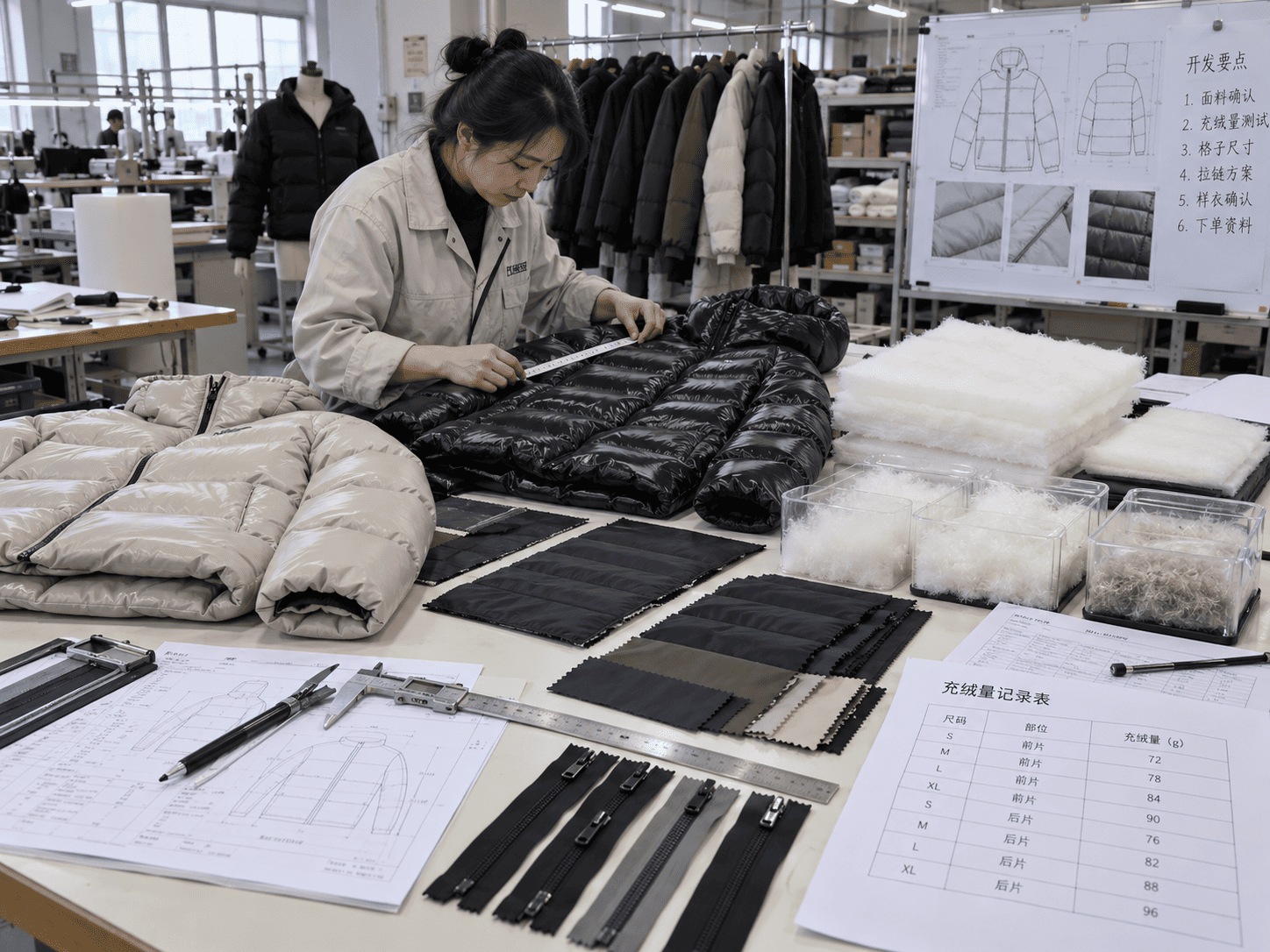
For fashion brands, puffers can look deceptively simple.
A front panel may contain only:
- Shell
- Insulation
- Lining
- Quilting
But changing any one of those changes the entire garment.
That is why the first question should not be:
“How many grams of filling should I use?”
It should be:
“What kind of puffer are we trying to build?”
Table of Contents
- What Types of Puffer Jackets and Vests Can You Make?
- Which Fill Should You Choose: Down or Synthetic?
- Which Shell Fabrics Work Best for Puffers?
- Which Construction Details Make a Puffer Look Premium?
- How Should You Brand a Puffer Jacket?
- What MOQ, Cost, and Timing Should You Expect?
- Conclusion
What Types of Puffer Jackets and Vests Can You Make?
“Puffer” describes a construction direction rather than one fixed style.
Custom puffer programs can include classic hip-length jackets, cropped streetwear puffers, longline coats, vests, hooded jackets, lightweight packable styles, reversible jackets, and technical insulated outerwear. Each requires a different balance of insulation, quilting, shell, fit, and garment weight.
Classic Puffer Jacket
A classic puffer may include:
- Hip-length body
- Horizontal quilting
- Stand collar
- Full zipper
- Elastic or adjustable hem
This is a useful core style for:
- Fashion
- Streetwear
- Corporate outerwear
Cropped Puffer
A cropped puffer often uses:
- Boxier body
- Larger visual channels
- Shorter hem
- More exaggerated volume
Because the body is short, proportion becomes especially important.
A jacket can easily look:
too round
or:
too flat.
Longline Puffer Coat
Long coats use much more:
- Shell
- Lining
- Insulation
than a standard jacket.
They also need careful fit through:
- Hip
- Seat
- Hem
so that the garment works when:
walking and sitting.
Puffer Vest
A vest removes the sleeves but still needs:
- Armhole shaping
- Collar construction
- Balanced insulation
It can work for:
layering
and transitional seasons.
Hooded Puffer
The hood may be:
- Fixed
- Detachable
- Insulated
- Lightly lined
A heavily insulated hood changes:
weight and balance.
Lightweight / Packable Puffer
The goal is not simply:
“use less filling.”
A packable puffer needs the full system to remain:
- Lightweight
- Compressible
- Wearable after unpacking
That includes:
shell, lining, insulation, zipper, and trims.
Reversible Puffer
A reversible jacket is more complicated than:
putting a second fabric inside.
Both faces need:
- Clean seams
- Usable pockets
- Appropriate closures
- Branding placement
This usually adds:
development and sewing complexity.
Our Production Approach
We manufacture jacket and outerwear products through our garment-production operation, including:
- Lightweight jackets
- Windbreakers
- Insulated jackets
- Puffer-style products
depending on the project.
Specialist processes, materials, insulation sourcing, printing, or embroidery may involve long-term specialist suppliers or partner workshops that we coordinate directly.
Which Fill Should You Choose: Down or Synthetic?
The insulation is one of the most important puffer specifications.
But avoid reducing the choice to:
down = premium
and:
synthetic = cheap.
Down and synthetic insulation use different structures and have different sourcing, care, loft, moisture, cost, and design considerations. The correct choice depends on the intended climate, jacket weight, silhouette, care instructions, material claims, budget, and testing requirements.
Down
Down can provide high loft at relatively low weight.
That makes it attractive for products where brands value:
- Low weight
- Compressibility
- Loft
But a down program also needs more control over:
- Fill specification
- Down/feather composition
- Material sourcing
- Traceability
- Leakage
- Care
Fill Power
Fill power is commonly used when specifying down.
But do not turn it into:
“higher number = warmer jacket.”
Fill power describes a property of:
the insulation.
The final thermal performance of a jacket also depends on:
- Amount of fill
- Distribution
- Baffle construction
- Fit
- Shell
- Air leakage
- Garment design
So two jackets using the same fill-power down can still provide:
different thermal performance.
ASTM Requirements for Down and Feather Filling
ASTM D4522-24[^1] is the current ASTM performance specification covering feather and down filling materials used in products including:
- Wearing apparel
- Sleeping bags
- Comforters
The key point for brands is that down specification should be treated as:
a controlled material specification,
not simply a marketing word.
Responsible Down Standard
If your brand wants to make a certified responsible-down claim, the documentation has to support it.
Textile Exchange's Responsible Down Standard[^2] covers animal-welfare requirements and chain of custody for certified down.
RDS prohibits practices including:
- Live plucking
- Force feeding
and uses third-party certification through the supply chain.[^2]
As of 2026, Textile Exchange continues to allow use of the Responsible Down Standard while its wider standards system evolves.[^2]
Do We Need to Be RDS-Certified to Sew a Down Jacket?
This needs careful wording.
If the finished product is intended to carry:
an RDS-certified product claim,
the required certification and chain-of-custody system needs to be followed through the applicable supply chain.
Buying some down that happens to originate from an RDS-certified source does not automatically mean:
the finished jacket can carry the RDS label.
Textile Exchange's claims system has specific requirements for certified organizations and product claims.[^2]
So discuss:
- Supplier certification
- Transaction documentation
- Claim requirements
before confirming the product.
Synthetic Insulation
Synthetic insulation can be supplied in different forms.
For example:
- Sheet / batting insulation
- Loose synthetic filling
The correct choice depends on the construction.
Sheet insulation may work well for:
more controlled layer-based construction.
Loose synthetic fill can create:
a puffier channel appearance
more similar to loose down filling.
Is Synthetic Always Better When Wet?
Avoid that absolute statement.
Some synthetic insulation systems may retain structure and performance differently from down under damp conditions.
But the actual result depends on:
- Fiber
- Construction
- Moisture level
- Garment system
If moisture performance is important:
test the actual material and garment.
Is Down Always Warmer Than Synthetic?
No.
The correct question is:
at what weight, loft, construction, and test condition?
A heavily insulated synthetic jacket may be warmer than:
a very lightly filled down jacket.
Fiber category alone does not determine:
whole-garment warmth.
How Do You Measure Warmth?
This is where marketing language often becomes too simple.
Warmth is a system-level performance. Fill type and amount matter, but shell, baffles, fit, air movement, moisture, and construction also influence the thermal resistance of the finished product.
Textile and Multilayer Thermal Resistance
The current ISO 11092:2026[^3] specifies methods for measuring:
- Thermal resistance
- Water-vapour resistance
of textiles and multilayer assemblies using a sweating guarded hotplate.
The standard was newly updated in:
2026.
It can be used with materials such as:
- Fabrics
- Coatings
- Foams
- Multilayer textile systems
But ISO specifically notes that its laboratory test conditions are not intended to represent:
every real comfort situation.[^3]
Whole-Garment Thermal Insulation
For finished garments, ISO 15831:2004[^4] describes measurement of clothing thermal insulation using:
a thermal manikin.
ISO reviewed and confirmed this standard in 2024.[^4]
This distinction is useful.
A supplier can know:
the insulation material specification
without automatically knowing:
exactly how warm the finished jacket will feel to every wearer.
Avoid Unverified Temperature Ratings
Do not write:
“Good to -20°C”
because the jacket:
looks thick.
Temperature comfort depends on:
- Activity
- Wind
- Humidity
- Base layers
- Individual wearer
- Garment fit
If the brand requires a real thermal-performance claim:
define the claim
and test accordingly.
Which Shell Fabrics Work Best for Puffers?
The shell does more than create the visual style.
It helps contain:
the insulation
and controls:
- Surface feel
- Wind
- Noise
- Water behavior
- Durability
Puffer shells may use tightly constructed nylon or polyester fabrics with matte, semi-matte, glossy, ripstop, peached, coated, or other finishes. The correct shell depends on insulation type, desired appearance, leakage control, water-performance target, hand feel, and durability.
Nylon Shell
Nylon is common for:
puffers and lightweight outerwear.
Possible finishes include:
- Matte
- High shine
- Crinkle
- Soft-touch
But:
nylon does not automatically mean premium.
Final quality depends on:
- Yarn
- Density
- Weave
- Finish
Polyester Shell
Polyester can also make:
excellent puffer shells.
It may suit:
- Fashion puffers
- Uniforms
- Commercial outerwear
depending on specification.
Ripstop
Ripstop creates a:
grid structure.
It can provide:
technical visual character
and may improve resistance to certain forms of tearing.
But the word:
ripstop
is not a universal durability rating.
Down-Proof Fabric
For loose down or feather filling, shell selection becomes more demanding.
The textile needs to help reduce:
fill migration through the fabric.
But leakage is not only about:
weave density.
It can also occur around:
- Needle holes
- Seams
- Stitching
- Damaged shell
- Feather quills
So do not promise:
zero feather leakage
simply because the supplier calls the fabric:
down-proof.
Synthetic Fill
Synthetic insulation generally creates less concern about:
feather-quill penetration.
But the shell still needs the right:
- Strength
- Hand
- Stability
for the garment.
Shell Noise
Some woven synthetic shells create a noticeable:
swishing or crackling sound.
This depends on:
- Fabric construction
- Coating
- Finish
- Stiffness
Do not assume:
lighter = quieter
or:
peached = always quiet.
Handle and move the actual fabric swatch.
Is Water-Repellent the Same as Waterproof?
No.
This distinction is especially important with winter outerwear.
A water-repellent finish may reduce surface wetting, while waterproof performance concerns resistance to water penetration. Whole-garment rain protection also depends on seams, closures, hood construction, and other openings.
ISO 4920:2012[^5] specifies a spray test for resistance to:
surface wetting.
ISO explicitly states that the test is not intended to predict:
rain penetration
because it does not measure water passing through the fabric.[^5]
For fabric water penetration, ISO 811:2018[^6] specifies a hydrostatic-pressure method.
ISO reviewed and confirmed ISO 811 in 2025, so it remains current.[^6]
What Does This Mean for a Puffer Brand?
If you add a surface finish and the water beads:
you may have useful water-repellent performance.
That does not automatically mean:
waterproof puffer.
For a stronger waterproof claim, you may need:
- Appropriate shell
- Seam sealing
- Suitable zipper construction
- Hood design
- Garment-level evaluation
depending on the specification.
Which Construction Details Make a Puffer Look Premium?
A puffer gets its visual identity from:
volume and consistency.
A well-developed puffer should maintain controlled insulation distribution, consistent quilting, balanced proportions, clean seams, functional cuffs and hem, appropriate lining, and closures that work with the thickness of the garment.
Fill Distribution
For loose filling, consistency matters.
If one channel receives:
too little,
it may look flat.
If another receives:
too much,
it may become:
overfilled or distorted.
So production needs:
a controlled filling method.
Does More Fill Always Mean More Warmth?
Not necessarily in a simple linear way.
More insulation may increase potential loft and thermal resistance within a particular construction.
But overfilling a channel can:
- Compress insulation
- Change drape
- Distort shape
The garment needs the correct relationship between:
- Channel volume
- Insulation type
- Fill quantity
Stitch-Through Quilting
In a stitch-through construction:
layers are sewn together along the quilting lines.
This is common because it can be:
- Efficient
- Lightweight
- Visually clean
But sewn areas create:
less insulation thickness
at those lines.
Baffle Construction
A baffle can create internal walls between:
outer and inner layers.
This may help maintain insulation depth through the chamber.
But do not write:
box baffle = premium
as an automatic rule.
It is simply:
a different construction.
It adds:
- Components
- Sewing
- Development
and can make sense when the product requires it.
Quilting Pattern
Possible patterns include:
- Wide horizontal
- Narrow horizontal
- Box
- Diamond
- Curved
- Custom pattern
The pattern affects:
- Style
- Fill chamber
- Sewing
- Distribution
A very large chamber may behave differently from:
a small chamber.
Channel Alignment
Check that quilting lines align where the design requires:
- Front
- Side
- Back
- Sleeve
especially on fashion puffers.
Collar
A heavily padded stand collar needs enough structure to:
stand cleanly
without becoming uncomfortable.
Chin Guard
A chin guard can stop:
zipper or slider
from touching the face.
This is a small detail that can improve:
wear comfort.
Cuffs
Options include:
- Elastic outer cuff
- Internal elastic
- Inner rib cuff
- Adjustable tab
A tight cuff may help reduce air entry.
But it still needs to feel:
comfortable.
Hem
Possible systems include:
- Elastic
- Drawcord
- Cord stopper
The hem can affect:
both silhouette and air movement.
Pockets
Possible pocket types include:
- Welt
- Zipper welt
- Side seam
- Patch
A bulky puffer needs pockets positioned so they remain:
easy to use.
Why Do Feathers or Fill Leak Out?
A customer may see:
one small feather
and immediately think:
the jacket is defective.
The real situation can be more complicated.
Possible leakage paths include:
- Fabric structure
- Needle holes
- Seam areas
- Feather shafts
- Damage
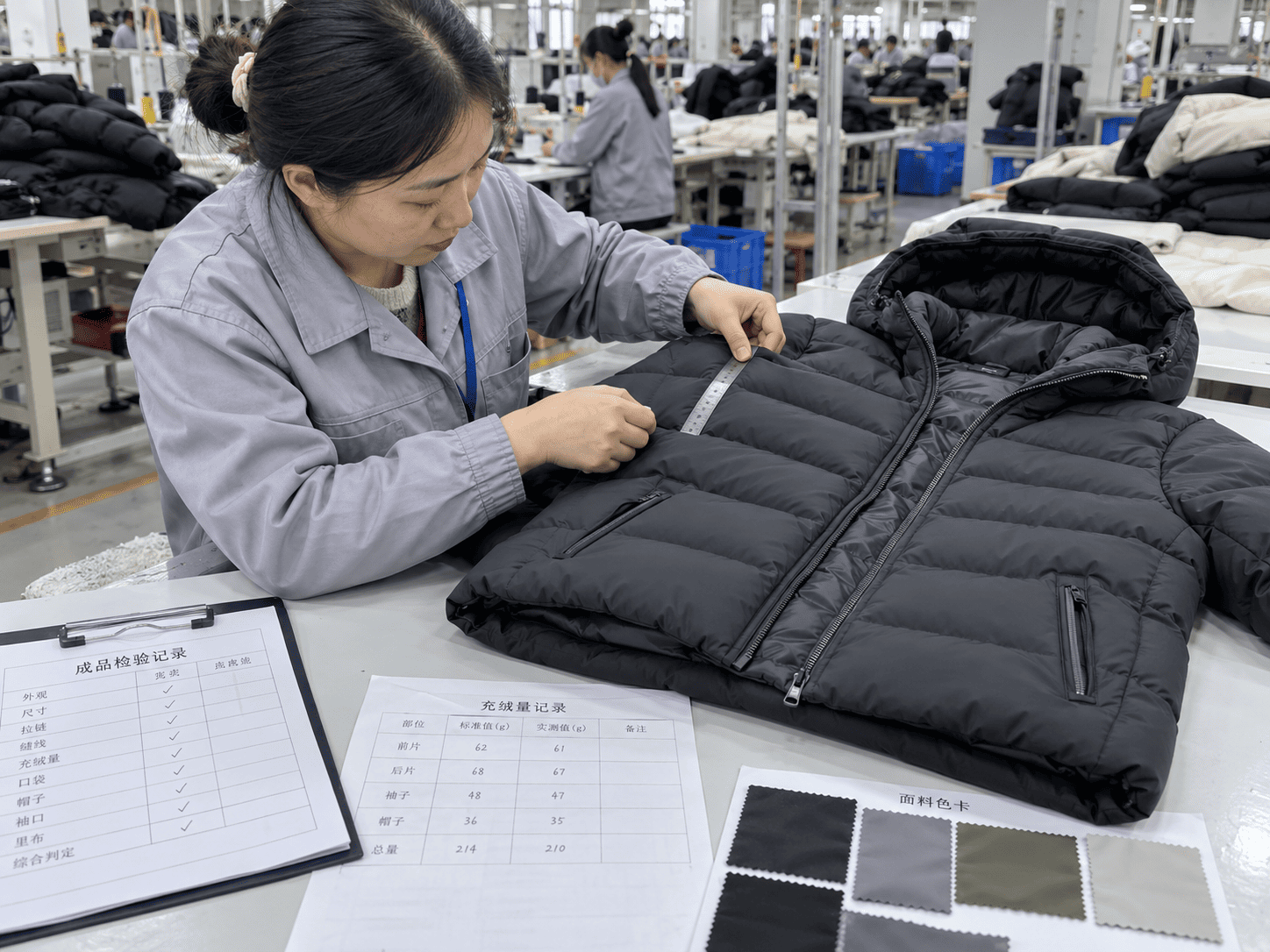
So quality control should check:
the full garment system.
Do Not Overuse Stitch Density
Making the stitch extremely dense does not automatically solve leakage.
More needle penetrations can create:
more holes.
The sewing setup needs to balance:
- Needle
- Thread
- Stitch length
- Shell
Test the Actual Sample
Do not approve:
shell fabric
and:
fill
only as separate samples.
Make the puffer.
Then evaluate:
- Fill migration
- Surface leakage
- Seam areas
- Wash behavior
as a complete garment.
How Should You Brand a Puffer Jacket?
The padded surface creates different branding challenges from:
a flat T-shirt.
Puffer branding should be planned around the insulation and quilting. Patches, pre-embroidered shell panels, heat transfers compatible with the shell, custom pulls, labels, and printed linings can all work when they are developed before final assembly.
Embroidery
Direct embroidery through:
a finished padded jacket
can create problems.
It may:
- Compress fill
- Distort the channel
- Create uneven puckering
A better process may be:
embroidering the shell panel before insulation and assembly.
Another option is:
an embroidered patch.
Rubber / Silicone Patch
A patch can work well on:
- Chest
- Sleeve
But check the patch weight.
A very heavy patch on a lightweight shell can:
pull the fabric.
Heat Transfer
Transfers can create:
clean logos.
But synthetic shell fabrics may be sensitive to:
- Heat
- Pressure
- Coatings
Test:
the exact transfer
on:
the exact shell.
Branded Zipper Pull
A custom pull can add:
subtle identity.
But custom zipper-pull availability, tooling, MOQ, price, and lead time depend on:
the actual supplier and program.
Do not quote one mold price as:
an industry standard.
Printed Lining
This creates branding inside:
the jacket.
Check:
- Colorfastness
- Hand
- Transfer
before bulk.
Labels
The care label needs to reflect:
the complete jacket.
That includes:
- Shell
- Lining
- Insulation
- Decoration
- Trims
especially because a puffer may require more careful washing and drying than:
a basic T-shirt.
How Should You Test a Puffer Before Bulk?
A sample should go through more than:
a fitting.
1. Fit Test
Check:
- Shoulder
- Chest
- Sleeve
- Armhole
- Body length
while wearing:
the intended base layers.
A winter jacket often needs more layering ease than:
a shirt.
2. Loft / Fill Appearance
Compare:
- Channels
- Front
- Back
- Sleeves
for even appearance.
3. Zipper Operation
A thick jacket creates more pressure around:
the front opening.
Check:
- Smooth operation
- Bottom insertion
- Alignment
- Two-way slider if used
4. Wash / Care Test
Follow the intended care method and then inspect:
- Loft
- Fill distribution
- Shell
- Lining
- Zipper
- Decoration
The recovery process after drying may also matter.
5. Water Testing
If the product claims:
surface water repellency,
use an appropriate method.
If it claims:
water penetration resistance,
define a different performance target.
6. Thermal Testing
If the brand wants a specific thermal-performance claim:
decide whether material-level or garment-level testing is appropriate.
Do not create a temperature rating from:
fill weight alone.
What MOQ, Cost, and Timing Should You Expect?
Puffers are among the more complex garment categories.
Cost depends on shell fabric, lining, insulation type, fill quantity, quilting or baffle construction, zipper system, hood, pockets, trims, decoration, testing, and order quantity.
Typical Starting MOQ
For our standard jacket projects:
around 50 pcs/style
can be a practical starting point.
The actual MOQ depends on:
- Shell
- Insulation
- Colors
- Trims
- Construction
Insulation Cost
Down can be more expensive than many synthetic options.
But do not use:
down always costs X% more
because pricing depends on:
- Specification
- Fill quality
- Supplier
- Certification requirements
- Market conditions
Fill Quantity
More fill generally means:
more material cost.
But the right quantity needs to match:
the intended chamber and silhouette.
Shell
Specialized shells can increase cost because of:
- Finish
- Coating
- Construction
- Down-proof requirements
Quilting
More complex quilting can increase:
- Sewing operations
- Handling
- Alignment work
Baffles
Internal baffle construction adds:
material and labor.
Zippers
Possible cost changes include:
- Standard vs premium zipper
- One-way vs two-way
- Custom pull
Hood
A detachable insulated hood requires:
more components
than:
a simple fixed hood.
Sample Timing
For a relatively standard insulated style:
5–14 days
can be a starting sampling range when materials are available.
But puffers can require longer when the project includes:
- Special shell
- Custom insulation
- Down certification
- Custom trims
- Complex baffles
- Testing
Bulk Timing
Our standard garment bulk range is generally:
20–30 days
after:
- Final sample approval
- Deposit
- Materials ready
But complex outerwear should be scheduled with:
extra buffer.
Do not promise every puffer will fit the shortest standard garment timeline.
Payment
For new bulk orders, our normal structure is:
50% before production + 50% before shipment.
How Early Should You Start a Winter Puffer Program?
Earlier than:
a T-shirt program.
A winter launch has a fixed selling window.
You need to work backward from:
the date stock must be in the destination market.
Allow time for:
- Fabric and fill selection
- Sample
- Fit changes
- Material testing
- Bulk material
- Production
- Inspection
- Freight
- Customs
- Local fulfillment
A jacket arriving after:
the cold-weather sales period
can be expensive inventory.
Chinese New Year
If the production schedule overlaps:
Chinese New Year,
build extra time into:
- Material purchasing
- Specialist processes
- Production
- Freight
because supplier and factory schedules can tighten before the holiday.
Green Flags and Red Flags
| Green flag | Red flag |
|---|---|
| Specifies down or synthetic fill properly | Says only “premium filling” |
| Controls fill quantity and distribution | Fills channels by appearance only |
| Discusses fill power separately from garment warmth | Says higher fill power guarantees warmer jacket |
| Uses documented certified down when required | Makes RDS claims without chain-of-custody support |
| Selects shell for insulation and end use | Chooses shell only by shine |
| Checks shell, seams and needle holes for leakage | Assumes “down-proof” means zero feathers |
| Explains stitch-through vs baffle construction | Calls every box baffle automatically premium |
| Defines water-repellent vs waterproof | Calls a DWR puffer waterproof |
| Tests heat-transfer branding on the actual shell | Uses standard heat settings blindly |
| Evaluates complete-jacket thermal performance when needed | Creates temperature ratings from fill grams |
| Allows extra time for complex outerwear | Promises every puffer on a basic tee timeline |
| States certification scope carefully | Claims the garment factory owns certifications it does not hold |
Conclusion
A good puffer is not simply:
a jacket with more filling.
It is a controlled insulation system.
Start by deciding:
what the jacket needs to do.
Is it:
- Fashion?
- Streetwear?
- Everyday winter wear?
- Lightweight layering?
- Technical cold-weather outerwear?
Then select:
down
or:
synthetic insulation
for that job.
If you use down:
define the actual fill specification.
If you need a certified material claim such as:
RDS,
plan the certification and chain-of-custody requirements before bulk.
Do not assume buying certified raw material automatically gives:
the finished product
a certified label claim.
Then select the shell.
A good shell needs the right combination of:
- Hand
- Density
- Appearance
- Noise
- Water behavior
- Insulation containment
for the actual design.
Next:
build the chambers correctly.
The amount of insulation needs to match:
the space available.
Too little can look:
flat.
Too much can distort:
the silhouette.
And remember:
fill power does not equal finished-jacket warmth.
The finished garment also depends on:
- Insulation quantity
- Baffles
- Quilting
- Fit
- Shell
- Closures
- Air movement
If a brand needs a real thermal-performance claim:
test it.
The same applies to:
water.
A surface that beads water is not automatically:
waterproof.
Use the appropriate test for the claim you intend to make.
Then plan the branding before:
the jacket is fully assembled.
Embroidery, patches, transfers, zipper pulls, and lining graphics all interact with:
the shell and insulation.
Finally:
wear the sample.
Wash it.
Compress it.
Open and close the zipper.
Check the fill channels.
Look for leakage.
Check whether the loft returns.
A puffer should not only look:
full
on the day it leaves the factory.
It should remain:
balanced, functional, and visually consistent
through real use.
That is what separates:
a jacket that only photographs well
from:
a well-developed puffer product.
Footnotes & References
[^1]: ASTM International — ASTM D4522-24, Standard Performance Specification for Feather and Down Fillings for Textile Products. Covers performance requirements for down, feather, and related filling materials used in textile products including wearing apparel, sleeping bags, and comforters. The standard applies to the filling material itself rather than establishing whole-garment warmth.
https://store.astm.org/d4522-24.html
[^2]: Textile Exchange — Responsible Down Standard (RDS). The RDS is a voluntary third-party certification standard addressing animal welfare and chain of custody for down and feathers. It prohibits live plucking and force feeding and uses certification and chain-of-custody requirements to support verified material claims. Textile Exchange continues to support use of RDS while its broader standards system evolves.
https://www.textileexchange.org/responsible-down-standard/
https://textileexchange.org/labeling-standards-claims/
[^3]: International Organization for Standardization — ISO 11092:2026, Textiles — Physiological Effects — Measurement of Thermal and Water-Vapour Resistance Under Steady-State Conditions. Specifies methods for measuring thermal resistance and water-vapour resistance of fabrics and multilayer textile systems using a sweating guarded hotplate. The 2026 edition replaces ISO 11092:2014. ISO notes that the laboratory conditions do not themselves define specific physiological comfort situations.
https://www.iso.org/standard/85998.html
[^4]: International Organization for Standardization — ISO 15831:2004, Clothing — Physiological Effects — Measurement of Thermal Insulation by Means of a Thermal Manikin. Describes a procedure for measuring the thermal insulation of a clothing ensemble as effective for the wearer under defined conditions using a thermal manikin. ISO reviewed and confirmed the standard in 2024.
https://www.iso.org/standard/28720.html
[^5]: International Organization for Standardization — ISO 4920:2012, Textile Fabrics — Determination of Resistance to Surface Wetting (Spray Test). Specifies a spray-test method for evaluating resistance to surface wetting. ISO explicitly states that this test is not intended to predict rain-penetration resistance because it does not measure water passing through the fabric. ISO reviewed and confirmed the standard in 2023.
https://www.iso.org/standard/50706.html
[^6]: International Organization for Standardization — ISO 811:2018, Textiles — Determination of Resistance to Water Penetration — Hydrostatic Pressure Test. Specifies a hydrostatic-pressure method for evaluating fabric resistance to water penetration. ISO reviewed and confirmed this edition in 2025, so it remains current.
https://www.iso.org/standard/65149.html