

Custom Blank Apparel Manufacturer: How Do Print Shops and Brands Get Their Own Blanks Made?
Your print shop has loyal clients.
You know which hoodie colors sell.
You know which T-shirt fits customers reorder.
You know which decoration methods work best.
But every competitor is buying:
the same blank.
Then one day your supplier runs out of:
black size L.
Or the next batch feels slightly different.
The manufacturer changes the fabric.
Your best-selling hoodie is suddenly no longer:
your best-selling hoodie.
That is the weakness of building your business around a product specification you do not control.
Custom blank apparel is undecorated clothing produced to your own specification for later printing, embroidery, transfer, or resale. Instead of choosing from a catalog garment, you define the fabric, GSM, fit, construction, core colors, labels, and packaging. The advantage is greater product control and differentiation; the trade-off is MOQ, production lead time, inventory planning, and the need to manage reorders carefully.
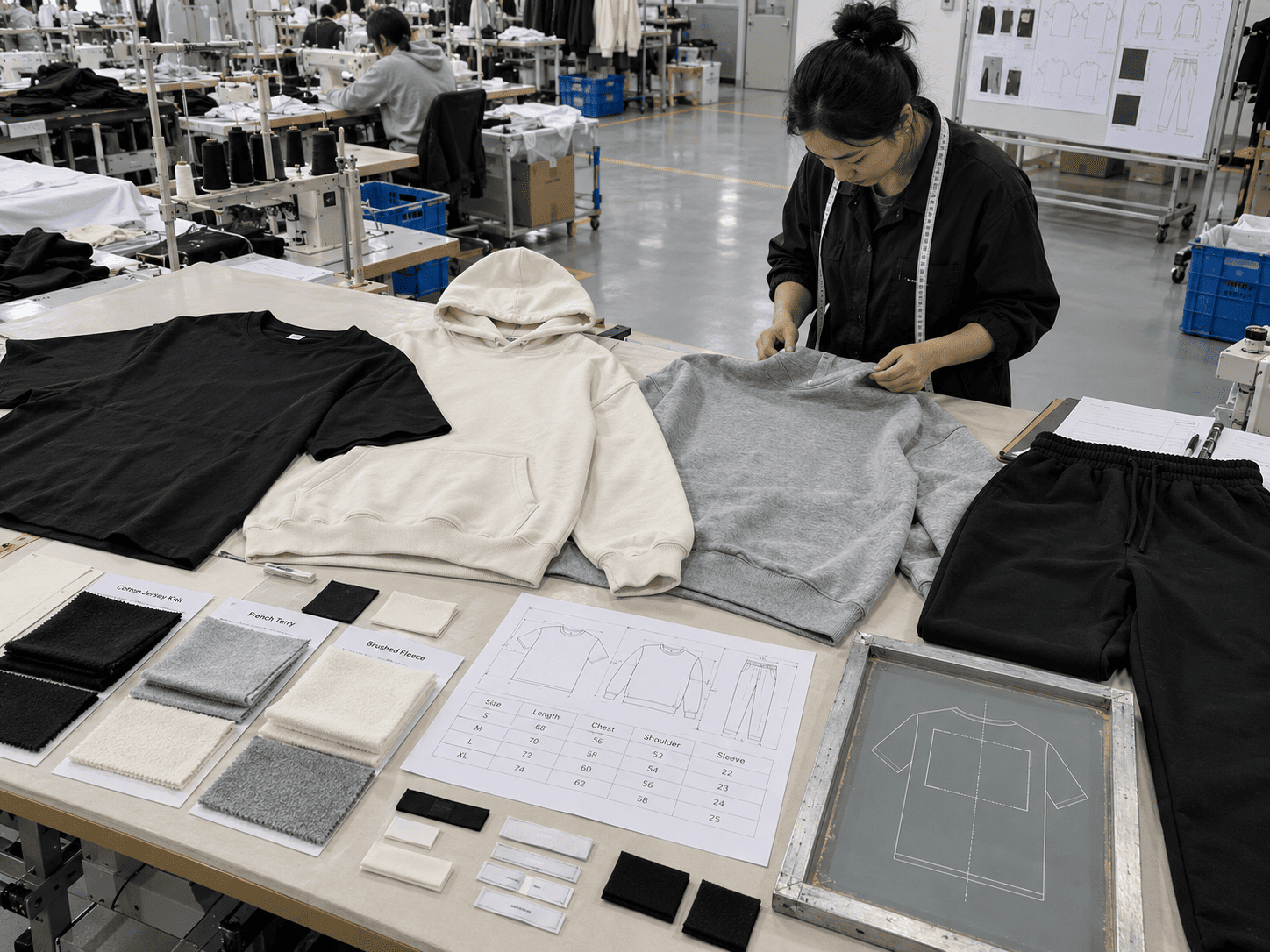
For a decorator, a blank garment is not really:
blank.
It is the foundation for every product that comes after it.
The:
- Surface
- Fit
- Shrinkage
- Shade
- Seam placement
- Label
can all affect the final decorated garment.
Table of Contents
- What Are Custom Blanks, and How Are They Different from Catalog Blanks?
- Who Should Consider Custom Blank Apparel?
- Which Fabrics and Fits Make the Best Blanks?
- How Do You Make Blanks Easy to Decorate?
- How Do Labels, Packaging, and Size Runs Work for Blanks?
- What MOQ, Cost, and Timing Should You Expect?
- Conclusion
What Are Custom Blanks, and How Are They Different from Catalog Blanks?
Catalog blanks and custom blanks solve different problems.
Catalog blanks are finished stock garments produced in standardized fabrics, colors, fits, and size ranges for immediate purchase. Custom blanks are produced to order from an agreed specification, allowing the buyer to control the fabric, weight, pattern, colors, labels, and repeat-production reference.
Catalog Blanks
Catalog blanks are useful because they are:
- Available quickly
- Easy to order
- Available in low quantities
For a decorator who receives:
one-off orders,
that flexibility can be ideal.
Custom Blanks
Custom blanks make more sense when you want:
- Your own fit
- Your own GSM
- Your own fabric
- Your own core colors
- Your own label system
The product becomes:
a repeatable manufacturing specification.
Custom Does Not Mean Nobody Else Can Ever Copy It
Be careful with the word:
exclusive.
If your pattern and specification are developed for your company, another customer should not be supplied using your confidential pattern without permission.
But custom manufacturing does not automatically create:
legal exclusivity
over a basic hoodie silhouette.
If exclusivity matters:
- Protect confidential tech packs
- Control artwork
- Use contracts where appropriate
- Protect trademarks and original designs where legally available
Catalog vs Custom
| Factor | Catalog blank | Custom blank |
|---|---|---|
| Availability | Ready stock | Made to order |
| Small quantity | Excellent | MOQ applies |
| Fabric | Existing catalog | Selected specification |
| GSM | Catalog options | More control |
| Fit | Existing block | Custom pattern possible |
| Color | Existing stock | Stock or custom-dye program |
| Labels | Supplier system | Customizable |
| Lead time | Short | Production lead time |
| Inventory | Supplier holds stock | Buyer usually plans stock |
| Reorders | Depends on catalog availability | Based on retained specification |
Our Model
We do not operate primarily as:
a ready-stock blank wholesaler.
Our core business is:
made-to-order OEM/ODM production.
That means a blank program can be developed around:
your own product specification
rather than buying finished inventory from our shelf.
Who Should Consider Custom Blank Apparel?
Custom blanks are not right for every business.
They make the most sense when a decorator, brand, merch supplier, or apparel business has repeat demand for a relatively small number of core styles and wants more control over product consistency, fit, and branding.
Screen-Printing Shops
A print shop may already have customers asking for:
- Heavy tee
- Oversized tee
- Premium hoodie
Instead of selling the same blank as every local competitor, it can develop:
its own base garment.
That changes the sales conversation from:
“Which blank brand do you want?”
to:
“This is our own 300+ GSM tee.”
Embroidery Shops
Embroiderers also benefit from controlling:
- Fabric stability
- Chest construction
- Hoodie thickness
because those affect:
embroidery results.
Merch Companies
Merch programs often need:
repeatability.
For example:
a creator sells the same black hoodie three times per year.
A defined blank specification can make reordering easier.
Brands Decorating Locally
Some brands prefer to:
manufacture blanks overseas
and then:
- Screen print
- Embroider
- Personalize
locally.
That can be useful when they need:
short-turn customization
after importing the base garments.
Corporate and Team Suppliers
A supplier may hold:
core blank inventory
and decorate it as orders arrive.
But this model only works well when demand is:
predictable enough
to justify stock.
Who Should Not Use Custom Blanks?
Custom blanks may not be suitable if you need:
- 1 piece
- 20 colors
- Immediate delivery
- No inventory
In that case:
catalog blanks
or:
print-on-demand
may be better.
Which Fabrics and Fits Make the Best Blanks?
There is no single best blank.
A good blank is a garment developed around the decoration methods and customer segment you expect to serve. Fabric stability, surface, GSM, fit, color, shrinkage, and construction all matter.
Heavyweight T-Shirts
Heavyweight tees are popular for:
- Streetwear
- Merch
- Premium decorators
Possible weights may include:
- 240 GSM
- 280 GSM
- 320 GSM
- 330 GSM+
depending on the program.
But:
higher GSM ≠ automatically better blank.
A very heavy jersey can still have:
- Poor recovery
- Rough hand
- Excessive shrinkage
Cotton Jersey
Cotton jersey is widely used because it can work with many decoration processes.
But do not say:
“cotton works perfectly for all screen printing and DTG.”
Actual decoration results depend on:
- Surface
- Yarn
- Finish
- Pretreatment
- Garment color
- Ink system
A smooth compact jersey may print differently from:
a rough open-end jersey.
French Terry
French terry is useful for:
- Hoodies
- Crewnecks
- Sweatpants
Possible compositions include:
- 100% cotton
- Cotton/polyester blends
depending on:
hand, shrinkage, and price target.
Fleece
Brushed fleece creates:
a warmer blank.
But brushing changes the inside surface and can also affect:
dimensional behavior.
Performance Fabrics
Performance blanks may use:
- Polyester
- Polyester/elastane
But decoration needs to be planned carefully.
A polyester garment can have risks such as:
- Dye migration
- Heat sensitivity
depending on its dye and decoration process.
Sublimation
Traditional dye sublimation is primarily suited to:
suitable polyester-based substrates,
especially:
white or light-colored polyester.
Do not simplify that to:
all polyester = sublimation ready.
The actual textile still needs to be compatible with:
the transfer temperature and process.
Blank Fit
Fit is just as important as fabric.
Possible blank directions include:
- Classic
- Relaxed
- Oversized
- Boxy
- Dropped shoulder
- Cropped
A print shop may build its entire reputation around:
one excellent tee block.
Keep the Approved Pattern
Once the customer approves:
- Shoulder
- Chest
- Body length
- Sleeve
- Neck
- Bottom
the production reference should be retained for:
future reorders.
But do not silently modify:
approved base measurements
when adding larger sizes.
Grade from the agreed base according to:
the intended size system.
What Does Pre-Shrunk Actually Mean?
This is especially important for blanks.
A printer may apply:
heat
after receiving the garment.
Then the customer may:
wash it again.
Pre-shrunk means that a fabric or garment has undergone a process intended to reduce later dimensional change. It does not mean the garment will have zero shrinkage.
ISO 5077:2007[^1] provides a standardized method for determining dimensional change in textiles after specified washing and drying procedures.
And ISO 6330:2021[^2] provides standardized domestic washing and drying procedures used in textile testing.
So if a blank supplier says:
“pre-shrunk,”
ask:
What dimensional-change result do you actually get under the agreed care process?
That is more useful.
How Do You Make Blanks Easy to Decorate?
A decorator-friendly blank is designed with the next process in mind.
Decoration-friendly blanks should provide appropriate fabric surface, stable dimensions, usable print areas, compatible colors and finishes, and construction that does not interfere unnecessarily with common decoration placements.
Print Area
For a T-shirt:
common decoration areas include:
- Left chest
- Center chest
- Full front
- Full back
Do not place:
- Unnecessary seams
- Large pockets
- Structural panels
through those areas if the blank is mainly intended for:
printing.
Hoodie Back Prints
For oversized back artwork, check:
- Hood position
- Shoulder seam
- Sleeve seam
The decorator may need enough uninterrupted space for:
the intended print.
Fabric Surface
A smoother fabric can sometimes support:
cleaner fine-detail printing.
But the right surface depends on:
the process.
Screen Printing
Screen printing can work very well on many:
cotton and blended garments.
But the printer still needs to select:
- Ink
- Underbase
- Cure
for the actual fabric.
DTG
DTG performance depends on:
- Fiber
- Pretreatment
- Surface
- Garment color
- Printer system
It should not be marketed simply as:
100% cotton = perfect DTG.
DTF
DTF can work on many textile types.
But large DTF graphics create:
a more noticeable film layer.
The blank should be tested if DTF is one of the main expected decoration methods.
Embroidery
Embroidery blanks need enough:
stability
for the artwork.
A very thin garment may require:
backing
and can still distort if the logo is too dense.
Heat Exposure
Decorators may use:
- Heat presses
- Curing dryers
So the blank fabric should be evaluated for:
heat stability
where relevant.
Can You Guarantee the Same Black on Every Reorder?
This is another common blank-apparel question.
The correct answer is:
you can control color against an approved standard, but you should not promise that different dye lots will be physically identical.
Keep Approved References
Useful records may include:
- Pantone target
- Approved lab dip
- Approved bulk swatch
- Dye-lot information
For reorders, new material can be evaluated against:
the approved reference.
Dye Lots Can Vary
Different production lots may show:
slight shade variation.
This can be influenced by:
- Fiber
- Dye
- Finishing
- Process
So the better promise is:
controlled within the agreed color tolerance.
Not:
exactly identical forever.
This matters for print shops because the same ink color can look different on:
two slightly different black fabrics.
How Do Labels, Packaging, and Size Runs Work for Blanks?
Blank garments are unusual because the end buyer may:
rebrand them later.
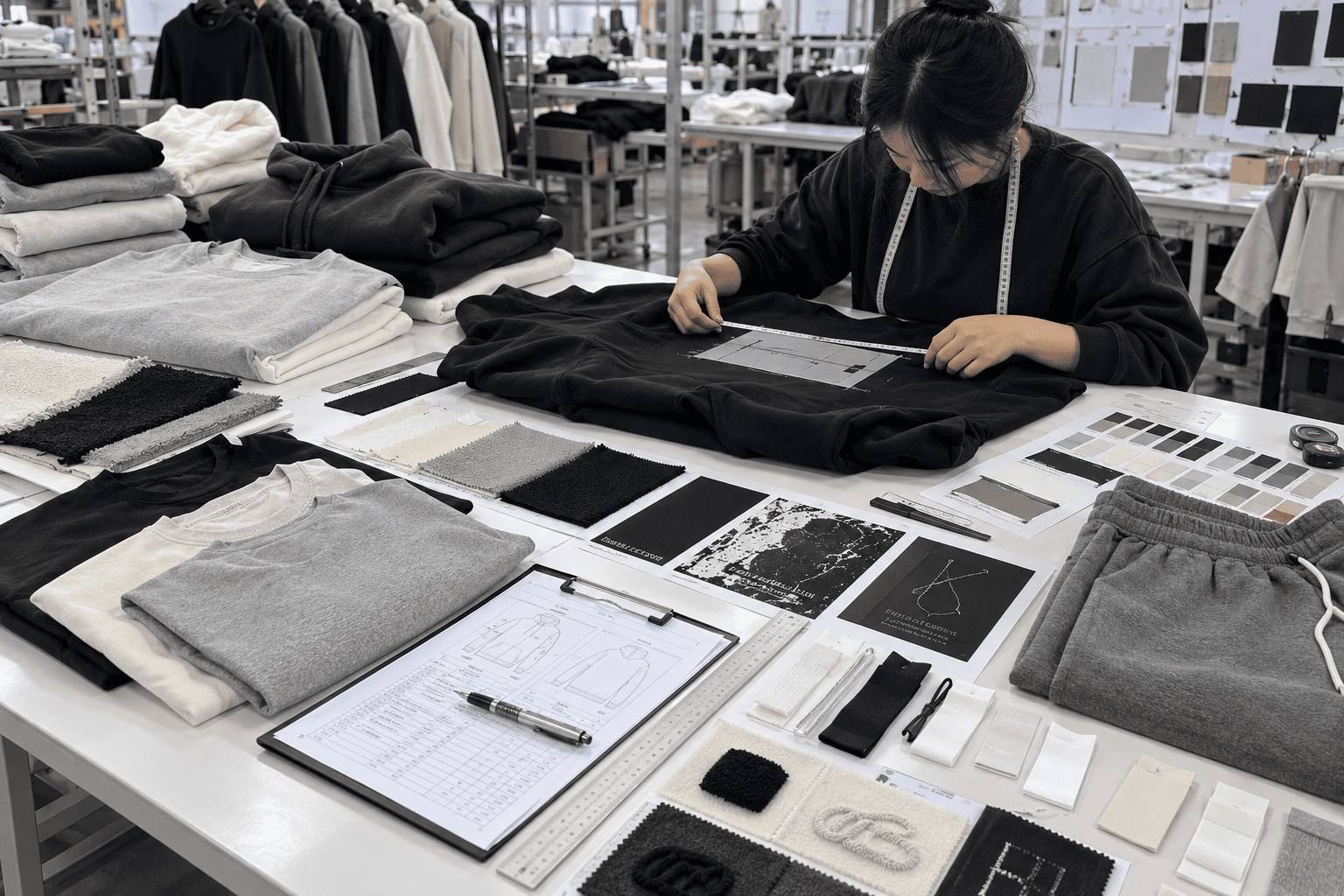
That makes label planning important.
Brand Label
If you sell the garments under:
your own blank-apparel brand,
you can use:
your own neck label.
Tear-Away Label
A tear-away construction can make later:
rebranding
easier.
But do not confuse:
a removable brand label
with:
legally required textile information.
U.S. Labeling Requirements
For U.S. textile products, FTC rules generally require appropriate information such as:
- Fiber content
- Country of origin
- Responsible company identity
depending on the product and applicable rule.
The FTC Textile Fiber Products Identification Act guidance[^3] covers fiber-content and related textile labeling requirements.
Care instructions are governed separately by the FTC Care Labeling Rule[^4].
So a decorator should not simply remove:
all labels
and sell the garment without replacing required information.
Printed Neck Labels
These can be useful for:
- Brand
- Size
but the printed area should not become:
stiff
or uncomfortable.
Care / Fiber Labels
A side-seam label can carry:
- Fiber
- Care
- Origin
- Other required information
depending on the destination market.
Packaging
For wholesale blank programs, packaging should support:
warehouse handling.
Possible approaches include:
- Individual bagging
- Size stickers
- Color codes
- Cartons by SKU
Avoid Over-Packaging
A decorator who will immediately:
open every bag
may not need:
premium individual packaging.
Ask how the stock will actually be handled.
How Should You Plan Size Runs?
Small blank runs can become fragmented quickly.
Suppose the MOQ is:
50 hoodies.
And you want:
XS
S
M
L
XL
2XL
That is only:
about eight pieces per size
before any demand weighting.
For many of our small hoodie programs:
up to four sizes at 50 pcs
is more practical.
If five or six sizes are needed:
increasing the order quantity
usually gives a better size breakdown.
Use Actual Customer Data
Print shops with sales history should use:
their own size mix.
Do not blindly copy:
generic industry percentages.
Keep the Base Size Stable
Once the fit is approved:
do not change the M measurement
just to make grading easier.
Extend the size range around:
the agreed base specification.
What MOQ, Cost, and Timing Should You Expect?
Custom blanks follow garment-production economics.
They are not:
stock-wholesale economics.
Typical Starting MOQ
For our standard programs:
| Product | Typical starting point |
|---|---|
| T-shirt | Around 100 pcs/style |
| Shorts | Around 100 pcs/style |
| Hoodie | Around 50 pcs/style |
| Crewneck | Around 50 pcs/style |
| Sweatpants | Around 50 pcs/style |
| Matching set | Around 50 sets |
The exact MOQ still depends on:
- Fabric
- Colors
- Size breakdown
- Trims
Colors
Color count can have a major impact.
If a 100-piece T-shirt order is split across:
10 colors,
each color only has:
10 pieces.
That can make fabric purchasing inefficient.
Full-Roll vs Loose-Cut Fabric
In some sourcing programs:
full-roll purchasing
provides better fabric pricing than:
small loose-cut quantities.
But do not write:
loose-cut fabric is always double the price.
That depends on:
the fabric supplier.
Fabric Weight
A heavier fabric usually increases:
material consumption by weight.
But it does not create one fixed cost increase.
Final garment cost also depends on:
- Fabric width
- Marker
- Composition
- Yarn
- Finish
Oversized Fit
An oversized fit often consumes:
more fabric
than a standard fit.
But the actual difference should come from:
marker consumption,
not a generic percentage.
Labels
Custom labels may have:
their own supplier MOQ.
For some of our programs:
woven labels can start at around:
100 pieces.
But actual supplier MOQ and cost should be:
confirmed per project.
Packaging
Packaging has separate:
- MOQ
- Unit cost
- Freight impact
A blank wholesaler may prefer simple packaging because:
the garment will be decorated again.
Do Custom Blanks Get Cheaper at 200, 1,000, or 5,000 Pieces?
Usually:
larger quantities can improve unit economics.
But do not publish one universal:
price-break ladder.
The cost curve depends on:
- Fabric purchasing
- Cutting efficiency
- Sewing
- Trim MOQ
- Color split
- Packaging
A 1,000-piece order split over:
20 colors
can be less efficient than:
500 pieces in one color.
So we quote:
the actual program.
Sampling and Bulk Timing
For standard available materials:
Sampling: approximately 5–14 days
For standard bulk programs:
Bulk production: approximately 20–30 days
after:
- Final approval
- Deposit
- Materials ready
Custom:
- Knitting
- Dyeing
- Fabric development
can add time.
Payment
For new bulk orders, our normal structure is:
50% before production + 50% before shipment.
What About EXW, FOB, and Shipping?
Keep manufacturing price and logistics terms separate.
ICC Incoterms® 2020[^5] defines internationally recognized trade terms that allocate specific delivery responsibilities, costs, and risk between seller and buyer.
Terms such as:
EXW
and:
FOB
do not simply mean:
“shipping included”
or:
“shipping not included.”
They define specific responsibilities in the transaction.
For a blank-apparel program, the quote should therefore clearly state:
- Garment price basis
- Incoterm
- Named place/port
- Freight if separately quoted
rather than simply saying:
FOB price
with no location.
Why Reorders Matter More Than the First Order
This is where custom blanks become valuable.
The first order develops:
- Pattern
- Fabric
- Color
- Labels
The second order should start from:
those approved references.
Keep the Pattern
Use the approved:
measurement specification.
Keep Fabric Data
Record:
- Composition
- GSM
- Width
- Finish
Keep Color References
Maintain:
the approved target and bulk reference.
Keep Trim Information
Record:
- Label
- Sewing thread
- Rib
- Drawcord
where applicable.
Do Not Assume No Development Is Ever Needed Again
A reorder may still need review if:
- Fabric supplier changes
- Dye lot changes
- Trim changes
- Size range changes
So:
reorder does not mean zero QC.
It means:
a much stronger starting reference.
Green Flags and Red Flags
| Green flag | Red flag |
|---|---|
| Develops the blank around your decoration method | Uses one fabric for every process |
| Measures actual dimensional change | Says pre-shrunk means zero shrinkage |
| Keeps approved color references | Promises every dye lot will be identical |
| Keeps your approved pattern | Changes fit on every reorder |
| Designs clear decoration areas | Seams block common print positions |
| Tests DTG / DTF / screen print on actual fabric | Says cotton works perfectly with every printing method |
| Plans polyester around the real sublimation process | Calls every polyester garment sublimation-ready |
| Separates removable branding from legal labeling | Removes all labels without considering regulations |
| Plans size runs from real sales data | Splits tiny orders across too many sizes |
| Quotes actual supplier MOQ | Publishes universal trim minimums |
| Uses real quantity/colour mix for pricing | Promises fixed price breaks at every quantity |
| Retains specification for reorders | Treats every reorder as an unrelated product |
Conclusion
Custom blanks are not simply:
unprinted clothes.
For a print shop or decorator, they can become:
the core product behind the entire business.
But only if the specification is controlled.
Start with:
the customer you serve.
Do they want:
- Heavy streetwear tees?
- Premium hoodies?
- Classic corporate blanks?
- Performance products?
Then build the fabric around:
the decoration method.
Do not choose cotton only because:
“cotton prints well.”
Check the actual surface.
Do not choose polyester only because:
“we want sublimation.”
Make sure the substrate and color suit the real sublimation process.
Then develop:
the fit.
A boxy tee or oversized hoodie can become:
your blank brand's signature.
Once it is approved:
protect the base measurements.
Do not randomly change them on the next production.
Then control shrinkage.
“Pre-shrunk” is useful.
But:
pre-shrunk does not mean zero shrinkage.
Measure dimensional change under:
the agreed care process.
Then control color.
Keep:
- Approved color target
- Bulk reference
- Dye-lot information
But do not promise:
every reorder will be physically identical.
The goal is:
controlled shade within the approved tolerance.
Next:
plan the label system properly.
A tear-away brand label can be useful.
But a removable brand label does not mean:
fiber, care, origin, and other legally required information can simply disappear.
Finally:
plan the blank as an inventory program.
Custom blanks make the most sense when the same:
- Fabric
- Fit
- Colors
sell repeatedly.
The first production establishes:
the product.
The reorders build:
the business.
That is when a print shop stops depending entirely on someone else's catalog blank
and starts selling:
its own apparel platform.
Footnotes & References
[^1]: International Organization for Standardization — ISO 5077:2007, Textiles — Determination of Dimensional Change in Washing and Drying. Specifies a method for determining dimensional change in fabrics, garments, and other textile articles after specified washing and drying procedures. ISO reviewed and confirmed this edition in 2022.
https://www.iso.org/standard/41877.html
[^2]: International Organization for Standardization — ISO 6330:2021, Textiles — Domestic Washing and Drying Procedures for Textile Testing. Specifies standardized domestic washing and drying procedures used for textile testing. Test conditions matter because washing and drying methods can affect dimensional-change results.
https://www.iso.org/standard/75934.html
[^3]: U.S. Federal Trade Commission — Textile Fiber Products Identification Act / Textile Fiber Rule. FTC requirements govern fiber-content disclosures, country-of-origin information, and identification of the manufacturer or other responsible company for covered textile products sold in the United States.
https://www.ftc.gov/legal-library/browse/rules/textile-fiber-rule
[^4]: U.S. Federal Trade Commission — Care Labeling Rule, 16 CFR Part 423. Requires manufacturers and importers of covered textile wearing apparel to provide regular-care instructions and to have a reasonable basis for those instructions.
https://www.ftc.gov/legal-library/browse/rules/care-labeling-textile-wearing-apparel-certain-piece-goods
[^5]: International Chamber of Commerce — Incoterms® 2020. ICC's Incoterms rules define internationally recognized trade terms that allocate specified delivery obligations, costs, and risks between seller and buyer. Terms such as EXW and FOB should be used together with the appropriate named place or port and should not be treated simply as shorthand for whether freight is included.
https://iccwbo.org/business-solutions/incoterms-rules/incoterms-2020/