
Golf Apparel Manufacturer: How Do You Make Golf Clothing That Performs on the Course and Looks Sharp Off It?
Your golf polo looks excellent in the product photos.
The collar is crisp.
The body fits cleanly.
The logo embroidery looks sharp.
Then somebody actually plays 18 holes in it.
At the top of the swing, the back feels tight.
After several hours, the shirt feels heavier with sweat than expected.
After washing, the collar no longer sits as cleanly as it did on the sample table.
That is the difference between:
a polo that looks like golf apparel
and:
golf apparel developed for actual use.
Good golf clothing needs to balance appearance and movement. The fabric, pattern, collar construction, seam placement, waistband, pockets, decoration, and care performance all need to work together. Polyester, nylon, cotton, and stretch-woven fabrics can all be suitable, but the fiber name alone does not prove breathability, quick drying, UV protection, recovery, or premium quality.
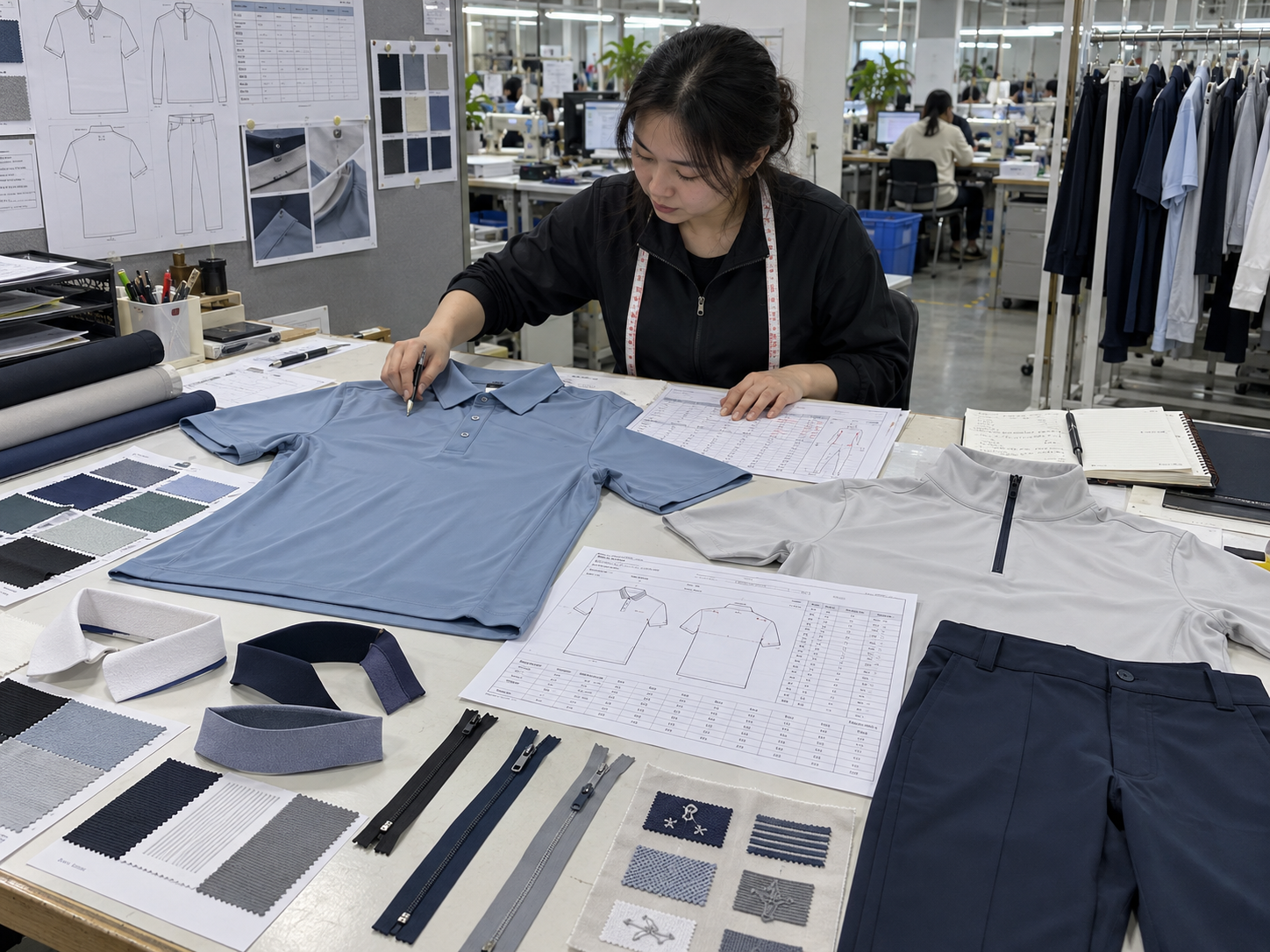
For most golf brands, the collection begins with:
the polo.
Then comes:
- Quarter-zip
- Pants
- Shorts
- Vest
- Windbreaker
The challenge is keeping the range visually smart while making every piece comfortable enough for:
walking, bending, rotating, and swinging.
Table of Contents
- What Does a Golf Apparel Manufacturer Make?
- Which Fabrics Work Best for Golf Clothing?
- How Should Golf Clothing Fit for the Swing?
- Which Details Make Golf Apparel Look Premium?
- How Should You Brand Golf Apparel?
- What MOQ, Cost, and Timing Should You Expect?
- Conclusion
What Does a Golf Apparel Manufacturer Make?
A golf collection is usually built as a layering system.
A golf apparel manufacturer may produce performance polos, traditional pique polos, quarter-zips, mock-neck tops, golf pants, shorts, vests, windbreakers, and other lightweight layers. The correct product specification depends on whether the collection is designed for performance golf, club wear, corporate programs, tournaments, or lifestyle use.
Performance Golf Polo
This is usually the core product.
Possible features include:
- Stretch knit
- Lightweight construction
- Structured collar
- Side splits
- Longer back hem
- Small embroidered logo
But there is no single fabric called:
golf performance fabric.
The actual material needs to be selected by specification.
Classic Pique Polo
Cotton or cotton-blend pique creates a more traditional appearance.
It can work particularly well for:
- Clubhouse apparel
- Corporate golf
- Lifestyle collections
- Hospitality uniforms
It may not behave the same as a lightweight synthetic performance knit during hot-weather play.
That is not necessarily a weakness.
It is simply a different product.
Quarter-Zip Pullover
A quarter-zip is a natural layering piece.
It may use:
- Smooth stretch knit
- Double knit
- Brushed-back knit
- Lightweight performance jersey
The key is making sure it layers over a polo without becoming:
too tight across the back
or:
too bulky around the armhole.
Golf Pants
Golf pants are usually woven rather than knit.
Possible fabrics include:
- Polyester/elastane stretch woven
- Nylon/elastane stretch woven
- Mechanically stretchy woven
- Other performance trouser fabrics
The fabric needs to look:
clean and structured
while still allowing movement.
Golf Shorts
Golf shorts usually share many of the same requirements as pants:
- Clean waistband
- Functional pockets
- Comfortable rise
- Appropriate leg opening
- Movement
Vest
A vest keeps the arms free.
Depending on the program, it may be:
- Lightweight woven
- Stretch woven
- Lightly insulated
- Quilted
Windbreaker
A lightweight golf windbreaker can help manage:
wind and changing conditions.
But if a brand wants to make:
water-repellent
or:
waterproof
claims, those need to be defined and tested separately.
Our Production Approach
We manufacture golf-related products including:
- Polos
- Quarter-zips
- Performance tops
- Woven pants
- Shorts
- Lightweight jackets
through our garment-production operation.
That means a golf brand can coordinate:
tops and bottoms
with one production team.
Specialist decoration such as:
- Embroidery
- Printing
- Certain logo applications
may be completed by long-term partner workshops that we coordinate directly.
Which Fabrics Work Best for Golf Clothing?
There is no universal best golf fabric.
Choose the material according to the garment's intended use, climate, hand feel, stretch and recovery, air or moisture behavior, appearance, care requirements, and target cost. Polyester, nylon, cotton, and blended fabrics can all work well when the construction is appropriate.
Polyester/Spandex
Polyester/elastane knits are widely available for:
- Polos
- Performance tops
- Quarter-zips
Potential advantages can include:
- Stretch
- Good color options
- Compatibility with many performance fabric programs
But do not automatically claim:
quick-dry
or:
moisture-wicking
because the composition says polyester.
Those are performance properties of:
the actual fabric.
Nylon/Spandex
Nylon/elastane can create:
- Smooth hand
- Soft surface
- Premium tactile feel
in some constructions.
But:
nylon = premium
is too simple.
A high-quality polyester fabric can outperform a low-quality nylon in:
- Hand
- Recovery
- Surface
- Durability
Compare the actual swatches.
Polyester Pique
Polyester pique can provide:
the visual texture of a polo
while keeping the product within a synthetic performance-fabric program.
Again, evaluate:
- Hand
- Stretch
- Air permeability
- Drying behavior
on the actual material.
Cotton Pique
Cotton pique remains useful for:
- Traditional golf looks
- Club polos
- Lifestyle apparel
It can feel natural and substantial.
But if the product is intended for:
hot-weather tournament use,
the brand should wear-test it rather than assuming cotton or polyester is automatically better.
Stretch Woven
Golf pants and shorts often need:
movement
without looking like:
gym leggings.
Stretch woven fabric can provide both:
structure and mobility.
But woven fabric does not have to contain elastane to move.
Some materials use:
mechanical stretch.
Brushed-Back Knit
This can work for:
cool-weather quarter-zips.
It may add:
- Warmth
- Softness
but a heavier brushed fabric may also affect:
- Drying
- Breathability
- Layering
So the intended climate matters.
Fabric Comparison
| Fabric direction | Possible use | Main points to check |
|---|---|---|
| Polyester/elastane knit | Performance polo | Stretch, drying, pilling |
| Nylon/elastane knit | Premium-feel polo | Hand, recovery, pilling |
| Polyester pique | Sport polo | Surface, comfort, airflow |
| Cotton pique | Traditional polo | Shape retention, shrinkage |
| Stretch woven | Pants / shorts | Mobility, recovery, abrasion |
| Brushed-back knit | Quarter-zip | Warmth, bulk, pilling |
| Lightweight woven | Windbreaker | Wind resistance, noise, finish |
Does “Performance Fabric” Automatically Mean Quick-Dry?
No.
This is one of the most common marketing shortcuts.
A fabric may dry differently depending on:
- Fiber
- Yarn
- Structure
- Thickness
- Finish
- Water absorption
- Surface area
So if:
quick-dry
is an important selling point, test:
the real fabric.
The same applies to:
breathable.
That word can refer to several different textile behaviors.
One relevant laboratory property is water-vapour permeability.
ISO 15496:2018[^1] provides a quality-control method for measuring the water-vapour permeability of textiles.
But ISO also notes that this simplified method should not be used as a complete physiological-performance classification.
That is a good reminder:
one fabric test rarely describes the entire wearing experience.
What About UPF and Sun Protection?
Golf products spend a lot of time:
outdoors.
So UPF is commercially attractive.
But it needs evidence.
Do not claim UPF 30, UPF 50, or UPF 50+ simply because the fabric is polyester, dense, dark, or marketed by the mill as “sun protection.” Use test data that applies to the material or finished product under the relevant program.
For the U.S. market, ASTM D6603[^2] provides guidance for labeling UV-protective textile products using instrumental UV-protection data.
Factors influencing UV transmission can include:
- Fiber
- Color
- Density
- Stretch
- Wetness
- Finish
Stretch is especially relevant for:
close-fitting golf garments.
A fabric may provide different coverage when it is:
relaxed
versus:
extended on the body.
So if UPF is a key claim:
test the actual product specification.
How Should Golf Clothing Fit for the Swing?
Golf fit is not simply:
“make the shoulder wider.”
The swing involves:
- Shoulder rotation
- Scapular movement
- Torso rotation
- Arm extension
- Hip movement
Golf clothing should be evaluated dynamically. The pattern needs enough mobility for the intended swing while still presenting a clean silhouette when the wearer is standing, walking, and sitting.
Polo Shoulder and Back
A polo can look perfect from the front and still feel restrictive.
At the top of a swing:
the upper back expands
and the arms move away from the body.
Check:
- Across-back width
- Armhole
- Shoulder
- Sleeve opening
- Fabric extension
together.
Stretch Fabric Helps—but Does Not Fix a Bad Pattern
This is important.
A highly elastic fabric can hide:
pattern problems.
But the customer may still feel:
- Pulling at the armhole
- Collar movement
- Body riding up
So:
stretch ≠ good fit.
Test Stretch and Recovery
For programs where elasticity matters, ISO 20932-1:2018[^3] provides methods for evaluating fabric elasticity.
But again:
fabric data
and:
garment fit
are separate.
Wear-test the finished polo.
Back Hem
A longer back hem can help if the polo is designed to:
stay tucked.
But it is not mandatory.
Some modern golf collections are designed to be:
worn untucked.
So first decide:
tucked or untucked?
Then design the hem accordingly.
Side Splits
Side splits can help:
- Hem movement
- Sitting comfort
- Untucked appearance
They also add a classic polo detail.
Sleeve Opening
A sleeve that grips the upper arm too tightly may feel restrictive.
But overly loose sleeves can make a performance polo look:
sloppy.
The correct balance depends on:
- Target customer
- Body type
- Brand aesthetic
Quarter-Zip Fit
A quarter-zip needs to layer over:
the polo.
Check:
- Armhole
- Bicep
- Chest
- Shoulder
- Sleeve
while the polo is underneath.
Do not fit the quarter-zip only:
over bare skin.
Golf Pants
The swing is not the only movement.
Players also:
- Bend to read putts
- Crouch
- Sit in carts
- Walk for hours
So pants need enough room through:
- Seat
- Hip
- Thigh
- Rise
- Crotch curve
while still looking clean.
Negative Ease Is Not the Goal
Golf pants are generally not leggings.
Even when the fabric stretches well:
do not make the pattern too tight and expect the elastane to solve it.
Which Details Make Golf Apparel Look Premium?
Golf apparel often uses relatively simple silhouettes.
That means small details become more visible.
Premium appearance comes from proportion, collar and placket stability, clean sewing, appropriate trims, consistent pockets, and thoughtful finishing—not from adding the maximum number of “premium” details.
Collar Construction
A curling collar can make a polo look old quickly.
But there is no single collar construction that guarantees:
no curling.
Possible options include:
- Flat-knit collar
- Rib-knit collar
- Self-fabric collar
- Structured collar
The result depends on:
- Yarn
- Knit
- Interlining where used
- Placket
- Sewing
- Laundering
Test After Washing
This is critical.
A collar that looks excellent:
before wash
may behave differently:
after several washes.
ISO 5077:2007[^4] provides a method for evaluating dimensional change after specified washing and drying procedures.
Use washed samples to check:
- Collar
- Body
- Sleeve
- Placket
together.
Placket
A clean placket should:
- Lie flat
- Stay straight
- Match the design proportions
Possible constructions include:
- Two-button
- Three-button
- Hidden placket
- Zip placket
Buttons
Buttons may be:
- Tonal
- Contrast
- Mother-of-pearl-look
- Branded
Custom buttons can add identity.
But custom mold or supplier MOQ should be confirmed per project.
Sleeve Finish
Possible finishes include:
- Clean hem
- Rib cuff
- Binding
- Bonded or laser-cut style where the fabric/process supports it
The method should suit:
the material and aesthetic.
Seams
Avoid saying:
“flat seams are always premium.”
A polo does not need flatlock everywhere.
The correct seam construction depends on:
- Fabric
- Position
- Comfort requirement
- Appearance
The best seam is:
the appropriate seam.
Golf Pant Waistband
Possible premium details include:
- Clean internal waistband
- Belt loops
- Waistband extension
- Shirt-gripper tape
But gripper tape is:
an option
not a requirement.
If used, test:
- Comfort
- Adhesion
- Wash durability
Pockets
Golf pants may need space for:
- Phone
- Scorecard
- Tee
- Ball marker
Possible constructions include:
- Slash pockets
- Welt pockets
- Zip pockets
A beautiful shallow pocket that cannot hold normal items is:
poor product design.
How Do You Check Pilling on Golf Fabrics?
Pilling matters because golf garments can experience:
- Repeated washing
- Bag friction
- Arm movement
- Seat friction
For controlled evaluation, ISO 12945-2:2020[^5] specifies a modified Martindale method for assessing:
- Pilling
- Fuzzing
- Matting
This can be particularly useful for:
- Brushed quarter-zips
- Soft performance knits
- Certain polos
A very soft fabric can feel excellent in the showroom but still need:
surface-durability testing.
How Should You Brand Golf Apparel?
Golf apparel normally benefits from:
controlled branding.
Embroidery, heat transfers, woven labels, branded buttons, back-yoke marks, and secondary club or event logos can all work. The decoration should suit the fabric weight, stretch, and intended aesthetic.
Chest Embroidery
This is a classic golf placement.
Possible location:
left chest.
Keep in mind:
a very dense embroidery on a lightweight stretch polo may cause:
- Puckering
- Stiffness
- Distortion
Use appropriate:
- Backing
- Stitch density
- Logo size
Sleeve Logo
This works well for:
- Clubs
- Sponsors
- Events
- Tournaments
A second logo should be planned from the beginning so the shirt still feels:
balanced.
Heat Transfer
A lightweight transfer can work well on:
performance fabrics.
But test:
- Adhesion
- Stretch
- Heat sensitivity
- Wash performance
on the actual textile.
Back Yoke
A subtle logo at:
center back neck
can work for modern golf brands.
Woven Label
A small side-seam or hem label gives:
low-key branding.
Branded Buttons
Useful when the design is intended to feel:
more tailored.
But confirm:
- MOQ
- Tooling
- Lead time
before committing.
Golf Club and Tournament Programs
For club or tournament orders, the same base polo may need:
multiple logo versions.
For example:
Base polo — Brand logo
Version A — Club A sleeve logo
Version B — Club B sleeve logo
That requires production planning because every logo variation creates:
another decoration operation.
How Should Golf Apparel Be Tested?
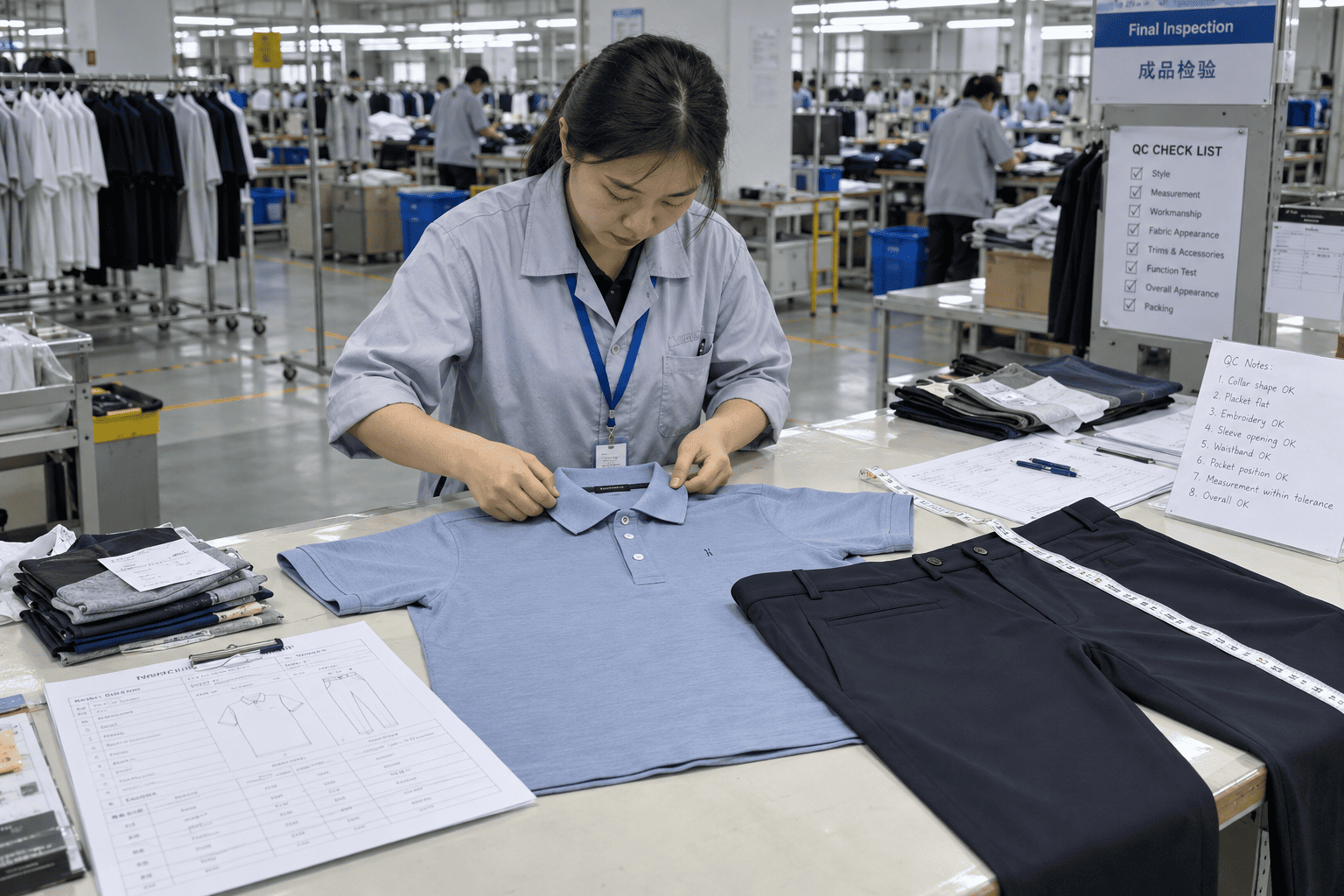
Do not approve only:
appearance.
1. Wear Test
Wear the polo during:
actual rotation and arm movement.
Check:
- Shoulder
- Back
- Hem
- Sleeve
- Collar
2. Wash Test
Wash the actual sample using the intended care procedure.
Check:
- Measurements
- Collar shape
- Placket
- Decoration
- Fabric surface
3. Pilling
If the fabric is prone to surface change:
request appropriate testing.
4. Stretch / Recovery
For performance pieces:
evaluate the actual stretch fabric rather than relying only on elastane percentage.
5. UPF
If the brand makes a UPF claim:
use valid supporting test data.
6. Care Instructions
For U.S. apparel, the FTC Care Labeling Rule[^6] requires covered manufacturers and importers to provide care instructions and have a reasonable basis for those instructions.
So do not automatically put:
Machine Wash Cold / Tumble Dry Low
on every golf polo.
Base the instructions on:
the actual garment.
What MOQ, Cost, and Timing Should You Expect?
Golf ranges often combine:
knit tops
and:
woven bottoms.
That means the sourcing structure can differ by product.
Typical Starting MOQ
For our normal programs:
| Product | Typical starting point |
|---|---|
| Golf polo | Around 100 pcs/style |
| Quarter-zip | Around 50 pcs/style |
| Golf shorts | Around 100 pcs/style |
| Golf pants | Around 100 pcs/style |
| Windbreaker | Around 50 pcs/style |
Final MOQ depends on:
- Fabric
- Color
- Size range
- Trims
- Decoration
Fabric Drives Cost
Avoid a universal rule such as:
nylon costs more than polyester.
Often it may.
But the actual quotation depends on:
- Yarn
- Construction
- GSM
- Width
- Finish
- Supplier
Collar and Placket
A custom:
- Knit collar
- Jacquard collar
- Stripe collar
- Structured placket
may increase:
- Development
- MOQ
- Sewing work
Pockets
Golf pants with:
welt pockets
may take more sewing work than:
simple patch pockets.
Branding
Each additional:
- Sleeve logo
- Chest logo
- Back logo
adds another:
decoration operation.
Colors
A golf collection may want:
White
Navy
Black
Green
Sky blue
Pink
But every extra color adds:
material purchasing complexity.
For a small first collection:
fewer colors
with:
more pieces per color
can be more efficient.
Sample Timing
Standard samples with available fabrics generally take us around:
5–14 days.
Custom:
- Fabric
- Collar
- Buttons
- Testing
can extend that.
Bulk Timing
For standard programs, bulk production is typically around:
20–30 days
after:
- Final sample approval
- Deposit
- Materials ready
Payment
For new bulk orders, our normal structure is:
50% before production + 50% before shipment.
How Should a New Golf Brand Build Its First Collection?
Keep it focused.
You do not need:
15 styles.
A practical first range might be:
Option 1: Core Golf Range
- Performance polo
- Quarter-zip
- Golf pants
Option 2: Summer Range
- Performance polo
- Golf shorts
- Lightweight windbreaker
Option 3: Club / Corporate Range
- Classic polo
- Quarter-zip
- Vest
Then build the product system.
Share Colors Where Practical
Using coordinated:
- Navy
- White
- Black
across several styles can simplify:
development and merchandising.
Develop a Core Polo Block
Once the polo fit is approved:
keep the core measurement block.
Then future versions can change:
- Fabric
- Color
- Logo
- Collar
without rebuilding the entire fit from zero.
Keep the Approved Size Data
If your approved M fits correctly:
do not randomly change it when extending the range to:
XL or 2XL.
Grade from:
the approved base.
Test on a Golfer
This sounds obvious.
But it matters.
Do not approve golf clothing only on:
a mannequin.
Ask the wearer to:
- Rotate
- Raise arms
- Swing
- Bend
- Sit
- Walk
The garment should work through all of those movements.
Green Flags and Red Flags
| Green flag | Red flag |
|---|---|
| Recommends fabric from actual performance needs | Calls every polyester fabric quick-dry |
| Provides physical swatches | Chooses fabric only by composition |
| Tests movement during fitting | Fits only while standing straight |
| Talks about stretch and recovery | Chooses fabric only from spandex % |
| Wash-tests collar construction | Guarantees collar will never curl |
| Checks pilling on soft knits | Judges durability by hand feel |
| Uses real test data for UPF claims | Says polyester automatically has UPF 50+ |
| Develops pants through seat, rise and thigh | Says stretchy fabric solves fit |
| Tests embroidery on actual fabric | Uses heavy embroidery on thin material blindly |
| Confirms trim MOQ | Promises every custom button at tiny quantity |
| Gives accurate production capabilities | Overstates ownership of separate factories |
| Bases care instructions on tested product | Copies the same care label onto every style |
Conclusion
Golf apparel has to do two jobs.
It needs to look:
clean enough for the clubhouse.
And move:
well enough for the course.
That balance starts with:
the fabric.
Do not choose a fabric because the supplier calls it:
performance polyester
or:
premium nylon.
Touch it.
Stretch it.
Wash it.
Wear it.
Check:
- Recovery
- Pilling
- Dimensional stability
- Drying behavior
- Surface
and any specific claim the brand wants to make.
Then build the fit around:
movement.
A golf swing creates more demand across the:
shoulder, back, armhole, and torso
than a static fit photo shows.
For pants, think about:
- Rise
- Seat
- Hip
- Thigh
- Crotch
- Waist
not simply:
“add stretch.”
Then refine the details.
The collar should stay clean.
The placket should lie flat.
The pockets should work.
The waistband should be comfortable.
The embroidery should not distort the fabric.
And if your product says:
UPF
or:
quick-dry,
make sure that claim comes from:
the actual material and testing
rather than the fiber name.
A good golf garment should still look sharp:
after the swing,
after the round,
and after repeated washing.
That is what turns:
a polo with a golf logo
into:
real golf apparel.
Footnotes & References
[^1]: International Organization for Standardization — ISO 15496:2018, Textiles — Measurement of Water Vapour Permeability of Textiles for the Purpose of Quality Control. Provides a method for evaluating water-vapour permeability of textiles for quality-control purposes. ISO notes that the method is not intended as a complete physiological-performance classification.
https://www.iso.org/standard/65150.html
[^2]: ASTM International — ASTM D6603, Standard Guide for Labeling of UV-Protective Textiles. Provides guidance for labeling textile products intended to offer protection from UVA and UVB radiation, based on instrumental UV-protection data and applicable labeling requirements.
https://store.astm.org/d6603-19.html
[^3]: International Organization for Standardization — ISO 20932-1:2018, Textiles — Determination of the Elasticity of Fabrics — Part 1: Strip Tests. Provides methods for measuring elasticity and related stretch/recovery properties of fabrics using strip or loop test procedures.
https://www.iso.org/standard/69489.html
[^4]: International Organization for Standardization — ISO 5077:2007, Textiles — Determination of Dimensional Change in Washing and Drying. Specifies a method for determining dimensional changes in fabrics and garments after specified washing and drying procedures. ISO reviewed and confirmed the standard in 2022, so it remains current.
https://www.iso.org/standard/41877.html
[^5]: International Organization for Standardization — ISO 12945-2:2020, Textiles — Determination of Fabric Propensity to Surface Pilling, Fuzzing or Matting — Part 2: Modified Martindale Method. Provides a controlled method for evaluating resistance to pilling, fuzzing, and matting of textile fabrics.
https://www.iso.org/standard/75375.html
[^6]: U.S. Federal Trade Commission — Care Labeling Rule, 16 CFR Part 423. Requires manufacturers and importers of covered textile wearing apparel to provide regular-care instructions and have a reasonable basis for those instructions.
https://www.ftc.gov/legal-library/browse/rules/care-labeling-textile-wearing-apparel-certain-piece-goods