Windbreaker and Track Jacket Manufacturer: How Do You Make Nylon Jackets That Look Sharp and Last?
Your retro windbreaker looks excellent in the design file.
The color blocking is sharp.
The zipper line is clean.
The jacket has exactly the 1990s sportswear look you wanted.
Then the first sample arrives.
The fabric feels too thin.
The side pocket zipper creates waves.
The contrast panels do not meet at the same height.
The lining pulls at the hem.
And the front zipper looks slightly twisted when the jacket is worn.
Lightweight woven jackets can expose small construction problems very quickly.
A good windbreaker or track jacket depends on the complete system: fabric, pattern, panel alignment, seam control, zipper installation, pockets, lining, elastic or rib trims, and decoration. Nylon and polyester can both work well, but neither fiber automatically makes the jacket premium. The correct material and construction need to be chosen for the actual style and end use.
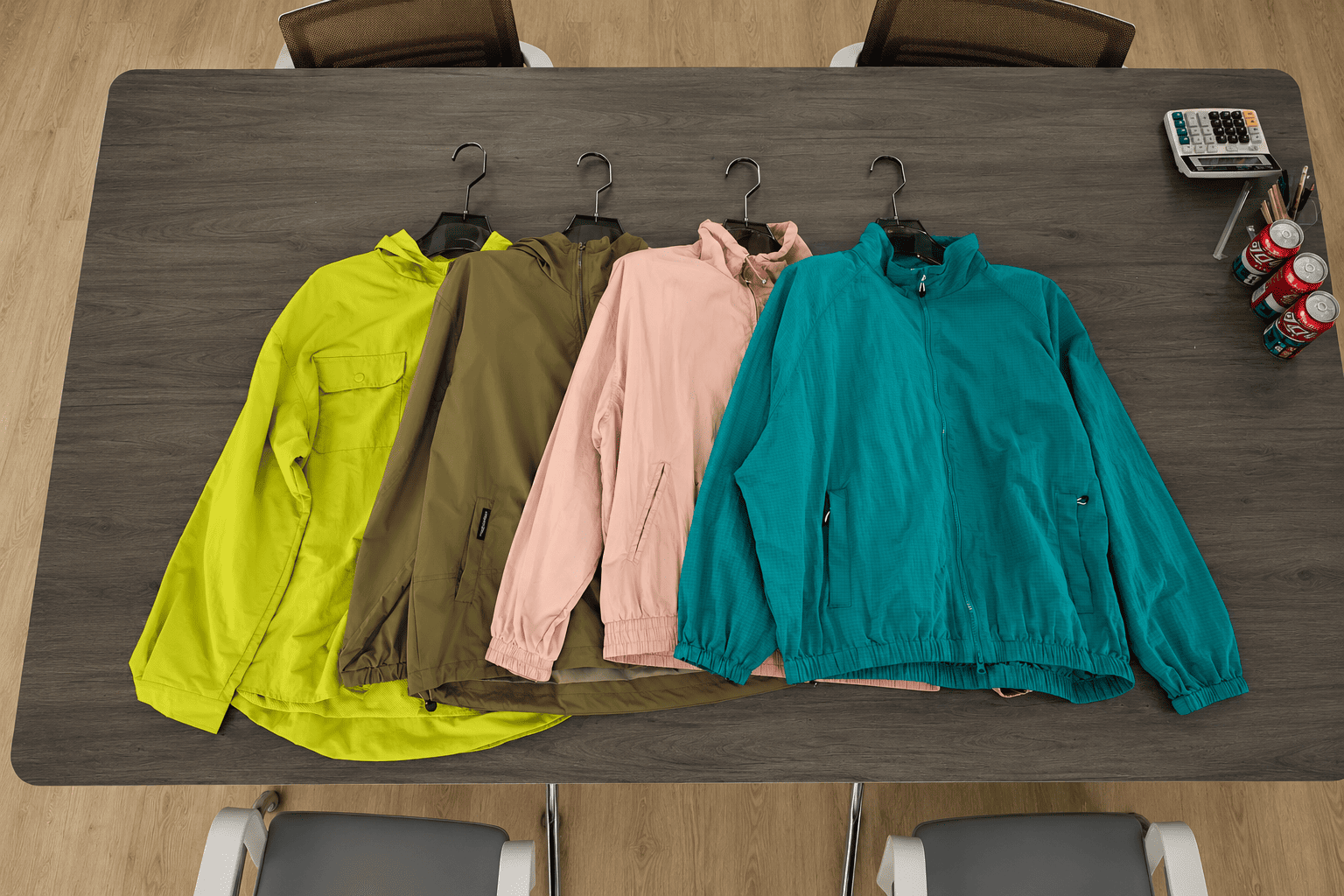
A windbreaker may look simpler than a heavyweight hoodie.
But it often involves more components:
- Shell fabric
- Lining
- Several panels
- Main zipper
- Pocket zippers
- Elastic
- Drawcord
- Cord stoppers
- Snaps
- Branding
Each one can change the final result.
Table of Contents
- What Types of Windbreakers and Track Jackets Can You Make?
- Which Fabrics Work Best for Windbreakers and Track Jackets?
- Which Construction Details Make a Nylon Jacket Look Premium?
- How Should You Choose Zippers, Pockets, and Trims?
- How Should You Brand a Windbreaker or Track Jacket?
- What MOQ, Cost, and Timing Should You Expect?
- Conclusion
What Types of Windbreakers and Track Jackets Can You Make?
“Windbreaker” and “track jacket” are often used together.
But they are not one fixed product.
Common styles include lightweight full-zip windbreakers, pullover windbreakers, retro color-block jackets, woven or tricot track jackets, coach jackets, and lightweight running shells. Each requires a different combination of fabric, pattern, closure, lining, and trim.
Full-Zip Windbreaker
Typical features include:
- Full front zipper
- Hood or stand collar
- Elastic cuffs
- Elastic or drawcord hem
- Side pockets
This is a common style for:
- Streetwear
- Teamwear
- Lifestyle collections
Pullover Windbreaker
A pullover version may use:
- Quarter zip
- Half zip
- Kangaroo pocket
- Side opening
This gives a more:
retro sportswear
or:
outdoor
look.
Retro Color-Block Windbreaker
This style depends heavily on:
panel design.
The pattern may include:
- Contrast shoulder
- Sleeve panel
- Chest stripe
- Side panel
The quality of the final garment depends on how accurately those sections meet.
Track Jacket
A classic track jacket may be:
woven
or:
knit tricot.
Typical features include:
- Stand collar
- Full zipper
- Side stripes
- Elastic or rib trims
- Matching track pants
Coach Jacket
Coach jackets usually have:
- Snap front
- Point or flat collar
- Straight hem
- Drawcord at bottom
They are often made from:
- Nylon
- Polyester
- Woven twill
Lightweight Running Shell
A running shell may prioritize:
- Low weight
- Movement
- Ventilation
- Packability
Potential details include:
- Stretch woven
- Back vent
- Mesh panel
- Reflective decoration
Our Woven Garment Capability
We manufacture woven products including:
- Windbreakers
- Track jackets
- Nylon shorts
- Woven pants
through our garment-production operation.
That allows a brand developing both:
knit products
and:
woven products
to manage them through one production team.
Specialist decoration processes may still be handled by long-term partner workshops that we coordinate directly.
Which Fabrics Work Best for Windbreakers and Track Jackets?
The shell fabric changes almost everything about the jacket.
Choose fabric based on appearance, hand feel, weight, structure, noise, breathability, water performance, and end use—not simply whether the fiber is nylon or polyester.
Nylon Taffeta
Nylon taffeta is commonly associated with:
classic windbreakers.
Depending on the yarn and finish, it can feel:
- Smooth
- Crisp
- Lightweight
It may also have:
- Matte
- Semi-shiny
- Crinkled
surface options.
Polyester Taffeta
Polyester can also create a lightweight woven jacket.
It is often commercially attractive because of:
- Wide availability
- Color options
- Cost structure
But that does not mean:
polyester = cheap.
High-quality polyester woven fabrics can also be used for premium garments.
Nylon vs Polyester
Avoid the rule:
“Nylon is softer and more premium.”
Sometimes it is.
Sometimes it is not.
Actual hand depends on:
- Yarn
- Filament size
- Density
- Weave
- Finish
- Coating
A high-quality matte polyester can feel better than a low-quality nylon.
So compare:
physical swatches.
Crinkle Fabric
Crinkle finishes can create:
- Vintage appearance
- Retro sportswear texture
- More visual depth
This can work especially well for:
1990s-inspired windbreakers.
But crinkle is a:
finish / construction direction,
not one specific fiber.
Ripstop
Ripstop contains a visible reinforcement grid.
It is often used when the designer wants:
- Technical appearance
- Outdoor influence
- Tear resistance
But “ripstop” does not automatically mean:
extremely durable.
Performance depends on the actual material specification.
Polyester Twill
A lightweight or medium woven twill can work well for:
- Coach jackets
- Uniform-inspired jackets
- More structured silhouettes
Knit Tricot
Traditional track jackets may use:
polyester tricot.
This produces a different look from woven windbreaker fabric.
The garment may feel:
- Softer
- More flexible
- More sports-oriented
Stretch Woven
Stretch woven fabrics can work for:
- Training jackets
- Running shells
- Travel wear
But “stretch woven” does not automatically mean:
nylon/elastane.
It may be:
- Polyester/elastane
- Nylon/elastane
- Mechanically stretchy polyester
depending on the product.
Is Water-Repellent the Same as Waterproof?
No.
This distinction is important on an outerwear product page.
A water-repellent surface can help water bead and roll away from the fabric, while waterproof performance concerns resistance to water penetrating through the material and, for a complete garment, also depends on seams, closures, construction, and testing.
ISO 4920:2012[^1] specifies a spray test for evaluating resistance to:
surface wetting.
ISO explicitly notes that this method is not intended to predict resistance to rain penetration, because it does not measure water passing through the material.
That is exactly why:
water-repellent ≠ waterproof.
Water Penetration
For fabrics intended to resist penetration, ISO 811:2018[^2] specifies a hydrostatic-pressure method for measuring resistance to water passing through the fabric.
ISO reviewed and confirmed ISO 811 in 2025, so this edition remains current.[^2]
Complete Jacket Performance
Even strong shell fabric may not create a waterproof jacket if the garment has:
- Unsealed seams
- Standard zipper openings
- Needle holes
- Open vents
So if your brand wants to market:
waterproof
agree the required:
- Fabric performance
- Seam construction
- Garment testing
before development.
Do not simply ask:
“Can you add DWR?”
and then market the garment as:
waterproof.
Does Heavier Fabric Feel More Premium?
Sometimes.
Not automatically.
A heavier woven fabric may produce:
- More body
- Different drape
- Less transparency
but fabric quality also comes from:
- Yarn
- Density
- Surface
- Finish
- Construction
A well-engineered lightweight running shell may intentionally feel:
extremely light.
That is not low quality.
Likewise:
a heavier taffeta
can still feel cheap if:
- Surface is harsh
- Fabric is noisy
- Finish is poor
So do not select windbreaker fabric using GSM alone.
Which Construction Details Make a Nylon Jacket Look Premium?
Light woven fabrics show mistakes clearly.
Premium appearance comes from accurate cutting, controlled sewing, clean panel alignment, stable zipper installation, well-shaped pockets, appropriate lining, consistent elastic or rib application, and the correct needle/thread setup for the chosen shell fabric.
Panel Alignment
This is critical for:
color blocking.
Imagine a contrast stripe that runs:
front body → side seam → back body.
If it meets:
2 cm higher
on the back,
the whole garment looks wrong.
The pattern needs to define:
where the panel intersects each seam.
Grading Color Blocks
This matters when scaling:
S → M → L → XL → 2XL.
Do not simply enlarge each panel independently.
The visual relationships need to remain controlled through grading.
For example:
- Chest stripe height
- Sleeve panel
- Side panel intersection
should still look intentional.
Seam Puckering
One of the most common problems in lightweight woven jackets is:
puckering.
Possible causes include:
- Needle size
- Thread
- Stitch density
- Machine tension
- Differential feeding
- Fabric stability
- Operator handling
So the solution is not:
“turn down machine tension”
every time.
The actual combination needs adjusting.
Needle and Thread
Very light woven fabric may react badly to:
- Oversized needle
- Excessive stitch density
- Heavy thread
Potential results include:
- Visible needle holes
- Seam damage
- Puckering
The sewing setup should be chosen for:
the actual shell fabric.
Lining
A windbreaker may be:
- Unlined
- Mesh lined
- Taffeta lined
Mesh can help provide:
- Separation from skin
- Air movement
- Sport appearance
A light woven lining can create:
- Cleaner interior
- More structured feel
But lining also adds:
- Cost
- Labor
- Weight
Lining Length
The lining cannot simply match the shell without considering:
movement and construction.
If the relationship is wrong, you may see:
- Pulling
- Bagging
- Hem distortion
after wear or laundering.
Elastic Cuffs
Elastic can be:
- Enclosed
- Bound
- Exposed
depending on the design.
Check:
- Recovery
- Comfort
- Width
- Finished opening
rather than simply specifying:
“elastic cuff.”
Rib Cuffs
Rib changes the visual language.
It can make a jacket feel more like:
- Varsity
- Track
- Streetwear
But rib and woven shell may behave differently after washing.
Test them together.
Bartacks
Bartacks may be useful around:
- Pocket ends
- High-stress openings
- Certain zipper areas
But bartacks should be placed because:
the construction requires reinforcement,
not because more bartacks automatically mean higher quality.
How Should You Choose Zippers, Pockets, and Trims?
A lightweight jacket can look excellent until:
the zipper is installed badly.
Choose zipper type and pocket construction according to the fabric, opening, garment weight, intended look, and stress on the component. Zipper rippling is usually a system issue involving both zipper and garment construction rather than just zipper weight.
Coil Zipper
A coil zipper is often useful for:
- Windbreakers
- Track jackets
- Pockets
because it can be:
flexible
and relatively:
lightweight.
Reverse Coil
This gives a cleaner visual surface.
It is popular on:
- Technical jackets
- Minimal sportswear
Two-Way Zipper
Two-way front zippers can be useful for:
- Longer jackets
- Oversized silhouettes
where opening from the bottom improves:
movement.
Why Does a Front Zipper Wave?
Possible causes include:
- Stretchy shell fabric
- Stable zipper tape against unstable fabric
- Differential feeding
- Sewing tension
- Seam allowance
- Fabric shrinkage
- Zipper-tape movement
- Pressing
That is why:
zipper too heavy
is not a complete diagnosis.
Welted Zip Pockets
A clean zip pocket should have:
- Straight opening
- Flat welt
- Even zipper position
- Reinforced ends where necessary
If the pocket opening:
waves,
it may be caused by:
- Poor stabilization
- Feeding
- Cutting
- Construction
Slash Pockets
These are simpler visually.
But check:
- Pocket opening length
- Pocket-bag depth
- Reinforcement
A beautiful pocket that cannot hold a phone is not:
functional.
Custom Zipper Pullers
Brands often want:
logo zipper pulls.
Do not tell a buyer:
“YKK doesn't do small custom orders.”
YKK officially offers full-order pullers with:
- Brand logos
- Original shapes
for eligible programs.[^3]
Its own guidance also says production lots apply and details should be confirmed through the zipper supplier or purchase channel.
So the accurate answer is:
YKK customization depends on the product, production lot, sourcing channel, quantity, price, and lead time.
For some smaller orders, we may instead use:
a standard zipper
plus:
a separately developed logo pull
where technically appropriate.
For some of our sourcing programs, a custom pull mold may be roughly:
USD 130–180
depending on the:
- Design
- Size
- Material
- Finish
That is our sourcing reference.
It is not a universal industry price.
Cord Stoppers and Toggles
Check:
- Cord diameter
- Stopper opening
- Spring force
- Finish
- Color
Small parts need to work together.
Do not approve each one separately and assume the finished system will work.
How Should You Brand a Windbreaker or Track Jacket?
Woven synthetic fabrics can be branded successfully.
But the decoration needs to suit:
the substrate.
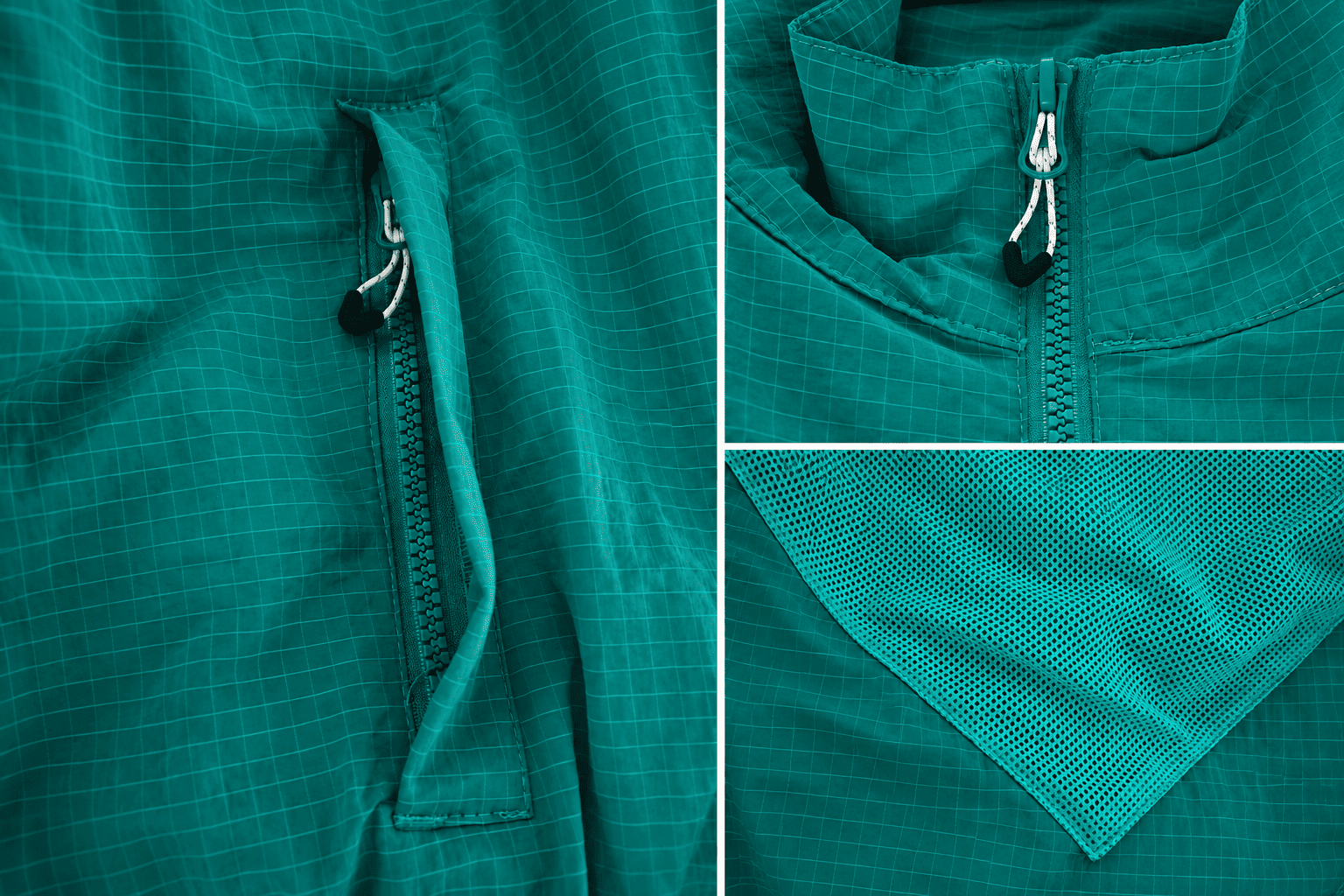
Embroidery, compatible screen-print systems, heat transfers, patches, reflective details, custom zipper pulls, and printed linings can all work, but they should be sampled on the actual fabric because coatings, heat sensitivity, stretch, and surface finish affect adhesion and appearance.
Embroidery
Embroidery can work well on:
- Chest
- Sleeve
- Back
But very lightweight fabric may require:
- Backing
- Stabilization
- Appropriate stitch density
A very dense embroidery can distort:
thin shell fabric.
Screen Printing
Some nylon or coated fabrics require:
specific ink systems or pretreatment.
Do not assume the same ink that works on:
cotton jersey
will work on:
coated nylon.
Test:
- Adhesion
- Appearance
- Wash durability
on the actual textile.
Heat Transfer
Heat transfer can work for:
- Small logos
- Technical graphics
- Reflective details
But the press parameters need to suit:
the fabric.
Too much heat may affect some:
- Coatings
- Finishes
- Synthetic textiles
Again:
test the actual fabric.
Rubber / Silicone / Woven Patches
These can create:
strong branding
without a large print.
Check:
- Patch weight
- Attachment
- Edge
- Garment drape
A very heavy patch can pull on:
a very light shell.
Reflective Decoration
Reflective prints and tapes are popular for:
- Running jackets
- Technical streetwear
They can increase:
visual conspicuity.
But they do not automatically make the jacket:
certified high-visibility safety apparel.
ANSI/ISEA 107-2020[^4] specifies requirements for certified high-visibility safety apparel, including:
- Material performance
- Design
- Minimum material areas
- Garment classifications
A reflective logo by itself does not establish compliance.
Printed Lining
Printed lining can create a premium hidden detail.
But if the lining has:
large artwork
or:
dark colors,
test:
- Colorfastness
- Transfer
- Comfort
before bulk.
How Should You Test a Windbreaker Before Bulk?
A jacket sample should be more than:
a photo approval.
1. Fit Test
Check:
- Shoulder
- Chest
- Sleeve
- Body length
- Arm movement
especially if:
the outer shell has little stretch.
2. Zipper Test
Open and close:
repeatedly.
Check:
- Slider movement
- Alignment
- Bottom stop
- Front balance
3. Pocket Test
Actually put:
- Phone
- Keys
- Wallet
inside if the pocket is meant to hold them.
4. Wash Test
For washable jackets, evaluate the complete garment under the intended care procedure.
ISO 6330:2021[^5] specifies standardized domestic washing and drying procedures for textile testing.
After laundering, inspect:
- Shell
- Lining
- Zipper
- Elastic
- Embroidery
- Panels
together.
5. Water Performance
If the product makes:
water-repellent
or:
water-resistant
claims, agree what you actually want tested.
For example:
Surface wetting → ISO 4920
Fabric water penetration → ISO 811
Those are different properties.
6. Decoration Test
Check:
- Peeling
- Cracking
- Adhesion
- Puckering
- Embroidery distortion
after:
wear and laundering.
What MOQ, Cost, and Timing Should You Expect?
Windbreakers may use lightweight fabric.
That does not mean:
simple production.
Cost is influenced by shell fabric, panel count, color blocking, lining, zipper specification, number of pockets, elastic or rib, custom trims, decoration, finishing, and order quantity.
Typical Starting MOQ
For our jacket programs:
around 50 pcs/style
can be a practical starting point depending on:
- Fabric
- Colors
- Trim
- Decoration
The actual MOQ is confirmed project by project.
Color Blocking
One jacket may contain:
Black
Cream
Green
shell panels.
Even though it is one garment:
you are buying three material colors.
That can increase:
- Fabric purchasing
- Cutting complexity
- Shade-control work
Panel Count
More panels normally mean:
- More pattern pieces
- More cutting
- More seam operations
- More alignment points
That affects cost.
Lining
A lining adds:
- Material
- Cutting
- Sewing
- Finishing
So:
unlined shell
and:
fully lined jacket
should not be expected to cost the same.
Zippers
Cost changes with:
- Brand
- Type
- Chain
- Length
- Slider
- Two-way construction
- Custom pull
Pocket Construction
A simple slash pocket normally requires less work than:
a welted zipper pocket.
Fabric
Do not publish:
“nylon always costs more than polyester.”
Often it may.
But actual quotation depends on:
- Yarn
- Construction
- Finish
- Width
- Supplier
- Quantity
Use the real fabric price.
Water-Repellent Finish
A special finish can add:
- Textile-processing cost
- Testing requirements
But the cost depends on:
the mill and specification.
Sample Timing
For standard available materials:
5–14 days
is a practical sampling range for us.
Custom:
- Fabric
- Trims
- Hardware
- Special finishing
can add time.
Bulk Timing
For standard production:
20–30 days
after:
- Final approval
- Deposit
- Materials ready
is a normal working range.
Payment
For new bulk orders, our normal structure is:
50% before production + 50% before shipment.
Should You Make a Matching Track Set?
Often, yes.
A windbreaker can pair with:
- Track pants
- Nylon shorts
to create a complete:
set.
This can give the collection:
stronger visual identity.
Use the Same Fabric Where It Makes Sense
Using the same approved shell fabric can help:
- Appearance
- Sourcing
- Color coordination
But top and bottom do not have to come from:
the exact same physical roll
in every program.
The important thing is:
controlled specification
and:
shade management.
Fit Still Needs to Be Developed Separately
The jacket and pants have different:
- Movement
- Ease
- Stress points
So do not treat a set as:
one pattern.
Develop each garment properly.
Green Flags and Red Flags
| Green flag | Red flag |
|---|---|
| Recommends fabric by end use | Says nylon is always premium |
| Provides physical shell swatches | Chooses material from photos |
| Aligns color-block panels | Panels miss across seams |
| Controls lightweight woven puckering | Accepts wavy seams as normal |
| Diagnoses zipper ripple as a system issue | Blames zipper weight only |
| Makes functional pocket samples | Makes shallow decorative pockets |
| Explains water-repellent vs waterproof | Calls DWR fabric waterproof |
| Tests decoration on actual substrate | Assumes cotton printing settings work on nylon |
| Confirms YKK options by actual program | Says YKK custom is impossible |
| Treats reflective detail as decoration unless certified | Calls any reflective strip safety wear |
| Tests garment after laundering | Approves only from first-day appearance |
| Explains own production and partner processes clearly | Claims every process is in one building |
Conclusion
A good windbreaker is not defined by:
nylon.
And a premium track jacket is not defined by:
GSM.
The result comes from how all the pieces work together.
Start with:
the actual use.
Is this jacket:
- Streetwear?
- Running?
- Teamwear?
- Retro sportswear?
- Lightweight outerwear?
Then choose the shell.
Compare:
- Nylon
- Polyester
- Ripstop
- Taffeta
- Tricot
- Stretch woven
using real swatches.
Next, develop the pattern carefully.
Color-blocked jackets need:
panel alignment.
Lightweight shells need:
controlled seams.
Zippers need:
stable installation.
Pockets need to:
sit flat and work.
Then decide what water performance you actually need.
A spray-test result tells you about:
surface wetting.
It does not automatically prove:
rain penetration resistance.
And a water-repellent fabric does not make:
a waterproof garment
without the correct complete construction.
Then add branding.
Use:
- Embroidery
- Transfers
- Compatible printing
- Patches
- Custom pullers
- Reflective details
only after testing them on:
the actual shell material.
Finally:
wash and wear the sample.
Open the zipper.
Load the pockets.
Move your arms.
Check the lining.
Look at the panels.
Because lightweight jackets reveal:
small mistakes.
That is also what makes a well-made windbreaker look so clean.
When the:
fabric, pattern, sewing, zippers, pockets, lining, and branding
all work together,
the jacket does not need to feel heavy to feel:
premium.
Footnotes & References
[^1]: International Organization for Standardization — ISO 4920:2012, Textile Fabrics — Determination of Resistance to Surface Wetting (Spray Test). Specifies a spray-test method for evaluating resistance to surface wetting. ISO explicitly notes that the test is not designed to predict rain-penetration resistance because it does not measure water passing through the fabric. The standard was reviewed and confirmed in 2023 and remains current.
https://www.iso.org/standard/50706.html
[^2]: International Organization for Standardization — ISO 811:2018, Textiles — Determination of Resistance to Water Penetration — Hydrostatic Pressure Test. Specifies a hydrostatic-pressure method for measuring resistance of fabrics to water penetration. ISO reviewed and confirmed this edition in 2025, so it remains current.
https://www.iso.org/standard/65149.html
[^3]: YKK Japan — Full-Order PRIFA® and Pullers. YKK states that full-order pullers can be developed with customer brand logos or original shapes for eligible programs. Production lots apply, and specifications, pricing, availability, and ordering details should be confirmed with the relevant zipper supplier or purchase channel.
https://lyncs.ykkfastening.com/shop/c/cFOD01/
[^4]: International Safety Equipment Association — ANSI/ISEA 107-2020, American National Standard for High-Visibility Safety Apparel. The standard defines requirements covering materials, garment design, minimum material areas, and performance classes for high-visibility safety apparel. A decorative reflective logo or tape alone does not demonstrate that the complete garment complies with the standard.
https://safetyequipment.org/ansi-isea-107-2020/
[^5]: International Organization for Standardization — ISO 6330:2021, Textiles — Domestic Washing and Drying Procedures for Textile Testing. Specifies standardized domestic washing and drying procedures for textile fabrics, garments, and other textile articles, allowing garment and decoration performance to be evaluated under repeatable care conditions.
https://www.iso.org/standard/75934.html