

Why Do Clothes Shrink, and How Do Manufacturers Prevent It?
Your hoodies look perfect when they arrive.
The chest measurement is correct.
The sleeves sit exactly where you approved them.
The body length matches the size chart.
Then the first customer reviews appear:
“It shrank after one wash.”
Another customer says:
“The sleeves are shorter now.”
Someone posts a photo comparing a new Medium with a washed Medium.
The difference is obvious.
The sewing may be fine.
The real problem may have started much earlier:
the fabric's dimensional behavior was not properly controlled.
Clothing can change size after washing because fibers, yarns, and fabric structures react to moisture, heat, mechanical action, and the tension introduced during knitting, dyeing, finishing, cutting, and garment production. Manufacturers reduce this risk by testing dimensional change, preparing and relaxing fabric, using pre-shrinking or stabilization where appropriate, adjusting patterns based on actual test results, and creating care instructions from the finished garment's tested behavior.
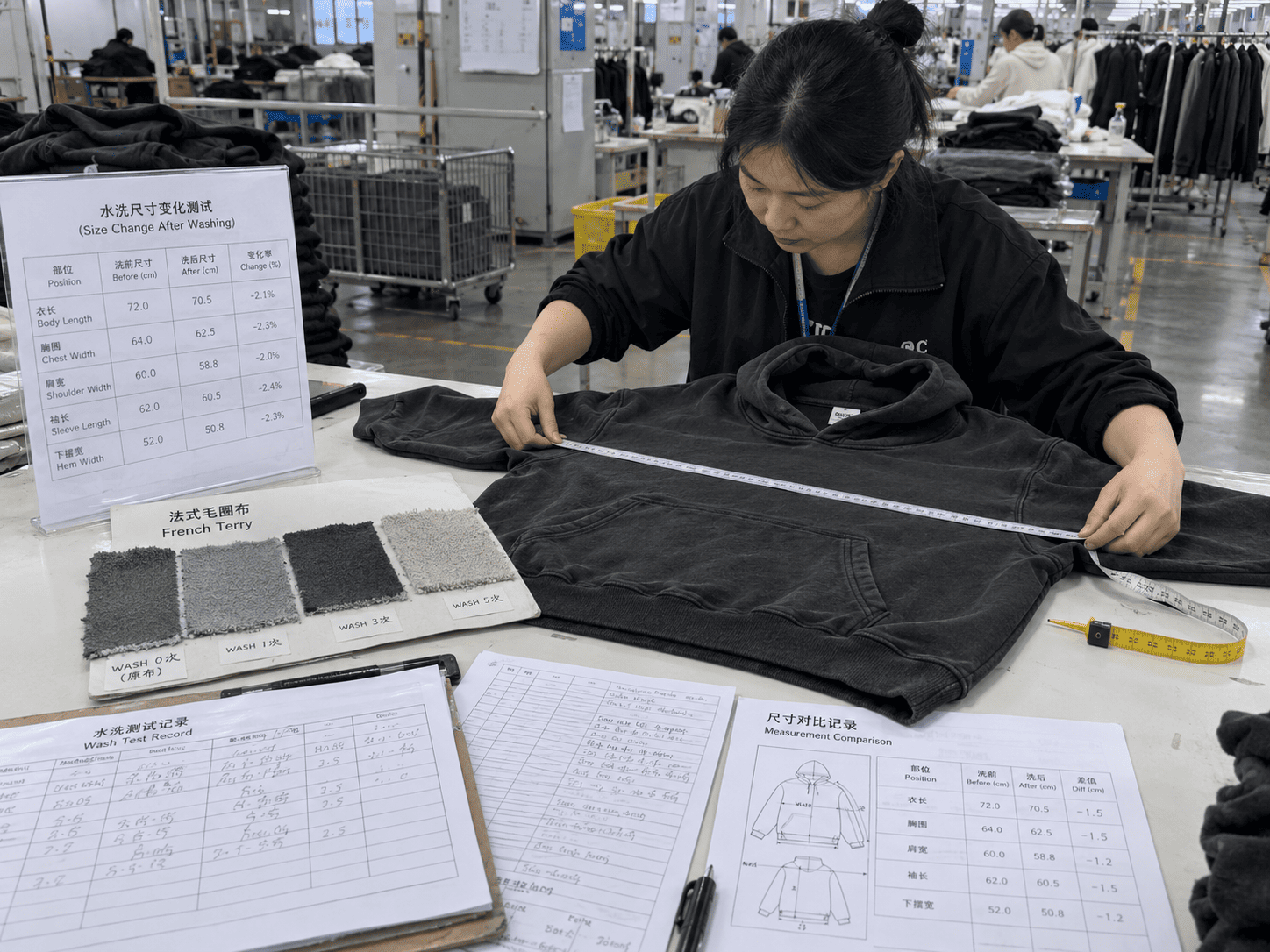
For a clothing brand, shrinkage is not a small technical issue.
It affects:
- Fit
- Size consistency
- Returns
- Reviews
- Repeat purchases
A garment can be beautifully sewn and still fail the customer if its dimensions change more than expected after washing.
That is why shrinkage control starts before bulk cutting.
Table of Contents
- Why Do Clothes Shrink After Washing?
- Which Fabrics Are More Likely to Change Size?
- How Do Factories Test Shrinkage Before Production?
- How Is Shrinkage Controlled During Production?
- What Can Your Brand Do to Reduce Shrinkage Complaints?
- Which Shrinkage Problems Should You Watch For?
- Conclusion
Why Do Clothes Shrink After Washing?
Customers often describe all size change as:
shrinkage.
From a textile-production point of view, several mechanisms may be involved.
Dimensional change can result from relaxation of fabric tension, fiber swelling, felting or structural movement in some materials, finishing effects, heat exposure, and repeated laundering. The amount and direction of change depend on the actual textile construction and care process.
Relaxation Shrinkage
During knitting, dyeing, finishing, and fabric handling, the textile can carry residual tension.
When the fabric is later exposed to:
- Water
- Heat
- Agitation
part of that tension may relax.
The fabric then moves toward a more stable structure.
This can change:
- Length
- Width
and not necessarily by the same amount.
Fiber Swelling
Some fibers absorb more moisture than others.
When fibers absorb water, they may swell.
That can temporarily or permanently affect the geometry of:
- Yarn
- Loops
- Fabric structure
after washing and drying.
But avoid the shortcut:
“natural fibers always shrink.”
Fiber content is only one factor.
Heat
Heat can influence dimensional behavior during:
- Washing
- Tumble drying
- Pressing
- Heat setting
- Print curing
The effect depends on the textile.
Some fabrics are relatively stable.
Others can change more noticeably.
Mechanical Action
Washing also introduces:
- Agitation
- Tumbling
- Friction
which can help the fabric relax or distort.
Progressive Change
Some textiles show most dimensional change in the first wash.
Others may continue to move slightly over several wash cycles.
So if durability matters, one wash may not tell the whole story.
Length and Width Can Behave Differently
This is important.
A hoodie might show:
- More change in body length
- Less change in chest
or the reverse.
There is no universal rule that:
all knits shrink more in length than width.
The behavior depends on the:
- Knit construction
- Yarn
- Finishing
- Fabric width
- Manufacturing tension
That is why both directions should be measured.
Which Fabrics Are More Likely to Change Size?
There is no reliable ranking based only on fiber name.
Dimensional stability depends on fiber, yarn, knit or weave structure, finishing, fabric weight, elastane content, heat setting, washing method, and whether the fabric has already been stabilized.
Cotton Jersey
Cotton jersey can show noticeable dimensional change if it has not been sufficiently stabilized.
Risk depends on:
- Knit structure
- Yarn
- Finishing
- Wash method
A lightweight cotton jersey is not automatically less stable than a heavier one.
Cotton French Terry
French terry can perform very well when:
- Fabric is properly finished
- Dimensional change is tested
- Pattern is developed around the actual result
Heavyweight cotton still needs testing.
High GSM does not prevent shrinkage.
Cotton/Polyester Blends
Adding polyester can sometimes improve dimensional stability.
But the result depends on the blend and construction.
Do not assume:
blend = low shrinkage.
Test it.
Rib Knits
Rib is especially important because it may behave differently from the body fabric.
A hoodie may use:
- French terry body
- Separate rib at cuff and hem
Those two fabrics need to work together.
Viscose / Rayon / Modal
Regenerated cellulose fabrics can show meaningful dimensional movement depending on:
- Structure
- Wet behavior
- Finishing
But do not publish:
viscose always shrinks more than cotton.
The actual fabric should decide.
Polyester / Nylon Stretch Fabrics
Synthetic fibers may often show good dimensional stability.
But they are not automatically:
zero shrinkage.
Fabric structure, elastane, heat setting, washing, and drying can still change dimensions.
Linen
Linen can change after laundering.
The result depends heavily on:
- Fabric construction
- Finishing
- Pre-washing
So avoid one universal linen shrinkage percentage.
Denim
Denim is a special category.
Raw or untreated denim and washed denim can behave very differently.
Garment washing may intentionally change:
- Size
- Color
- Hand
before the product reaches the customer.
That change needs to be built into the production process.
Fabric Risk Overview
| Fabric direction | What to watch |
|---|---|
| Cotton jersey | Relaxation and wash change |
| Cotton French terry | Length / width movement |
| Cotton-poly fleece | Blend-specific behavior |
| Rib | Growth or shrinkage relative to body |
| Viscose / modal | Wet dimensional behavior |
| Polyester / nylon stretch | Heat / structure / elastane behavior |
| Linen | Wash-related dimensional change |
| Denim | Wash-process shrinkage and torque |
How Do Factories Test Shrinkage Before Production?
A good factory should not wait until customers complain.
The fabric should be evaluated before bulk cutting.
Dimensional-change testing compares marked or measured dimensions before and after an agreed washing and drying procedure, then calculates the percentage change in each direction.
ISO 5077:2007[^1] specifies a method for determining dimensional change in:
- Fabrics
- Garments
- Other textile articles
after specified washing and drying procedures.
The Washing Procedure Also Matters
ISO 5077 tells you how to determine dimensional change.
The laundering conditions still need to be defined.
ISO 6330:2021[^2] provides domestic washing and drying procedures used for textile testing.
That means a professional shrinkage result should not simply say:
“Shrinkage: 3%.”
It should also be clear:
under which washing and drying procedure?
A Typical Factory Test Flow
- Take fabric from the relevant bulk material.
- Identify lengthwise and widthwise directions.
- Mark or measure the specified test area.
- Wash under the agreed procedure.
- Dry under the agreed procedure.
- Condition if required.
- Measure again.
- Calculate dimensional change.
- Decide whether production can proceed.
Basic Calculation
If the original distance is:
100 cm
and after washing it measures:
97 cm
the dimensional change is:
-3%.
If it becomes:
102 cm
that is growth rather than shrinkage.
So the more accurate term is often:
dimensional change.
Test Both Directions
Record separately:
- Lengthwise change
- Widthwise change
because they may be different.
Fabric Test vs Garment Test
Both can be useful.
Fabric test
helps before cutting.
Finished-garment wash test
shows the behavior of:
- Body
- Rib
- Seams
- Construction
together.
For important programs, I prefer having both kinds of information where practical.
How Is Shrinkage Controlled During Production?
Testing identifies the behavior.
Production needs to respond to it.
Shrinkage control may involve fabric relaxation, mechanical or finishing stabilization, pre-shrinking where applicable, pattern compensation, controlled heat exposure, and finished-garment measurement. No single step guarantees zero dimensional change.
Fabric Relaxation
Fabric rolls may carry tension from:
- Knitting
- Rolling
- Transport
Allowing material to relax before cutting can reduce:
unexpected movement after cutting.
The exact relaxation requirement depends on the fabric.
Pre-Shrinking / Stabilization
Different fabrics may use different stabilization processes.
The purpose is to reduce uncontrolled movement before the garment reaches the customer.
But:
pre-shrunk does not mean zero shrinkage.
It means the supplier has applied a process intended to improve dimensional stability.
The remaining change still needs to be measured.
Pattern Compensation
Suppose a fabric consistently shows a known dimensional change after the agreed wash process.
The pattern may need compensation.
But the factory should not use:
one standard percentage
for all cotton.
Pattern adjustment should come from:
the actual fabric result.
Do Not Overcompensate
This is equally important.
If the expected finished body length is:
70 cm
you should not blindly add:
5%
just because the fabric contains cotton.
If actual test data shows less movement, overcompensation can make the finished garment:
too long before wash
or still wrong after wash.
Heat During Decoration
Processes such as:
- Screen-print curing
- Heat transfer
- Pressing
can expose fabric to elevated temperatures.
Some textiles may respond dimensionally.
But avoid the statement:
“printing always shrinks the printed area.”
It depends on:
- Fabric
- Temperature
- Dwell time
- Process
The correct answer is:
test the actual combination.
Mixed Materials
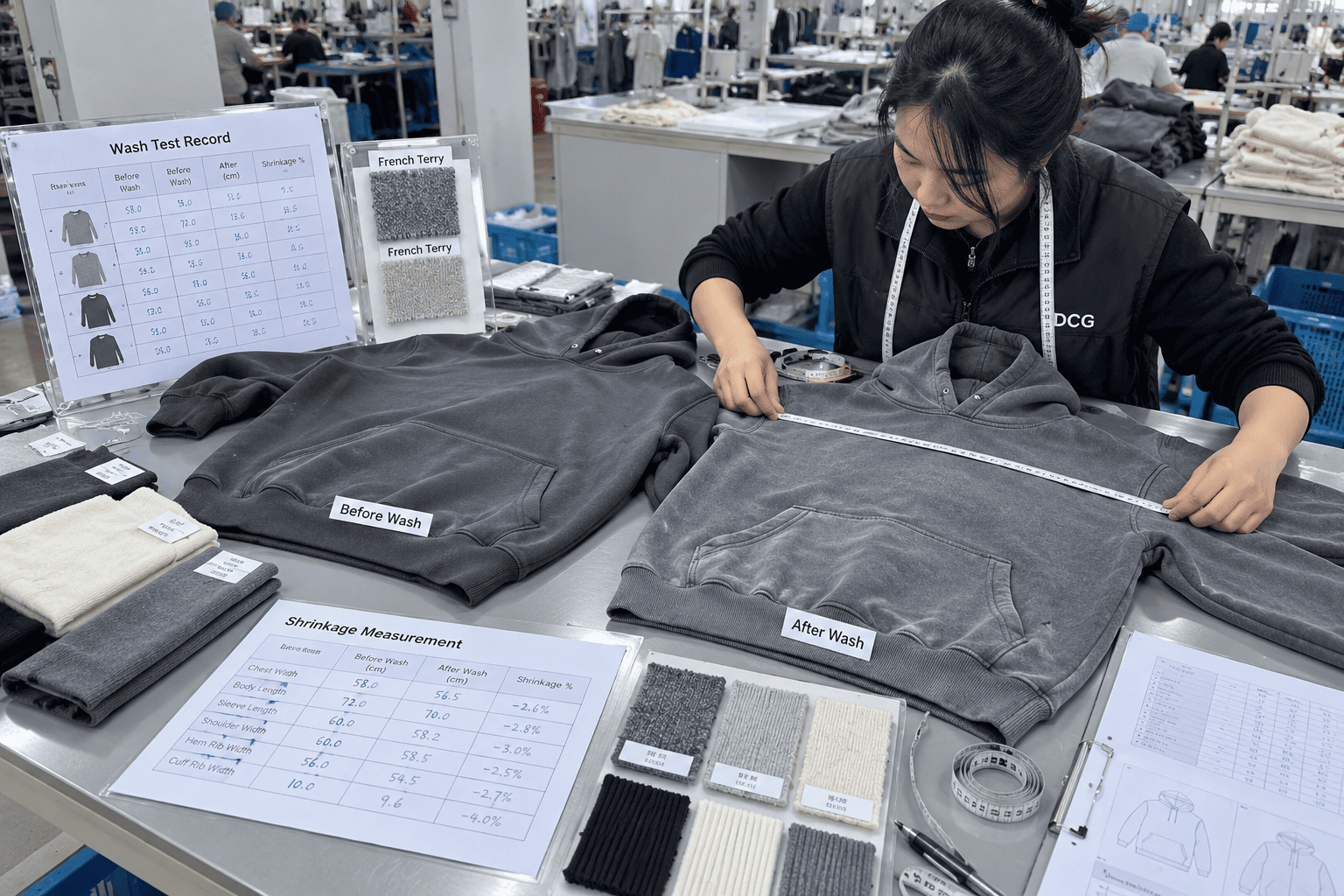
A hoodie might include:
- French terry body
- Rib cuff
- Drawcord
- Embroidery
The body and rib are especially important because they can respond differently after laundering.
Test them together.
What Can Your Brand Do to Reduce Shrinkage Complaints?
The factory controls production.
The brand also needs to control:
the specification.
Brands reduce shrinkage disputes by defining dimensional-change expectations, approving washed samples where relevant, using clear garment measurements, specifying the care method, and making sure the customer instructions are supported by actual testing.
Put Shrinkage Requirements in the Tech Pack
Instead of saying:
“Low shrinkage.”
write something measurable.
For example:
Dimensional change to be evaluated under agreed laundering procedure; acceptance tolerance to be confirmed with supplier.
If you have a retailer-specific requirement, put the exact requirement in writing.
Do Not Copy One Universal Tolerance
There is no single shrinkage limit that suits:
- T-shirt
- Hoodie
- Legging
- Linen shirt
- Denim
The acceptable level should be agreed for:
the product and market.
Wash the Sample
This is one of the simplest useful checks.
Before approving bulk:
- Measure the sample.
- Wash it according to intended care.
- Dry it.
- Measure again.
- Try it on again.
Then look at:
- Body length
- Sleeve
- Chest
- Shoulder
- Rib
- Overall shape
Care Labels Need Evidence
For products sold in the United States, the FTC Care Labeling Rule[^3] requires manufacturers and importers of covered apparel to provide care instructions and have a reasonable basis for those instructions.
That means do not automatically print:
Machine wash cold. Tumble dry low.
on every garment.
It may be appropriate.
But the actual product should support it.
Care Method Can Affect Shrinkage
If a garment performs acceptably with:
- Lower-temperature washing
- Line drying
but changes significantly with:
high-temperature tumble drying,
the safe care instruction should reflect the tested product.
Product-Page Measurements Help
Customers should know whether your size chart shows:
- Body measurements
- Garment measurements
For shrinkage-sensitive garments, finished-garment measurements can help buyers understand:
the actual size they are purchasing.
Which Shrinkage Problems Should You Watch For?
Dimensional change does not always look like:
“the whole garment became smaller.”
Sometimes it appears as distortion.
Body Gets Shorter
Possible reasons include:
- Lengthwise relaxation
- Finishing behavior
- Wash conditions
The answer is:
test the actual fabric
and compensate appropriately.
Sleeves Become Too Short
This can be especially noticeable on:
- Long sleeve tees
- Hoodies
because even a relatively small change can affect where the cuff sits.
Side Seams Twist
A T-shirt may come out of the wash with:
one side seam moving toward the front
and the other toward the back.
That is not simply “shrinkage.”
It may involve:
spirality or torque.
ISO 16322-3:2021[^4] provides a method for measuring spirality after laundering in knitted garments.
This is especially relevant for:
single jersey.
Rib and Body Behave Differently
If the body fabric and rib have different dimensional behavior:
- Hem may wave
- Cuff may pull
- Waist may distort
That is why testing:
body fabric only
may not be enough.
Printed Area Looks Puckered
Possible causes can include:
- Local heat exposure
- Differential dimensional behavior
- Print-film stiffness
- Construction tension
Do not automatically blame:
ink shrinkage.
Review the whole process.
Mixed-Fabric Panels
A garment may contain:
- Main fabric
- Mesh
- Rib
- Lining
Each can move differently.
This is particularly important for:
- Activewear
- Panelled garments
- Matching sets
Garment-Dyed Products
Garment dye and wash processes intentionally expose the finished product to:
- Moisture
- Chemistry
- Heat
- Mechanical action
So the pattern may need to be developed for the finished washed dimensions.
That is a separate workflow from:
cutting a stable finished fabric and selling it without garment washing.
How Do You Measure Finished Garments Consistently?
Shrinkage data is only useful if measurements are taken consistently.
ISO 18890:2018[^5] provides standardized garment-measurement methods and allows additional POMs to be agreed where needed.
For a hoodie, typical post-wash checks may include:
- Body length
- Half chest
- Shoulder
- Sleeve length
- Bottom width
- Cuff opening
Use the same measurement method:
before and after washing.
Otherwise, measurement error can look like shrinkage.
What About AQL?
Shrinkage acceptance and AQL should not be confused.
AQL is used for:
statistical lot inspection.
It is not:
- A shrinkage tolerance
- A measurement tolerance
- Permission for a percentage of garments to shrink
The current ISO 2859-1:2026[^6] provides AQL-indexed sampling schemes for lot-by-lot inspection.
If your specification says:
Garment measurement tolerance ±1 cm
and:
Shrinkage tolerance X% under agreed test
those are separate controls from:
AQL sampling.
Green Flags and Red Flags
| Green flag | Red flag |
|---|---|
| Tests actual bulk fabric | Uses one shrinkage assumption for every fabric |
| Records length and width separately | Says “shrinkage is about 5%” with no test |
| Defines laundering procedure | Gives a percentage with no wash method |
| Allows fabric to relax where needed | Cuts immediately without considering fabric tension |
| Uses test results for pattern compensation | Adds one fixed allowance to every cotton garment |
| Tests rib with body fabric | Assumes all components change equally |
| Checks washed garment measurements | Approves only the unwashed sample |
| Reviews spirality when relevant | Calls every twist “shrinkage” |
| Uses evidence-based care instructions | Copies one care label onto every product |
| Separates tolerance from AQL | Says AQL 2.5 means 2.5% shrinkage/defects allowed |
Conclusion
Shrinkage is not mysterious.
But it is also not as simple as:
cotton shrinks, polyester does not.
Dimensional behavior comes from the complete textile system:
- Fiber
- Yarn
- Knit or weave
- Finishing
- Fabric tension
- Washing
- Drying
- Heat
- Garment construction
So start with testing.
Measure the fabric:
before and after the agreed laundering process.
Record:
- Lengthwise change
- Widthwise change
Then decide what to do.
Maybe the fabric needs:
- More stabilization
- Relaxation
- Pattern compensation
Maybe the fabric is already stable enough.
Then test the finished garment.
Because the customer does not wear:
a fabric swatch.
They wear:
a complete hoodie, tee, legging, or pant.
Check how:
- Body
- Sleeves
- Rib
- Seams
behave together.
And remember:
pre-shrunk does not mean zero shrinkage.
It means the fabric has been processed to improve dimensional stability.
The remaining behavior still needs to be understood.
Finally, write care instructions based on the actual product.
Do not promise:
“will never shrink.”
A better promise is:
“The fabric and finished garment are tested for dimensional change under the agreed care conditions, and production is controlled against the approved specification.”
That is how a manufacturer turns shrinkage from a customer complaint into a controlled production variable.
Footnotes & References
[^1]: International Organization for Standardization — ISO 5077:2007, Textiles — Determination of Dimensional Change in Washing and Drying. Specifies a method for determining dimensional change in fabrics, garments, and other textile articles after specified washing and drying procedures. ISO reviewed and confirmed the standard in 2022, so it remains current.
https://www.iso.org/standard/41877.html
[^2]: International Organization for Standardization — ISO 6330:2021, Textiles — Domestic Washing and Drying Procedures for Textile Testing. Specifies domestic washing and drying procedures used for textile testing and provides standardized conditions that can be paired with dimensional-change evaluation.
https://www.iso.org/standard/75934.html
[^3]: U.S. Federal Trade Commission — Care Labeling Rule, 16 CFR Part 423. Requires manufacturers and importers of covered textile wearing apparel to provide care instructions and to possess a reasonable basis for those instructions before sale.
https://www.ftc.gov/legal-library/browse/rules/care-labeling-textile-wearing-apparel-certain-piece-goods
[^4]: International Organization for Standardization — ISO 16322-3:2021, Textiles — Determination of Spirality After Laundering — Part 3: Woven and Knitted Garments. Provides a method for measuring spirality in garments after laundering and is particularly relevant when evaluating twisting in knitted products.
https://www.iso.org/standard/78782.html
[^5]: International Organization for Standardization — ISO 18890:2018, Clothing — Standard Method of Garment Measurement. Defines major garment measurement points and standardized measurement methods while allowing additional POMs to be agreed between interested parties. ISO reviewed and confirmed the standard in 2024, so it remains current.
https://www.iso.org/standard/63693.html
[^6]: International Organization for Standardization — ISO 2859-1:2026, Sampling Procedures for Inspection by Attributes — Part 1. Provides AQL-indexed acceptance-sampling schemes for lot-by-lot inspection. AQL is a statistical inspection framework and should not be confused with garment measurement tolerance or dimensional-change tolerance.
https://www.iso.org/standard/2859-1