
Activewear Fabric Guide: Should You Choose Polyester Spandex or Nylon Spandex?
Your leggings sample feels good in your hand.
The fabric is smooth.
It stretches easily.
The first fitting looks fine.
Then you start testing it.
After repeated wear, the knees begin to bag.
The inner thighs start to pill.
When the model squats, the fabric becomes more transparent than expected.
The garment was stretchy.
But stretch alone was not enough.
A good activewear fabric needs the right combination of stretch, recovery, opacity, dimensional stability, surface durability, colorfastness, moisture behavior, hand feel, and garment construction. Polyester/spandex and nylon/spandex can both work very well, but neither fiber combination automatically guarantees better performance. The correct choice depends on the actual fabric construction, finish, garment, target price, and testing results.

Polyester is by far the largest synthetic textile fiber globally.
According to Textile Exchange's Materials Market Report 2026[^1], polyester represented approximately 59% of global fiber production in 2025, with about 82.5 million tonnes produced.
Polyamide, which includes nylon, is used at a much smaller global scale.
But market share does not tell you which fabric is:
better for leggings.
That requires looking at the fabric itself.
Table of Contents
- What Makes a Fabric Good for Activewear?
- How Do Polyester Spandex and Nylon Spandex Compare?
- How Much Spandex Should Your Fabric Have?
- Which Fabric Suits Each Activewear Product?
- Which Finishes and Tests Should You Ask About?
- What MOQ, Cost, and Timing Should You Expect?
- Conclusion
What Makes a Fabric Good for Activewear?
Activewear has a harder job than a normal casual T-shirt.
It may need to:
- Stretch repeatedly
- Recover after movement
- Handle sweat
- Resist abrasion
- Stay opaque
- Survive frequent washing
A strong activewear fabric is not simply “stretchy.” It should meet the specific requirements of the garment, including stretch and recovery, opacity, surface durability, dimensional stability, colorfastness, and moisture or drying performance where those claims are relevant.
Stretch
Stretch describes:
how far the material extends.
A fabric can stretch because of:
- Elastane
- Knit structure
- Mechanical stretch
But high stretch alone does not mean good fit retention.
Recovery
Recovery is what happens after stretching.
The question is:
Does the fabric return close to its original dimension?
Poor recovery can contribute to:
- Bagging at knees
- Loose seat
- Stretched waistband
- Garment growth
For stretch fabrics, ISO 20932-1:2018[^2] provides test methods using fabric strips or loops to evaluate elasticity and related properties.
ISO reviewed and confirmed this standard in 2024, so it remains current.[^2]
Opacity
For leggings, opacity matters especially under extension.
A fabric may look solid:
flat on the cutting table
and become noticeably more transparent when stretched across:
- Hip
- Seat
- Thigh
- Knee
This is why fabric approval should include:
an actual worn sample.
Pilling
Activewear experiences repeated friction at:
- Inner thigh
- Underarm
- Seat
- Waist
- Gym equipment
Pilling can therefore become a major quality issue.
ISO 12945-2:2020[^3] specifies a modified Martindale method for evaluating resistance to:
- Pilling
- Fuzzing
- Matting
under controlled rubbing.
Dimensional Stability
Synthetic stretch fabrics can still change dimension after:
- Washing
- Drying
- Heat exposure
Do not assume:
polyester or nylon = zero shrinkage.
ISO 5077:2007[^4] provides a method for determining dimensional change after specified washing and drying procedures.
Moisture Management
This term needs careful use.
A fiber name alone does not prove a finished fabric:
- Wicks sweat
- Dries faster
- Keeps skin dry
Those properties depend on:
- Yarn
- Fabric structure
- Finish
- Fabric thickness
- Test method
So if your product page will say:
moisture-wicking
or:
quick-dry
the claim should be supported by the actual fabric program.
GSM
GSM tells you:
fabric mass per square meter.
It can influence:
- Hand
- Drape
- Warmth
- Coverage
- Material consumption
But it does not automatically determine:
- Opacity
- Compression
- Recovery
- Durability
A dense 220 GSM fabric may behave very differently from a more open 260 GSM fabric.
How Do Polyester Spandex and Nylon Spandex Compare?
Both combinations are widely used in activewear.
But you should avoid turning them into a simple:
cheap vs premium
story.
Polyester/spandex and nylon/spandex can both be engineered for high-performance activewear. Polyester often offers strong dyeing and printing versatility and can be commercially efficient, while nylon can produce a very smooth and soft hand. Actual strength, abrasion resistance, recovery, drying behavior, and durability still depend on yarn, knit structure, GSM, finishing, and the specific fabric.
Polyester/Spandex
Polyester-based stretch fabrics can work well for:
- Training tops
- Shorts
- Printed leggings
- Sportswear
- Running garments
Potential advantages include:
- Good dimensional control
- Broad fabric availability
- Strong compatibility with polyester dyeing and sublimation systems
- Competitive cost in many programs
But do not assume:
polyester always dries fast.
A thick brushed polyester fabric may feel very different from a lightweight performance knit.
Nylon/Spandex
Nylon-based stretch fabrics are often selected when brands want:
- Smooth hand
- Soft surface
- Premium tactile feel
They are widely used for:
- Leggings
- Sports bras
- Fitted active tops
Some nylon fabrics can offer excellent:
- Recovery
- Abrasion performance
But those properties are fabric-specific.
The word:
nylon
alone does not guarantee them.
Hand Feel
This is often the most obvious difference in a showroom.
A nylon/elastane legging fabric may feel:
- Smooth
- Cool
- Silky
while a polyester/elastane fabric may feel:
- Smooth
- Technical
- Firmer
depending on construction and finish.
But modern finishing can blur that difference.
A brushed polyester may feel softer than an unbrushed nylon.
Abrasion
Avoid saying:
nylon is always more abrasion-resistant.
Fiber type contributes, but final abrasion behavior also depends on:
- Yarn size
- Filament structure
- Knit density
- Surface finish
Test the actual textile if abrasion matters.
Recovery
The same applies to recovery.
Do not write:
nylon has better recovery.
Instead ask:
How does this exact fabric recover after repeated extension?
That is a measurable question.
Printing
Polyester-based fabric is a common choice when the program needs:
- Sublimation
- All-over graphics
Traditional sublimation is especially suited to:
suitable polyester substrates.
Nylon is not normally treated as the same straightforward sublimation base.
Other print systems may be used depending on the fabric and process.
Polyester vs Nylon/Spandex Overview
| Factor | Polyester/Spandex | Nylon/Spandex |
|---|---|---|
| Hand feel | Technical to very soft depending on finish | Often smooth / silky |
| Stretch | Fabric-specific | Fabric-specific |
| Recovery | Fabric-specific | Fabric-specific |
| Abrasion | Depends on construction | Depends on construction |
| Drying | Depends on fabric / finish | Depends on fabric / finish |
| Sublimation | Strong option on suitable polyester | Less straightforward |
| Cost | Often lower | Often higher |
| Typical use | Tops, shorts, printed pieces | Leggings, bras, fitted pieces |
The table shows common commercial directions.
It should not replace:
fabric testing.
How Much Spandex Should Your Fabric Have?
This is one of the most misunderstood activewear specifications.
A buyer sees:
25% spandex
and assumes:
more compression.
That is not how it works.
Spandex percentage tells you composition, not the final compression, support, stretch force, or recovery of the garment. Two fabrics with the same elastane percentage can feel completely different because of their yarn, knit construction, GSM, finishing, and pattern.
Why Spandex Percentage Is Not Enough
Compare:
Fabric A
75% nylon / 25% spandex
Fabric B
75% nylon / 25% spandex
Same composition.
But Fabric A may be:
- Dense
- Firm
- High resistance to stretch
while Fabric B may be:
- Soft
- Easy stretch
- Light support
because the structures differ.
More Spandex Does Not Automatically Mean More Compression
Compression is a garment-level result.
It can depend on:
- Fabric extension force
- Recovery
- Pattern
- Negative ease
- Seam construction
So do not market:
30% elastane = high compression
without actual evidence.
Common Commercial Ranges
You may see activewear fabrics such as:
- 90/10
- 88/12
- 85/15
- 80/20
- 75/25
and other compositions.
These are useful starting references.
They are not performance ratings.
Low Elastane Content
A lower elastane percentage can work for:
- Training tees
- Relaxed tops
- Some shorts
where large four-way extension is not required.
Higher Elastane Content
A higher percentage may be used in:
- Leggings
- Sports bras
- Fitted garments
but again:
the finished fabric still needs testing.
Compression and Shaping
For tummy-control or compression-style garments, evaluate:
- Waistband construction
- Fabric force
- Negative ease
- Panel placement
- Fit
rather than selecting the fabric from composition alone.
Which Fabric Suits Each Activewear Product?
There is no one activewear fabric that is best for:
everything.
The correct fabric depends on the job of the garment. A soft legging, a high-support sports bra, a lightweight running top, and a printed gym short require different combinations of stretch, recovery, weight, opacity, surface, and moisture behavior.
Leggings
Key priorities:
- Stretch
- Recovery
- Opacity
- Pilling resistance
- Waist stability
Both:
polyester/spandex
and:
nylon/spandex
can work.
For premium hand feel, brands often consider nylon blends.
For printed programs, polyester may be commercially practical.
Sports Bras
Look beyond fiber.
Check:
- Fabric force
- Recovery
- Lining
- Elastic
- Cup construction
- Pattern
A sports bra's support does not come from fabric composition alone.
Training Tees
Possible requirements:
- Lightweight
- Stretch
- Comfortable hand
- Moisture management where needed
- Fast drying where supported
Polyester/elastane can be a practical option.
But again:
verify the actual fabric.
Gym Shorts
Possible options include:
- Polyester/elastane knit
- Nylon/elastane knit
- Stretch woven
depending on:
- Silhouette
- Training type
- Pocket construction
Do not assume activewear shorts must be knit.
Running Tops
Running products may benefit from:
- Lightweight construction
- Air permeability
- Low wet cling
- Appropriate drying behavior
Those are properties to test.
Not just:
polyester = running fabric.
Lifestyle / Yoga
Soft brushed or double-brushed fabrics can work very well where the priorities are:
- Comfort
- Soft hand
- Matte appearance
But a “buttery soft” fabric is not automatically:
high-performance
or:
high-compression.
Product/Fabric Direction
| Product | Possible fabric direction | Main checks |
|---|---|---|
| Leggings | Nylon/spandex or polyester/spandex | Opacity, recovery, pilling |
| Sports bra | Firm stretch knit | Support system, recovery |
| Training tee | Lightweight stretch knit | Moisture / drying behavior |
| Gym shorts | Stretch knit or woven | Movement, abrasion |
| Running top | Lightweight performance knit | Drying, comfort |
| Lifestyle yoga | Brushed stretch knit | Hand, recovery |
| Compression style | Dense stretch fabric | Fabric force + fit |
| Printed activewear | Suitable polyester program | Print + stretch |
Which Finishes and Tests Should You Ask About?
Activewear claims should come from:
the real fabric.
Not just supplier vocabulary.
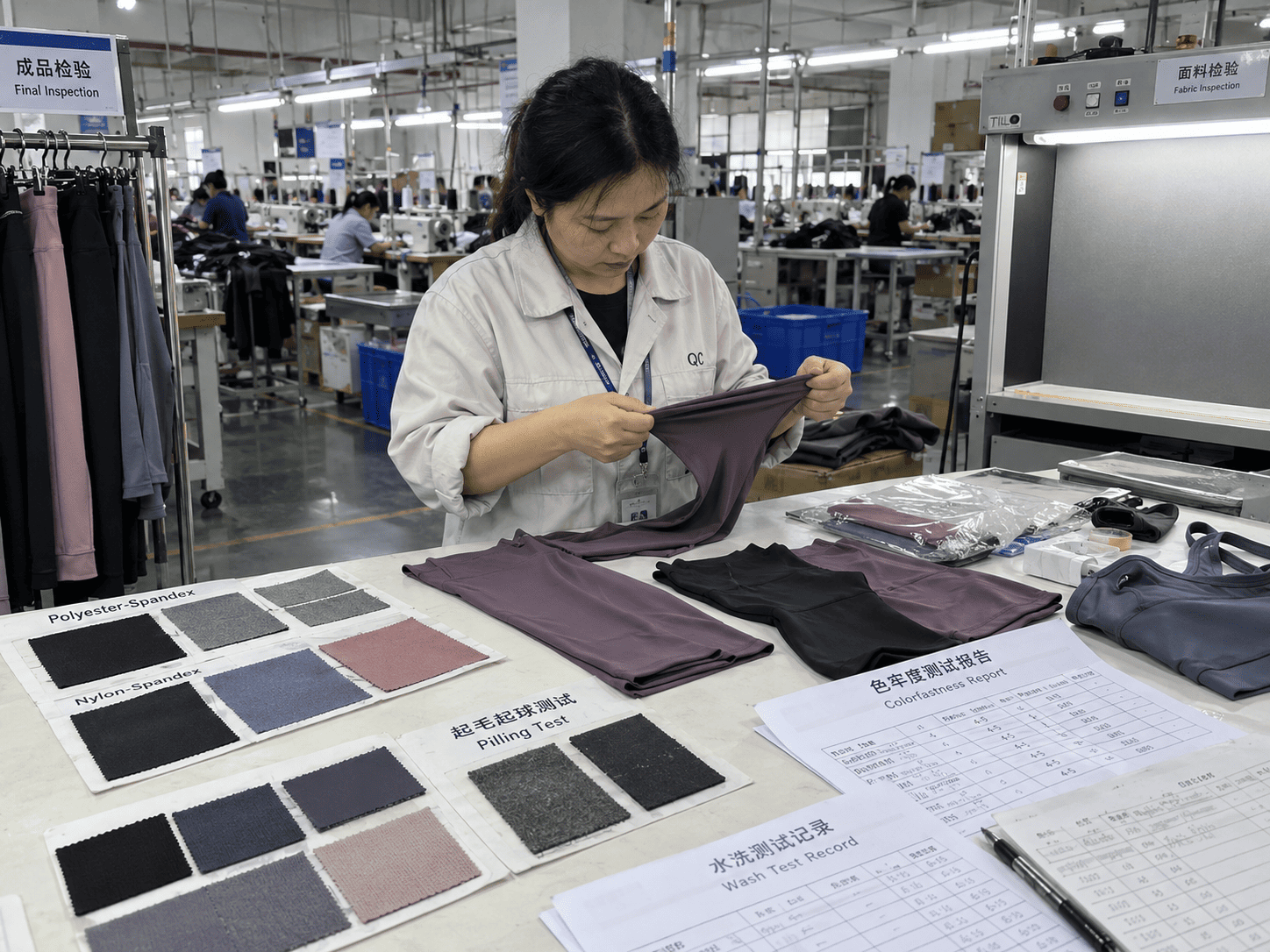
Ask what finishes are applied, what test results are available, and whether the test is on the same fabric you are buying. Then test the finished garment where fit and construction affect performance.
Stretch and Recovery
Use actual testing when this is important.
ISO 20932-1 provides a recognized test method for elasticity-related fabric properties.[^2]
Pilling
Use ISO 12945-2:2020[^3] where controlled pilling evaluation is needed.
Dimensional Change
Use ISO 5077:2007[^4] together with the appropriate laundering procedure for dimensional-change assessment.
Colorfastness to Washing
Activewear is washed frequently.
ISO 105-C06:2010[^5] specifies methods for evaluating textile colorfastness to domestic and commercial laundering.
ISO reviewed and confirmed this edition in 2026, so it remains current.[^5]
Colorfastness to Perspiration
For activewear, perspiration is obviously relevant.
ISO 105-E04:2013[^6] specifies a method for determining resistance of textile color to human perspiration.
Opacity / Squat Test
The squat test is extremely useful.
But it is:
a practical garment-fit evaluation
not a standardized laboratory opacity test.
To check leggings:
- Use the correct size.
- Wear them on the intended body.
- Test under realistic lighting.
- Squat or bend.
- Look at the stretched seat and thigh.
This tells you whether:
- Skin
- Underwear
- Internal label
becomes visible.
Does Higher GSM Automatically Fix See-Through?
No.
Higher weight can help in some fabrics.
But opacity also depends on:
- Knit density
- Yarn
- Color
- Extension
- Construction
A dense lighter fabric may outperform a heavier but open structure.
Moisture-Wicking Finish
Ask:
Is the performance inherent to the fabric or added as a finish?
Then ask:
How has it been tested?
Do not publish a moisture-wicking claim because the mill wrote:
“quick dry”
on a fabric card.
Anti-Pilling Finish
A finish may help surface performance.
But pilling resistance still depends on:
- Fiber
- Yarn
- Knit
- Surface
- Wear
Test the textile.
Should You Use OEKO-TEX®, GRS, or Other Certified Fabrics?
Certification claims need precise wording.
A garment factory and a fabric mill are:
not automatically certified under the same scope.
If a program requires:
OEKO-TEX® STANDARD 100
or another textile certification, ask for:
- Current certificate
- Scope
- Product class
- Supplier
- Validity
and make sure it covers the material being used.
Do not say:
“our activewear is OEKO-TEX certified”
unless the actual certification scope supports that claim.
For our projects, certified fabrics can be sourced when the customer program requires them, subject to:
- Supplier
- Availability
- MOQ
- Documentation
What MOQ, Cost, and Timing Should You Expect?
Activewear pricing depends heavily on the fabric.
But avoid turning:
nylon = expensive
polyester = cheap
into a universal rule.
Cost depends on fiber, yarn, knit construction, GSM, elastane system, finishing, dyeing, printing, supplier, order quantity, and testing requirements. Nylon/spandex is often priced higher than comparable polyester/spandex in commercial sourcing, but the actual fabric quotation should control the decision.
Typical Starting MOQ
For our standard programs:
| Product | Typical starting point |
|---|---|
| Leggings | Around 150 pcs/style |
| Training tees | Around 100 pcs/style |
| Shorts | Around 100 pcs/style |
| Matching sets | Around 50 sets depending on fabric/program |
The final MOQ depends on:
- Fabric
- Colors
- Printing
- Size range
- Trim requirements
Fabric MOQ vs Garment MOQ
This distinction matters.
We may be able to sew:
150 leggings.
But if the brand wants:
- Custom-knit fabric
- Custom dye
- Special finish
the textile mill may impose a separate MOQ.
That can become the actual project minimum.
What Drives Activewear Cost?
| Cost driver | Why it matters |
|---|---|
| Fiber | Different raw-material programs |
| Yarn / construction | Changes performance and hand |
| GSM | Changes material consumption |
| Elastane system | Affects fabric specification |
| Finish | Additional textile processing |
| Color | Stock vs custom dye |
| Sublimation / transfer / other decoration | |
| Testing | Third-party lab cost |
| Quantity | Purchasing and production efficiency |
Does Higher Spandex Always Cost More?
Not necessarily in a simple linear way.
The price depends on:
- Full yarn specification
- Supplier
- Knit
- Fabric program
Use the actual quote.
Does Heavier Fabric Always Cost More?
Heavier fabric usually increases:
material mass per garment.
But final price also depends on:
- Width
- Composition
- Yarn price
- Finish
- Supplier
Again:
GSM alone does not tell you the final cost.
Colors
A small order in:
one color
can be easier than the same total quantity split into:
four colors.
That is because each color creates:
- Separate material purchasing
- Separate lot management
Small cut quantities may cost more than full-roll purchases.
But do not publish:
“loose-cut fabric always costs twice as much.”
That is supplier-specific.
Sample Timing
For standard programs with available material:
5–14 days
is a common sample range for us.
Custom fabric or special testing adds time.
Bulk Timing
For standard programs:
20–30 days
after:
- Final approval
- Deposit
- Materials ready
is a practical production range.
Payment
For new bulk orders, our normal structure is:
50% before production + 50% before shipment.
How Should You Choose Between Polyester and Nylon?
Do not start with:
“Which fiber is premium?”
Start with:
“What does this garment need to do?”
Choose the Fabric by These Questions
- How should it feel?
- How much should it stretch?
- How strongly should it recover?
- Does it need to stay opaque under high extension?
- Will it be printed?
- How often will it be washed?
- Where will friction happen?
- What is the target price?
Then compare real swatches.
For a Premium Legging
You might compare:
- Nylon/spandex option A
- Polyester/spandex option B
on:
- Hand
- Recovery
- Opacity
- Pilling
- Price
Do not choose nylon just because someone told you:
nylon is premium.
For a Printed Gym Range
A suitable polyester-based fabric may be more practical when:
- Sublimation is important
- Artwork coverage is high
For a Sports Bra
Focus heavily on:
- Fabric force
- Recovery
- Pattern
- Elastic
- Lining
rather than selecting solely from composition.
For a Low-MOQ First Collection
Sharing the same approved fabric across:
- Leggings
- Shorts
- Sports bra
may help the brand reach fabric minimums.
But only do this if the textile actually works for all products.
Green Flags and Red Flags
| Green flag | Red flag |
|---|---|
| Recommends fabric by garment function | Uses one activewear fabric for everything |
| Talks about recovery, not just stretch | Says high spandex automatically means compression |
| Tests actual material | Judges quality from composition only |
| Checks opacity while worn | Approves leggings only on a table |
| Uses pilling testing when relevant | Says nylon/polyester cannot pill |
| Separates quick-dry claims from fiber name | Says polyester is automatically quick-dry |
| Checks dimensional change | Says synthetic fabric cannot shrink |
| Reviews perspiration colorfastness | Checks only appearance |
| Confirms certification scope | Claims certificates it cannot show |
| Uses real supplier prices | Says nylon is always a fixed percentage more expensive |
Conclusion
Polyester/spandex and nylon/spandex are both useful activewear materials.
Neither is automatically:
better.
Polyester can be an excellent choice for:
- Training
- Printed activewear
- Shorts
- Tops
especially where a polyester-compatible print system is part of the design.
Nylon can be a strong choice for:
- Leggings
- Sports bras
- Fitted pieces
when the approved fabric provides the:
- Hand
- Recovery
- Surface
the brand wants.
But do not buy a fabric from the fiber name alone.
And do not buy it from:
spandex percentage
alone.
A fabric that says:
75% nylon / 25% spandex
does not tell you:
- Stretch force
- Recovery
- Compression
- Pilling
- Opacity
- Shrinkage
- Drying performance
You still need to test.
For activewear, I would rather approve a fabric after checking:
- Stretch
- Recovery
- Pilling
- Dimensional change
- Colorfastness
- Opacity
- Finished-garment fit
than choose it because a supplier called it:
premium nylon.
That is the difference between a fabric that feels impressive for five minutes in a showroom and one that still performs after:
squats, sweat, friction, and repeated washing.
Footnotes & References
[^1]: Textile Exchange — Materials Market Report 2026. Textile Exchange reports that global fiber production reached approximately 139 million tonnes in 2025. Polyester remained the most widely produced fiber, accounting for about 59% of total global fiber production, with approximately 82.5 million tonnes produced.
https://textileexchange.org/knowledge-center/reports/materials-market-report-2026/
[^2]: International Organization for Standardization — ISO 20932-1:2018, Textiles — Determination of the Elasticity of Fabrics — Part 1: Strip Tests. Describes test methods using fabric strips or loops to measure elasticity and related properties. ISO reviewed and confirmed the standard in 2024, so it remains current.
https://www.iso.org/standard/69489.html
[^3]: International Organization for Standardization — ISO 12945-2:2020, Textiles — Determination of Fabric Propensity to Surface Pilling, Fuzzing or Matting — Part 2: Modified Martindale Method. Specifies a modified Martindale method for evaluating resistance to pilling, fuzzing, and matting.
https://www.iso.org/standard/75375.html
[^4]: International Organization for Standardization — ISO 5077:2007, Textiles — Determination of Dimensional Change in Washing and Drying. Specifies a method for determining dimensional change in fabrics, garments, and other textile articles after specified washing and drying procedures. ISO reviewed and confirmed the standard in 2022, so it remains current.
https://www.iso.org/standard/41877.html
[^5]: International Organization for Standardization — ISO 105-C06:2010, Textiles — Tests for Colour Fastness — Part C06: Colour Fastness to Domestic and Commercial Laundering. Specifies methods for evaluating resistance of textile color to domestic or commercial laundering. ISO reviewed and confirmed the edition in 2026, so it remains current.
https://www.iso.org/standard/51276.html
[^6]: International Organization for Standardization — ISO 105-E04:2013, Textiles — Tests for Colour Fastness — Part E04: Colour Fastness to Perspiration. Specifies a method for determining resistance of textile color to the action of human perspiration. ISO reviewed and confirmed the standard in 2023, so it remains current.
https://www.iso.org/standard/57973.html