
Which Printing Method Should You Choose for Custom Clothing? Screen, Discharge, Puff, DTF, and Sublimation Compared
Your artwork looks perfect on the computer.
The colors are sharp.
The gradients are smooth.
The logo looks clean.
Then the first garment sample arrives.
The print feels too thick.
The white looks slightly different on the black fabric.
The fine details are not as sharp as expected.
After washing, the print does not behave the way you imagined.
The artwork may not be the problem.
The problem may be:
the printing method.
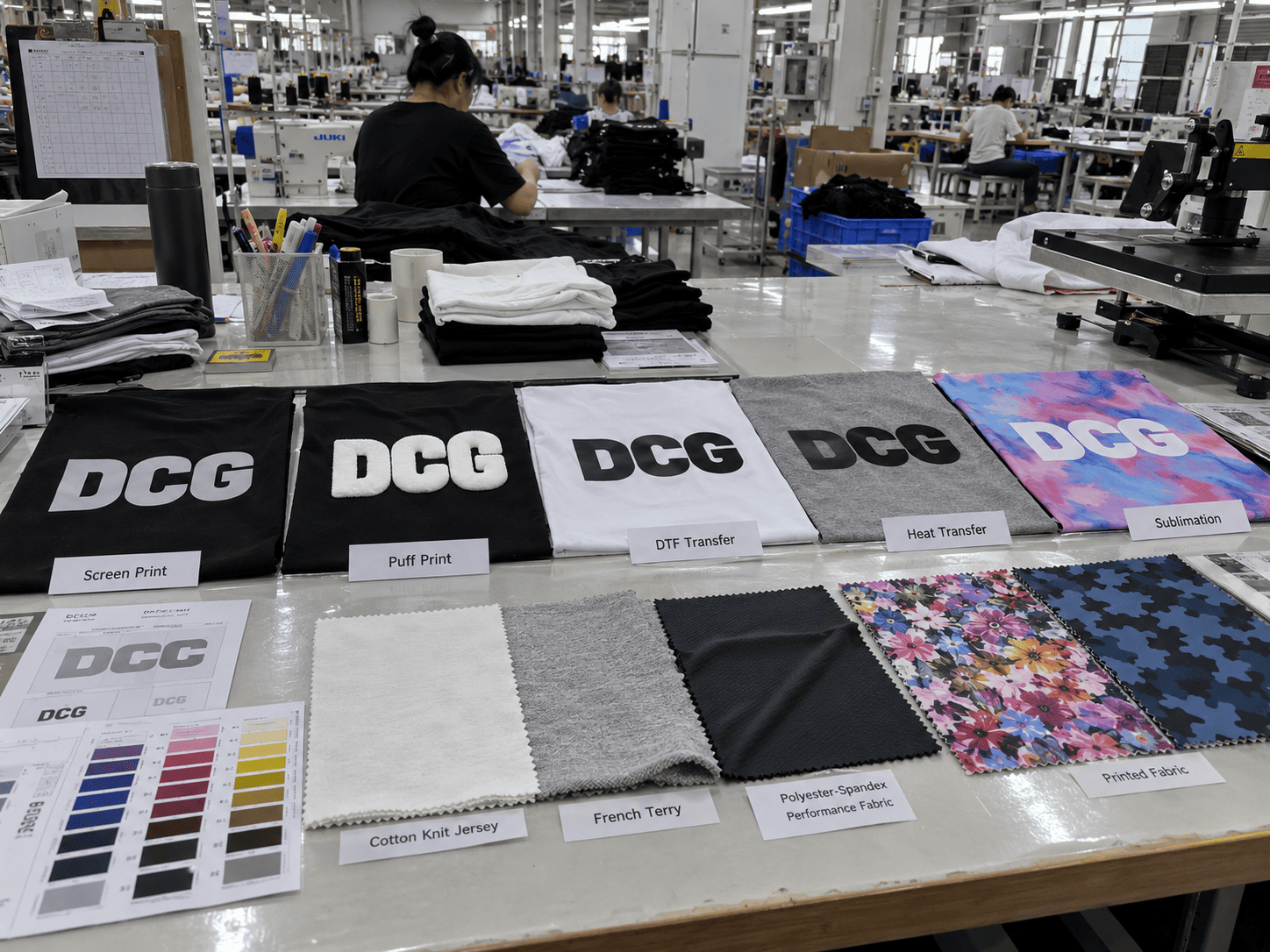
The right printing method depends on the fabric, garment color, artwork, print size, stretch, surface texture, desired hand feel, quantity, and wash requirements. Screen printing works well for many bold graphics, water-based and discharge systems can create softer effects on suitable fabrics, puff adds texture, DTF and transfers can handle detailed artwork and smaller runs, and sublimation is especially useful for polyester-based all-over printing.
The important point is:
there is no single “best” printing method.
The best method is the one that works with:
your garment.
Table of Contents
- What Are the Main Printing Methods for Custom Clothing?
- When Is Screen Printing the Right Choice?
- What Are Discharge and Water-Based Prints?
- When Do Puff Prints, Heat Transfers, and DTF Make Sense?
- When Should You Use All-Over and Sublimation Printing?
- How Do Fabric, Print Size, and Quantity Change the Cost?
- Conclusion
What Are the Main Printing Methods for Custom Clothing?
Different print methods behave differently because they place color on the garment in different ways.
The main options for custom clothing include plastisol screen printing, water-based screen printing, discharge printing, puff printing, heat transfer, DTF, and sublimation or other digital textile-printing methods.
The right choice depends first on:
the fabric.
Then:
- Artwork
- Color
- Print size
- Quantity
- Hand feel
- Stretch
- End use
Printing Methods at a Glance
| Method | Common use | Typical hand | Key strength |
|---|---|---|---|
| Plastisol screen print | Cotton and many blends | Noticeable ink layer | Strong opacity |
| Water-based screen print | Suitable cotton and blends | Softer | Softer hand |
| Discharge | Suitable dyed cotton | Very soft | Vintage / dyed-in effect |
| Puff | Cotton and blends | Raised | 3D texture |
| Heat transfer | Many compatible fabrics | Film-like | Clean detail |
| DTF | Many compatible fabrics | Flexible film | Complex multi-color artwork |
| Sublimation | Polyester-based fabric | Virtually no surface feel | All-over color |
These are general directions.
They are not guarantees.
Every production program should still test:
actual ink + actual fabric + actual wash condition.
Printing Is a Specialist Process
Our garment cutting and sewing is handled through our own garment production.
Specialist printing is completed through long-term print partners that we coordinate directly.
That means we control:
- Artwork
- Placement
- Size
- Garment reference
- Bulk timing
while the printing itself is handled by workshops with the appropriate equipment.
That is common in apparel manufacturing.
When Is Screen Printing the Right Choice?
Screen printing is one of the most widely used garment-decoration methods.
Screen printing is usually a strong choice for bold graphics, solid colors, larger runs, and designs where opacity and repeatability matter. Its economics improve as quantity increases because screens and setup costs are spread across more pieces.
How Screen Printing Works
A stencil is created on a mesh screen.
Ink is pushed through the open areas onto the garment.
For multi-color artwork, separate separations are usually created for each print color.
For example:
Red
White
Black
may require:
three separate color screens.
Does Every Color Need Its Own Screen?
In conventional spot-color screen printing:
usually, yes.
Each color normally has its own screen.
But the exact production setup can change depending on:
- Artwork
- Halftones
- CMYK process printing
- Specialty effects
- Printer workflow
So the simple rule:
one color = one screen
is useful for quoting basic spot-color artwork.
It is not the only possible screen-printing workflow.
Does Every Garment Size Need a Different Screen?
No.
This is an important correction.
If:
S
M
L
XL
all use the same physical artwork size:
30 × 35 cm
the same screen can generally be used across those garment sizes.
You normally need a different screen when:
the print artwork or physical print dimension changes.
For example:
S–XL: 30 × 35 cm
2XL–4XL: 38 × 44 cm
now you have two print sizes.
That usually creates additional setup.
Plastisol Screen Printing
Plastisol is widely used because it can provide:
- Good opacity
- Strong color
- Consistency
especially on:
- Dark cotton
- Hoodies
- Streetwear
It generally sits more on the surface of the fabric than a soft-hand water-based system.
That can make it feel:
- Slightly raised
- More noticeable
especially on large solid prints.
Large Prints Need More Thought
A small chest logo:
8 × 8 cm
may feel very different from:
a 35 × 45 cm solid back print.
Large, heavily inked areas may feel:
- Heavier
- Less breathable
- Stiffer
depending on the ink system and coverage.
So print method should be chosen together with:
print area.
Quantity and Screen Printing
Screen printing becomes more efficient when:
- Quantity increases
- Artwork stays consistent
- Number of colors stays manageable
For very small runs with complicated full-color artwork, DTF or another digital-transfer method may sometimes be more practical.
What Are Discharge and Water-Based Prints?
Some brands want the graphic to feel less like:
a layer sitting on top.
That is where softer ink systems can be useful.
Water-based printing and discharge printing can create a softer hand on suitable textiles, but neither should be treated as universally compatible with every cotton garment, dye system, blend, or finish.
Water-Based Ink
Water-based screen-printing systems use water as a major carrier component.
On suitable textiles, they can create a print that feels:
- Softer
- Less plastic-like
than a heavy surface ink.
This is attractive for:
- T-shirts
- Vintage graphics
- Large artwork
where the brand does not want a very heavy print hand.
Does Water-Based Always Work on Cotton?
No.
The result depends on:
- Fabric color
- Dye
- Pretreatment
- Ink system
- Cure temperature
- Desired opacity
A light garment is usually easier than:
a deep black heavyweight garment
when the goal is a bright opaque color.
For dark garments, the printer may need:
- Different ink chemistry
- Underbase
- Multiple passes
- Another method
depending on the desired result.
Discharge Printing
Discharge printing is different.
Instead of simply covering the original garment color, the discharge chemistry modifies or removes dye in the printed area.
Color can then be introduced into that area depending on the ink system.
This can create a:
- Soft
- Matte
- Vintage
result.
Does Discharge Work on Every 100% Cotton Fabric?
No.
This is important.
The result depends heavily on:
- Dye chemistry
- Garment color
- Fabric finishing
- Previous treatments
Two black 100% cotton T-shirts can produce very different discharge results if they use different dyes.
So:
100% cotton
does not guarantee:
perfect discharge.
Cotton/Poly Blends
On a blend, the cotton and polyester components may respond differently.
This can create:
- Heathered
- Vintage
- Uneven
effects.
Sometimes that is exactly what the brand wants.
Sometimes it is not.
Test first.
Approve on the Actual Fabric
This is especially important for:
- Discharge
- Water-based ink
- Washed garments
because the final appearance can shift depending on the actual textile.
Do not approve only from:
a digital mockup.
When Do Puff Prints, Heat Transfers, and DTF Make Sense?
Flat ink is not always the best choice.
Some designs need:
- Texture
- Fine detail
- Stretch compatibility
- Small-run flexibility
Puff Printing
Puff printing creates a raised surface when the ink system expands under heat.
It is popular for:
- Streetwear
- Logos
- Bold text
- Graphic details
Puff works best when the artwork leaves enough space for the raised effect to form cleanly.
Very fine:
- Lines
- Small lettering
- Tight detail
may not reproduce as cleanly.
Puff Height Is Not Unlimited
Brands sometimes request:
“Make the puff as high as possible.”
More is not automatically better.
Too much expansion can create:
- Uneven surface
- Loss of detail
- Cracking risk
- Poor edge definition
The print shop needs to balance:
- Ink
- Additive
- Mesh
- Cure
- Artwork
Heat Transfer
Heat transfer is a broad category.
It can include:
- Vinyl-type transfers
- Printed transfers
- Silicone transfers
- Reflective transfers
- Other specialty films
These methods can be useful for:
- Small logos
- Performance garments
- Fine shapes
- Labels
Stretch Fabrics
A performance garment may contain:
- Polyester/elastane
- Nylon/elastane
The decoration needs to move with the textile.
A suitable flexible transfer may work well.
But do not assume:
any heat transfer works on any stretch fabric.
The transfer should be checked for:
- Extension
- Recovery
- Adhesion
- Heat tolerance
on the actual material.
DTF
Direct-to-film printing produces artwork onto a film system, which is then transferred to the garment using heat.
DTF is useful for:
- Small runs
- Multi-color graphics
- Fine detail
- Complex artwork
because it does not require the same screen setup as traditional spot-color screen printing.
DTF Hand Feel
DTF creates a layer on the textile surface.
A small logo may feel:
very flexible.
A very large solid DTF graphic may feel:
- More noticeable
- Less breathable
- More film-like
than a soft water-based print.
So ask:
How large is the graphic?
not only:
Is DTF good?
DTF Durability
Good DTF production depends on:
- Film
- Ink
- Adhesive powder
- Heat
- Pressure
- Time
A transfer that is under-cured or incorrectly pressed may fail.
That is why wash testing matters.
Reflective Transfers
Reflective graphics can create:
- Visual impact
- Increased visibility in low light
But:
reflective decoration does not automatically make the garment certified high-visibility workwear.
Standards such as ANSI/ISEA 107-2020[^1] specify requirements for certified high-visibility safety apparel.
A decorative reflective logo alone should not be marketed as meeting such a standard unless the complete garment actually complies.
When Should You Use All-Over and Sublimation Printing?
All-over printing is different from placing a graphic on a finished garment.
The design may cover:
- Front
- Back
- Sleeves
- Entire fabric surface
Traditional dye sublimation is especially effective on suitable polyester-based substrates because the dye transfers into the polyester under heat, producing color with essentially no separate print layer on the fabric surface.
Why Polyester Works So Well
Sublimation dyes are designed to interact with polyester under heat.
That is why this method is widely used for:
- Activewear
- Printed leggings
- Jerseys
- Sports tops
- All-over graphics
Best Base Color
Traditional sublimation generally performs best on:
- White
- Light-colored
polyester-based fabric.
Why?
Because sublimation dye does not normally create an opaque white underbase.
The base fabric color influences the printed result.
That means printing a bright yellow design onto:
black polyester
is not the same as screen printing opaque yellow ink onto black.
Is Sublimation Permanent?
The dye becomes part of the polyester substrate rather than sitting as a thick layer on top.
That means it does not normally:
- Crack
- Peel
like a surface film can.
But overall color durability still depends on:
- Dye
- Process
- Fabric
- Heat
- Laundering
- Light exposure
What About Cotton?
Do not write:
“cotton cannot be all-over printed.”
That is too absolute.
Cotton can be printed using other processes.
What is more accurate is:
traditional dye sublimation is primarily suited to polyester-based substrates.
For cotton, other systems may include:
- Pigment printing
- Reactive printing
- Digital textile printing
- Screen printing
depending on the product and production program.
Double-Brushed Polyester
Double-brushed polyester can also be printed.
But the brushed surface may change how the finished design appears.
It may look:
- Softer
- Less sharp
- More matte
depending on:
- Brushing
- Print process
- Surface pile
Again:
test the actual fabric.
How Do Fabric, Print Size, and Quantity Change the Cost?
Print cost is not one fixed number.
Printing cost is affected by the print method, number of colors, physical dimensions, artwork complexity, number of placements, garment fabric, quantity, and whether new screens, transfers, or setup work are required.
1. Method
Different methods have different:
- Setup
- Material
- Labor
cost structures.
2. Number of Colors
For spot-color screen printing:
more colors generally mean:
- More screens
- More setup
- More print passes
So a:
1-color logo
is usually easier to produce than:
a 6-color illustration.
3. Print Size
A larger print may use:
- More ink
- Larger transfer area
- More production time
depending on method.
4. Different Print Sizes
If S–XL use:
30 × 35 cm
and 2XL–4XL use:
38 × 44 cm
the larger artwork may require:
a separate screen or print setup.
But if every garment uses the same physical print size:
you do not automatically need a different screen for each clothing size.
5. Number of Placements
A garment may have:
- Front
- Back
- Left sleeve
- Right sleeve
Each placement is another production operation.
6. Fabric
Different fabrics may require different:
- Ink
- Pretreatment
- Cure conditions
- Transfer systems
For example:
a lightweight stretch nylon blend
should not automatically receive the same print setup as:
400 GSM cotton French terry.
7. Quantity
Screen setup costs become more efficient at larger quantities.
A screen that costs money to prepare is still required whether the order is:
50 pcs
or:
500 pcs.
8. Full Coverage
All-over printing can involve:
- Printing fabric before cutting
- Larger printed area
- Artwork repeat setup
which can change both:
material cost
and:
production workflow.
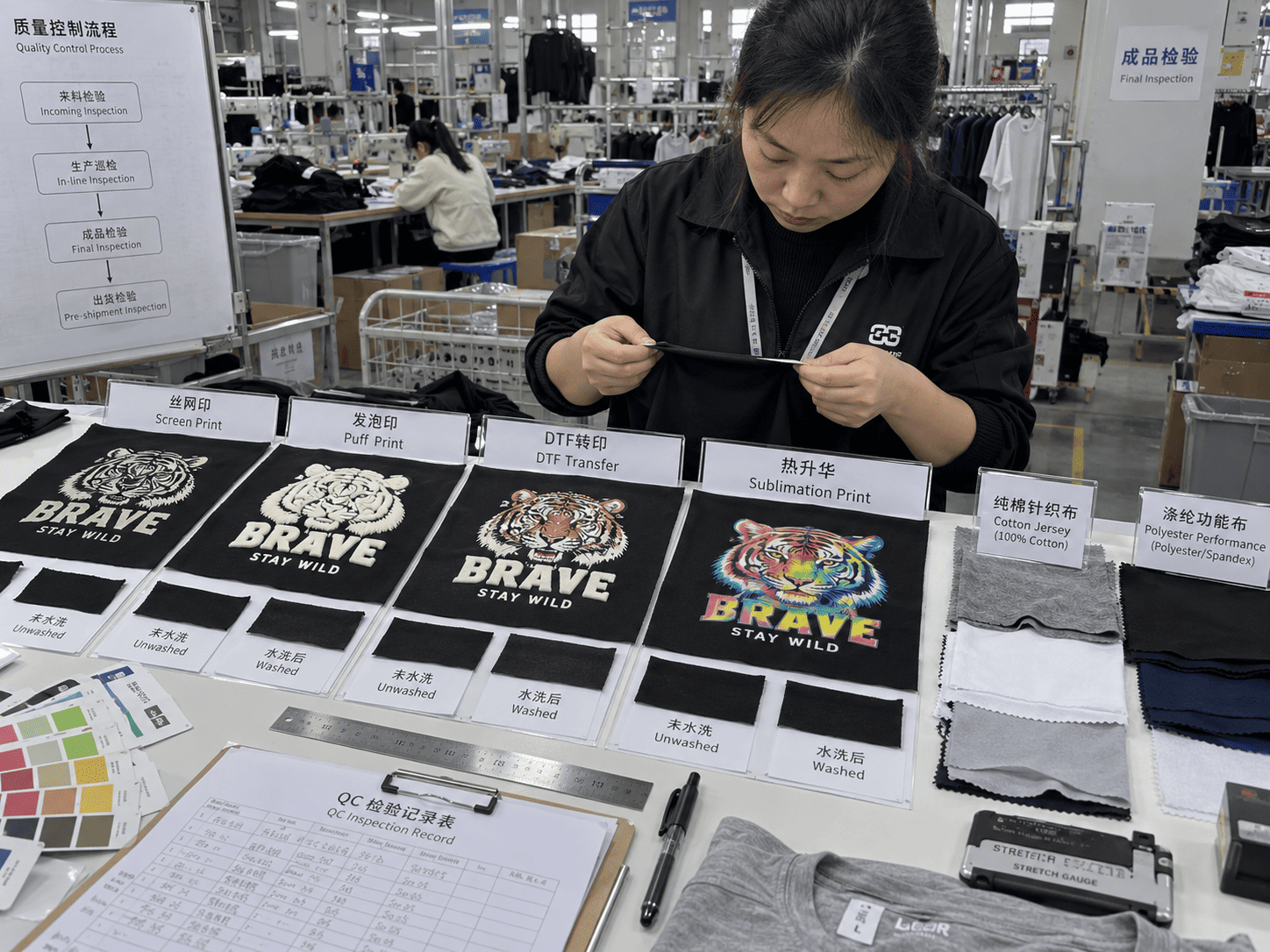
How Should You Test a Print Before Bulk?
This is one of the most important steps.
A print that looks excellent on day one may not behave the same after:
- Washing
- Stretching
- Rubbing
Wash Fastness
ISO 105-C06:2010[^2] provides methods for testing the color fastness of textiles to domestic and commercial laundering.
For printed garments, the actual evaluation should consider:
- Fabric
- Color
- Wash process
together.
Rubbing / Crocking
ISO 105-X12:2016[^3] provides a method for assessing textile color fastness to rubbing.
This can be relevant when evaluating:
- Dark prints
- Pigment
- Dyed substrates
depending on the product.
Stretch Test
For stretch garments, manually check:
- Extension
- Recovery
- Cracking
- Lifting
on the finished sample.
A beautiful print lying flat can fail when worn.
Actual Garment Wash
We also recommend testing:
the completed garment
rather than only the fabric swatch.
This catches interaction between:
- Printing
- Sewing
- Heat
- Fabric
- Care method
Care Label
For apparel sold in the United States, the FTC Care Labeling Rule[^4] requires manufacturers and importers of covered textile apparel to provide regular-care instructions and have a reasonable basis for those instructions.
So the correct workflow is:
print sample → test → confirm safe care → write care label.
Not:
copy the same washing instruction onto every printed garment.
How Should You Control Print Color?
Print color should be approved separately from:
fabric dye.
They are different systems.
Pantone References
For brand colors, physical standards can help communicate the target.
Pantone Fashion, Home + Interiors[^5] is widely used for textile color communication.
But a fabric Pantone target and a print ink target may need separate approval.
Printed Sample Matters
A color mixed correctly in the ink room may appear different after printing because of:
- Fabric color
- Underbase
- Ink opacity
- Surface texture
So approve:
the print on the actual substrate.
White Ink on Dark Fabric
White can appear different depending on:
- Underbase
- Number of passes
- Fabric dye
- Cure
- Ink system
A slightly warm or cool white does not automatically mean production failed.
Define the target.
Then approve the sample.
How Do You Choose Between Screen Print and DTF?
This is one of the most common questions.
Choose Screen Printing When:
- Quantity is larger
- Artwork has fewer colors
- You want strong spot colors
- You want special ink effects
- Print repeatability matters
Choose DTF When:
- Quantity is smaller
- Artwork has many colors
- There are gradients
- You need fast sampling
- You do not want many screens
But Compare Hand Feel
For a:
small chest graphic
DTF may be excellent.
For a:
large 40 × 50 cm back graphic
the film feel may become more noticeable.
The final decision should include:
wear experience.
How Do You Choose Between Screen Print and Water-Based?
Use plastisol or another surface screen-print system when:
- Opacity is critical
- Bold colors matter
- Fabric color is dark
Consider water-based when:
- Softer hand matters
- Actual fabric is compatible
- Artwork suits the process
Do not decide based only on:
“premium.”
A well-executed plastisol print can be premium.
A badly executed water-based print is not.
Green Flags and Red Flags
| Green flag | Red flag |
|---|---|
| Asks about fabric first | Recommends one method for everything |
| Tests actual substrate | Approves only from digital mockup |
| Explains screen setup | Says every garment size needs a separate screen |
| Checks discharge compatibility | Says all cotton discharges perfectly |
| Tests stretch fabrics | Uses rigid transfers blindly |
| Explains large DTF hand feel | Says DTF always feels invisible |
| Uses suitable sublimation substrate | Says sublimation works the same on every fiber |
| Checks wash performance | Judges durability on day one |
| Treats reflective print as decoration unless certified | Calls any reflective logo safety wear |
| Explains specialist partners clearly | Pretends every decoration process is in-house |
What MOQ, Cost, and Timing Should You Expect?
Printing does not replace the garment MOQ.
For our standard programs:
- Hoodies: around 50 pcs/style
- T-shirts: around 100 pcs/style
depending on:
- Fabric
- Colors
- Size breakdown
- Decoration
Sample Timing
Standard garment sampling usually falls around:
5–14 days
depending on:
- Fabric availability
- Print method
- Artwork
- Number of placements
Complex printing or specialty treatments can add time.
Bulk Timing
For standard programs:
20–30 days
after:
- Final approval
- Deposit
- Materials ready
is a practical range.
Special printing, custom fabric, or several subcontracted processes can extend the schedule.
Payment
For new bulk orders, our standard structure is:
50% before production + 50% before shipment.
Conclusion
The best printing method is not:
the newest one.
It is not:
the most expensive one.
And it is not:
the method your competitor used.
Choose the method by asking:
What is the garment made from?
Then:
- What is the artwork?
- How large is the print?
- How many colors?
- How much stretch?
- What hand feel do you want?
- How many pieces?
- How should it perform after washing?
Use screen printing when:
bold graphics and production scale make sense.
Use water-based or discharge when:
the actual fabric and dye system support the softer effect.
Use puff when:
you want controlled 3D texture.
Use DTF when:
you need flexible short-run production and complex artwork.
Use suitable heat-transfer systems when:
the garment and performance requirements support them.
Use traditional sublimation especially when:
you are working with suitable polyester-based substrates and all-over graphics.
Then test.
Wash it.
Stretch it.
Rub it.
Look at it on the real garment.
Because printing is not finished when the artwork leaves the computer.
It is finished when the customer can wear and wash the garment without the decoration becoming the weakest part of the product.
Footnotes & References
[^1]: International Safety Equipment Association — ANSI/ISEA 107-2020, American National Standard for High-Visibility Safety Apparel and Accessories. The standard establishes performance requirements for materials and design used in certified high-visibility safety apparel. Decorative reflective printing alone does not mean a garment complies with this standard.
https://safetyequipment.org/ansi-isea-107-2020/
[^2]: International Organization for Standardization — ISO 105-C06:2010, Textiles — Tests for Colour Fastness — Part C06: Colour Fastness to Domestic and Commercial Laundering. Specifies methods for evaluating textile color fastness under laundering conditions.
https://www.iso.org/standard/51276.html
[^3]: International Organization for Standardization — ISO 105-X12:2016, Textiles — Tests for Colour Fastness — Part X12: Colour Fastness to Rubbing. Specifies a method for determining resistance of textile color to rubbing and staining of other materials.
https://www.iso.org/standard/65216.html
[^4]: U.S. Federal Trade Commission — Care Labeling Rule, 16 CFR Part 423. Requires manufacturers and importers of covered textile wearing apparel to provide care instructions and to have a reasonable basis for those instructions.
https://www.ftc.gov/legal-library/browse/rules/care-labeling-textile-wearing-apparel-certain-piece-goods
[^5]: Pantone — Fashion, Home + Interiors. Pantone's FHI system provides physical color standards widely used in fashion and textile development. Physical standards should be used for final color evaluation rather than relying only on digital simulations.
https://www.pantone.com/na/en-us/fashion-home-interiors