Visiting a Clothing Factory in China: How Do You Plan a Visit That Is Worth the Trip?
You fly twelve hours to visit a clothing factory in China.
The supplier picks you up.
You see:
- A clean showroom
- Several racks of samples
- A sewing line from the doorway
Then comes lunch.
A few photos.
A ride back to the hotel.
The visit felt friendly.
But you still do not know:
- Who actually cuts your fabric
- Which processes happen inside the factory
- How bulk measurements are checked
- Who handles defects
- Whether your order will actually be made at the site you visited
That is not a useful factory visit.
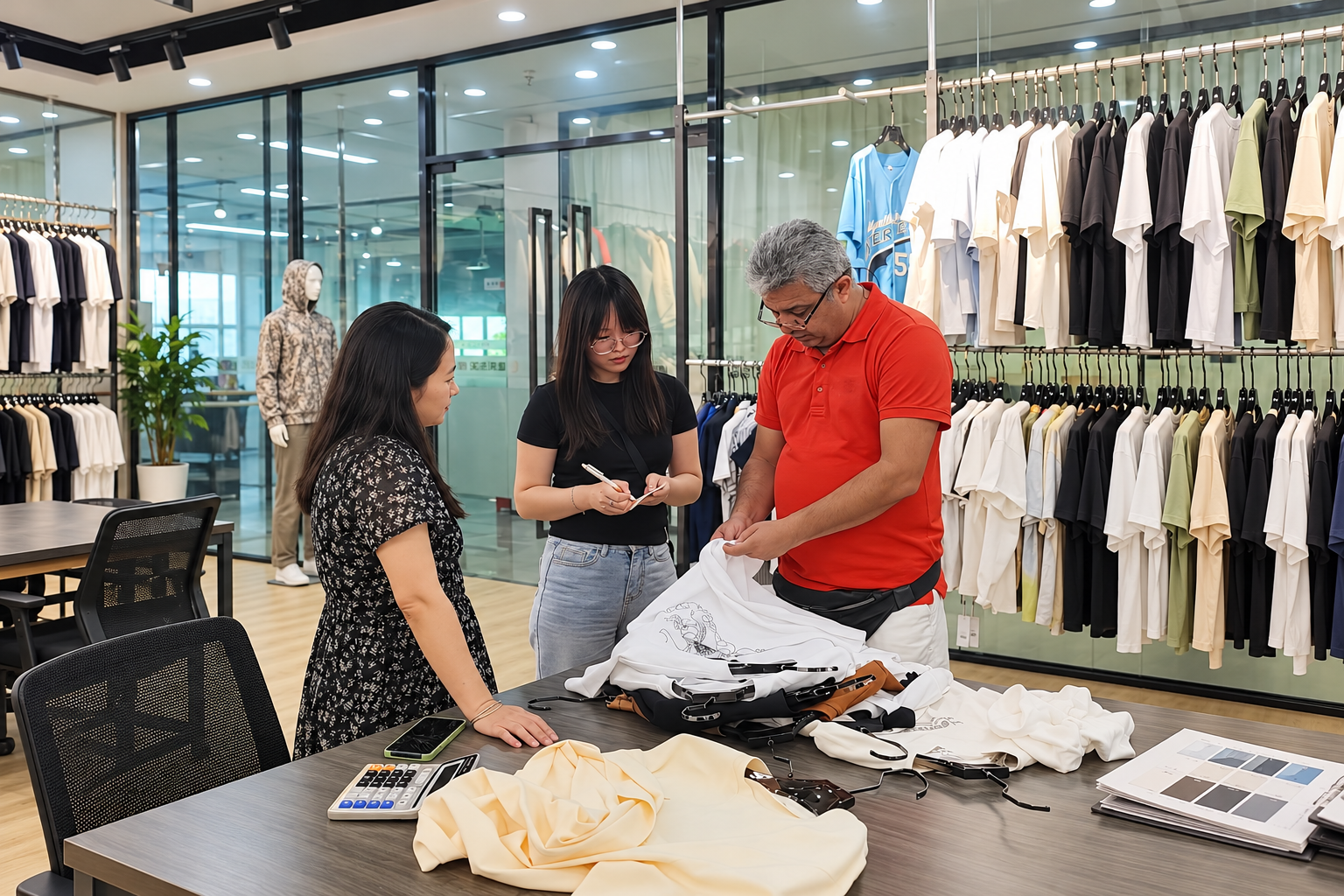
A worthwhile clothing factory visit should let you follow the real production process, meet the team responsible for your order, inspect fabric handling, cutting, sewing, quality control, finishing, and packing, and resolve open sample or production questions face to face. The key is to agree on a working agenda before you arrive rather than spending the entire visit in the showroom.
For serious clothing programs, visiting once can answer questions that are difficult to judge through:
- Photos
- Video calls
But you do not need to travel for every order.
The most valuable visits usually happen:
- Before a large first bulk order
- At the beginning of a long-term supplier relationship
- When developing technically difficult products
- When you want to understand capacity and quality systems more deeply
Table of Contents
- Why Should You Visit Your Clothing Factory?
- How Do You Plan the Trip to a Factory in China?
- What Should You See on the Factory Floor?
- Which Questions Should You Ask During the Visit?
- What Should You Bring to Make the Visit Productive?
- How Do You Follow Up After the Visit?
- Conclusion
Why Should You Visit Your Clothing Factory?
You can learn a lot from:
- Samples
- Video calls
- Inspection reports
- Production photos
But being on the factory floor gives you another level of understanding.
A factory visit can help you confirm what production really happens at the site, understand the supplier's workflow and QC system, meet the people responsible for your order, review samples directly with technicians, and see whether the factory is a realistic fit for your product category and expected order volume.
Confirm What Actually Happens In-House
A supplier may tell you:
“We make everything.”
But that sentence can mean many things.
During a visit, ask to see:
- Fabric storage
- Cutting
- Sewing
- Finishing
- QC
- Packing
Then ask which specialist processes are handled elsewhere.
For our garment production, our core:
- Pattern development
- Cutting
- Sewing
- Garment assembly
- Quality control
are handled through our garment-production operation.
Some specialist processes, such as:
- Embroidery
- Certain printing
- Garment washing
- Other specialized decoration
may be handled by long-term specialist partner workshops that we coordinate directly.
That is normal in apparel manufacturing.
What matters is that the supplier is clear about it.
Meet the People Behind Your Order
Your salesperson is important.
But production also involves:
- Merchandiser
- Pattern maker
- Sample technician
- Production manager
- QC staff
Meeting them helps you understand who is making the decisions when:
- A measurement is unclear
- Fabric behaves differently
- Artwork needs adjustment
- A production issue appears
Solve Sample Problems Faster
Imagine the hoodie sample has:
- Shoulder too wide
- Sleeve too long
- Hood too flat
Through email, you might send:
photos → comments → revised sample → more comments.
At the factory, you can put the garment on a fit model or mannequin and discuss:
- Shoulder position
- Sleeve balance
- Hood shape
with the pattern team at the same time.
That can turn several days of back-and-forth into one working session.
Check Whether the Factory Fits Your Product
A good T-shirt factory is not automatically the right partner for:
- Structured jackets
- Technical activewear
- Complex cargo pants
Look at what is actually running on the floor.
Ask:
“How often do you make products similar to mine?”
That is often more useful than asking:
“Can you make this?”
because almost every supplier will answer yes to the second question.
How Do You Plan the Trip to a Factory in China?
A good factory visit starts before you buy the plane ticket.
Confirm the visit date with the factory, check the latest official visa rules for your passport, avoid major Chinese public holidays, agree on the working agenda in advance, and allow enough time to see production rather than trying to visit several factories in one rushed day.
Check Current Entry Rules
China's visa policies have changed substantially in recent years.
As of 2026, holders of ordinary passports from a number of countries can enter China visa-free for up to 30 days for permitted purposes including:
- Business
- Tourism
- Visiting family or friends
- Exchanges
- Transit
depending on nationality and the current policy.
The Chinese Embassy in the United States' 2026 visa-free policy guidance[^1] lists the nationalities covered and the applicable policy periods.
China also added Canada and the United Kingdom to the 30-day unilateral visa-free program from February 17, 2026 through December 31, 2026.[^2]
Because these policies can be:
- Extended
- Changed
- Expanded
- Allowed to expire
always check the latest official information for your own passport before booking.
Visa-Free Entry Is Different From Visa-Free Transit
This distinction matters.
China's 240-hour visa-free transit policy is designed for eligible passengers transiting China on the way to a third country or region.
The National Immigration Administration[^3] states that the policy currently covers eligible citizens from 55 countries and allows qualifying travelers to stay for up to 10 days when meeting the required transit conditions.
A simplified example:
London → China → Tokyo
may qualify if all requirements are met.
But:
London → China → London
is not the same transit structure.
So do not assume:
240-hour transit = 10-day tourist visa.
Check your exact itinerary.
Which Airport Should You Use for Dongguan?
For a factory in Dongguan, common arrival options include:
- Shenzhen
- Guangzhou
- Hong Kong
The best choice depends on:
- Your international route
- Flight price
- Arrival time
- Immigration requirements
- Ground transport
If you visit us in Humen, we can confirm the most practical route based on your itinerary before you travel.
Avoid Major Chinese Holidays
Try to avoid factory visits during:
- Chinese New Year / Spring Festival
- National Day holiday around early October
Also be careful about the weeks immediately before Chinese New Year.
The factory may still be technically open.
But the team can be extremely busy finishing:
- Bulk orders
- Fabric
- Packing
- Shipments
before the holiday.
Share the Agenda Before You Arrive
Do not arrive and say:
“Show me the factory.”
Send a list such as:
- Review current samples
- Review fabric options
- Visit cutting room
- Visit sewing lines
- Review QC
- Discuss bulk timeline
- Discuss packaging
- Confirm next sample changes
This allows the correct staff to be available.
How Long Should You Allow?
For a serious supplier:
at least half a day
is better than a 45-minute tour.
For an important project:
a full working day
can be much more useful.
If you also want to visit:
- Fabric market
- Printing workshop
- Embroidery partner
- Wash facility
you may need additional time.
What Should You See on the Factory Floor?
Do not only look at the newest sewing machines.
Follow the garment.
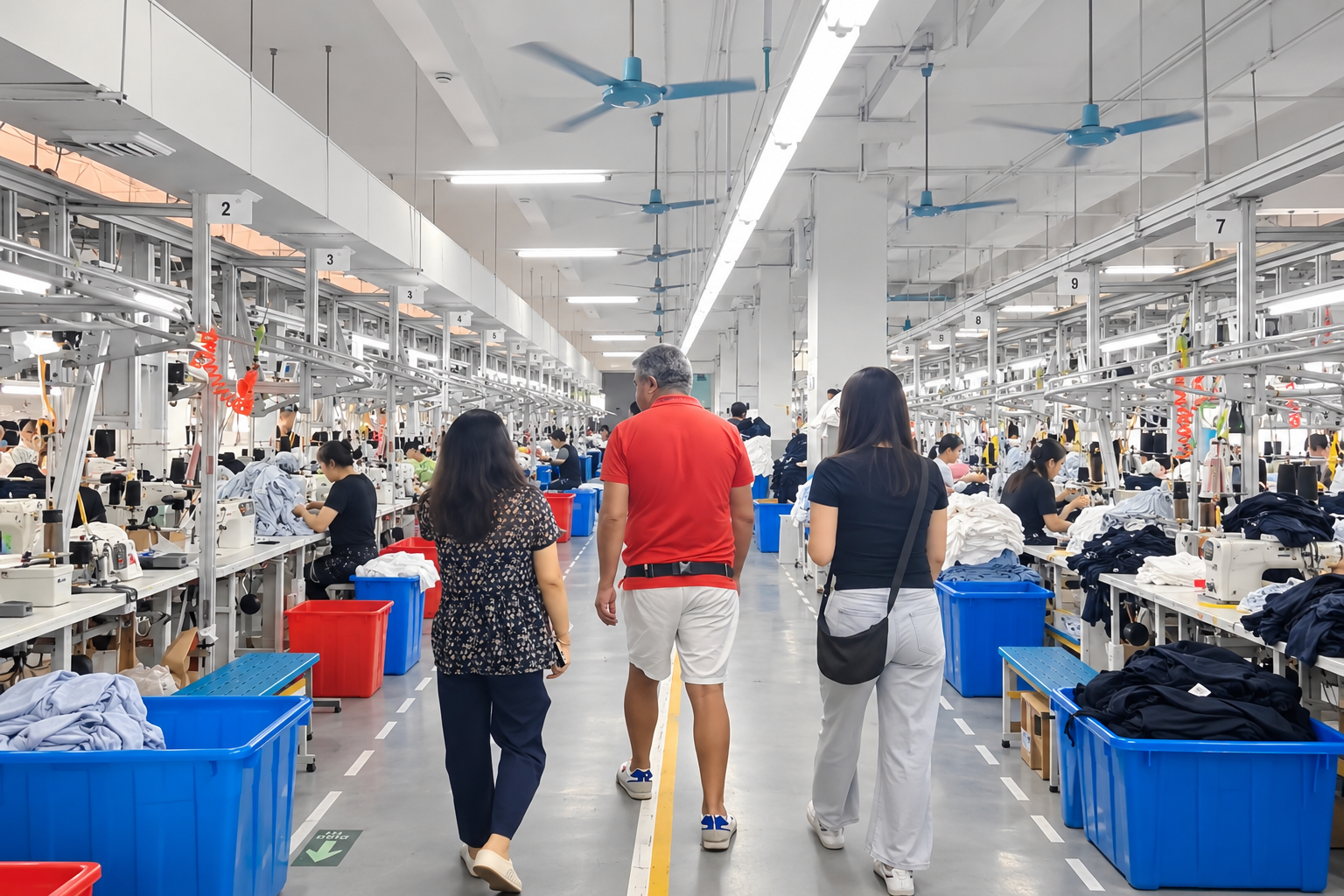
A useful clothing factory visit should follow the product from incoming fabric through fabric inspection, cutting, sewing, inline QC, finishing, final inspection, packing, and finished-goods storage. This lets you see not only how garments are made, but where mistakes are supposed to be detected.
1. Fabric Storage
Look at how fabric rolls are:
- Stored
- Identified
- Separated
Ask:
- Are dye lots marked?
- Are rolls protected?
- How do you avoid mixing shades?
For repeat orders, shade control is especially important.
A reorder cannot always be guaranteed to match an earlier dye lot perfectly.
What matters is having an agreed color-control process.
2. Fabric Inspection
Ask:
“What happens when fabric arrives?”
Look for processes such as:
- Visual inspection
- Defect identification
- Shade checking
- Fabric reference retention
Do not assume the first quality check happens after sewing.
By then, it is too late to solve many fabric problems efficiently.
3. Dimensional / Shrinkage Checking
Ask how the factory checks fabric or garments for dimensional change.
For relevant products, this can help determine:
- Pattern compensation
- Finished-garment measurements
- Wash instructions
A supplier saying:
“100% cotton always shrinks 5%”
is giving you an assumption.
A better supplier tests the actual material.
4. Cutting Room
Look for:
- Marker preparation
- Fabric spreading
- Cutting accuracy
- Bundling
Ask how:
- Sizes
- Colors
- Dye lots
are kept organized after cutting.
A mistake here can follow the garment all the way through production.
5. Sewing Lines
This is where buyers often spend most of their attention.
Look at:
- Products currently running
- Machine types
- Line organization
- Operator workflow
But avoid judging the entire factory from whether every table looks perfectly staged.
A real working production floor will look like:
a working production floor.
The important question is whether the workflow is controlled.
6. Inline Quality Control
Ask:
“Where is the first sewing inspection?”
A strong system should not depend only on final inspection.
Inline checks can find:
- Stitch problems
- Wrong operations
- Measurement drift
before hundreds of garments are completed.
7. Finishing
This may include:
- Thread trimming
- Cleaning
- Pressing
- Measurement checking
Look at whether garments are being prepared consistently before packing.
8. Final Inspection
Ask which:
- Measurements
- Appearance points
- Workmanship issues
are checked.
If statistical acceptance sampling is used, understand what that means.
The current ISO 2859-1:2026[^4] provides AQL-indexed acceptance-sampling schemes for lot-by-lot inspection.
An AQL such as:
2.5
should not be interpreted as:
“2.5% defective garments are allowed.”
It is part of a statistical sampling plan.
9. Packing
Check:
- Folding
- Polybags
- Size stickers
- Hangtags
- Carton labels
- Carton assortment
Many expensive fulfillment problems start with simple packing mistakes.
Which Questions Should You Ask During the Visit?
The factory floor tells you what exists.
Your questions tell you how the business operates.
Ask About Your Product Category
Instead of:
“How many pieces can your factory make?”
ask:
“How much capacity do you normally allocate to products like mine?”
Total factory capacity does not tell you whether the factory has the right:
- Equipment
- Workers
- Experience
for your specific product.
Ask What Is In-House
Ask:
“Which processes for my order happen here?”
Then:
“Which processes go to specialist partners?”
A clear answer is a green flag.
Trying to pretend:
everything happens in one building
when it does not is not.
Ask About Sampling
Questions:
- Who makes the pattern?
- Who reviews my comments?
- How many revision rounds are typical?
- What happens if the fabric changes after the first sample?
This tells you how the factory thinks during development.
Ask About Defects
A useful question is:
“Tell me about a production problem you had recently and how you solved it.”
That often tells you more than:
“Do you have good quality?”
Nobody answers no to that.
Ask About Reorders
Ask:
“If I reorder this black hoodie six months later, how do you control shade?”
A serious answer should acknowledge that different dye lots can vary.
Do not expect:
perfectly identical forever.
Ask about the control method.
Ask About Lead Time
For our normal programs:
- Samples commonly take around 5–14 days
- Bulk commonly takes around 20–30 days after final approval and deposit
But a factory should also explain what can extend that timing:
- Custom fabric
- Washing
- Special trims
- Complex decoration
- Peak season
Ask About Payment
For our new bulk orders, the normal structure is:
50% before production + 50% before shipment.
Your visit is a good time to clarify:
- Payment method
- Deposit timing
- Balance timing
- Sample payment
before the first large order.
Ask About Social-Compliance Audits
Ask:
“Which audit covers this exact production site?”
That wording matters.
A supplier may operate:
- Several factories
- Partner workshops
An audit at one site should not automatically be treated as covering every other site.
Our factory has undergone SMETA/Sedex auditing.
Sedex describes SMETA[^5] as a social-audit methodology used to assess working conditions and related practices at individual sites.
It is better to say:
SMETA audit
than:
SMETA certified.
SMETA is not a product certification or a simple pass/fail badge.
Questions Worth Asking
| Topic | Useful question |
|---|---|
| Product experience | How often do you make products like mine? |
| In-house production | Which steps happen here? |
| Partners | Which specialist processes are outsourced? |
| Fabric | How do you control dye lots? |
| QC | Where are inline checks performed? |
| Final inspection | What inspection plan do you use? |
| Defects | What happens when defects are found? |
| Reorders | How do you control repeat-order shade? |
| Lead time | What could delay my project? |
| Payment | What are the terms for a new buyer? |
| Audit | Which site does this audit cover? |
| Communication | Who is my daily contact after I leave? |
What Should You Bring to Make the Visit Productive?
The best factory visits are not tours.
They are working sessions.
Bring the items that require decisions: reference garments, tech packs, measurement charts, artwork, physical color references, fabric ideas, rough quantities, and a written list of unresolved questions.
Reference Garments
If you like:
- Fit
- Fabric
- Collar
- Hood
of an existing garment, bring it.
A physical reference is much easier to understand than:
“I want it slightly more premium.”
Tech Pack
Bring the latest version.
Not an old version saved on your phone from three months ago.
Review:
- Construction
- Measurements
- Artwork
- Labels
- Packaging
with the team.
Size Chart
Bring the actual garment measurements you want to approve.
If there are uncertain POMs, use the visit to agree:
- Where to measure
- How to measure
- Tolerance
Physical Color References
If color is important, bring:
- Pantone textile reference
- Approved swatch
- Existing garment
Physical reference is much more useful than:
a phone screenshot.
Artwork
Bring high-resolution or vector artwork where possible.
Then you can discuss:
- Print size
- Embroidery size
- Position
- Technique
using the real garment.
Quantity Plan
You do not need a final purchase order.
A rough forecast such as:
Black — 300 pcs
Grey — 200 pcs
Cream — 100 pcs
helps the factory discuss:
- Fabric rolls
- Color MOQ
- Cost
- Timing
more realistically.
Prepare Questions Before the Visit
Write the list before the flight.
Otherwise it is surprisingly easy to forget the most important question after:
- Factory tour
- Sample meeting
- Lunch
- Fabric selection
How Do You Follow Up After the Visit?
This step is often missed.
Everyone leaves the meeting feeling:
“We agreed.”
Two weeks later, the buyer and factory remember the agreement differently.
After the factory visit, turn every important verbal decision into a written record: sample changes, measurements, fabrics, colors, artwork, quantities, responsibilities, prices, and target timing. Then update the tech pack so production is controlled by documents rather than memory.
Send a Written Summary
Within one or two days, send something like:
Sample Changes
- Reduce shoulder by 1.5 cm
- Increase hood height by 2 cm
- Move back print 3 cm upward
- Change cuff rib to approved reference
Then ask the factory to confirm.
Update the Tech Pack
This is critical.
Do not leave:
Visit comments
in WhatsApp
while:
Tech Pack V2
still contains the old measurements.
The production document should reflect the final decision.
Confirm the Revised Sample
If changes are needed, confirm:
- Which sample is being remade
- What changed
- Target completion date
Confirm Price After Specification Changes
A visit may result in upgrades:
- Heavier fabric
- Extra embroidery
- New trim
- Different construction
Those changes may affect price.
Finalize the specification first.
Then finalize the commercial quotation.
Third-Party Inspection Can Reduce Future Travel
You do not have to return to China for every bulk order.
After the relationship is established, you may use:
- Production photos
- Video calls
- Inspection reports
- Third-party pre-shipment inspection
We accept third-party inspection before shipment.
That gives buyers another way to verify bulk production without flying to China every time.
Green Flags and Red Flags During a Factory Visit
| Green flag | Red flag |
|---|---|
| Welcomes planned factory visits | Repeatedly avoids the visit |
| Shows real production areas | Shows only the showroom |
| Explains partner processes clearly | Claims every process is in-house |
| Introduces technical staff | Only salesperson participates |
| Lets you ask detailed process questions | Gives vague answers |
| Shows how QC works | Says “our quality is always good” |
| Discusses dye-lot variation realistically | Guarantees perfect shade forever |
| Identifies which audit covers which site | Uses one audit to imply every site is covered |
| Explains production constraints | Promises every deadline |
| Confirms decisions in writing | Leaves everything verbal |
Should You Visit Before Every Order?
No.
For many buyers, one good visit at the beginning of the relationship is enough to understand:
- Factory structure
- Team
- Workflow
- QC system
After that, routine repeat orders can often be managed through:
- Tech packs
- Samples
- Video calls
- QC reports
- Third-party inspection
Visit again when something materially changes.
For example:
- Much larger order volume
- New product category
- New production site
- Major quality issue
- Long-term sourcing review
That makes the travel more valuable.
Conclusion
A factory visit should answer one question:
“Do I understand how my product will actually be made here?”
Not:
“Did I get a nice factory photo?”
Before the trip:
- Check current visa rules
- Confirm the factory date
- Avoid major holidays
- Share your agenda
At the factory:
- Follow the production flow
- Inspect fabric handling
- See cutting
- Walk the sewing floor
- Understand inline QC
- See finishing and packing
- Ask what happens off-site
Then meet the people who will actually work on your product.
Bring:
- Reference garments
- Tech packs
- Size charts
- Artwork
- Color references
- Quantity plans
and use the day to make decisions.
After the visit:
write everything down.
Update the tech pack.
Confirm the revised sample.
Confirm timing.
Confirm pricing.
A factory visit does not replace:
- Samples
- Contracts
- Quality control
- Inspection
But it can give you something those documents cannot:
a clear understanding of how the supplier actually works.
That is what makes the trip worth the flight.
Footnotes & References
[^1]: Embassy of the People's Republic of China in the United States — FAQs on China's Unilateral Visa-Free Policy, updated February 2026. The official guidance lists ordinary-passport holders currently eligible for China's unilateral visa-free entry program and explains the permitted purposes and maximum 30-day stay. Policy periods differ by nationality, so travelers should confirm the current rules before booking.
https://us.china-embassy.gov.cn/lsfw/zj/qz/202412/t20241224_11516389.htm
[^2]: Embassy of the People's Republic of China in the United States — Foreign Ministry Spokesperson's Remarks on Including Canada and the UK in the Visa-Free Program. China announced that ordinary-passport holders from Canada and the United Kingdom can enter visa-free for up to 30 days for qualifying purposes from February 17, 2026 through December 31, 2026.
https://us.china-embassy.gov.cn/eng./fyrth/202602/t20260215_11860467.htm
[^3]: National Immigration Administration of China — 240-Hour Visa-Free Transit Policy. NIA states that eligible citizens from 55 countries may use the 240-hour visa-free transit policy when holding valid travel documents and confirmed onward transportation to a third country or region, subject to the approved ports, stay areas, and other policy conditions.
https://www.nia.gov.cn/Enquiry/publish/showQuestion.jsp?MZ=ZeSrDZebGPU0duUAzcy7SQ%3D%3D
[^4]: International Organization for Standardization — ISO 2859-1:2026, Sampling Procedures for Inspection by Attributes — Part 1. The current edition provides AQL-indexed acceptance-sampling schemes for lot-by-lot inspection. AQL is part of a statistical sampling framework and should not be interpreted simply as an allowed percentage of defective garments.
https://www.iso.org/standard/2859-1
[^5]: Sedex — SMETA Audit. Sedex describes SMETA as a social-audit methodology used by businesses to assess working conditions and related practices at individual sites. SMETA audits are carried out by approved third-party Affiliate Audit Companies and should not be described as a product certification or simple pass/fail badge.
https://www.sedex.com/solutions/smeta-audit/