
What Makes a Premium Hoodie? Which Construction Details Should Your Brand Specify?
You put two black hoodies side by side.
From a distance, they look almost the same.
Both are cotton.
Both have a hood.
Both have a kangaroo pocket.
Both carry a small chest logo.
But when you pick them up, the difference becomes obvious.
One feels balanced and substantial.
The hood holds its shape.
The rib returns after you stretch it.
The pocket sits cleanly.
The seams look controlled.
After several washes, the garment still looks close to the original sample.
The other hoodie feels flat.
The cuffs flare.
The hood collapses.
The body twists slightly.
That difference does not come from one magic specification.
A premium hoodie is the result of many controlled decisions: fabric construction and weight, dimensional stability, hood shape, rib performance, fit, seam construction, reinforcement, trims, decoration, and finishing. A high GSM or double-layer hood can support a premium product, but neither automatically makes a hoodie premium. The details need to work together and should be written clearly into the tech pack.
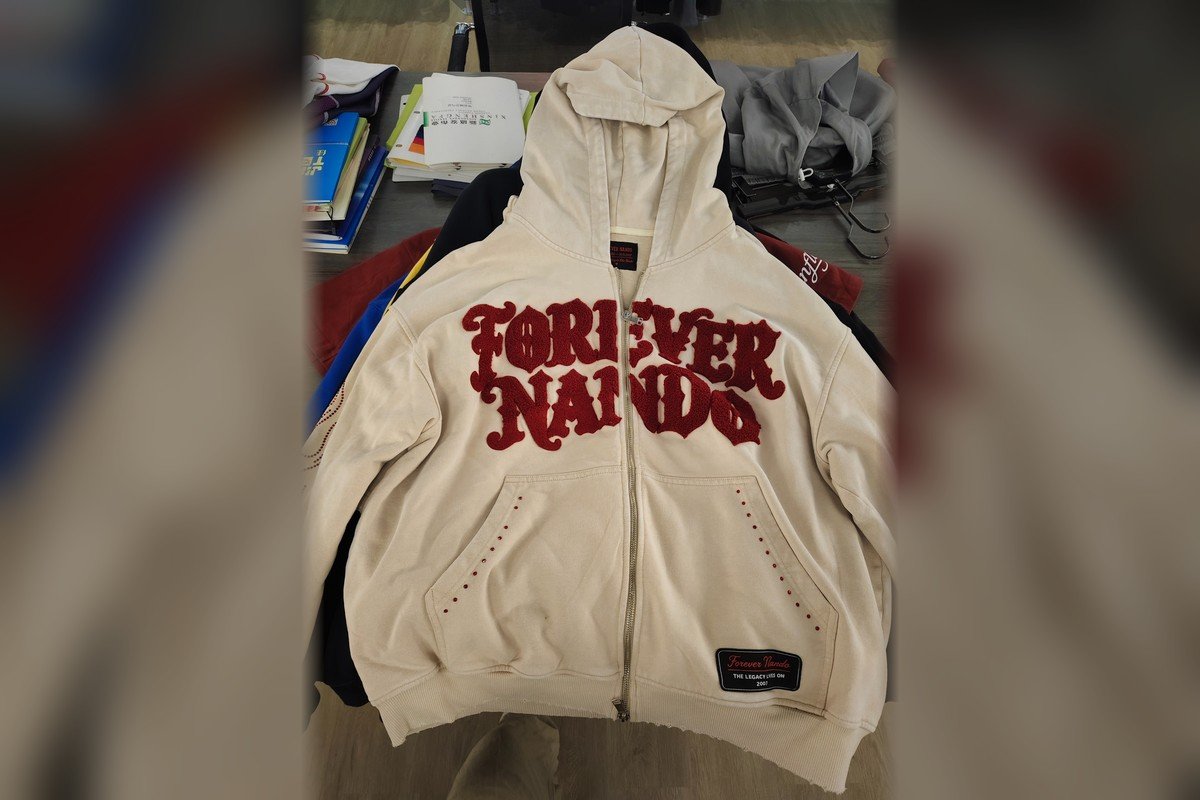
For us as a clothing manufacturer, this is one of the most important points when a customer says:
“I want a premium hoodie.”
“Premium” is not a complete technical specification.
We still need to know:
- Fabric
- GSM
- Fit
- Hood shape
- Rib
- Seams
- Trims
- Decoration
- Wash requirements
That is where the real product begins.
Table of Contents
- What Separates a Premium Hoodie from a Basic One?
- Which Fabric and Weight Make a Hoodie Feel Premium?
- How Should the Hood Be Constructed?
- Which Body Details Make the Biggest Difference?
- Which Trims and Finishing Details Lift the Look?
- What MOQ, Cost, and Timing Should You Expect?
- Conclusion
What Separates a Premium Hoodie from a Basic One?
A premium hoodie does not need to use every expensive option available.
It needs the right details for the design.
The biggest differences are usually fabric quality and stability, fit, hood construction, rib performance, sewing consistency, reinforcement, and carefully selected trims. Premium is about the complete garment rather than one specification such as GSM.
A Basic Hoodie Can Still Be Good
A lighter hoodie is not automatically low quality.
For example, a brand may intentionally want:
- Lightweight fleece
- Single-layer hood
- Simple trims
- Regular fit
because the product is designed for:
- Warm weather
- Layering
- Promotional use
That can still be a well-made garment.
The problem begins when the brand wants:
heavy premium streetwear
but the technical specification is written like a basic promotional hoodie.
Premium Means Intentional
Compare two directions:
| Detail | Simpler direction | Premium / more developed direction |
|---|---|---|
| Fabric | Standard stock knit | Carefully selected or custom fabric |
| GSM | Light to medium | Weight selected for target silhouette |
| Hood | Basic shape | Developed shape and controlled volume |
| Rib | Standard | Tested for stretch and recovery |
| Basic sewing | Controlled shape + reinforced stress points | |
| Seams | Functional construction | Clean, consistent finishing |
| Fit | Standard block | Brand-specific fit |
| Trims | Generic | Selected to match garment |
| Labels | Standard | Brand-specific presentation |
| Testing | Minimal | Wash / measurement / performance checks |
Notice something important:
I did not write:
basic = 280 GSM
and:
premium = 400 GSM.
That would be too simple.
Which Fabric and Weight Make a Hoodie Feel Premium?
Fabric is usually the first thing a buyer notices.
But weight is only one part of fabric quality.
A premium hoodie may use heavyweight French terry, brushed fleece, or another well-developed knit. The correct GSM depends on the intended climate, fit, structure, hand feel, and end use. Higher GSM increases fabric mass but does not automatically guarantee better durability, recovery, softness, or overall quality.
What Does GSM Actually Tell You?
GSM means:
grams per square meter.
It measures fabric mass per unit area.
The active ASTM D3776/D3776M-20(2025)[^1] covers methods for determining fabric mass per unit area.
That makes GSM useful.
But it does not tell you everything.
Two fabrics can both be:
400 GSM
and feel completely different.
One may be:
- Compact
- Dense
- Smooth
Another may be:
- Bulky
- Soft
- Loosely knitted
So GSM should be read together with:
- Composition
- Yarn
- Knit construction
- Finishing
- Hand feel
French Terry
French terry generally has:
- Smooth face
- Loopback interior
It can create a cleaner, less fluffy feel than brushed fleece.
It works well for:
- Streetwear
- Oversized hoodies
- Year-round collections
depending on weight and climate.
Brushed Fleece
Brushed fleece has a raised inner surface.
It can feel:
- Softer
- Warmer
- Fluffier
than an equivalent unbrushed loopback fabric.
That can be attractive for:
- Winter products
- Comfort-focused hoodies
But brushed fleece should still be evaluated for:
- Pilling
- Surface shedding
- Dimensional stability
Common Hoodie Weight Directions
For our hoodie programs, customers may choose fabrics around:
- 320 GSM
- 350 GSM
- 380 GSM
- 400 GSM
- 480 GSM
- 500 GSM
- 600 GSM
depending on the project.
That does not mean every weight is always available in:
- Every composition
- Every color
- Every finish
Stock availability and custom-knitting minimums still matter.
Is 500 GSM Automatically Better Than 380 GSM?
No.
A 500 GSM hoodie can feel impressive because of its mass.
But if:
- The hood is badly shaped
- The rib stretches out
- The shoulder balance is wrong
- The fabric shrinks badly
the garment will not feel premium for long.
A well-developed 380 GSM hoodie can outperform a poorly developed 500 GSM hoodie.
Pre-Shrunk Does Not Mean Zero Shrinkage
This is another point brands should understand.
Pre-shrinking or shrinkage-control finishing can help reduce dimensional change.
It does not mean:
0% shrinkage forever.
For textile evaluation, ISO 5077:2007[^2] specifies a method for determining dimensional change after specified washing and drying procedures.
ISO reviewed and confirmed the standard in 2022, so it remains current.[^2]
For a hoodie, we may check:
- Body length
- Chest
- Sleeve length
- Hood dimensions
- Rib areas
before and after the agreed wash process.
Pattern Compensation Should Follow Testing
Do not simply assume:
100% cotton = 5% shrinkage.
One fabric may change:
2%.
Another:
5%.
Another behaves differently in length and width.
The pattern should respond to the actual fabric.
How Should the Hood Be Constructed?
The hood is one of the strongest visual elements of a hoodie.
A good hood can make the whole garment look more substantial.
A premium hood should have the volume, shape, opening, neckline balance, and internal construction that match the design. Double-layer and three-panel hoods are common premium options, but neither is automatically superior; the right construction depends on fabric weight, fit, intended appearance, and cost.
Single-Layer Hood
A single-layer hood uses one main layer.
Possible benefits:
- Lighter
- Less bulky
- Lower fabric consumption
It can be perfectly suitable for:
- Lightweight hoodies
- Activewear
- Warm climates
So:
single layer = cheap
is too simplistic.
Double-Layer Hood
A double-layer hood adds:
- More fabric
- More body
- Cleaner inside appearance
It can help create a substantial streetwear look.
But two layers of very heavy fabric can also become:
- Bulky
- Heavy around the neck
So the design has to be balanced.
Two-Panel Hood
A traditional two-panel hood uses:
left + right
pieces joined around the center.
It is simple and widely used.
Three-Panel Hood
A three-panel hood usually adds a center panel.
That can help create:
- More shaped volume
- Different head fit
- More controlled top profile
But again:
three-panel does not automatically equal premium.
A well-shaped two-panel hood can look better than a poorly developed three-panel hood.
Hood Measurements Matter
Important POMs may include:
- Hood height
- Hood width
- Hood opening
- Neck opening
- Center panel width
- Overlap at front
The exact measurement method should be agreed.
ISO 18890:2018[^3] defines major garment measurement points and methods and allows additional measurement points to be agreed between the interested parties.
This is useful because many hood measurements are brand-specific.
Hood and Neckline Must Work Together
If the hood is large and heavy but the neck opening is too wide:
the hood may pull backward.
If the neck opening is too tight:
the garment may feel uncomfortable.
So hood development cannot be separated from:
- Shoulder
- Neck
- Body pattern
Drawcord or No Drawcord?
Both can look premium.
A drawcord gives:
- Classic appearance
- Additional branding opportunity
No drawcord can create:
- Minimal look
- Cleaner neckline
The decision is stylistic.
Eyelets
Options may include:
- Metal eyelets
- Embroidered eyelets
- Buttonhole-style openings
The best option depends on:
- Fabric
- Brand direction
- Product market
Which Body Details Make the Biggest Difference?
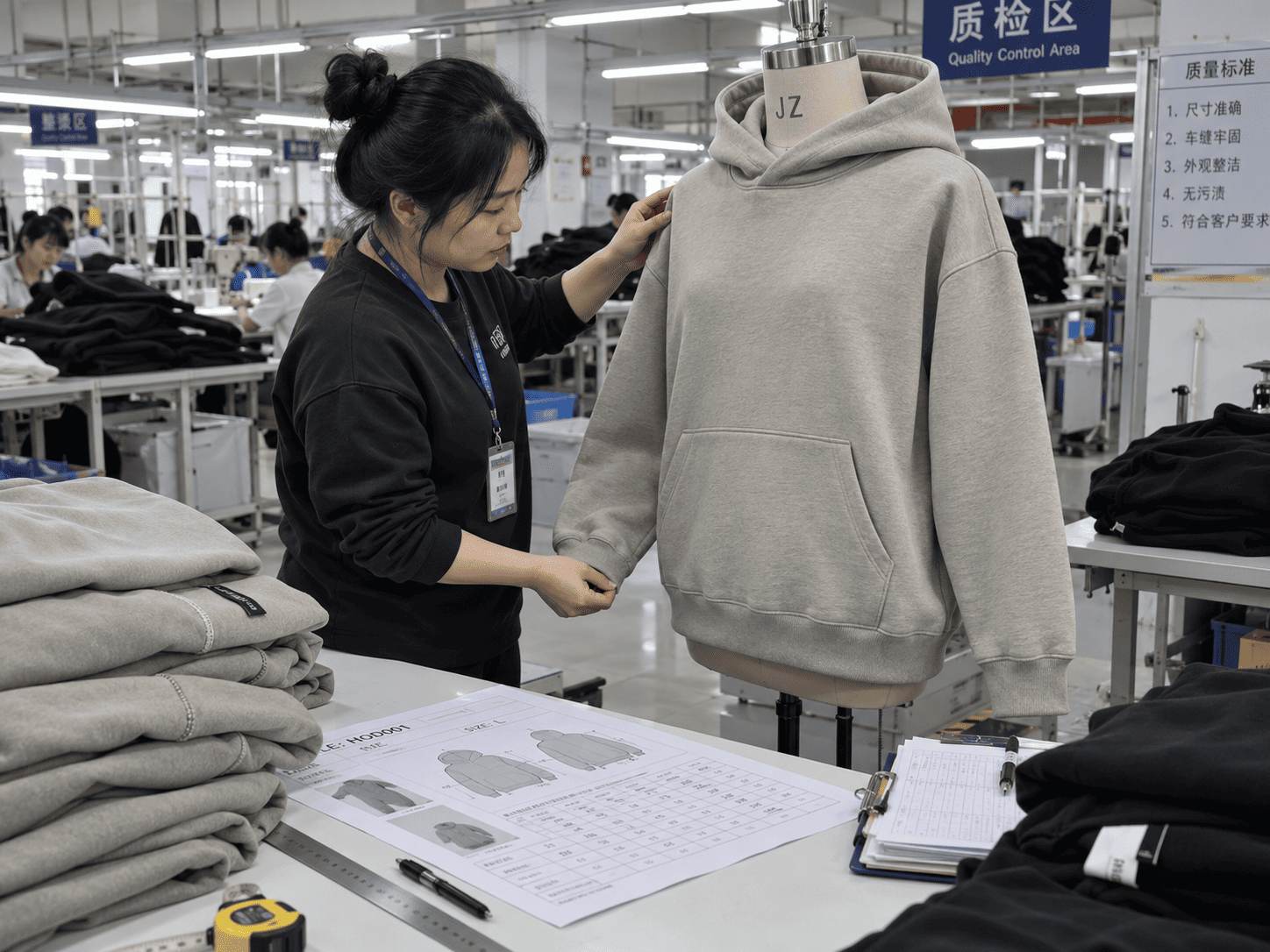
After fabric and hood structure, body details strongly affect how the hoodie ages.
Rib recovery, pocket construction, reinforcement, seam control, shoulder balance, and accurate grading often matter more to long-term quality than decorative hardware.
Rib Cuffs and Hem
Rib is one of the areas where customers quickly notice quality.
If the cuff grows after repeated stretching:
the hoodie begins to look tired.
Does More Spandex Mean Better Rib?
Not necessarily.
Elastane can help with:
- Stretch
- Recovery
but performance also depends on:
- Rib construction
- Yarn
- Elastane quality
- Finishing
- Cuff ratio
So do not write:
“5% spandex = premium rib.”
Approve the actual rib.
Cuff Ratio
The cuff circumference usually needs to work with the sleeve opening.
Too loose:
- Cuff may flare
Too tight:
- Sleeve gathers excessively
- Wrist may feel uncomfortable
There is no universal ratio for every fabric.
Rib Height
A taller cuff can create:
- Stronger streetwear look
- More stacking at the sleeve
But it changes total sleeve proportion.
So cuff height belongs in the tech pack.
Kangaroo Pocket
Important details include:
- Width
- Height
- Opening angle
- Position
- Top edge
The pocket should look proportional to the body.
Bartacks
Pocket openings receive repeated pulling.
Bartacks or another suitable reinforcement at stress points can help support:
- Pocket corners
- Openings
depending on the construction.
But reinforcement should be intentional.
Shoulder Construction
Common options:
- Set-in
- Dropped shoulder
- Raglan
For oversized streetwear, dropped shoulders are common.
But the rest of the pattern must change with them.
Dropped Shoulder and Sleeve Length
A common mistake is:
increase shoulder width
without adjusting:
- Sleeve length
- Bicep
- Cuff
- Arm balance
Then the sleeve becomes too long.
The correct solution is not simply:
“shorten every sleeve by 5 cm.”
The sleeve needs to be balanced against the intended shoulder drop.
Seam Finish
Depending on the design, sewing may include:
- Overlock
- Coverstitch
- Flatlock
- Topstitch
A visible coverstitch can create a clean visual effect.
But:
more stitching ≠ automatically higher quality.
The seam method should suit:
- Fabric
- Stretch
- Design
Neck / Shoulder Tape
Tape can help:
- Clean the inside
- Cover seams
- Add branding
But not every hoodie needs the same construction.
Pilling Matters Too
Premium perception changes quickly if the surface pills after limited wear.
ISO 12945-2:2020[^4] specifies the modified Martindale method for determining resistance to:
- Pilling
- Fuzzing
- Matting
of textile fabrics.
Pilling depends on:
- Fiber
- Yarn
- Construction
- Finish
- Friction
not simply fabric weight.
Which Trims and Finishing Details Lift the Look?
Trims can strengthen a premium design.
But they should support the garment rather than compensate for a weak base product.
Drawcords, cord tips, labels, neck tape, hangtags, packaging, and decoration can elevate the presentation, but custom trims often carry separate supplier MOQs, setup charges, and lead times. These should be confirmed for each project rather than treated as universal industry minimums.
Drawcord
Possible options:
- Round
- Flat
- Cotton
- Polyester
- Matching color
- Contrast color
Thickness should visually suit the garment.
A very thin cord on a 500 GSM streetwear hoodie may look unbalanced.
Cord Tips
Possible finishes include:
- Metal
- Silicone
- Dipped
- Knotted
- Custom molded
For our projects, custom zipper pulls or similar molded accessories may involve:
- Tooling
- MOQ
- Mold cost
depending on the design and supplier.
Do not put one universal minimum on the website.
Woven Main Label
A woven label can create a clean brand presentation.
But a printed label can also be appropriate.
The choice depends on:
- Brand aesthetic
- Comfort
- Garment
- Budget
Neck Print
For some brands, a printed neck label creates:
- Cleaner feel
- No physical label at neck
But printing should still withstand the intended laundering.
Hangtags
Hangtags may require their own supplier MOQ.
For some of our projects, a supplier may quote minimums such as:
500 pcs
but that is project-specific.
It should not be presented as a universal industry rule.
Custom Packaging
The same principle applies.
Custom:
- Polybags
- Mailers
- Boxes
can each have different:
- MOQ
- Printing setup
- Mold / plate costs
depending on the supplier.
Decoration
Premium hoodie decoration might include:
- Screen print
- DTF
- DTG
- Embroidery
- Appliqué
- Chenille
- Puff print
- Silicone
- Embossing
The “most premium” method depends on the design.
A small high-quality screen print may look better than unnecessarily complicated embroidery.
Specialist Decoration
Our core garment development, cutting, and sewing is handled through our garment production.
Specialist processes such as:
- Embroidery
- Some printing
- Appliqué
- Special decorative techniques
can be handled by long-term partner workshops that we coordinate directly.
That is more accurate than claiming every specialist process happens under one roof.
How Should a Premium Hoodie Be Tested?
A hoodie can look excellent before washing.
That is not enough.
Dimensional Change
Check:
- Body length
- Chest
- Sleeve
- Hood
using the agreed laundering method.
ISO 5077 provides the dimensional-change framework.[^2]
Rib Recovery
Stretch:
- Cuff
- Hem rib
and evaluate how well they return.
Do not rely only on fiber composition.
Pilling
For fleece and other surfaces where pilling risk matters, ISO 12945-2 provides a standardized evaluation route.[^4]
Measurement
Keep an agreed garment measurement chart.
ISO 18890 can provide a useful measurement framework.[^3]
Care Instructions
Care labels should follow actual product behavior.
For U.S. apparel, the FTC Care Labeling Rule[^5] requires covered manufacturers and importers to provide care instructions and possess a reasonable basis for them.
That means you should not automatically use:
Machine wash cold / tumble dry low
on every hoodie without considering:
- Fabric
- Decoration
- Rib
- Wash finish
Fiber Labels
For covered U.S. textile products, the FTC Textile Fiber Rule[^6] requires disclosure including:
- Generic fiber names
- Percentages by weight
- Manufacturer or marketer identity
- Country of processing or manufacture
So if your hoodie is:
80% Cotton / 20% Polyester
the supported composition should be reflected accurately.
What MOQ, Cost, and Timing Should You Expect?
Premium construction does not automatically require a huge MOQ.
But some materials and trims can create their own minimums.
For our standard hoodie programs, a practical starting MOQ is around 50 pieces per style. At 50 pieces, keeping the order to about four sizes is usually more practical. Fabric, custom colors, decoration, accessories, and trim supplier minimums can still affect the final MOQ.
Typical Hoodie Starting Point
| Item | Typical direction |
|---|---|
| Hoodie MOQ | Around 50 pcs/style |
| Practical size range at 50 pcs | Around 4 sizes |
| Sample | Usually 5–14 days |
| Bulk | Usually 20–30 days after approval |
| Payment | 50% before bulk + 50% before shipment |
These are practical ranges.
They are not guarantees for every project.
What Drives Premium Hoodie Cost?
| Cost driver | Why it matters |
|---|---|
| Fabric | Composition, GSM, finish, width |
| Oversized fit | Higher material consumption |
| Double hood | Extra fabric and sewing |
| Three-panel hood | Additional pattern/sewing |
| Rib | Custom rib specification |
| Decoration | Size, method, placements |
| Garment wash | Additional processing |
| Trims | Custom supplier costs |
| Packaging | Custom setup / MOQ |
| Colors | Fabric purchasing efficiency |
Heavier Fabric Usually Costs More—But Not Only Because of GSM
A 500 GSM fabric generally uses more material mass than a 350 GSM fabric.
But fabric price also depends on:
- Fiber
- Yarn
- Width
- Finishing
- Supplier
So you cannot calculate hoodie quality or final price from GSM alone.
Full Roll vs Small Cut
Using full rolls can sometimes give better fabric pricing.
Small cut quantities may cost more.
But do not publish:
“small cut fabric is always double the full-roll price.”
The actual premium depends on:
- Fabric supplier
- Stock availability
- Color
- Quantity
Use the real fabric quotation.
Colors Matter
Imagine:
50 hoodies in one color
vs.
50 hoodies in five colors.
The sewing MOQ is still 50 pieces.
But the fabric purchasing situation is very different.
That is why small orders usually work better with:
- Fewer colors
- More pieces per color
Custom Fabric
If the brand wants:
- Unique GSM
- Custom knit
- Special composition
- Custom dye
the fabric mill may impose a separate MOQ.
That can become the real minimum.
Sample Timing
Our standard sample timing is generally:
5–14 days
depending on:
- Fabric availability
- Construction
- Decoration
- Custom trims
Bulk Timing
For standard programs:
20–30 days
after:
- Final approval
- Deposit
- Materials ready
is a practical production range.
Custom fabric or special washing can add time.
Payment
For new bulk orders, our standard structure is:
50% before production + 50% before shipment.
What Should You Put in a Premium Hoodie Tech Pack?
If you want the factory to reproduce your design accurately, do not write:
“premium heavyweight hoodie.”
Write the actual specification.
Fabric
Example:
100% cotton French terry
400 GSM
Black
Fit
Specify:
- Chest
- Length
- Shoulder
- Sleeve
- Bottom
with tolerance.
Hood
Specify:
- Single / double layer
- Two / three panel
- Height
- Width
- Opening
- Drawcord / no drawcord
Rib
Specify:
- Composition if known
- Height
- Cuff opening
- Hem height
- Color
Specify:
- Width
- Height
- Opening
- Position
- Reinforcement
Decoration
Specify:
- Method
- Artwork
- Size
- Placement
- Colors
Labels
Specify:
- Main label
- Size label
- Care label
- Country-of-origin information as required
Packaging
Specify:
- Standard or custom
- Fold method
- Sticker
- Barcode
- Hangtag
When these points are documented, the factory does not have to guess what:
“premium”
means to your brand.
Green Flags and Red Flags
| Green flag | Red flag |
|---|---|
| Asks what “premium” means to your brand | Says 500 GSM automatically means premium |
| Provides actual fabric specs | Talks only about GSM |
| Tests dimensional change | Promises zero shrinkage |
| Develops hood shape | Uses the same hood on every fit |
| Checks rib recovery | Judges rib only by spandex % |
| Defines garment POMs | Sizes by vague S/M/L references |
| Reinforces stress points where needed | Adds no reinforcement |
| Explains specialist processes honestly | Claims every process is in-house |
| Confirms trim MOQ per supplier | Publishes one MOQ for every trim |
| Uses actual fabric quotes | Says small fabric cuts always cost exactly 2× |
| Gives evidence-based care instructions | Copies one wash label to every hoodie |
Conclusion
A premium hoodie is not created by one number.
Not:
500 GSM.
Not:
100% cotton.
Not:
three-panel hood.
Not:
metal tips.
Any one of those details can be useful.
None of them guarantees a premium garment.
Start with the fabric.
Choose the:
- Composition
- GSM
- Knit structure
- Finish
that support the intended product.
Then test dimensional behavior.
Pre-shrunk fabric can help.
It does not mean zero shrinkage.
Next, develop the hood.
Decide:
- Volume
- Height
- Opening
- Layers
- Panel construction
based on the garment.
Then look at the rib.
A premium-looking cuff should maintain the intended shape after use.
Do not select it only because the supplier says:
“This one contains spandex.”
Then develop the body:
- Shoulder
- Sleeve
- Chest
- Hem
- Seams
as one pattern.
If you use dropped shoulders, adjust the sleeve accordingly.
Then choose trims.
Drawcords, labels, neck tape, hangtags, and packaging should reinforce the design.
They should not be the only reason the garment looks expensive.
Finally:
write everything down.
Because if the tech pack only says:
“premium hoodie, heavy cotton”
the factory still has to make dozens of decisions for you.
A premium hoodie is the result of those decisions being made deliberately.
That is the difference between a hoodie that only looks good in the first product photo and one that still feels like your brand after the customer has worn and washed it.
Footnotes & References
[^1]: ASTM International — ASTM D3776/D3776M-20(2025), Standard Test Methods for Mass Per Unit Area (Weight) of Fabric. The active ASTM standard covers methods for determining fabric mass per unit area and is applicable to most textile fabrics.
https://store.astm.org/d3776_d3776m-20r25.html
[^2]: International Organization for Standardization — ISO 5077:2007, Textiles — Determination of Dimensional Change in Washing and Drying. Specifies a method for determining dimensional change in fabrics, garments, and other textile articles following specified washing and drying procedures. ISO reviewed and confirmed the standard in 2022, so it remains current.
https://www.iso.org/standard/41877.html
[^3]: International Organization for Standardization — ISO 18890:2018, Clothing — Standard Method of Garment Measurement. Defines major measurement points and methods for measuring finished garments and allows additional measurement points to be agreed between interested parties. ISO reviewed and confirmed the standard in 2024, so it remains current.
https://www.iso.org/standard/63693.html
[^4]: International Organization for Standardization — ISO 12945-2:2020, Textiles — Determination of Fabric Propensity to Surface Pilling, Fuzzing or Matting — Part 2: Modified Martindale Method. Specifies a modified Martindale method for evaluating resistance to pilling, fuzzing, and matting.
https://www.iso.org/standard/75375.html
[^5]: U.S. Federal Trade Commission — Care Labeling Rule, 16 CFR Part 423. Requires manufacturers and importers of covered textile apparel to provide regular-care instructions and maintain a reasonable basis for those instructions.
https://www.ftc.gov/legal-library/browse/rules/care-labeling-textile-wearing-apparel-certain-piece-goods
[^6]: U.S. Federal Trade Commission — Textile Fiber Rule, 16 CFR Part 303. Requires covered textile products sold in the United States to disclose generic fiber names and percentages by weight, the manufacturer or marketer identity, and the country where the product was processed or manufactured.
https://www.ftc.gov/legal-library/browse/rules/textile-fiber-rule