

Clothing Manufacturer Warehousing and Fulfillment: Can Your Factory Store and Ship Orders for You?
Your first 300 hoodies are finished.
Production went well.
But now you have another problem:
Where do you put them?
Your apartment is too small.
Renting a warehouse makes no sense yet.
A local fulfillment company wants receiving fees, storage fees, and minimum monthly volume.
So you ask your manufacturer:
“Can you just keep my stock and ship orders when I sell them?”
Sometimes, yes.
But warehousing and fulfillment are very different from simply making garments.
Factory warehousing means your manufacturer keeps finished inventory after production. Factory fulfillment means that stock can later be picked, packed, and shipped in batches—or, where the logistics and import rules make sense, directly to individual customers. It can be useful for small brands and test launches, but delivery speed, customs, duties, tax, returns, inventory accuracy, and fulfillment responsibility all need to be planned before you choose this model.
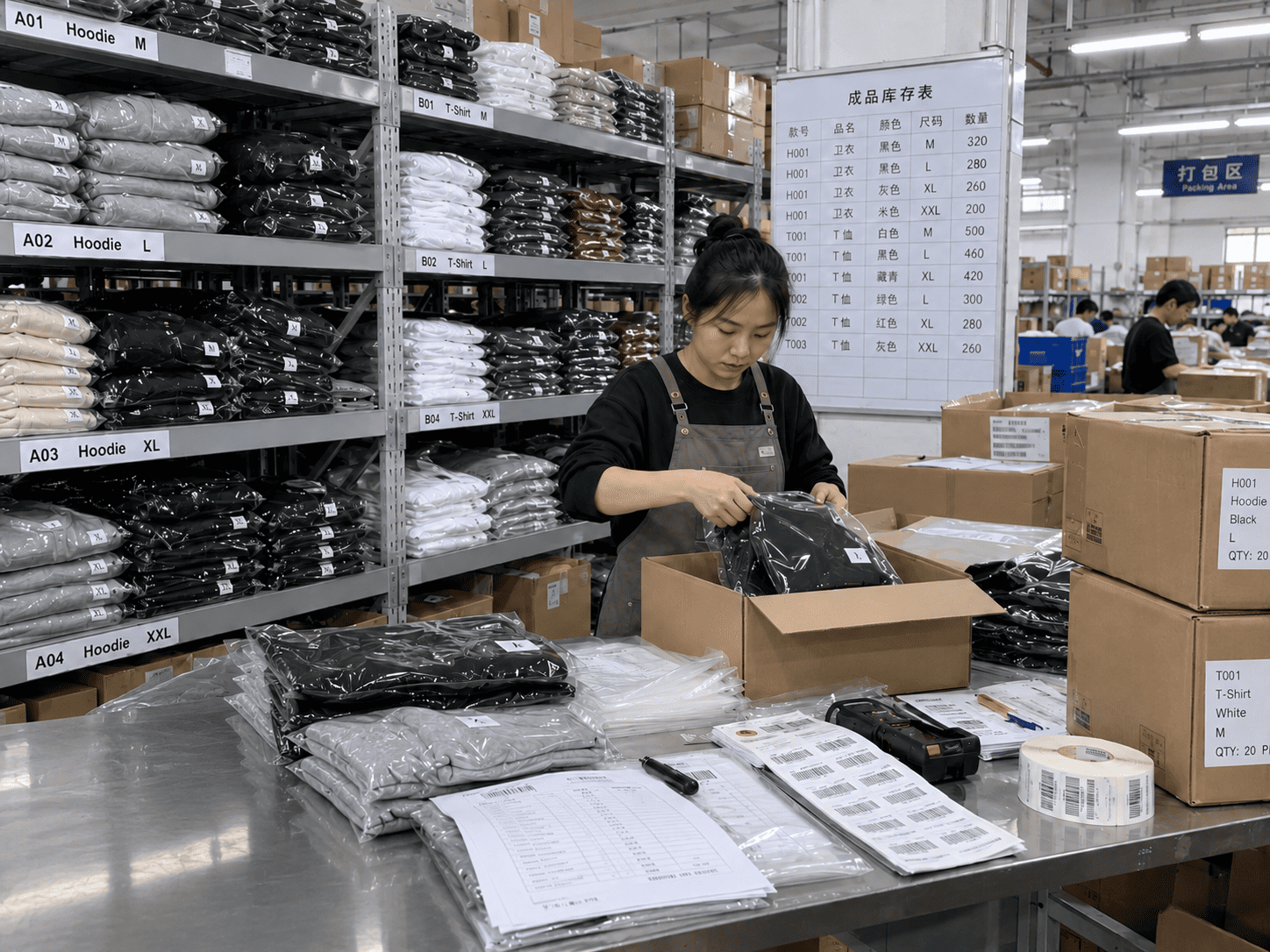
Outsourced fulfillment itself is a large and growing business.
According to Fortune Business Insights[^1], the global e-commerce fulfillment services market is estimated at approximately USD 40.2 billion in 2026 and projected to reach about USD 115.68 billion by 2034.
But for a clothing brand, the important question is not:
“Should I outsource fulfillment?”
It is:
“Where should my inventory sit, and who should ship it?”
That answer can change as the brand grows.
Table of Contents
- What Does Factory Warehousing and Fulfillment Mean?
- When Does Shipping Directly from the Factory Make Sense?
- How Does Factory Fulfillment Compare With a 3PL in Your Market?
- How Do Storage and Fulfillment Fees Work?
- What Should You Plan Before Using Factory Fulfillment?
- Which Risks Should You Watch For?
- Conclusion
What Does Factory Warehousing and Fulfillment Mean?
These terms are often mixed together.
They are related, but not identical.
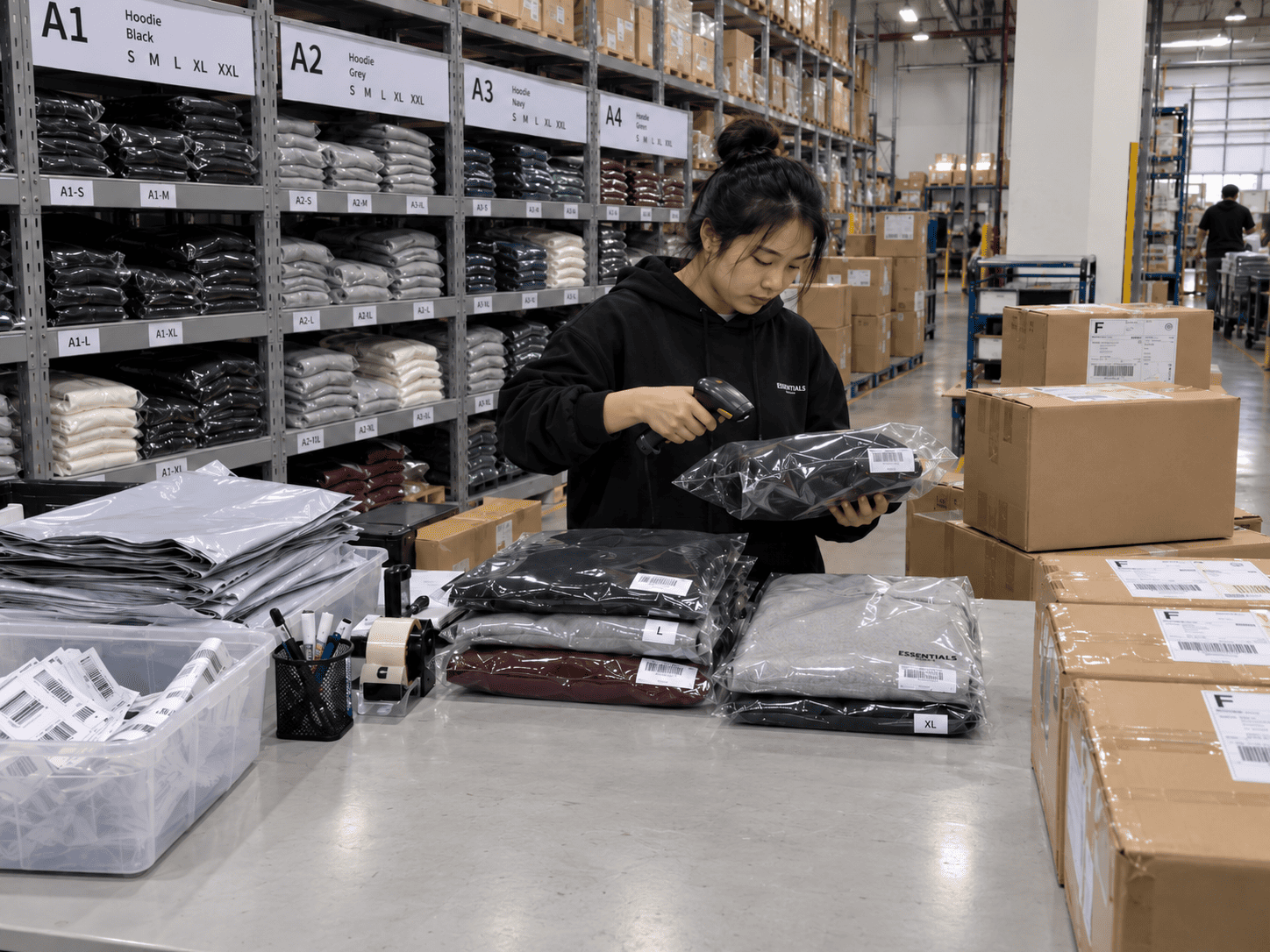
Warehousing means holding finished stock. Fulfillment means receiving an order, locating the correct SKU and size, picking the item, packing it, generating shipping information, handing it to a carrier, and updating inventory.
Storage Only
The simplest model is:
- Factory finishes your bulk order.
- Goods remain stored in China.
- You request stock later.
- Factory sends cartons in batches.
This can be useful if you do not want all inventory shipped immediately.
Batch Shipping
For example:
Production: 1,000 hoodies
First shipment:
300 pcs by air
Second shipment:
400 pcs by sea
Remaining:
300 pcs stored temporarily
This can help a brand:
- Control cash flow
- Replenish gradually
- Avoid sending all stock at once
Direct-to-Customer Fulfillment
A more complex model is:
Customer places an order on your website.
Factory receives order information.
Factory picks:
Black Hoodie
Size L
then packs and ships one parcel directly to the customer.
This creates very different requirements from bulk export.
Typical Post-Production Services
| Service | What happens |
|---|---|
| Storage | Finished inventory remains at the supplier |
| Batch release | Several cartons are shipped when requested |
| Pick and pack | Individual SKUs are selected and packed |
| Direct shipping | Parcel is shipped to the end customer |
| Custom packing | Inserts, stickers, branded bags or boxes are added |
| Inventory reporting | Remaining stock is reported by SKU |
| Relabeling / kitting | Products may be grouped or prepared for a specific order |
Factory Storage Is Not Automatically a Professional 3PL
This distinction matters.
A garment manufacturer may be very good at:
- Sewing
- QC
- Packing bulk cartons
without having the systems of a dedicated fulfillment warehouse.
A professional 3PL may use:
- Barcode scanning
- Warehouse management software
- Automated inventory updates
- Carrier integrations
- Formal return processing
So ask exactly what your factory's fulfillment service includes.
For our clients, inventory holding and smaller shipment releases can be arranged depending on the project, with packing and shipping requirements confirmed before the stock is stored.
When Does Shipping Directly from the Factory Make Sense?
Factory fulfillment can work well.
But not for every brand.
Direct shipping from the factory is most useful when order volume is still manageable, delivery speed is not the brand's main promise, and the economics of international parcel shipping, customs, duties, and tax have been checked for the destination market.
Good Use Case: Pre-Orders
Suppose a creator launches:
200 hoodies
as a pre-order.
Customers already understand that fulfillment may take longer.
The garments can be produced and shipped after the drop closes.
That can make overseas fulfillment more practical.
Good Use Case: Test Drop
You are testing a new design.
You do not know whether you will sell:
20 pieces
or:
200.
Holding stock closer to production may reduce the need to import a large quantity before demand is proven.
Good Use Case: Slow-Moving Styles
A brand may move:
best sellers → local warehouse
and keep:
slow styles → factory inventory
for longer.
That creates a hybrid inventory model.
Poor Use Case: Next-Day Delivery
If your website promises:
Next-day delivery
to U.S. customers, shipping every parcel internationally from China is unlikely to fit that customer experience.
A local 3PL is usually better positioned for fast domestic delivery.
Poor Use Case: High Daily Order Volume
If the brand is processing hundreds or thousands of consumer orders every day, fulfillment becomes a specialized logistics operation.
At that point, you may need:
- WMS integration
- Automated order syncing
- Carrier selection
- Returns processing
- Service-level agreements
A garment production team should not automatically replace a professional fulfillment network.
Delivery Promises Need to Be Realistic
For U.S. online sales, the FTC Mail, Internet, or Telephone Order Merchandise Rule[^2] requires sellers to have a reasonable basis for the shipping timeframe they advertise.
If no shipping timeframe is stated, the Rule generally requires a reasonable basis to expect shipment within 30 days.[^2]
So do not advertise:
“ships in 24 hours”
unless your fulfillment setup can actually support that promise.
How Does Factory Fulfillment Compare With a 3PL in Your Market?
A 3PL is a third-party logistics provider.
It normally specializes in:
- Receiving stock
- Warehousing
- Inventory control
- Pick and pack
- Parcel shipping
- Returns
Factory fulfillment can reduce the need to move all stock into your market immediately, while a local 3PL can provide faster domestic delivery, easier returns, and stronger fulfillment systems. Neither model is automatically cheaper; the answer depends on order volume, parcel weight, customs, tax, destination, storage duration, and service level.
Factory Fulfillment vs Local 3PL
| Factor | Factory fulfillment | Local-market 3PL |
|---|---|---|
| Initial bulk import | May be delayed or reduced | Usually required |
| Customer delivery | International | Domestic after import |
| Delivery speed | Usually slower | Usually faster |
| Customs process | Cross-border parcel rules apply | Bulk import first |
| Returns | More difficult internationally | Easier locally |
| Inventory system | Depends on factory | Often more advanced |
| Small test drops | Can work well | May carry minimum fees |
| High order volume | Less suitable unless systemized | Often better suited |
| Best sellers | Possible | Often better locally |
| Slow styles | Can stay at factory | Storage may become expensive |
“Each Parcel Is Its Own Import” Needs More Explanation
When goods are shipped individually from China to consumers in another country, those shipments are still subject to the destination country's import rules.
But the exact:
- Entry process
- Tax
- Duty
- Carrier handling
- Consumer liability
depends on the market and shipping model.
Do not assume that small parcels are automatically:
duty free.
United States: Low-Value Rules Changed
This is especially important now.
U.S. Customs and Border Protection[^3] states that, effective August 29, 2025, general duty-free de minimis treatment previously available for qualifying low-value imports was suspended for shipments from all countries, subject to current rules and applicable exceptions.
Affected imported goods may therefore be subject to:
- Duties
- Taxes
- Fees
- Customs entry requirements
depending on the shipment method and applicable rules.[^3]
That materially changes the economics of shipping single apparel orders directly from China to U.S. consumers.
European Union: Do Not Assume €150 Means Duty-Free
EU e-commerce rules have also changed.
The European Commission's 2026 guidance[^4] states that from July 1, 2026, the previous customs-duty exemption for qualifying low-value imported consignments was removed under the new arrangement, with a temporary €3 customs duty per item applying to certain distance sales of imported goods under the specified rules.
VAT rules also remain relevant.
The EU's Import One Stop Shop, or IOSS[^5], provides a simplified mechanism for VAT declaration and payment for qualifying distance sales of imported goods in consignments not exceeding €150.
So a brand shipping directly from China to EU consumers needs to plan:
- VAT
- Customs
- Carrier process
- IOSS where applicable
- Customer checkout experience
rather than simply calculating postage.
Import Rules Can Change
This is why fulfillment should not be selected only from an old YouTube video saying:
“Anything under X value is duty free.”
Check the current destination-market rules before launching.
Hybrid Fulfillment
For many brands, the most practical model is not:
factory or 3PL.
It is:
factory and 3PL.
For example:
Factory
- Backup inventory
- Pre-orders
- Slow-moving colors
U.S. 3PL
- Core black hoodie
- Best-selling sizes
- Fast domestic orders
That lets the brand balance:
- Speed
- Inventory risk
- Freight cost
How Do Storage and Fulfillment Fees Work?
A fulfillment quote usually contains several different charges.
The total fulfillment cost can include storage, receiving or stock handling, picking, packing, packaging materials, postage, special handling, returns, relabeling, and customs-related charges. Ask for each fee separately rather than comparing only one “fulfillment price.”
Storage Fee
Storage may be charged by:
- Carton
- Cubic meter
- Pallet
- Shelf space
- Month
A factory may use a simpler system than a professional warehouse.
Pick and Pack
This covers:
- Finding the SKU
- Checking the size
- Packing the order
- Preparing shipment
Some providers charge:
per order.
Others:
first item + additional item.
Packaging
Standard options:
- Polybag
- Courier bag
- Shipping carton
Custom options:
- Branded mailer
- Box
- Tissue
- Sticker
- Thank-you card
add cost.
Postage
For international direct fulfillment, postage can become one of the largest costs.
A heavyweight hoodie may weigh several times more than a lightweight tee.
That changes:
- Express price
- Postal price
- Air parcel economics
Special Handling
Examples:
- Gift note
- Bundle
- Folding requirement
- Barcode label
- Relabeling
- Promotional insert
Every manual step adds work.
Return Handling
A local 3PL may charge:
- Return receipt
- Inspection
- Rebagging
- Restocking
A factory may not have a formal returns workflow at all.
Ask before you launch.
What Should You Plan Before Using Factory Fulfillment?
The most important work happens before the first consumer order arrives.
1. Create SKU Logic
Do not store:
“Black Hoodie”
as one inventory item.
You need something like:
DC-H01-BLK-S
DC-H01-BLK-M
DC-H01-BLK-L
DC-H01-BLK-XL
Now every:
- Style
- Color
- Size
can be counted separately.
2. Confirm Size Breakdown
For smaller runs, too many sizes can fragment inventory badly.
For example:
50 garments across:
8 sizes
may leave only a few units in each size.
For our low-MOQ hoodie programs, 50 pieces are normally more practical across up to around four sizes, while a wider size range may work better at a higher total quantity.
The exact ratio should still follow your customer data.
3. Decide Packaging Before Production Ends
Will the product stay in:
standard polybag
until an order arrives?
Or should each garment already be packed in:
- Branded bag
- Retail box
- Shipping-ready packaging
?
That decision affects warehouse labor.
4. Decide How Orders Reach the Factory
Possible systems include:
- Spreadsheet
- Daily order file
- Shared system
- API integration
A small creator drop may work perfectly well with:
a daily order list.
A larger operation needs stronger automation.
5. Define the Data Fields
Each order should clearly show:
- Order number
- SKU
- Quantity
- Customer name
- Address
- Postal code
- Phone where required
- Shipping channel
- Special instruction
Missing data creates failed deliveries.
6. Confirm the Shipping Channel
Do you want:
- Express
- Postal
- Economy parcel
?
One channel will not necessarily be best for every country.
7. Define Who Pays Duties and Taxes
This needs to be clear before customers order.
Possible structures may result in:
- Seller paying
- Customer paying
- Tax collected at checkout
- Carrier collecting on import
depending on the destination and sales setup.
This is one reason logistics and tax advice should be confirmed for the markets you actually sell into.
8. Understand Incoterms®
The ICC Incoterms® 2020 rules[^6] clarify the allocation of:
- Tasks
- Costs
- Risks
between seller and buyer in contracts for delivery of goods.
Incoterms® 2020 remains the current ICC edition.[^6]
But one important point:
Incoterms® are primarily commercial delivery terms between seller and buyer.
They do not replace:
- Consumer returns policy
- VAT rules
- Customs law
- Marketplace rules
So do not treat:
DDP
as a complete fulfillment strategy by itself.
9. Set Inventory Reporting
At minimum, stock reports should track:
| Field | Example |
|---|---|
| Style | DC-H01 |
| Color | Black |
| Size | L |
| Starting stock | 50 |
| Shipped | 17 |
| Reserved | 3 |
| Available | 30 |
Without size-level reporting, overselling becomes very easy.
10. Define Report Frequency
Depending on volume:
- Per shipment
- Daily
- Weekly
may be appropriate.
A brand selling five pieces per week does not need the same system as one selling 500 per day.
How Should Returns Work?
Returns are one of the biggest differences between factory fulfillment and local fulfillment.
Returning Every Item to China May Be Inefficient
For a low-value garment, international return shipping can cost more than the product margin.
But that does not mean the answer should automatically be:
“refund without return.”
Brands need a return policy based on:
- Product value
- Fraud risk
- Local consumer law
- Marketplace rules
- Reason for return
Local Return Address
A brand may use:
- Its own office
- Returns partner
- 3PL
- Local consolidation address
for consumer returns.
Returned stock can then be:
- Restocked
- Inspected
- Consolidated
- Liquidated
depending on condition.
Quality Defect vs Customer Preference
These are different.
Quality defect
- Broken zipper
- Printing issue
- Wrong garment
Preference return
- Wrong size ordered
- Changed mind
Your workflow may treat them differently.
Which Risks Should You Watch For?
Factory fulfillment can be very useful.
But it puts:
production + stock + shipping
into one supplier relationship.
That increases the importance of controls.
Risk 1: Poor Inventory Visibility
This is probably the first operational risk.
If the factory says:
“We have about 100 left.”
that is not enough.
You need:
style + color + size.
Risk 2: Wrong SKU
Shipping:
M instead of L
is not a manufacturing defect.
It is a fulfillment error.
The warehouse needs a picking process.
Risk 3: International Delivery Delays
Consumer parcel networks can experience:
- Customs delay
- Address problems
- Carrier delay
- Peak-season congestion
So delivery promises need margin.
Risk 4: Unexpected Duty or Tax
This is increasingly important because rules have changed in major markets.
A consumer who expected:
$20 shipping
and then receives an unexpected import charge may blame the brand.
Risk 5: Storage Damage
Finished garments should be protected from:
- Moisture
- Dust
- Crushing
- Contamination
Long-term stock should not simply remain in loose production piles.
Risk 6: Old Inventory
Warehousing can hide a production-planning problem.
If you made:
2,000 pieces
and sell:
20 per month,
cheap storage does not solve the overstock.
Risk 7: Returns With No System
If the website accepts returns but nobody knows where they go, the problem appears only after launch.
Risk 8: One Partner Holds Everything
If one supplier:
- Makes
- Stores
- Packs
- Ships
all of your inventory, define what happens if the relationship ends.
Can the remaining stock be:
- Counted
- Released
- Shipped to another warehouse
without difficulty?
Put that process in writing.
Factory Fulfillment vs Local 3PL: Which Should You Choose?
There is no universal winner.
Start With Factory Fulfillment When:
- You are testing demand
- Order volume is low
- Customers accept longer shipping
- Inventory risk is more important than delivery speed
- Your destination-market customs economics work
Move More Stock to a Local 3PL When:
- Daily order volume rises
- Fast delivery becomes important
- Returns become frequent
- You need marketplace integrations
- You need stronger inventory automation
- International parcel costs become inefficient
Use a Hybrid Model When:
- You have clear best sellers
- Some styles sell slowly
- You still run pre-orders
- You want backup stock at the source
For many growing brands, this is the most flexible structure.
Green Flags and Red Flags
| Green flag | Red flag |
|---|---|
| Stock reported by SKU and size | “About 100 pieces left” |
| Storage fees agreed in advance | Fees decided later |
| Packing fees clearly defined | Vague fulfillment price |
| Shipping quoted by destination | One price for every country |
| Customs responsibility discussed | Assumes small parcels are tax-free |
| Gives realistic delivery times | Promises domestic speed from overseas |
| Has a picking/checking process | Ships from handwritten memory |
| Defines return workflow | No plan for returns |
| Protects stored inventory | Goods left loose |
| Can release remaining stock | Supplier makes stock transfer difficult |
| Supports hybrid fulfillment | Insists all stock must stay in one place |
Conclusion
Factory warehousing can solve a real problem for a growing clothing brand.
You manufacture:
300 hoodies.
You do not need:
a warehouse.
You may not yet need:
a full local 3PL contract.
Keeping some inventory with the manufacturer can give you flexibility.
But storage is the easy part.
The difficult part is:
fulfillment.
Once individual customer orders are involved, you need to think about:
- SKU accuracy
- Packing
- Shipping channels
- Delivery time
- Customs
- Duties
- VAT or sales tax
- Returns
- Inventory reporting
And in 2026, cross-border parcel rules deserve special attention.
Do not build a direct-from-China fulfillment model based on old assumptions that low-value parcels automatically enter major markets duty free.
Rules in both the United States and European Union have changed.
Check the actual destination before launch.
Then decide where each type of stock should sit.
Maybe:
new drops stay at the factory.
Maybe:
best sellers move to your U.S. or European 3PL.
Maybe:
pre-orders ship internationally while everyday basics ship domestically.
There is nothing wrong with changing the model as the brand grows.
In fact, that is usually the point.
Factory fulfillment can be a bridge between:
“I have boxes in my bedroom”
and:
“I operate a full professional logistics network.”
The right setup is not the one with the lowest storage fee.
It is the one that gives your customer a predictable experience while keeping your inventory risk and total fulfillment cost under control.
Footnotes & References
[^1]: Fortune Business Insights — E-Commerce Fulfillment Services Market. The report estimates the global e-commerce fulfillment services market at approximately USD 40.2 billion in 2026 and projects it to reach approximately USD 115.68 billion by 2034.
https://www.fortunebusinessinsights.com/e-commerce-fulfillment-services-market-117965
[^2]: U.S. Federal Trade Commission — Mail, Internet, or Telephone Order Merchandise Rule, 16 CFR Part 435. The Rule requires sellers to have a reasonable basis for the shipping timeframe they advertise. If no shipping timeframe is stated, sellers generally need a reasonable basis to expect shipment within 30 days. If shipment cannot be made as promised, delay-notification and refund obligations may apply.
https://www.ftc.gov/legal-library/browse/rules/mail-internet-or-telephone-order-merchandise-rule
[^3]: U.S. Customs and Border Protection — Duty Treatment for Low-Value Imports. CBP states that effective August 29, 2025, general duty-free de minimis treatment for low-value imports was suspended for shipments from all countries, subject to applicable exceptions and current entry requirements. Brands using direct-to-consumer cross-border fulfillment should confirm current duties, taxes, fees, carrier requirements, and customs procedures before launch.
https://www.help.cbp.gov/s/article/Article-1902
https://www.cbp.gov/sites/default/files/2025-08/factsheet_suspension_of_duty-free_de_minimis_treatment.pdf
[^4]: European Commission — EUR 3 Customs Duty / VAT Guidelines for E-Commerce Imports. European Commission guidance explains the customs treatment introduced from July 1, 2026 for certain low-value e-commerce imports, including the temporary EUR 3 customs duty arrangement for qualifying distance sales under the new rules.
https://vat-one-stop-shop.ec.europa.eu/eur-3-customs-duty-vat-guidelines-2026-06-16_en
[^5]: European Commission — VAT e-Commerce / Import One Stop Shop. The IOSS system provides a simplified mechanism for VAT declaration and payment for qualifying distance sales of imported goods in consignments not exceeding EUR 150. Applicable VAT, customs, and intermediary requirements depend on the seller and transaction structure.
https://vat-one-stop-shop.ec.europa.eu/index_en
https://taxation-customs.ec.europa.eu/customs/customs-procedures-import-and-export/customs-operations/customs-formalities-low-value-consignments_en
[^6]: International Chamber of Commerce — Incoterms® 2020. ICC's Incoterms® rules clarify the allocation of tasks, costs, obligations, delivery responsibilities, and risk between sellers and buyers under international and domestic sales contracts. Incoterms® 2020 remains the current edition.
https://iccwbo.org/business-solutions/incoterms-rules/
https://iccwbo.org/business-solutions/incoterms-rules/incoterms-2020/