

Double Brushed Fabric Clothing Manufacturer: How Do You Make Buttery-Soft Clothing That Lasts?
Your customer sends you a pair of leggings and says:
“I want this exact buttery-soft feel.”
You ask the factory for something similar.
The sample arrives.
The fabric is smooth.
It stretches well.
The composition looks right.
But the hand feel is completely different.
It feels more like normal performance jersey than the soft, matte, peached fabric in the reference.
Then you learn the difference:
the softness was not created by polyester alone.
It came from the surface finishing process.
Double brushed fabric is a textile construction that has been mechanically brushed on both sides to raise fibers at the surface and create a softer, more matte, peached hand. The final result depends on the base fabric, yarn, knit structure, brushing intensity, stretch and recovery, dyeing, finishing, and wash performance—not simply the words “double brushed” on a fabric card.
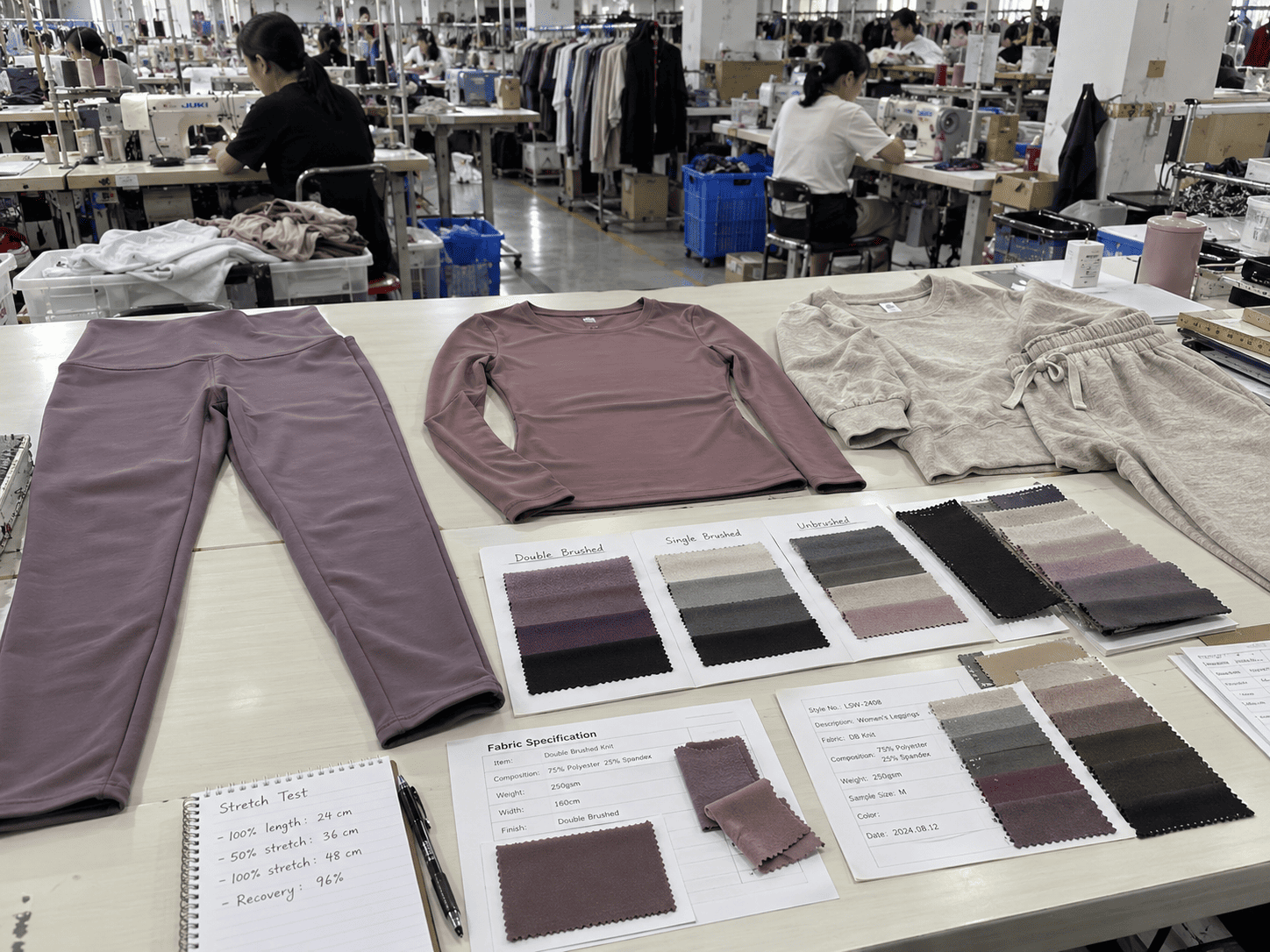
Double brushed fabrics are especially common in soft:
- Leggings
- Women's basics
- Lounge sets
- Dresses
- Kids' garments
and other comfort-led products.
Polyester is frequently used as the base fiber in this category.
According to Textile Exchange's Materials Market Report 2025[^1], around 132 million tonnes of fiber were produced globally in 2024, with polyester accounting for approximately 59% of total global fiber production.
But polyester content alone does not create the soft hand.
The finish matters.
Table of Contents
- What Is Double Brushed Fabric?
- Which Products Work Best in Double Brushed Fabric?
- How Does Brushing Change Printing and Color?
- Why Can Samples and Bulk Feel Different?
- How Do You Prevent Pilling and Other Quality Problems?
- What MOQ, Cost, and Timing Should You Expect?
- Conclusion
What Is Double Brushed Fabric?
The word double brushed describes a surface finish.
It does not define one universal fiber composition.
Double brushed fabric is typically a knitted fabric that has been brushed on both the face and the back. The brushing process raises fibers at the surface, producing a soft, low-luster, peached feel. Polyester/elastane is common, but other suitable textile constructions can also be brushed.
Brushing Is a Finishing Process
The base fabric is usually knitted first.
Then it may go through processes such as:
- Dyeing
- Heat setting
- Brushing
- Finishing
depending on the fabric program.
During brushing, the surface is mechanically treated so small fibers are raised from the textile structure.
That changes:
- Touch
- Surface appearance
- Light reflection
- Friction
- Print appearance
What Does “Buttery Soft” Mean?
“Buttery soft” is a marketing description.
It is not a standardized textile specification.
Two suppliers can both call a fabric:
buttery soft
and provide very different products.
One may feel:
- Smooth
- Silky
- Cool
Another:
- Peached
- Warm
- Matte
So if your brand cares about the exact hand feel, do not approve fabric from wording alone.
Approve:
a physical swatch.
Single Brushed vs Double Brushed
| Fabric direction | Surface treatment | Typical hand |
|---|---|---|
| Unbrushed knit | Neither side brushed | Smooth |
| Single brushed | One side brushed | Soft on one side |
| Double brushed | Both sides brushed | Soft inside and outside |
| Brushed-back fleece | Back surface raised more heavily | Fluffy inside |
| Peached fabric | Light surface finishing | Fine suede-like hand |
These categories can overlap in commercial terminology.
That is why the mill's:
- Fabric specification
- Physical swatch
- Finish reference
matter more than the marketing name.
Is Double Brushed Always Polyester/Spandex?
No.
Polyester/elastane is common because it can work well for:
- Stretch garments
- Printing
- Leggings
- Lounge products
But:
double brushed = finishing method
not:
double brushed = one fixed fiber recipe.
The exact fabric may vary in:
- Fiber composition
- GSM
- Knit structure
- Elastane percentage
- Width
- Finish
What Does Elastane Do?
Elastane can contribute:
- Stretch
- Recovery
But the percentage alone does not tell you how the fabric performs.
A fabric with:
8% elastane
is not automatically better at recovery than another fabric with:
5%.
Performance depends on:
- Elastane quality
- Yarn system
- Knit construction
- Heat setting
- Finishing
For stretch fabrics, ISO 20932-1:2018[^2] provides test methods that can be used to evaluate fabric elasticity and related properties.
That is more useful than judging recovery only by composition.
Which Products Work Best in Double Brushed Fabric?
The biggest advantage of double brushed fabric is usually:
comfort.
The soft surface works particularly well for garments worn close to the body.
Double brushed fabrics can work well for leggings, fitted tops, lounge sets, dresses, soft basics, and selected children's garments. Whether the fabric is appropriate for yoga, training, compression, or other performance applications depends on the actual textile properties—not the brushed finish alone.
Leggings
This is one of the best-known applications.
The fabric can create:
- Soft hand
- Matte appearance
- Comfortable wear
But leggings need more than softness.
Check:
- Stretch
- Recovery
- Opacity
- Waistband stability
- Pilling
- Dimensional stability
Lounge Sets
Double brushed fabrics can work naturally for:
- Long-sleeve top + pant
- Tee + short
- Tank + lounge pant
because the fabric usually creates:
- Soft hand
- Fluid drape
- Comfortable skin contact
Women's Tops
Possible products include:
- Fitted tees
- Long sleeves
- Tanks
- Bodysuit-style tops
Again, recovery becomes important.
If the garment stretches across the body and does not recover well, the fit may begin to look loose.
Dresses
A softer brushed knit may create:
- Flow
- Drape
- Matte surface
for fitted or relaxed dresses.
Children's Clothing
Softness can make the material attractive for kids' products.
But softness alone does not prove:
- Safety
- Hypoallergenic properties
- Suitability for sensitive skin
Children's garments still need the appropriate:
- Construction
- Trim safety
- Labeling
- Testing
for their target market.
Is Double Brushed Good for Yoga?
It can be.
But “yoga fabric” is not a technical specification.
A yoga legging still needs the right:
- Stretch
- Recovery
- Opacity
- Waist stability
Some double-brushed fabrics work very well.
Others may feel too soft or lack the desired hold.
What About Compression?
Be careful with this word.
A high elastane percentage or tight-fitting double-brushed fabric does not automatically mean:
compression fabric.
Actual garment compression depends on:
- Fabric force
- Pattern
- Negative ease
- Construction
If your brand wants a firm-hold activewear product, test the actual fabric and fit.
Do not make medical or therapeutic compression claims without appropriate evidence.
High-Intensity Training
A brushed fabric is not automatically unsuitable for training.
But the brushed surface may change:
- Moisture feel
- Drying experience
- Friction
compared with a smoother performance knit.
So instead of saying:
double brushed is bad for high-intensity training
say:
test the actual textile for the intended activity.
That is much more accurate.
How Does Brushing Change Printing and Color?
Brushing changes the surface of the textile.
That can influence how color and printed artwork are perceived.
Because brushing changes surface texture and light reflection, a brushed fabric can appear different from the same or similar color on a smooth fabric. Printed edges may also look softer depending on the printing method, pile height, fabric construction, and order of processing.
Does Brushing Always Make Color Lighter?
No.
That is too absolute.
Brushing can make the surface appear:
- Softer
- More matte
- Less sharp
because raised fibers change how light reflects from the surface.
But the actual visual result depends on:
- Fiber
- Dye
- Color
- Brush intensity
- Fabric construction
- Lighting
A black brushed fabric might appear visually different from a smooth black.
That does not mean every brushed fabric becomes a fixed percentage lighter.
Physical Color Approval Matters
Do not approve brushed fabric color from:
- Phone screen
- Photoshop
- Digital artwork alone
Use a physical reference whenever color matters.
The same principle applies when working with Pantone standards:
the target color and the actual textile still need physical evaluation on the real material.
Print Sharpness
A raised surface can visually soften:
- Fine lines
- Tiny lettering
- Very small detail
depending on the printing process.
That does not mean detailed artwork is impossible.
It means:
test it on the final fabric.
All-Over Print
This is where process order becomes very important.
Different factories and fabric mills may use different workflows.
For example:
- Knit fabric
- Dye or prepare base
- Brush / finish
or another approved sequence.
The correct order depends on the:
- Fiber
- Printing method
- Finish
- Desired hand
So avoid the universal statement:
“double brushed fabric is always brushed first and then printed.”
That is not true for every program.
Sublimation
Traditional sublimation works especially well with suitable polyester substrates.
It is widely used for:
- All-over prints
- Sportswear
- Printed leggings
But do not say:
cotton cannot be printed all over
as an absolute rule.
Other technologies can print cotton.
The key point is that traditional dye sublimation is primarily suited to polyester-based substrates, while other fibers need different print systems.
Artwork Should Be Approved on the Final Surface
For an all-over printed brushed legging, do not approve only:
- Original artwork
- Smooth base fabric
Approve:
the closest possible printed and finished fabric reference.
That reduces surprise around:
- Color
- Detail
- Surface appearance
Why Can Samples and Bulk Feel Different?
This is one of the most important commercial issues with custom fabric.
A garment sample may use available stock fabric.
Bulk production may use fabric produced specifically for the order.
Those are not always identical.
Sample-to-bulk differences can occur when the sample uses available stock fabric but bulk fabric is newly knitted, dyed, printed, brushed, or finished. Brands should identify exactly what the sample is approving: fit, construction, color, fabric hand, or all of them.
Sample Fabric Is Often Chosen for Speed
Imagine your custom fabric needs:
- Special GSM
- Custom color
- Custom brushing
- Custom print
but your sample quantity is only:
2 garments.
A mill may not want to run an entire custom fabric production program just to make a few meters.
So the sample may use:
- Closest stock fabric
- Closest stock color
- Similar brushed reference
Does Custom Brushing Always Need 200 kg?
No.
The original draft used:
around 200 kg
as though it were a general industry rule.
A mill may indeed quote:
- 100 kg
- 200 kg
- 300 kg
- One roll
- Several rolls
depending on:
- Machine
- Fabric
- Color
- Finish
- Mill policy
So treat a 200 kg minimum as:
a possible supplier-specific MOQ
not an industry standard.
What Should the Sample Approve?
Before sampling, agree whether the sample confirms:
Fit
- Measurements
- Pattern
- Silhouette
Construction
- Seams
- Waistband
- Binding
Decoration
- Position
- Size
Fabric
- Actual hand
- Stretch
- Color
If the real bulk fabric is not available, say clearly:
“This sample approves fit and construction. Bulk hand feel will follow the approved mill swatch.”
That is much better than pretending the sample is exact.
Stock Double-Brushed Fabric
This is the easiest route when MOQ is small.
If the brand chooses:
- Existing fabric
- Existing color
- Existing finish
the sample and bulk can usually be kept closer.
Custom Fabric
If the brand needs:
- Exact GSM
- Exact color
- Custom print
- Specific brushing level
bulk material development becomes a separate stage.
That can add:
- MOQ
- Cost
- Lead time
Keep a Reference Swatch
Once the final bulk fabric is approved, keep:
- Approved fabric swatch
- Dye-lot reference
- Finish reference
for comparison.
This is especially useful for repeat orders.
But remember:
a reorder cannot always be guaranteed to match the previous dye lot perfectly.
It should be controlled within the agreed color tolerance.
How Do You Prevent Pilling and Other Quality Problems?
Brushing intentionally raises fibers at the surface.
That soft surface also needs to withstand:
- Friction
- Washing
- Wearing
Pilling, fuzzing, surface wear, dimensional change, poor recovery, and opacity should be evaluated on the actual double-brushed fabric. These properties depend on the base yarn, construction, finishing, brushing, usage, and care—not one single factor such as polyester percentage or elastane content.
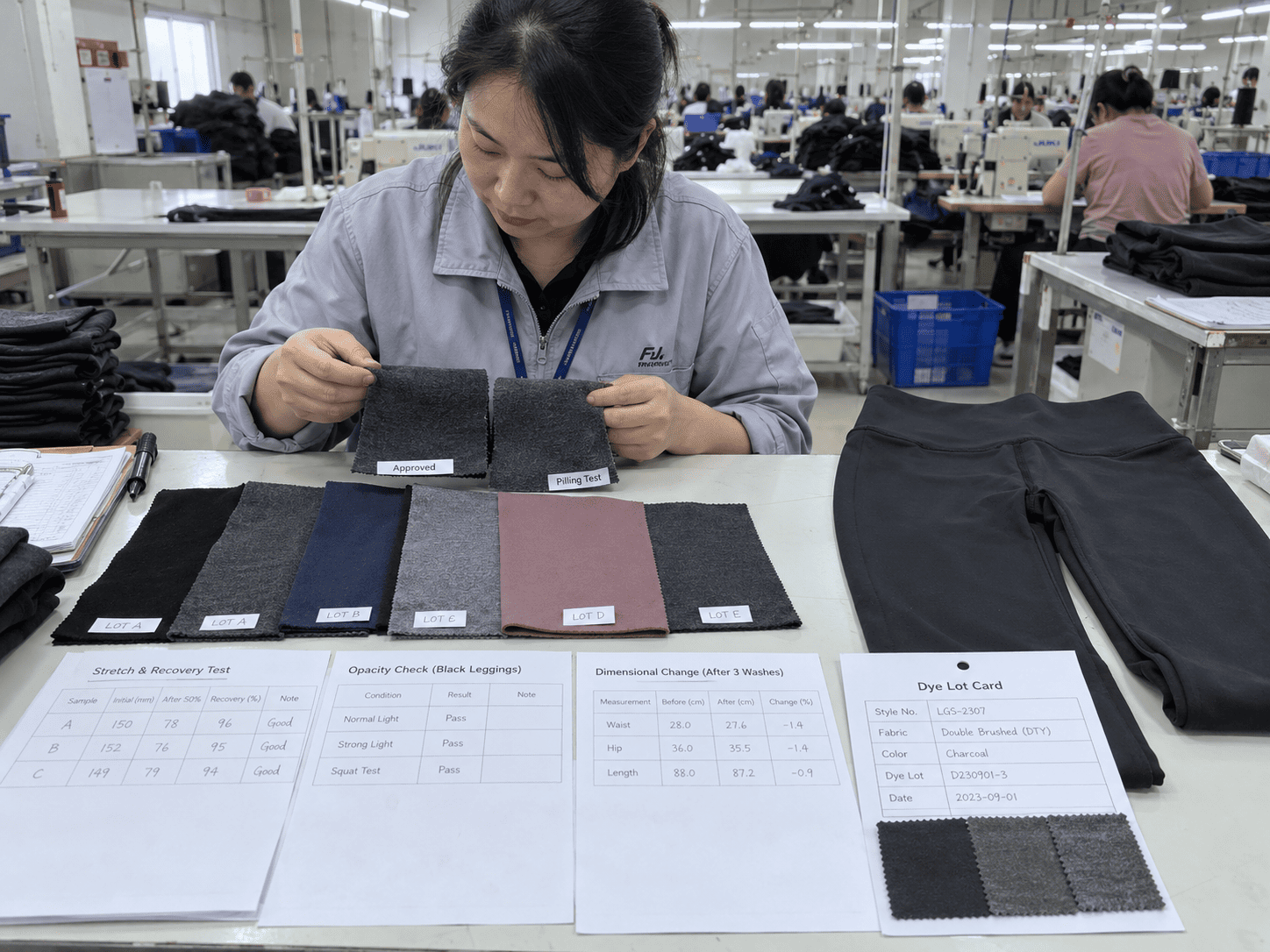
Pilling
This is one of the biggest concerns.
Friction can occur at:
- Inner thighs
- Underarms
- Seat
- Waist
- Bags rubbing against the garment
ISO 12945-2:2020[^3] specifies the modified Martindale method for evaluating a fabric's resistance to:
- Pilling
- Fuzzing
- Matting
under controlled rubbing.
This gives a much better technical basis than saying:
“better polyester does not pill.”
What Influences Pilling?
Possible factors include:
- Yarn
- Fiber
- Knit construction
- Surface finish
- Brush level
- Friction
- Laundering
Over-brushing may affect surface behavior.
But pilling should still be evaluated on the actual fabric.
Stretch and Recovery
Knee bagging can result from poor recovery.
But do not automatically solve it by adding more elastane.
First look at:
- Knit construction
- Elastane quality
- Heat setting
- Fabric recovery
- Garment pattern
Again, ISO 20932-1 can support evaluation of elasticity-related properties.[^2]
Opacity
Leggings should be checked under realistic extension.
A fabric may appear opaque:
flat on the table
but become transparent when stretched over:
- Hip
- Seat
- Knee
Check the actual:
- Color
- GSM
- Stretch level
on a worn sample.
A “squat test” is a practical fit review, but it is not itself a standardized laboratory method.
Dimensional Change
ISO 5077:2007[^4] provides a method for determining dimensional changes in fabrics and garments after specified washing and drying procedures.
This matters even with synthetic fabrics.
Do not assume:
polyester = zero shrinkage.
Fabric construction and finishing can still affect dimensions.
Dye-Lot Control
If several rolls are used, keep them identified.
A practical system may include:
- Roll number
- Dye-lot number
- Approved shade reference
Where possible, avoid randomly mixing visibly different lots within one garment or retail set.
Matching Sets
If the product is:
top + leggings
check the pieces together.
The goal is not necessarily to cut every piece from the exact same roll.
The better rule is:
use the approved fabric specification and controlled shade system, keeping visually compatible lots together where practical.
Care Instructions
The original article suggested:
cold wash, no high heat
as if it should be used automatically.
That may be appropriate for many brushed synthetic fabrics.
But care labels need to be based on actual product behavior.
For apparel sold in the United States, the FTC Care Labeling Rule[^5] requires manufacturers and importers to provide regular-care instructions and maintain a reasonable basis for those instructions.
So the correct workflow is:
test → determine safe care → label.
Not:
fabric name → copy generic washing instructions.
What MOQ, Cost, and Timing Should You Expect?
With double-brushed garments, there can be two different minimums:
- Garment production MOQ
- Fabric development MOQ
They are not always the same.
Our practical garment starting points depend on the product, while custom brushing, knitting, dyeing, or printing may create a separate mill-level fabric minimum. Stock double-brushed fabric can therefore support smaller programs more easily than a fully custom textile.
Typical Garment Starting Points
For our normal programs:
| Product | Typical starting point |
|---|---|
| Leggings | Around 150 pcs per style |
| Tops / tees | Around 100 pcs |
| Matching sets | Around 50 sets |
| Kids' products | Around 150 pcs depending on program |
These are practical starting points.
The final MOQ still depends on:
- Fabric
- Color
- Trim
- Size breakdown
Fabric MOQ
Custom fabric programs may carry their own minimum.
For example:
- Custom knitting
- Custom dyeing
- Custom brushing
- Custom all-over print
The mill may quote its MOQ in:
- Kilograms
- Rolls
- Meters
Do not assume:
200 kg everywhere.
Confirm the actual fabric supplier's requirement.
How Can You Use the Fabric MOQ More Efficiently?
If the same approved fabric works across:
- Leggings
- Crop top
- Long sleeve
- Lounge pant
you may be able to allocate the same material across several styles.
That can make a custom fabric program easier to reach.
But each style still needs its own:
- Pattern
- Size chart
- Production plan
What Drives Cost?
| Cost factor | Why it matters |
|---|---|
| Base fabric | Yarn, composition, construction |
| GSM | Changes material consumption |
| Brushing | Additional finishing |
| Custom color | Dyeing MOQ / setup |
| Custom print | Additional print process |
| Elastane | Changes material specification |
| Flatlock | Additional sewing complexity |
| Waistband | Construction and consumption |
| Quantity | Production efficiency |
| Testing | Additional test costs if required |
Does More Elastane Automatically Cost More and Perform Better?
Not necessarily.
A different elastane content can affect fabric price.
But more elastane is not automatically:
- Better
- More premium
- Stronger recovery
The fabric should be chosen for the actual fit and performance target.
Sample Timing
For a style using available fabric, sampling may commonly take:
5–14 days
depending on:
- Pattern
- Decoration
- Fabric availability
Custom Fabric Adds Another Timeline
If you need custom:
- Knitting
- Dyeing
- Printing
- Brushing
the fabric-development time happens before normal garment cutting and sewing.
That lead time should be confirmed separately.
Bulk Timing
Once:
- Final sample
- Fabric
- Artwork
- Bulk order
are approved and ready, standard garment bulk production commonly falls around:
20–30 days
for our normal programs.
A custom-fabric project may take longer overall because fabric needs to be produced first.
Payment
For new bulk orders, our normal structure remains:
50% before production + 50% before shipment.
How Do You Choose a Double Brushed Fabric Manufacturer?
Do not ask only:
“Do you have buttery-soft fabric?”
Almost every supplier can say yes.
Ask questions that reveal what the fabric actually is.
Ask for Composition
For example:
88% polyester / 12% elastane
or:
92% polyester / 8% elastane
rather than:
premium buttery fabric.
Ask for GSM
This helps identify whether the sample and bulk are even in the same weight range.
But do not use GSM as the only quality measure.
Ask Whether the Fabric Is Stock or Custom
This tells you a lot about:
- MOQ
- Sample consistency
- Lead time
- Color options
Ask What the Sample Fabric Represents
Does the sample confirm:
- Exact fabric?
- Closest stock fabric?
- Fit only?
Get that answer before paying for the sample.
Ask About Pilling
If the product is leggings:
How has this fabric been checked for pilling?
A supplier should understand why thigh friction matters.
Ask About Recovery
Do not accept:
“12% spandex, so recovery is excellent.”
Ask about the actual textile.
Ask About Wash Behavior
How does the garment behave after the intended wash cycle?
Check:
- Size
- Surface
- Softness
- Color
Green Flags and Red Flags
| Green flag | Red flag |
|---|---|
| Explains brushing as a finish | Treats “double brushed” as one fixed fabric |
| Provides composition + GSM | Says only “buttery soft” |
| Gives physical reference swatch | Approves by screen photo |
| Explains sample vs bulk fabric | Promises exact custom bulk feel from any stock sample |
| States real mill MOQ | Claims one universal brushing MOQ |
| Tests pilling | Says brushed fabric never pills |
| Evaluates stretch and recovery | Judges recovery only from elastane % |
| Checks wash behavior | Assumes polyester cannot shrink |
| Uses evidence-based care instructions | Copies one care label for every fabric |
Conclusion
Double brushed fabric sells because of one thing customers notice immediately:
touch.
But the soft hand is the beginning of the product-development process.
Not the end.
Start by identifying the actual fabric.
Ask for:
- Composition
- GSM
- Knit structure
- Stretch
- Recovery
Then understand the finish.
Double brushing describes:
what happens to the surface.
It does not automatically tell you:
- Fiber
- Performance
- Compression
- Durability
Next, approve the physical swatch.
“Soft.”
“Premium.”
“Buttery.”
are useful descriptions.
They are not technical specifications.
If color or printing matters, approve the design on the closest possible finished surface.
Brushing can change how the textile reflects light and how fine print detail is perceived.
But do not assume every brushed fabric becomes lighter or duller in exactly the same way.
Then clarify sample versus bulk.
If your sample uses stock fabric but bulk requires a custom brushed textile, write down what the sample is actually approving.
Fit?
Construction?
Print placement?
Hand feel?
The answer matters.
Then test the fabric.
For leggings and close-fitting garments, pay attention to:
- Pilling
- Stretch
- Recovery
- Opacity
- Dimensional change
- Dye-lot consistency
And create care instructions from actual evidence.
Finally, check MOQ at two levels:
garment MOQ
and:
fabric MOQ.
A factory may be able to sew 100 pieces.
That does not mean a fabric mill will custom knit, dye, brush, and print a new textile for only the material needed for those 100 pieces.
Stock fabric solves that problem for many smaller brands.
Custom fabric gives you more control when the volume supports it.
Because a good double-brushed product is not just:
soft on day one.
It should still:
- Fit
- Recover
- Stay opaque
- Control pilling
- Maintain its dimensions
- Match the approved color
after the customer has actually worn and washed it.
That is what turns a buttery-soft sample into a product worth reordering.
Footnotes & References
[^1]: Textile Exchange — Materials Market Report 2025. Textile Exchange reported that approximately 132 million tonnes of fibers were produced globally in 2024, with polyester representing around 59% of total global fiber production.
https://textileexchange.org/knowledge-center/reports/materials-market-report-2025/
[^2]: International Organization for Standardization — ISO 20932-1:2018, Textiles — Determination of the Elasticity of Fabrics — Part 1: Strip Tests. Describes straight-strip and loop test methods for measuring elasticity and related fabric properties. ISO reviewed and confirmed the standard in 2024, so it remains current.
https://www.iso.org/standard/69489.html
[^3]: International Organization for Standardization — ISO 12945-2:2020, Textiles — Determination of Fabric Propensity to Surface Pilling, Fuzzing or Matting — Part 2: Modified Martindale Method. Specifies a controlled method for determining resistance to pilling, fuzzing, and matting of textile fabrics under repeated rubbing.
https://www.iso.org/standard/75375.html
[^4]: International Organization for Standardization — ISO 5077:2007, Textiles — Determination of Dimensional Change in Washing and Drying. Specifies a method for determining dimensional change of textile fabrics, garments, and other textile articles after specified washing and drying procedures. The standard was reviewed and confirmed in 2022 and remains current.
https://www.iso.org/standard/41877.html
[^5]: U.S. Federal Trade Commission — Care Labeling Rule, 16 CFR Part 423. Requires manufacturers and importers of covered textile apparel to provide regular-care instructions and maintain a reasonable basis for those instructions before sale.
https://www.ftc.gov/legal-library/browse/rules/care-labeling-textile-wearing-apparel-certain-piece-goods