

Quarter-Zip Pullover Manufacturer: How Do You Make a Quarter Zip That Looks Sharp?
Your quarter-zip sample looks good on the hanger.
Then you put it on.
The collar collapses.
The zipper waves down the center front.
When you zip it all the way up, the slider or teeth feel uncomfortable against the chin.
And the whole garment suddenly looks cheaper than the sweatshirt beside it.
The problem is only a small area of the garment.
But it is the area closest to the face.
That is why a quarter zip can look either:
clean and premium
or:
unfinished and unstable
within a few centimeters.
A good quarter-zip pullover depends on the relationship between the fabric, zipper, collar, placket, fit, and construction. The zipper should sit smoothly, the collar should hold the intended shape, and the whole neckline needs to remain balanced both open and closed.
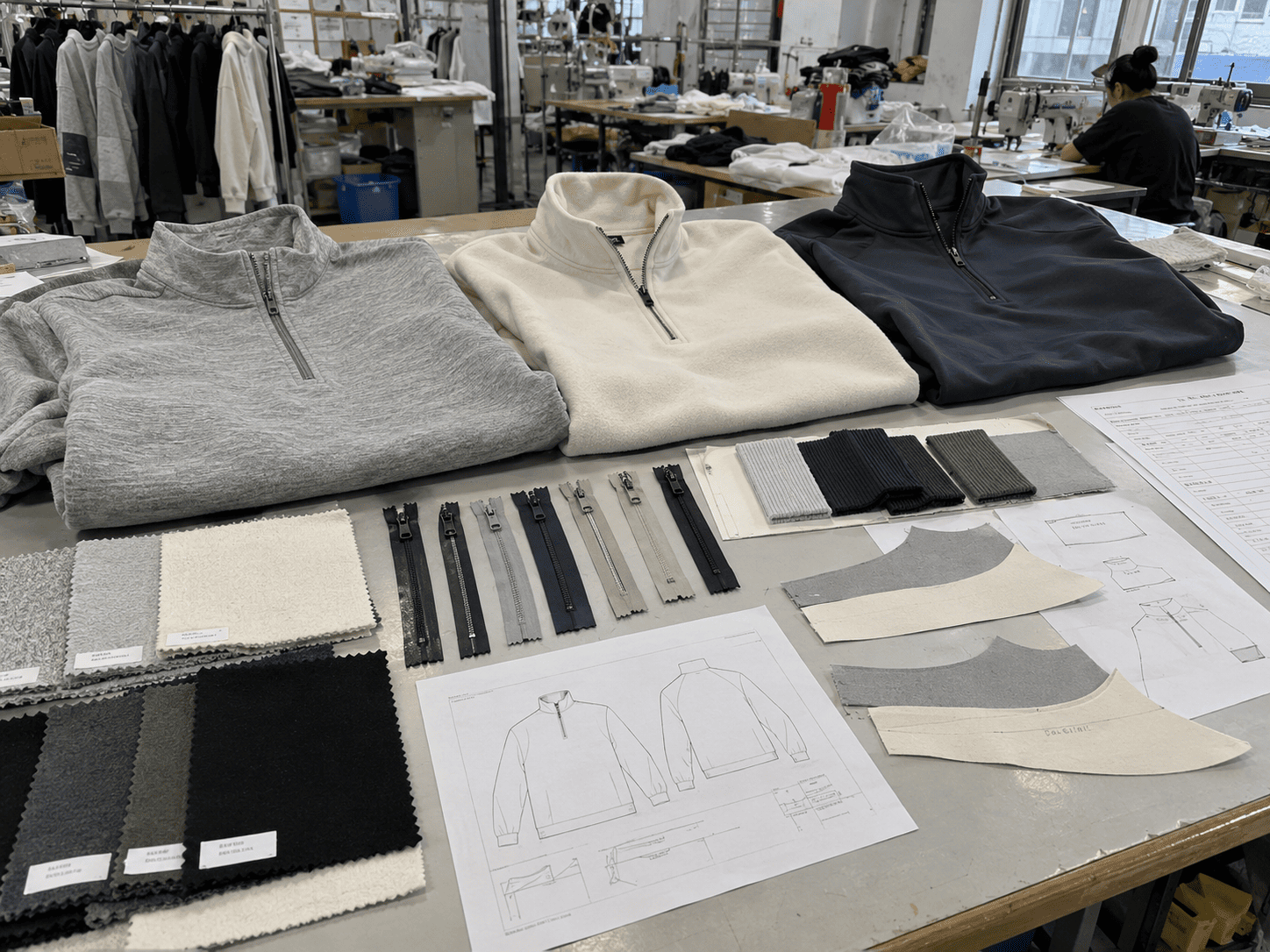
Quarter zips work across very different markets:
- Streetwear
- Golf
- Running
- Corporate uniforms
- Lifestyle clothing
- Outdoor layering
But a streetwear quarter zip and a golf quarter zip should not be developed the same way.
The silhouette may look similar.
The technical requirements are not.
Table of Contents
- What Types of Quarter-Zip Pullovers Can You Make?
- Which Fabrics Work Best for Quarter Zips?
- Why Does the Zipper and Collar Decide the Look?
- How Should a Quarter Zip Fit?
- How Should You Brand a Quarter Zip?
- What MOQ, Cost, and Timing Should You Expect?
- Conclusion
What Types of Quarter-Zip Pullovers Can You Make?
A quarter zip is a pullover with a partial front zipper.
That simple idea can become many different products.
Common quarter-zip styles include French terry and fleece sweatshirts, lightweight performance tops, golf pullovers, brushed-back training layers, oversized streetwear pullovers, and corporate uniform styles.
Common Quarter-Zip Directions
| Style | Typical fabric | Main look |
|---|---|---|
| Fleece quarter zip | Brushed fleece | Warm, casual |
| French terry quarter zip | Loopback French terry | Clean, lifestyle |
| Performance quarter zip | Polyester/elastane | Athletic |
| Golf quarter zip | Smooth stretch knit | Polished, sporty |
| Running layer | Lightweight performance knit | Technical |
| Oversized quarter zip | Heavy terry / fleece | Streetwear |
| Corporate quarter zip | Fleece / smooth knit | Uniform / merchandise |
| Women's cropped quarter zip | Terry / fleece / stretch knit | Lifestyle |
Quarter Zip vs Half Zip
These two terms are often used loosely.
Some brands call almost every partial front zipper:
quarter zip.
Others use:
half zip
when the zipper extends farther down the chest.
There is no need to create an artificial universal centimeter rule.
Instead, specify the actual:
- Zipper length
- Collar height
- Opening depth
in the tech pack.
For example:
Zipper length: 24 cm
is much clearer than:
“make it a normal quarter zip.”
Cut-and-Sew vs Flat-Knit
This distinction is also useful for buyers.
Our quarter zips are mainly:
cut-and-sew garments made from knitted fabric
such as:
- French terry
- Fleece
- Jersey
- Performance knit
They are different from fully fashioned sweaters produced on flat-knitting machines.
That affects:
- Construction
- Seam type
- MOQ
- Fabric sourcing
- Fit development
Product Category Matters
A heavyweight streetwear quarter zip may use:
- 400–500 GSM fabric
- Dropped shoulder
- Oversized body
- Heavy rib
- Metal-look zipper
A running quarter zip may instead use:
- Lightweight stretch knit
- Raglan sleeves
- Minimal collar bulk
- Reverse coil zipper
- Thumbholes
They share a zipper concept.
Almost everything else can be different.
Which Fabrics Work Best for Quarter Zips?
Fabric determines much more than warmth.
It affects:
- Collar shape
- Zipper stability
- Drape
- Stretch
- Weight
- Fit
- Surface appearance
French terry and fleece work well for lifestyle and streetwear quarter zips, while polyester- or nylon-based stretch knits are common for athletic and golf styles. The right choice depends on the intended structure, warmth, stretch, recovery, and use—not simply GSM.
French Terry
French terry has:
- Smooth outer face
- Loopback interior
It works well for:
- Lifestyle quarter zips
- Streetwear
- Transitional seasons
Common directions might include:
- 320 GSM
- 350 GSM
- 380 GSM
- 400 GSM+
depending on the design.
A heavier weight can create more structure.
But:
higher GSM does not automatically guarantee a better-standing collar.
Collar performance also depends on:
- Pattern
- Number of layers
- Rib or self-fabric
- Interlining
- Grain direction
- Construction
Brushed Fleece
Brushed fleece creates:
- More warmth
- Softer inner hand
- Winter feel
It works naturally for:
- Cold-weather streetwear
- Lifestyle
- Corporate outer layers
But very thick fleece can create bulk around:
- Zipper
- Collar seam
- Chin guard
So the collar construction still needs to be designed around the actual fabric.
Performance Knits
For:
- Running
- Golf
- Gym
- Travel
brands often choose polyester- or nylon-based stretch fabrics.
Important properties may include:
- Stretch
- Recovery
- Moisture handling
- Drying behavior
- Surface smoothness
- Pilling resistance
Do not write:
“polyester + elastane = quick dry”
as an automatic guarantee.
The actual fabric and finish determine performance.
Stretch and Recovery Matter Around the Zipper
This is especially important.
A knit fabric can stretch.
A zipper tape usually behaves differently.
If the body fabric stretches significantly while the zipper area is more stable, the two materials can fight each other during:
- Sewing
- Wearing
- Washing
For stretch fabrics, ISO 20932-1:2018[^1] provides test methods for measuring fabric elasticity and related properties using strip or loop specimens.
The standard remains current after review in 2024.[^1]
You do not need to quote ISO numbers to every customer.
But technically, this is why we should understand the actual stretch behavior before finalizing a performance quarter zip.
Waffle and Textured Knits
These can work for:
- Casual layering
- Lifestyle
- Travel
But textured fabrics require attention around the zipper.
A very irregular surface can make it harder to create a visually clean placket.
Fabric Weight Is Only One Variable
Two fabrics can both be:
380 GSM
and still behave completely differently.
One may be:
- Firm
- Dense
- Stable
The other:
- Soft
- Loose
- Stretchy
So when developing a quarter zip, check:
- GSM
- Composition
- Stretch
- Recovery
- Drape
- Thickness
- Shrinkage
not only the weight number.
Wash Behavior Matters
If the body fabric shrinks but the zipper does not change in the same way, the front can become distorted after laundering.
ISO 5077:2007[^2] specifies a method for determining dimensional change after specified washing and drying procedures.
That makes wash testing especially useful before approving:
- Cotton French terry
- Cotton fleece
- Garment-washed quarter zips
Why Does the Zipper and Collar Decide the Look?
The zipper sits in the visual center of the garment.
That makes small errors very visible.
A clean quarter zip needs the zipper tape, body fabric, placket, and collar to work as one construction. Rippling can result from differences in stretch, feeding, tension, shrinkage, or stabilization—not from one single cause.
Why Does the Zipper Ripple?
This is probably the most common quarter-zip problem.
Possible causes include:
- Knit fabric stretching during sewing
- Zipper tape being fed differently
- Incorrect presser-foot tension
- Poor stabilization
- Fabric dimensional change
- Incorrect zipper length
- Operator handling
So when a zipper waves, the solution is not automatically:
“use a softer zipper.”
The entire construction needs to be reviewed.
Stabilize the Placket
Depending on the fabric, the zipper area may use:
- Fusible reinforcement
- Stay tape
- Additional fabric layer
- Controlled sewing method
to prevent excessive stretching during assembly.
The correct solution depends on:
- Fabric
- Weight
- Stretch
- Desired appearance
Zipper Types
Common options include:
Coil Zipper
Useful for:
- Performance
- Lightweight garments
- Lifestyle pullovers
Advantages can include:
- Lower bulk
- Flexibility
- Clean appearance
Reverse Coil
With the coil positioned toward the inside, this can create a cleaner technical appearance.
YKK, for example, offers multiple reverse-coil options across casual and sports applications.[^3]
Molded Plastic
This creates a more visible, substantial look.
It may suit:
- Outdoor
- Streetwear
- Casual
depending on the scale of the garment.
Metal Zipper
Metal teeth can give:
- Vintage
- Premium
- Workwear-inspired
character.
But heavier hardware may not suit a lightweight performance knit.
Choose the Zipper for the Garment
Do not begin with:
“YKK metal zipper because premium.”
Begin with:
- Fabric
- Weight
- Style
- Function
- Wash process
Then choose the zipper.
Premium means:
appropriate for the product.
Zipper Color
Options include:
- Tone-on-tone
- Contrast tape
- Contrast teeth
- Metallic effect
- Matte finish
YKK's current product range, for example, includes coil zipper combinations with different tape, element, and sewing-thread colors, showing that zipper color can be treated as an intentional design component rather than just a functional trim.[^3]
Collar Height
The collar completely changes the personality of the quarter zip.
A lower mock neck can feel:
- Minimal
- Golf
- Office-friendly
A tall funnel collar can feel:
- Streetwear
- Outdoor
- Protective
Do not write:
“standard collar.”
Specify:
- Finished collar height
- Collar width
- Opening
- Shape
Collar Construction
A collar may be:
- Self-fabric
- Rib
- Double layer
- Reinforced
- Lined
A very soft self-fabric collar may collapse.
If the design requires a crisp standing collar, the solution may involve:
- Pattern adjustment
- Double layer
- More stable fabric
- Reinforcement
not simply increasing GSM.
Chin Comfort
When the zipper is fully closed, check whether:
- Slider
- Teeth
- Puller
contact the chin.
A chin guard or zipper garage can improve comfort.
But it should be integrated cleanly into the collar.
A bulky guard can look worse than the problem it is trying to solve.

How Should a Quarter Zip Fit?
There is no universal quarter-zip fit.
The product can be:
- Tailored
- Athletic
- Relaxed
- Oversized
- Cropped
Fit should be defined before pattern development because shoulder shape, chest ease, sleeve construction, collar dimensions, hem treatment, and zipper length all depend on the intended silhouette.
Classic Fit
Possible characteristics:
- Set-in sleeve
- Regular chest
- Rib cuff
- Rib hem
- Moderate collar
This works well for:
- Lifestyle
- Corporate
- Casual
Oversized Streetwear Fit
Possible characteristics:
- Dropped shoulder
- Wide chest
- Larger sleeve
- Boxy body
- Wider rib
- Heavy fabric
Do not create oversized fit by simply:
making every measurement bigger.
Control:
- Shoulder drop
- Body length
- Sleeve length
- Chest
- Hem
individually.
Otherwise the quarter zip can become:
- Too long
- Too wide
- Excessively oversized
rather than intentionally boxy.
Athletic Fit
Possible characteristics:
- Closer chest
- Raglan sleeve
- Stretch fabric
- Thumbholes
- Clean hem
Movement matters more.
Ask the wearer to:
- Reach forward
- Raise arms
- Rotate shoulders
The zipper should not:
- Pull
- Buckle
- Dig into the neck
during movement.
Golf Fit
A golf pullover often needs to balance:
- Clean appearance
- Shoulder mobility
- Layering
It may be worn over:
- Polo shirt
- Base layer
So the pattern should consider the intended layering.
Women's Cropped Style
Possible details include:
- Short body
- Relaxed sleeve
- Taller collar
- Elastic or rib hem
Cropped length should still be defined by measurement.
Not:
“make it a little shorter.”
Important Quarter-Zip POMs
Typical points include:
- Half chest
- Body length
- Shoulder
- Sleeve
- Bicep
- Cuff
- Hem
- Collar height
- Collar opening
- Zipper length
For a raglan style:
- Sleeve measurement method
must also be defined clearly.
Zipper Length Is a Fit Measurement Too
The zipper is not only a trim.
Its length affects:
- Neck opening
- Ease of dressing
- Visual proportion
A 3 cm difference can noticeably change the front appearance.
So put the finished zipper dimension directly into the specification.
How Should You Brand a Quarter Zip?
Quarter zips often look strongest with controlled branding.
The clean neckline already creates a focal point.
Common branding options include chest embroidery, small prints or transfers, sleeve graphics, collar or back-neck branding, woven labels, and custom zipper details. The decoration should be selected according to fabric weight, stretch, and intended use.
Chest Embroidery
This is classic for:
- Fleece
- French terry
- Corporate wear
- Golf-inspired products
A small left-chest logo can look very clean.
But embroidery adds:
- Thread
- Density
- Stabilizer
- Mechanical tension
So the actual fabric needs testing.
Light Performance Fabric
Heavy embroidery on a thin stretch knit can cause:
- Puckering
- Distortion
- Stiffness
In that case, alternatives may include:
- Heat transfer
- Silicone transfer
- Lightweight print
depending on the desired finish.
Streetwear
Streetwear gives more freedom.
Possible branding:
- Large back print
- Sleeve embroidery
- Appliqué
- Puff print
- Tonal chest logo
The quarter zip itself does not require small branding.
That is a style choice.
Custom Zipper Pulls
This is a strong branding opportunity.
Possible approaches include:
- Custom metal pull
- Rubber pull tab
- Cord pull
- Branded molded component
But avoid saying:
“YKK does not accept small custom orders.”
Availability depends on:
- Product
- Market
- Supplier
- Quantity
- Tooling
- Design
YKK's own product catalog includes customization examples such as original-design slider pulls and design elements.[^3]
So for a real project, confirm:
- MOQ
- Mold/tooling charge
- Lead time
with the zipper supplier.
Do Not Promise One Fixed Mold Price
A custom pull mold may sometimes cost:
USD 130
USD 150
USD 180
or another amount.
The actual price depends on:
- Material
- Size
- Shape
- Supplier
So quote the live project instead of publishing:
“custom zipper pull mold = $150.”
Decoration Production
Our garment production handles the garment itself.
Specialist processes such as:
- Embroidery
- Printing
- Certain custom decoration
can be handled by long-term partner workshops that we coordinate directly.
Before bulk, we confirm:
- Artwork
- Size
- Placement
- Color
- Technique
on the actual garment or suitable test panel.
What MOQ, Cost, and Timing Should You Expect?
A quarter zip generally requires more operations than a basic crewneck.
The main added components are:
- Zipper
- Placket
- Collar
For our standard fleece and French terry quarter-zip programs, a typical starting MOQ can be around 50 pieces per style, depending on fabric, colors, zipper, decoration, and trim requirements.
What Drives Quarter-Zip Cost?
| Cost factor | Why it matters |
|---|---|
| Fabric | Main raw-material cost |
| GSM | Changes fabric consumption |
| Zipper | Type, length, brand, finish |
| Collar | Layering and reinforcement |
| Placket | Additional sewing |
| Chin guard | Additional construction |
| Rib | Cuff and hem cost |
| Custom pull | Tooling / MOQ |
| Decoration | Print / embroidery |
| Quantity | Production efficiency |
Fabric
A 500 GSM cotton quarter zip naturally uses more material than a lightweight performance top.
But cost also depends on:
- Composition
- Mill
- Finish
- Quantity
not GSM alone.
Zipper
The price can change depending on:
- Coil
- Reverse coil
- Molded
- Metal
- Length
- Brand
- Color
A special finish or customized component can also create:
- MOQ
- Development charge
- Longer lead time
Collar
A simple single-layer collar costs less than a construction using:
- Double layers
- Reinforcement
- Chin guard
- Complex facing
Colors
A 100-piece order in:
one color
is easier to source than:
20 pieces × five custom colors.
Fabric and trim supplier minimums still matter.
Do Not Say Small Cut Fabric Always Costs Double
Sometimes small cut quantities are substantially more expensive.
Sometimes stock fabric is readily available.
So this should be quoted from the actual material supplier rather than made into a universal website rule.
Sample Timing
For standard quarter-zip styles, sampling may commonly fall around:
5–14 days
depending on:
- Fabric
- Zipper availability
- Decoration
- Complexity
If a completely custom zipper pull needs tooling, that can add time.
Bulk Timing
For standard programs, bulk may commonly take around:
20–30 days after final sample approval and deposit.
Large orders or custom-developed materials may require a different production schedule.
Payment
For new bulk orders, our normal structure is:
50% before bulk production + 50% before shipment.
U.S. Fiber Labels Still Apply
For textile quarter zips sold in the United States, the FTC Textile Fiber Rule[^4] generally requires covered products to disclose information including:
- Generic fiber names
- Fiber percentages by weight
- Manufacturer or marketer identity
- Country of processing or manufacture
So if the quarter zip is:
85% cotton / 15% polyester
the labeling should reflect the actual supported composition.
Care Instructions Matter Too
The FTC Care Labeling Rule[^5] requires manufacturers and importers of covered apparel to provide regular-care instructions and have a reasonable basis for those instructions.
This is relevant to quarter zips because the garment combines:
- Textile fabric
- Zipper
- Possible embroidery
- Rib
- Specialty finishes
Care instructions should work for the whole finished garment.
How Do You Choose a Quarter-Zip Manufacturer?
Do not ask only:
“Can you make a quarter zip?”
Ask to see how the supplier handles the difficult area:
zipper + collar + placket.
Green Flags and Red Flags
| Green flag | Red flag |
|---|---|
| Asks about zipper length | Uses one standard zipper length |
| Matches zipper to fabric | Chooses trim before fabric |
| Checks placket stability | Accepts zipper waviness |
| Defines collar height | Says “standard collar” |
| Fits collar open and closed | Checks only hanger appearance |
| Adds chin protection where needed | Slider scratches the chin |
| Tests lightweight fabric before embroidery | Embroiders everything the same |
| Confirms custom pull MOQ/tooling | Makes absolute YKK claims |
| Wash-tests applicable fabrics | Ignores zipper/fabric dimensional mismatch |
| Approves actual decoration before bulk | Goes to bulk from artwork only |
Check the Sample Zipped and Unzipped
This sounds obvious.
But it matters.
A quarter zip needs to look good in both states.
Fully Open
Check:
- Collar falls cleanly
- Zipper edges are symmetrical
- Facing does not show incorrectly
Half Open
Check:
- Collar balance
- Chest opening
- Zipper alignment
Fully Closed
Check:
- Collar shape
- Chin comfort
- Top-stop position
- Symmetry
Look From the Side
The front photo may look good.
Then from the side you see:
- Collar leaning outward
- Placket buckling
- Zipper pushing forward
So inspect:
- Front
- Side
- Back
- Movement
Wash the Sample When Necessary
For cotton-heavy quarter zips, check how the body fabric and zipper behave after the intended laundering.
The garment should not look perfect before wash and wavy afterward.
Confirm the Zipper Before Bulk
Record:
- Supplier
- Type
- Size
- Color
- Length
- Slider
- Pull
- Finish
in the tech pack or trim sheet.
A zipper should not be described only as:
“black zipper.”
Conclusion
A quarter zip looks simple.
But most of its quality is concentrated in one small area:
the top center front.
Start with the fabric.
Decide whether the product is:
- Heavy streetwear
- Classic lifestyle
- Corporate
- Golf
- Performance
Then evaluate:
- Weight
- Stretch
- Recovery
- Shrinkage
- Drape
Choose the zipper for that fabric.
Do not choose a heavy metal zipper just because:
“metal looks premium.”
And do not choose the lightest coil zipper simply because it is cheaper.
The two materials need to work together.
Then develop the placket.
A zipper should lie flat.
If it waves, review:
- Fabric feeding
- Stretch
- Tension
- Stabilization
- Shrinkage
- Construction
rather than blaming one component.
Develop the collar at the same time.
Specify:
- Height
- Opening
- Shape
- Layers
and check it both:
open
and:
closed.
Then define the fit.
A golf quarter zip and an oversized streetwear quarter zip are not the same garment with different logos.
Their:
- Chest
- Shoulder
- Sleeve
- Hem
- Collar
- Fabric
should reflect different customers.
Finally, add branding carefully.
Embroidery works very well on many fleece and French terry styles.
Lightweight performance knits may need a lighter decoration.
And if you want a branded zipper pull, check the actual supplier's:
- MOQ
- Tooling
- Lead time
rather than relying on a blanket statement about what a zipper company will or will not customize.
Because a great quarter zip is not defined by having a zipper on the chest.
It is defined by whether that zipper, collar, fabric, and pattern still look like one clean garment when the customer actually puts it on.
Footnotes & References
[^1]: International Organization for Standardization — ISO 20932-1:2018, Textiles — Determination of the Elasticity of Fabrics — Part 1: Strip Tests. Describes strip and loop test methods that can be used to measure elasticity and related properties of fabrics. The standard was reviewed and confirmed in 2024 and remains current.
https://www.iso.org/standard/69489.html
[^2]: International Organization for Standardization — ISO 5077:2007, Textiles — Determination of Dimensional Change in Washing and Drying. Specifies a method for determining dimensional change in fabrics, garments, and other textile articles after specified washing and drying procedures. The standard was reviewed and confirmed in 2022 and remains current.
https://www.iso.org/standard/41877.html
[^3]: YKK Fastening Products Group — Zipper Product and Custom Design References. YKK's current fastening catalog includes multiple zipper constructions for casual and sports applications, including reverse-coil options, color combinations, and products that support original-design slider pulls or other custom design details. Actual availability, MOQ, tooling, and lead time should be confirmed for each market and project.
https://www.ykkfastening.com/products/search/detail.html?pdid1=Design+Bottom+Stop
https://www.ykkfastening.com/products/search/detail.html?pdid1=Color+Combination+of+coil+zipper
https://www.ykkfastening.com/products/search/detail.html?pdid1=Silky+tape+zipper
[^4]: U.S. Federal Trade Commission — Textile Fiber Rule, 16 CFR Part 303. Requires covered textile products sold in the United States to disclose the generic names and percentages by weight of constituent fibers, the manufacturer or marketer identity, and the country where the product was processed or manufactured.
https://www.ftc.gov/legal-library/browse/rules/textile-fiber-rule
[^5]: U.S. Federal Trade Commission — Care Labeling Rule, 16 CFR Part 423. Requires manufacturers and importers of covered textile apparel to provide regular-care instructions and maintain a reasonable basis for those instructions.
https://www.ftc.gov/legal-library/browse/rules/care-labeling-textile-wearing-apparel-certain-piece-goods