
Women's Matching Set Manufacturer: How Do You Make Two-Piece Sets That Truly Match?
Your ribbed matching set looks perfect in the product photos.
Then a customer uploads a mirror selfie.
The top looks slightly lighter than the shorts.
Another customer says:
“The top fits me perfectly, but the pants are too big.”
A third washes the set and discovers the shirt became shorter while the trousers barely changed.
Now the product is still called:
“matching set.”
But the two pieces no longer feel like one product.
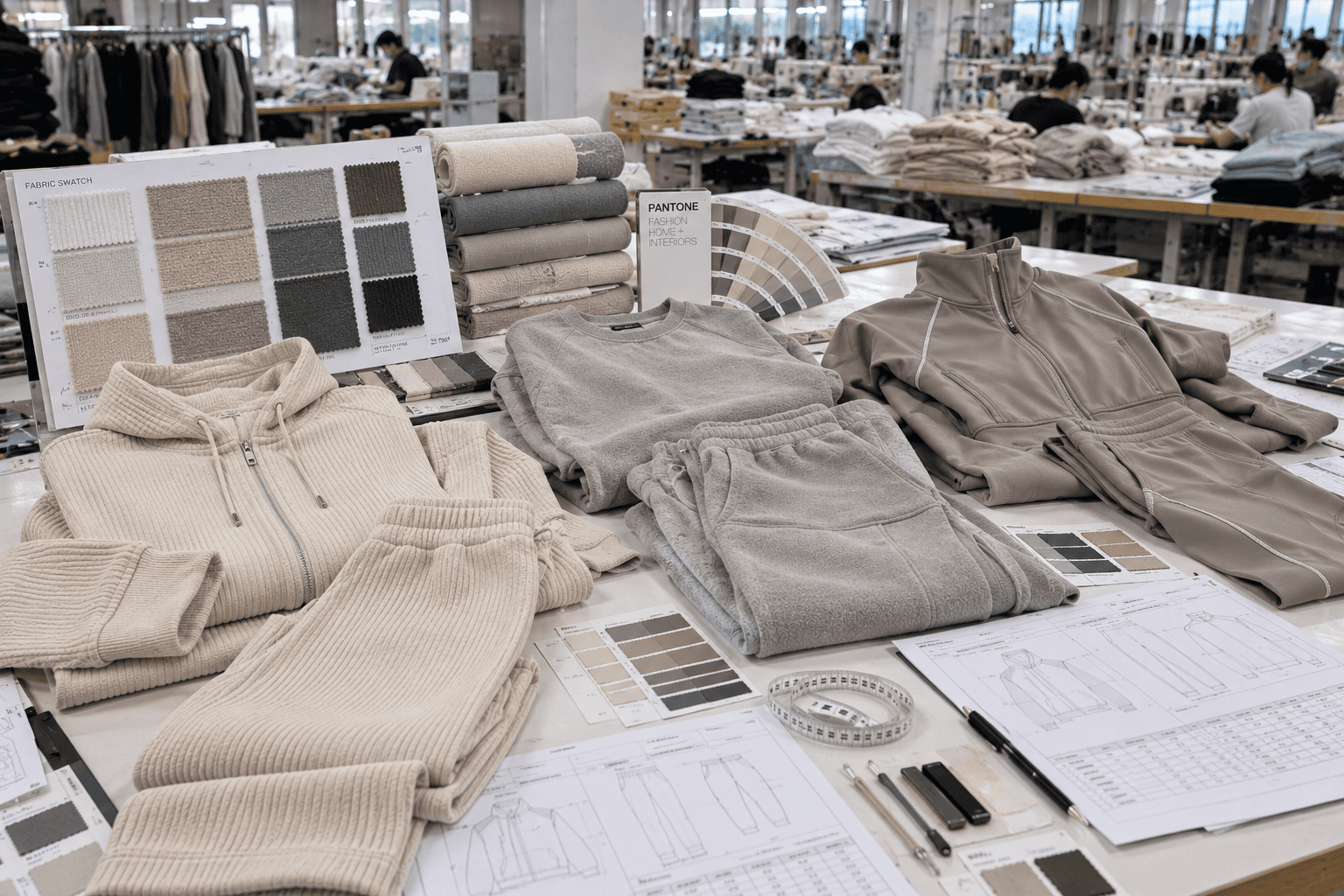
A women's matching set manufacturer develops the top and bottom as one coordinated program. Fabric, color, shrinkage, stretch, fit, trims, stitching, and finishing all need to work together so the two pieces still look and feel like a set after production and washing.
Matching sets also sit naturally inside the much larger athleisure and casualwear market.
According to IMARC Group's Athleisure Market report[^1], the global athleisure market was valued at approximately USD 430.1 billion in 2025 and is projected to reach around USD 759.7 billion by 2034, representing a CAGR of approximately 6.53% from 2026 to 2034.
Women represented approximately 49.8% of the market by end user in 2025.[^1]
But from the factory side, the interesting thing about a set is not simply that a brand can sell two pieces together.
It is that the customer immediately compares them.
They notice whether:
- The colors match
- The fabrics feel the same
- The waistband matches the top
- The logo positions feel balanced
- The fit works as one outfit
That makes set production less forgiving than producing two unrelated garments.
Table of Contents
- What Does a Women's Matching Set Manufacturer Make?
- Which Fabrics Work Best for Matching Sets?
- How Do You Make Sure the Top and Bottom Match?
- How Should You Size and Sell a Two-Piece Set?
- Which Construction Details Make a Set Look Premium?
- What MOQ, Cost, and Timing Should You Expect?
- Conclusion
What Does a Women's Matching Set Manufacturer Make?
A matching set is not one fixed silhouette.
It simply means two or more pieces are designed to be worn together.
Women's matching sets can include ribbed lounge sets, waffle-knit sets, French terry and fleece sets, activewear sets, shorts sets, wide-leg trouser sets, and other coordinated tops and bottoms.
Common Matching Set Types
| Set type | Typical combination | Main use |
|---|---|---|
| Ribbed set | Tank / crop top + pants / shorts | Casual / lounge |
| Waffle set | Long-sleeve top + relaxed pants | Lounge / sleep |
| French terry set | Crewneck / hoodie + shorts / joggers | Casual / streetwear |
| Fleece set | Hoodie + sweatpants | Winter / streetwear |
| Soft jersey set | Tee / tank + shorts / pants | Home / lounge |
| Activewear set | Sports bra + leggings | Gym / yoga |
| Activewear short set | Crop top / bra + bike shorts | Training / summer |
| Flare set | Fitted top + flare leggings | Lifestyle / yoga |
The Two Pieces Do Not Have to Use the Same Pattern Logic
Take:
sports bra + leggings
They may use the same outer fabric.
But the bra needs:
- Underband support
- Strap construction
- Armhole fit
- Bust coverage
The leggings need:
- Waistband
- Rise
- Hip shaping
- Inseam
- Gusset
They are developed separately.
They simply have to work together visually and functionally.
The same is true for:
hoodie + sweatpants.
A hoodie might use:
- Double-layer hood
- Rib cuff
- Kangaroo pocket
while the trousers need:
- Waist elastic
- Drawcord
- Cuffs
- Pockets
Matching does not mean making both garments with the same pattern logic.
It means developing them as one collection.
Our Production Direction
Our core production is knit garments, including:
- Hoodies
- Sweatshirts
- Sweatpants
- Shorts
- T-shirts
- Activewear
- Leggings
- Sports bras
So matching knit sets can be developed through the same garment-production workflow.
Specialist processes such as:
- Embroidery
- Printing
- Specialty washing
may be handled through long-term partner workshops that we manage directly.
That keeps the complete set under one production plan instead of treating the top and bottom as unrelated orders.
Which Fabrics Work Best for Matching Sets?
There is no single best fabric for a matching set.
The correct fabric depends on how the customer will wear it.
Rib knits work well for fitted and soft lounge sets, waffle knits add texture, French terry and fleece suit casual or streetwear sets, and nylon- or polyester-elastane constructions work well for activewear. What matters is using a material whose stretch, recovery, weight, drape, opacity, and wash behavior fit the design.
Common Set Fabrics
| Fabric | Character | Typical use |
|---|---|---|
| Fine rib knit | Smooth, stretchy | Fitted tops / pants |
| Wider rib knit | Textured | Lounge / casual |
| Modal / viscose blend rib | Soft, draped | Lounge |
| Waffle knit | Textured | Cozy sets |
| Cotton jersey | Soft | Tee + shorts |
| French terry | Structured but comfortable | Sweat sets |
| Brushed fleece | Warm | Hoodie + jogger |
| Nylon / elastane | Smooth and stretchy | Premium activewear |
| Polyester / elastane | Stretch + print-friendly | Training sets |
Rib Knit Needs More Than a GSM Number
Two rib fabrics can both be:
250 GSM
and still behave very differently.
One may:
- Stretch strongly
- Recover well
- Stay close to the body
while another may:
- Grow during wear
- Lose shape at the knee
- Change length after washing
So for fitted rib sets, check:
- Widthwise stretch
- Lengthwise stretch
- Recovery
- Shrinkage
- Spirality where relevant
- Opacity
not only weight.
Elasticity Can Be Tested
ISO 20932-1:2018[^2] describes strip and loop methods that can be used to measure elasticity and related properties of fabrics.
The standard was reviewed and confirmed in 2024 and remains current.[^2]
This is particularly relevant for:
- Rib sets
- Leggings
- Bike shorts
- Fitted tops
because a fabric that stretches easily but does not recover well can create a very different fit after several hours of wear.
Heavy Does Not Automatically Mean Premium
A heavier rib may feel:
- Thicker
- More substantial
- More opaque
which can be useful.
But heavier is not always better.
For summer lounge sets, excessive weight may feel too hot.
For fitted tops, a stiff heavy rib may not drape the way the brand wants.
Choose the fabric based on:
customer + season + silhouette + intended feel.
Light Colors Need Opacity Testing
White.
Cream.
Stone.
Light grey.
Pastel pink.
These colors can show more when stretched.
For fitted pants, shorts, or leggings, check the actual sample:
- Standing
- Bending
- Sitting
- Squatting
before approving bulk.
Sometimes the solution is:
- Denser fabric
- Better knit construction
- Reduced pattern tension
- Different lining
- Different color
rather than simply adding GSM.
Wash-Test the Actual Fabric
Matching sets become especially obvious when the two pieces change differently after washing.
ISO 5077:2007[^3] specifies a method for determining dimensional change in fabrics and garments after defined washing and drying procedures.
So for a set, we want to understand whether the fabric changes in:
- Length
- Width
before the pattern is locked.
The important point is not:
“rib fabric shrinks.”
It is:
“How does this particular rib fabric change under the care conditions intended for this garment?”
How Do You Make Sure the Top and Bottom Match?
This is the heart of the product.
If a customer buys a matching set, the top and bottom will be seen side by side.
Color consistency is best controlled by planning both pieces from the same approved fabric specification and color lot where practical, keeping physical shade references, controlling lot separation, and checking the finished pieces side by side before packing.
Do the Top and Bottom Have to Come From the Same Fabric Roll?
Not always.
That statement is too strict.
A production order may require several rolls.
The better rule is:
keep the pieces within the same approved fabric and dye-lot/shade-control system whenever practical.
If one dye lot includes several rolls, those rolls may still be suitable together.
What matters is actual shade control.
Why Dye Lots Matter
Textile dyeing is a production process.
A second dye lot produced later can show a small difference in:
- Lightness
- Chroma
- Hue
even when the target color is the same.
That is why:
“same Pantone number”
does not automatically guarantee that two independent dye lots will be visually identical.
Use a Physical Textile Color Standard
Pantone Fashion, Home + Interiors[^4] is designed for fashion and textile applications.
Pantone identifies TCX as the FHI format for soft surfaces such as:
- Textiles
- Apparel
- Thread
while TPG is more appropriate for hard surfaces.[^4]
Pantone also warns that colors displayed digitally are computer simulations and may not match physical Pantone standards exactly.
So for production, physical references are much more useful than:
a screenshot of Pantone 18-XXXX sent on WhatsApp.
But Pantone Is Only the Target
Once the fabric is approved, the actual bulk fabric becomes another important production reference.
Keep:
- Pantone reference
- Lab dip if applicable
- Approved fabric swatch
- Approved sample
For a reorder, compare the new fabric with those references.
Color Difference Can Be Quantified
For programs requiring tighter color control, ISO 105-J03:2009[^5] provides a method for calculating color differences between two textile specimens measured under the same conditions.
The standard expresses the total color difference numerically and allows a tolerance to be specified according to how closely the materials need to match.[^5]
This does not mean every 50-piece lounge set order needs laboratory ΔE testing.
Often, controlled visual comparison is sufficient.
But it shows why professional color matching is more than:
“looks close enough on my phone.”
Keep the Pieces Together Through Production
A practical workflow may look like:
| Stage | Control |
|---|---|
| Fabric approval | Same approved specification |
| Lot control | Track rolls / lots |
| Cutting | Avoid uncontrolled lot mixing |
| Bundling | Keep identified pieces organized |
| Sewing | Maintain lot information |
| Finishing | Use same approved process |
| Final QC | Compare top and bottom together |
| Packing | Pack matched pieces correctly |
Check More Than the Main Fabric
Customers notice other mismatches too.
Check:
- Rib
- Elastic
- Binding
- Drawcord
- Thread
- Zippers
- Logo thread
- Printed logo
- Hardware
For example, a cream hoodie with:
bright white drawcord
may look wrong unless the contrast was intentional.
Same Color Does Not Mean Every Material Looks Identical
This is another important distinction.
Suppose:
Body = French terry
Rib = 2×2 rib
Drawcord = polyester
All three are dyed toward the same target.
They may still reflect light differently.
The goal should be:
a visually coordinated set
not an unrealistic promise that every different fiber and surface will look mathematically identical.
How Should You Size and Sell a Two-Piece Set?
This is partly a manufacturing question.
It is also a business-model question.
A customer may be:
S on top + M on bottom.
What happens then?
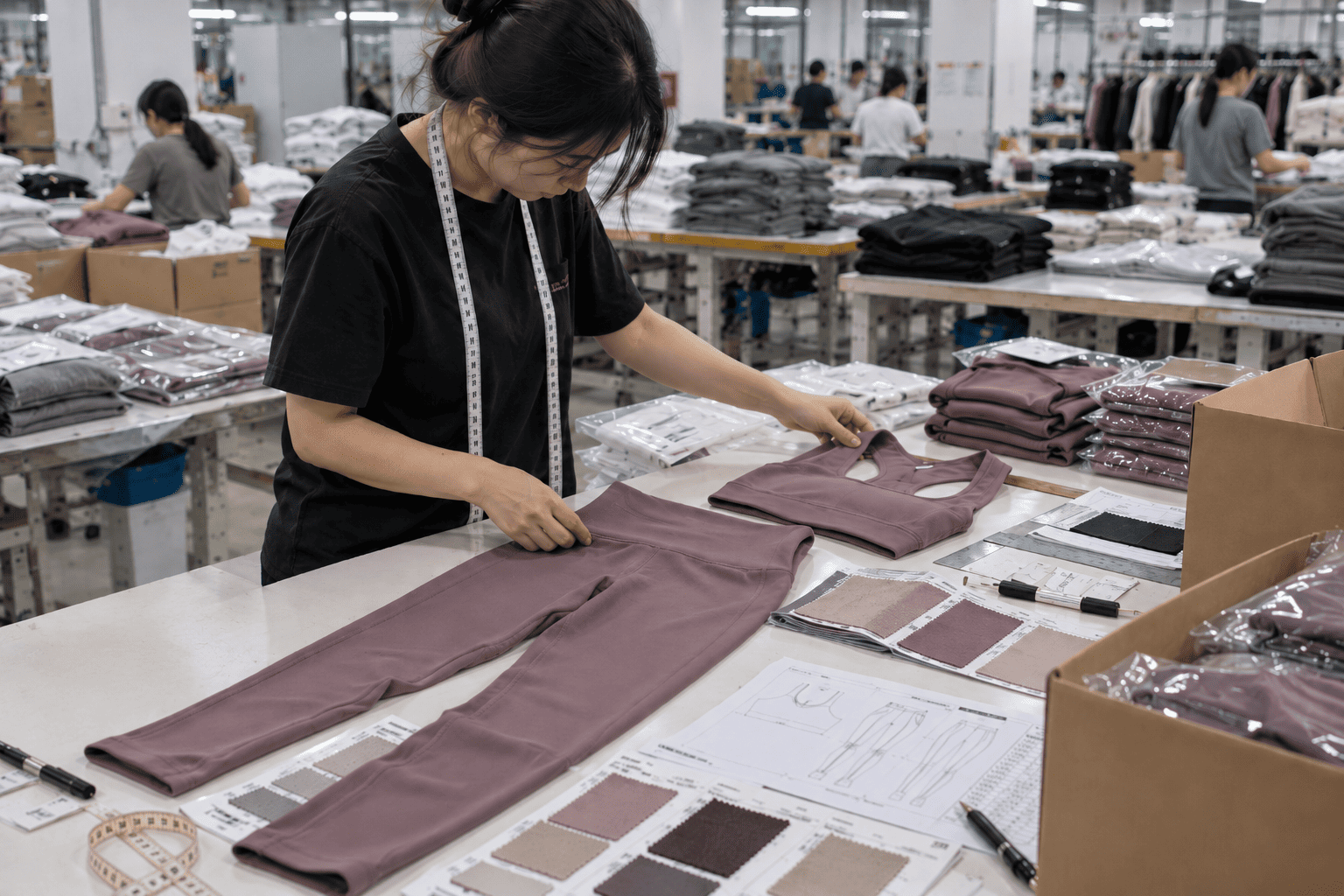
Brands can sell matching sets as one fixed size combination, as separate pieces, or as separates with a bundle option. The right system depends on inventory complexity, customer body proportions, price strategy, and how fitted the garments are.
Option 1: Fixed-Size Set
Customer buys:
Size M Set
and receives:
M top + M bottom.
Advantages:
- Simple SKU structure
- Easy packing
- Simple product page
- Easy inventory count
Disadvantage:
A customer who needs:
S top + M bottom
cannot choose it.
Option 2: Sell as Separates
Customer chooses:
Top: S
Bottom: M
Advantages:
- Better individual fit
- Customers can replace only one piece
- Easier upselling of extra colors
Disadvantages:
- More SKU complexity
- Top and bottom stock can become unbalanced
For example:
100 tops remain.
20 bottoms remain.
Technically you still have inventory.
But you do not have 100 complete sets.
Option 3: Separates + Bundle
This is often a useful commercial model.
Sell:
Top individually
Bottom individually
and offer:
Buy the matching set
as a bundle.
The customer still chooses each size.
This gives flexibility without forcing the brand to package every possible combination in advance.
The Top and Bottom Should Have Separate Measurement Charts
Do not write:
Set Size M
with one measurement chart.
The customer needs different information for:
Top:
- Chest
- Length
- Sleeve
- Shoulder where relevant
Bottom:
- Waist
- Hip
- Rise
- Inseam
For fitted activewear:
- Body waist
- Body hip
may also be useful.
Grade the Two Pieces Separately
A top and bottom have different fitting needs.
For example, a rib crop top may need grading focused on:
- Bust
- Underbust
- Armhole
- Body length
while the matching pants need:
- Waist
- Hip
- Rise
- Thigh
- Inseam
Using one generic grading rule for the entire set makes little sense.
Stretch Does Not Eliminate Sizing Problems
Stretchy fabric gives more fit flexibility.
But it does not mean:
one size fits everyone.
If a rib pant is stretched too far:
- Fabric may become transparent
- Waist may dig in
- Seams may strain
- Fit may distort
So size ranges still need real fitting and testing.
Which Construction Details Make a Set Look Premium?
Matching sets are often visually simple.
That means small construction mistakes become easier to notice.
A premium matching set depends on clean seams, controlled waistbands, stable necklines, matched thread and trims, correct rib or grain direction, balanced logo placement, and consistent finishing across both pieces.
Waistband Construction
For shorts, pants, or leggings, the waistband is one of the first things a customer feels.
Possible constructions include:
- Encased elastic
- Self-fabric waistband
- Double-layer waistband
- Elastic + drawcord
- Inner stabilizing elastic
The correct option depends on the product.
A wide waistband is not automatically premium.
It still needs:
- Correct tension
- Recovery
- Clean sewing
- Proper fit
Rib Direction
Rib fabric has a strong visible line.
If the vertical ribs lean or twist on one leg, it is noticeable.
Cutting needs to control:
- Fabric direction
- Relaxation
- Pattern placement
especially on fitted rib pants.
Necklines
A soft rib set can quickly look cheap if the neckline:
- Waves
- Stretches
- Gapes
after wearing or washing.
Binding and neck construction need enough recovery to return to shape.
Activewear Seams
Flatlock can be useful on certain activewear designs because it creates a flatter seam appearance.
But it is not automatically required for every activewear set.
Depending on design, factories may use combinations of:
- Overlock
- Coverstitch
- Flatlock
- Other stretch seam constructions
The seam must work with the fabric's extension.
Thread Should Be Planned
A tonal matching set normally looks cleaner when the thread is properly matched.
But contrast thread can also be a deliberate design feature.
The problem is not:
contrast.
The problem is:
accidental contrast.
Logo Placement Should Work as a Pair
Suppose:
Top logo = left chest
Bottom logo = left thigh
The two placements should feel intentional together.
For activewear, common approaches include:
- Small heat-transfer logo
- Silicone logo
- Tonal print
- Small embroidery where suitable
A very heavy or rigid decoration can distort highly stretchable fabric.
So test the decoration on the actual fabric.
What MOQ, Cost, and Timing Should You Expect?
Sets can be efficient because the top and bottom often share one fabric program.
But that does not mean every set has the same cost structure.
For our standard matching-set programs, MOQ can typically start around 50 sets per style, depending on fabric, colors, construction, trims, decoration, and whether the products are packed and sold as fixed sets or matching separates.
Our Typical Set MOQ
For a two-piece hoodie and sweatpant set:
50 sets per style can be a practical starting point.
That means:
50 tops
-
50 bottoms
rather than 50 individual garments total.
Final feasibility still depends on:
- Fabric
- Color
- Size range
- Custom trims
- Decoration
Fabric Minimums Still Matter
If one fabric can be used for both pieces, material purchasing becomes easier.
For example:
Cream rib top + cream rib pants
can share one fabric program.
But if the buyer wants:
20 cream
20 pink
10 green
the fabric supplier's per-color minimum becomes important.
Do Not Assume Fabric Must Always Be Bought by a Full Roll
This also depends on the supplier.
Options may include:
- Full-roll purchasing
- Available stock
- Cut yardage
- Custom dyeing
Small cut quantities can sometimes be more expensive per meter or kilogram.
But the exact premium is supplier-specific.
So avoid universal statements such as:
“small quantity fabric always costs double.”
It may.
It may not.
Quote the actual project.
What Drives Set Cost?
| Cost factor | Why it matters |
|---|---|
| Fabric | Main raw-material cost |
| Consumption | Two garments use more fabric |
| Weight | Changes material consumption |
| Fit | Wide-leg designs use more fabric |
| Layers | Double waistbands / lining add material |
| Trims | Elastic, zipper, drawcord, hardware |
| Decoration | Print / embroidery / silicone |
| Color count | Splits material purchasing |
| Packaging | Fixed-set packaging may add cost |
| Quantity | Affects production efficiency |
Fixed Set vs Separates Can Change Production Planning
Fixed set:
50 M tops
- 50 M bottoms
is straightforward.
Separates may instead require:
40 S tops
60 M tops
and:
30 S bottoms
70 M bottoms.
That can be better for your customers.
But the factory needs the exact size breakdown before bulk.
Sampling
A sample should confirm both pieces together.
Check:
- Fabric
- Color
- Fit
- Shrinkage
- Top-to-bottom proportion
- Logo
- Trims
- Packaging concept
Do not approve the top one week and the bottom three weeks later without ever seeing them together.
Sample Timing
For a standard style using available materials, sampling may commonly take around:
5–14 days
depending on:
- Fabric
- Construction
- Decoration
Custom-developed material or specialty trims can add time.
Bulk Timing
For standard programs, bulk production commonly falls around:
20–30 days after final approval and deposit
depending on:
- Quantity
- Fabric
- Color
- Decoration
- Production schedule
Payment
For new bulk orders, our normal payment structure is:
50% before bulk production and 50% before shipment.
How Do You Choose a Women's Matching Set Manufacturer?
Do not ask only:
“Can you make women's sets?”
Ask how they keep the two pieces consistent.
Green Flags and Red Flags
| Green flag | Red flag |
|---|---|
| Develops top and bottom together | Treats them as unrelated styles |
| Checks actual fabric shrinkage | Assumes rib always behaves the same |
| Tracks dye lots | Mixes fabric randomly |
| Keeps physical color references | Uses phone photos only |
| Checks finished pieces side by side | QC checks top and bottom separately |
| Grades top and bottom independently | One generic grading rule |
| Tests stretch / recovery where relevant | Checks only GSM |
| Explains fabric minimums by color | Gives one universal MOQ explanation |
| Keeps reorder references | Rematches from memory |
Ask to See the Two Pieces Together
A set sample should be evaluated as:
one outfit.
Put it on the same model.
Look at:
- Color
- Proportion
- Logo balance
- Waist position
- Top length
- Bottom rise
- Overall silhouette
A technically correct top and technically correct bottom can still look wrong when combined.
Check After Washing Too
If the garment is intended to be washable, the two pieces still need to behave like a set after laundering.
For example:
Top length changes -4%.
Bottom inseam changes -1%.
The colors still match.
But the original outfit proportion may now feel different.
That is why dimensional testing is part of matching-set development, not just a separate fabric test.
Labels Need to Match the Actual Products
For U.S. sales, the FTC Textile Fiber Rule[^6] requires covered textile products to disclose information including:
- Generic fiber names
- Percentages by weight
- Manufacturer or marketer identity
- Country of processing or manufacture
If the top and bottom genuinely use different materials, their labels must reflect the actual composition of each piece.
Do not automatically copy:
95% cotton / 5% elastane
from the top label onto the bottom if the bottom fabric is different.
A matching color does not mean matching fiber composition.
Conclusion
A good matching set is not simply:
two garments in approximately the same color.
The top and bottom need to feel like one product.
Start with the fabric.
Confirm:
- Construction
- GSM
- Stretch
- Recovery
- Opacity
- Shrinkage
Then approve the color using a physical textile standard and actual fabric.
For bulk, control:
- Fabric specification
- Dye lot
- Shade
- Trims
- Thread
and compare the finished top and bottom side by side.
Do not promise that different rolls, fibers, or dye lots will always be physically identical.
Instead, establish an approved standard and control production against it.
Then solve the sizing.
Decide whether customers buy:
one fixed set size
or:
different top and bottom sizes.
Grade each garment independently.
A sports bra and legging do not need the same grading logic simply because they are sold together.
Pay attention to construction.
Check:
- Waistbands
- Necklines
- Rib direction
- Seams
- Drawcords
- Logos
- Thread
because simple sets make small mistakes easy to see.
Finally, plan the production as one program.
Approve:
top + bottom + fabric + color + fit
together.
Because the customer is not going to inspect your production order.
They are going to put both pieces on at the same time.
And if the shade, fit, fabric, or proportions do not work together, they will notice immediately.
That is why a matching set has to do more than match in the product title.
It has to match in real life.
Footnotes & References
[^1]: IMARC Group — Athleisure Market Size, Share, Trends and Forecast 2026–2034. IMARC Group reports that the global athleisure market was valued at approximately USD 430.1 billion in 2025 and is projected to reach approximately USD 759.7 billion by 2034, representing a CAGR of about 6.53% during 2026–2034. Women accounted for approximately 49.8% of the market by end user in 2025.
https://www.imarcgroup.com/athleisure-market
[^2]: International Organization for Standardization — ISO 20932-1:2018, Textiles — Determination of the Elasticity of Fabrics — Part 1: Strip Tests. Specifies test methods using fabric strips or loops that can be used to measure elasticity and related fabric properties. The standard was reviewed and confirmed in 2024 and remains current.
https://www.iso.org/standard/69489.html
[^3]: International Organization for Standardization — ISO 5077:2007, Textiles — Determination of Dimensional Change in Washing and Drying. Specifies a method for determining dimensional changes in fabrics, garments, and other textile articles after defined washing and drying procedures. The standard was reviewed and confirmed in 2022 and remains current.
https://www.iso.org/standard/41877.html
[^4]: Pantone — Fashion, Home + Interiors (FHI). Pantone's FHI system is designed for fashion, textiles, apparel, and related products. Pantone identifies TCX as the color format intended for soft surfaces such as textiles and apparel and recommends physical standards for accurate production color evaluation.
https://www.pantone.com/na/en-us/fashion-home-interiors
https://www.pantone.com/na/en-us/products/fashion-home-interiors/cotton-swatch-card
[^5]: International Organization for Standardization — ISO 105-J03:2009, Textiles — Tests for Colour Fastness — Part J03: Calculation of Colour Differences. Provides a method for calculating the color difference between two textile specimens measured under the same conditions and allows a maximum color-difference tolerance to be specified according to the closeness of match required. The standard was reviewed and confirmed in 2025 and remains current.
https://www.iso.org/standard/51385.html
[^6]: U.S. Federal Trade Commission — Textile Fiber Rule. Requires covered textile products sold in the United States to disclose generic fiber names and percentages by weight, manufacturer or marketer identification, and the country where the product was processed or manufactured.
https://www.ftc.gov/legal-library/browse/rules/textile-fiber-rule