

Compression and Tummy-Control Activewear Manufacturer: How Do You Make Shaping Activewear That Works?
Your new leggings look perfect in the campaign photos.
The waistband is high.
The silhouette looks sculpted.
The product page says:
“Tummy Control.”
Then the reviews arrive.
The waistband rolls down during squats.
The fabric becomes see-through when stretched.
The knees start to bag after several wears.
And some customers say:
“I don't feel any shaping at all.”
That is the problem with compression activewear.
A marketing name cannot create compression.
Real shaping activewear depends on fabric stretch and recovery, pattern negative ease, waistband and panel construction, seam engineering, and fit testing on an actual body. “Tummy control” should describe something you can physically identify in the garment—not simply a phrase printed on the product page.
This is also a growing category.
According to SkyQuest's Compression Wear and Shapewear Market report[^1], the global market was estimated at approximately USD 10.31 billion in 2024 and USD 11 billion in 2025, with projections reaching approximately USD 18.48 billion by 2033.
But for a clothing brand, the more important question is not the market size.
It is:
How do you make a legging that actually feels supportive without making it uncomfortable?
That starts with the fabric.
Table of Contents
- What Does a Compression Activewear Manufacturer Make?
- Which Fabrics Create Real Compression?
- How Is Tummy Control Built Into a Garment?
- How Do You Get Compression Fit and Sizing Right?
- Which Quality Problems Show Up in Compression Wear?
- What MOQ, Cost, and Timing Should You Expect?
- Conclusion
What Does a Compression Activewear Manufacturer Make?
Compression and shaping are not limited to leggings.
The same design principles can be used across an activewear range.
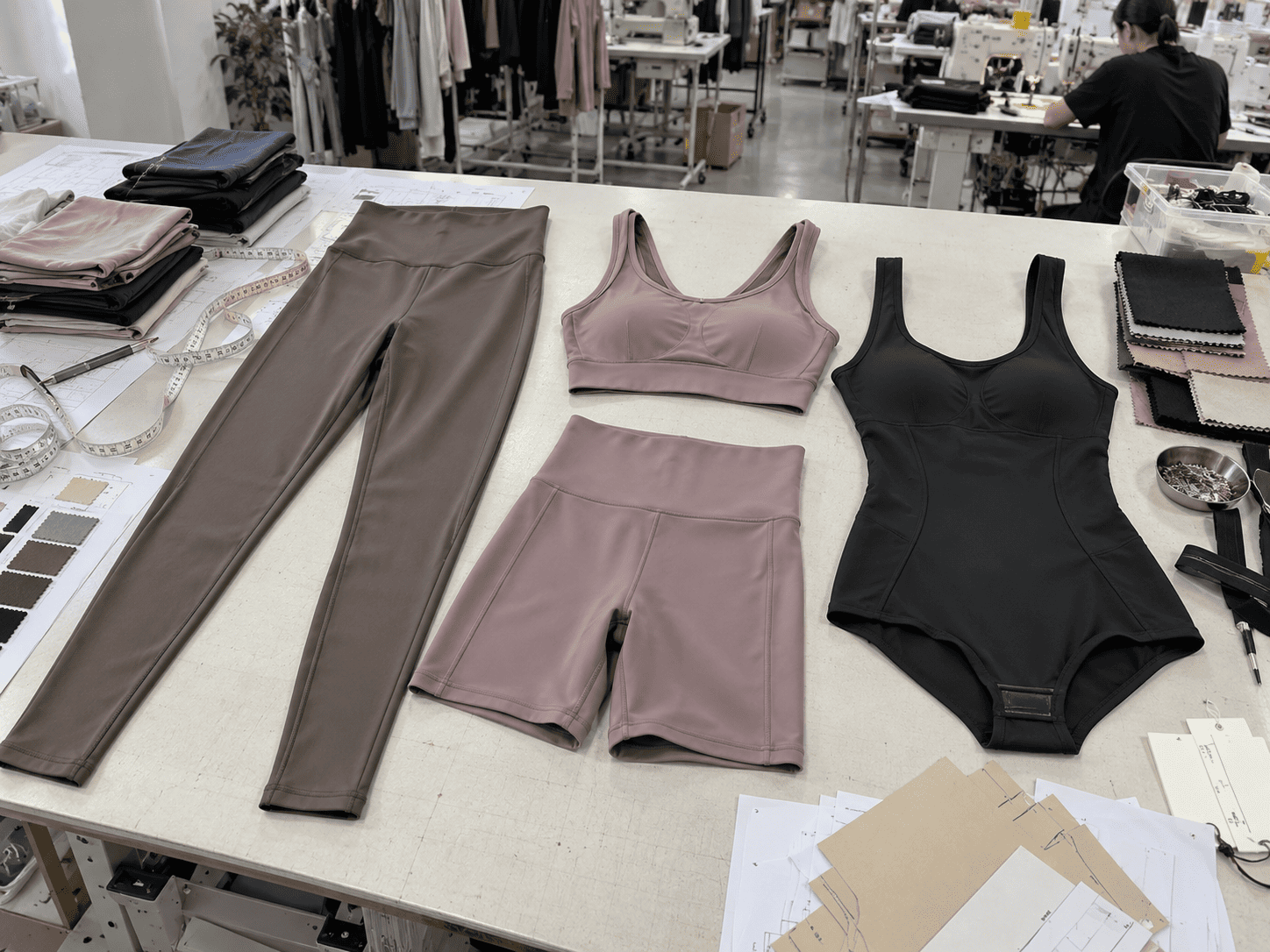
A compression activewear manufacturer can develop high-waist leggings, bike shorts, flare leggings, bodysuits, unitards, sports bras, crop tops, fitted long-sleeve tops, and other close-fitting products where stretch, recovery, and targeted support are important.
Common Compression and Shaping Products
| Product | Typical support direction | Main construction focus |
|---|---|---|
| High-waist leggings | Medium to firm | Waistband + torso hold |
| Bike shorts | Medium to firm | Waist + thigh fit |
| Flare leggings | Light to medium | Waist shaping + hip fit |
| Bodysuits | Medium to firm | Full torso shaping |
| Unitards | Medium to firm | Torso + lower-body fit |
| Sports bras | Light to high support | Underband, cup, straps |
| Crop tops | Light to medium | Fabric recovery + underband |
| Fitted long-sleeve tops | Light to medium | Torso and sleeve recovery |
Not Every Activewear Product Needs Maximum Compression
A yoga customer may want:
- Soft hand
- High stretch
- Gentle support
A strength-training customer may prefer:
- Firmer hold
- More stable waistband
- Stronger fabric recovery
A shaping bodysuit may prioritize:
- Torso control
- Smoothing
- Strategic double layers
These are different products.
So before selecting fabric, ask:
What should the customer feel when they put it on?
Possible answers might be:
- Barely there
- Light support
- Medium support
- Firm sculpting
That description is much more useful than simply saying:
“high compression.”
Sports Bras Need Their Own Development
Sports bras introduce another variable:
support during movement.
A high-support bra is not made by simply using thicker fabric.
Support can come from:
- Underband
- Cup shape
- Inner layers
- Strap width
- Back construction
- Fabric stretch
- Encapsulation or compression design
So even if the bra and legging use the same outer fabric, their patterns and internal construction can be completely different.
Which Fabrics Create Real Compression?
This is the most important technical section.
A fabric can stretch a lot and still provide weak support.
Another fabric may stretch less but recover strongly.
Compression performance is created by the relationship between fabric construction, extension, force, recovery, weight, and pattern negative ease. Spandex percentage alone does not tell you how supportive a finished garment will feel.
Spandex, Elastane, and Lycra
These terms are often confused.
Spandex and elastane are accepted generic names for the same general fiber category.
The U.S. Federal Trade Commission's textile-labeling guidance[^5] specifically notes that “elastane” may be used as an alternative name for “spandex.”
Lycra®, on the other hand, is a trademarked fiber brand rather than the generic name.
So a composition might correctly say:
80% Nylon / 20% Spandex
or:
80% Nylon / 20% Elastane
depending on the market and labeling convention.
Do not automatically write:
Lycra
unless the actual branded fiber is being used appropriately.
Is 20–30% Spandex Always Necessary?
No.
The original draft said real compression usually requires about:
20–30% spandex.
That range can appear in firm activewear fabrics.
But it should not be presented as a technical rule.
For example:
A tightly knitted fabric with 15% elastane may feel firmer than a loosely constructed fabric containing 25%.
Why?
Because compression depends on more than fiber percentage.
It also depends on:
- Knit construction
- Yarn
- Density
- Fabric weight
- Stretch direction
- Force required to stretch
- Recovery after stretching
Test Elasticity Instead of Guessing
ISO 20932-1:2018[^2] provides methods for measuring fabric elasticity and related properties using strip or loop tests.
The standard was reviewed and confirmed in 2024 and remains current.[^2]
For a factory or fabric development team, the lesson is simple:
Do not ask only:
“How much spandex?”
Also ask:
“How far does this fabric stretch, and how strongly does it return?”
Stretch vs Recovery
These are different.
Imagine Fabric A stretches very easily from:
100 cm → 160 cm
but after repeated wear it relaxes and stays at:
110 cm.
That fabric has high stretch but weak recovery.
Fabric B may only stretch:
100 cm → 140 cm
but returns close to its original dimension repeatedly.
For compression activewear, the second fabric may perform better.
Common Fabric Directions
| Fabric direction | Typical feel | Possible use |
|---|---|---|
| Nylon / elastane, smooth | Smooth, dense | Premium leggings |
| Nylon / elastane, brushed | Soft, buttery | Yoga / lifestyle |
| Polyester / elastane | Stable, printable | Training / printed activewear |
| Power mesh | Lightweight but resistant | Inner shaping panels |
| Double-layer stretch knit | More structure | Waistbands / tummy panels |
These are general sourcing directions.
Not fixed quality grades.
Nylon Is Not Automatically “Premium”
It is common to hear:
“Nylon/spandex is premium. Polyester/spandex is cheap.”
That is too simple.
A high-quality polyester activewear fabric can outperform a low-quality nylon fabric.
Nylon may provide a hand feel that some brands prefer.
Polyester can offer advantages for:
- Printing
- Moisture handling
- Color
- Cost
The correct choice depends on the product.
GSM Does Not Equal Compression
A heavier fabric often feels:
- Thicker
- More opaque
- More substantial
But heavier does not automatically mean:
higher compression.
A 320 GSM soft knit can feel less supportive than a dense 240 GSM power fabric.
So GSM should be considered together with:
- Stretch
- Recovery
- Density
- Structure
Opacity Needs Real Stretch Testing
An un-stretched black fabric may look completely opaque.
Then during a deep squat, the knit opens.
Suddenly:
- Skin
- Underwear
- Inner seams
become visible.
This is why activewear cannot be approved only on a table.
The garment has to be tested under real extension.
How Is Tummy Control Built Into a Garment?
If a supplier says:
“This is tummy-control.”
ask:
“Which construction creates the control?”
There should be a real answer.
Tummy control can be created through a high-rise waistband, wider waistband shape, double-layer construction, targeted inner panel, power mesh, seam placement, and pattern reduction. The correct combination depends on how much shaping the product needs.
Common Shaping Features
| Detail | Function |
|---|---|
| High-rise waist | Covers more of the lower torso |
| Wide waistband | Spreads pressure over larger area |
| Double-layer waistband | Adds structure and resistance |
| Inner power mesh | Creates targeted resistance |
| Contoured waistband | Follows waist and hip shape |
| No-front-seam construction | Reduces front seam pressure / cleaner look |
| Gusset | Supports movement and construction |
| Inner elastic | Stabilizes waist |
| Silicone grip | Can reduce movement in selected products |
A Wide Waistband Does Not Automatically Stop Rolling
The original draft said:
narrow waistband rolls; wide double-layer waistband stays flat.
A wider band often helps.
But it is not a guarantee.
Rolling can also be caused by:
- Incorrect negative ease
- Waistband too tight
- Waistband too loose
- Wrong height for body shape
- Weak recovery
- Pattern geometry
- Too much thickness
- Seam placement
So if a waistband rolls during a squat, the answer may not simply be:
make it wider.
The whole waistband system should be reviewed.
Double-Layer Waistbands
A double layer can increase:
- Opacity
- Stability
- Firmness
But it also increases:
- Fabric consumption
- Heat
- Sewing operations
For a shaping legging this may be useful.
For hot yoga, it may be excessive.
Power-Mesh Panels
Power mesh can be placed internally where additional support is needed.
For example:
- Lower abdomen
- Side waist
- Full front waist
The customer sees a clean outer garment.
Inside, the resistance may be much stronger in selected areas.
This is targeted shaping.
More Compression Is Not Always Better
A product can fail because it is too weak.
It can also fail because it is too tight.
Excessive pressure can cause:
- Discomfort
- Waist digging
- Difficult dressing
- Restricted movement
- Returns
So the target should be:
appropriate hold
not:
maximum possible tightness.
Be Careful With Medical Claims
This distinction is extremely important.
Activewear may be marketed as:
- Supportive
- Sculpting
- Shaping
- Compression fit
That is not the same thing as claiming:
- Medical compression
- Therapeutic compression
- Improved circulation
- Treatment of a condition
The U.S. FDA maintains specific device classifications for medical-support compression products. For example, FDA listings include medical compression stockings identified with defined pressure ranges such as 15–20 mmHg, 20–30 mmHg, and 30–40 mmHg under medical-device classifications.[^6]
So unless an activewear product has the appropriate regulatory basis and testing, do not borrow medical language.
A gym legging is not automatically a medical compression garment because it feels tight.
How Do You Get Compression Fit and Sizing Right?
Fabric is only half the equation.
The pattern determines how much of that stretch is used on the body.
Compression activewear usually uses negative ease, meaning some garment measurements are smaller than the body measurements they are designed to fit. But the amount of negative ease must be developed together with the specific fabric's stretch and recovery.
What Is Negative Ease?
Imagine the customer's hip circumference is:
100 cm.
The finished legging hip may be smaller than 100 cm when lying flat.
When worn, the fabric stretches around the body.
That difference creates:
- Close fit
- Tension
- Support
But there is no universal formula such as:
“make every legging 15% smaller than the body.”
Different fabrics need different pattern reductions.
Never Copy a Compression Pattern to a New Fabric Blindly
Suppose Fabric A has:
- Firm stretch
- Strong recovery
and Fabric B is:
- Very stretchy
- Soft
- Lower resistance
Using the same pattern may produce:
Fabric A:
firm sculpting
Fabric B:
soft fit with little hold
Or the opposite can happen if the second fabric is less extensible.
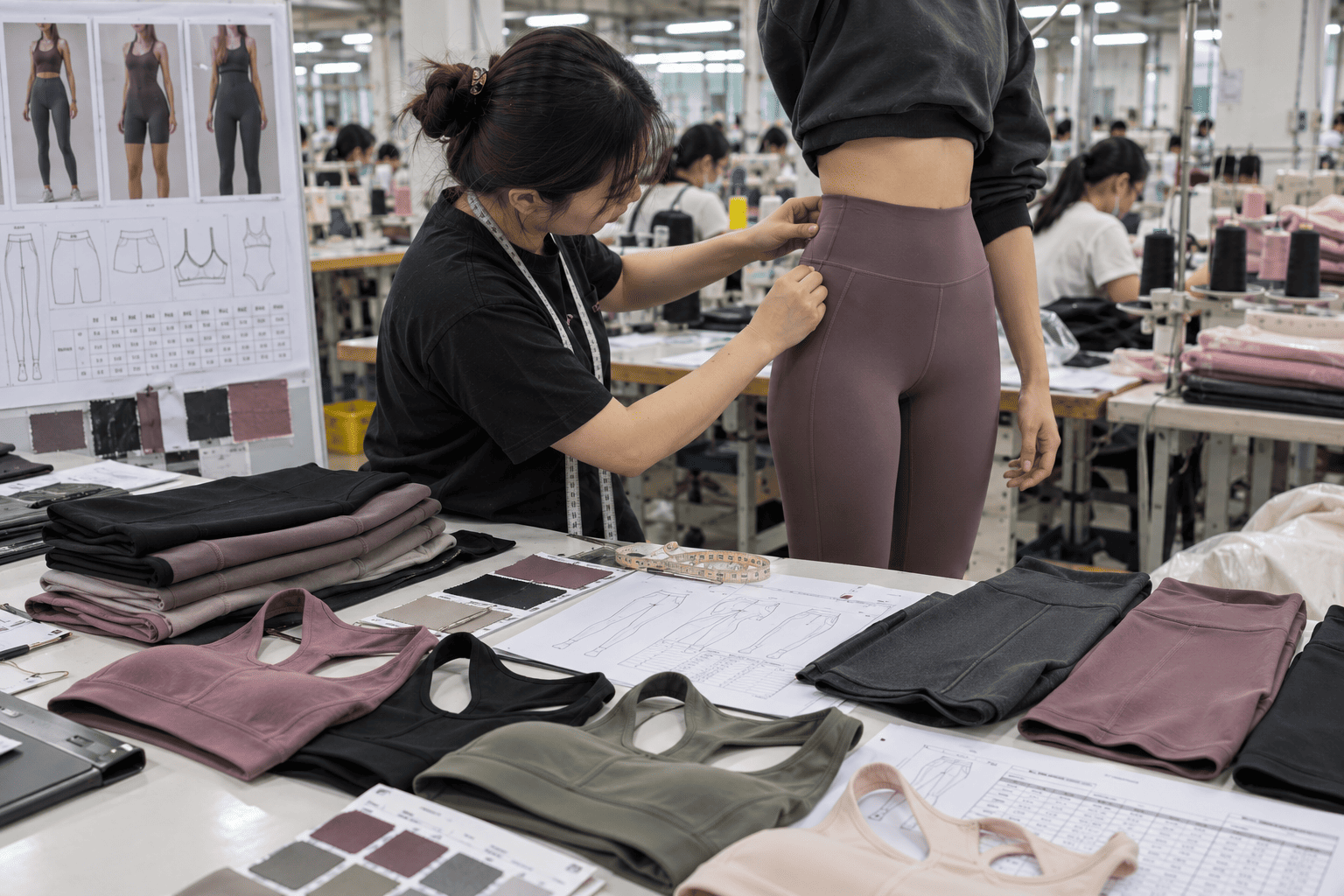
That is why every major fabric change should trigger another fit check.
Key Fit Points
| Area | What to check |
|---|---|
| Waist | Stable without digging |
| Waistband top | No rolling / gaping |
| Front rise | Enough coverage |
| Back rise | Does not pull down |
| Crotch | No excess tension |
| Hip / seat | Support without flattening unintentionally |
| Thigh | Firm but wearable |
| Knee | No sagging |
| Calf | Correct taper |
| Inseam | Correct length |
| Leg opening | No excessive pressure |
Squat Test
A squat test is a very useful practical development check.
Ask the wearer to:
- Stand normally.
- Bend.
- Perform a deep squat.
- Move under strong or daylight-like illumination.
Check:
- Opacity
- Waist movement
- Crotch fit
- Back rise
- Seam strain
- Fabric recovery
A garment can look perfect standing still and fail immediately under movement.
Squat-Proof Is Not Only About Fabric Weight
See-through problems can come from:
- Light fabric
- Open knit
- Excessive pattern reduction
- Wrong size
- Light color
- Overstretch at hip / seat
So if a customer says:
“make it thicker.”
that may solve the problem.
But sometimes the real fix is:
reduce the amount of stretch at the hip.
Fit Test More Than One Size
Compression grading needs care.
Testing only size M is risky.
At minimum, check strategic sizes across the range.
For example:
- Smaller size
- Base size
- Larger size
Larger sizes may need different consideration for:
- Waistband height
- Rise
- Panel shape
- Strap width
- Leg proportion
The goal is not simply to enlarge every measurement mechanically.
Which Quality Problems Show Up in Compression Wear?
Compression garments operate under tension.
That makes weaknesses obvious.
Common problems include poor fabric recovery, see-through areas, rolling waistbands, seam failure, pilling, shade mismatch, dimensional change, and fit distortion under stretch. Most should be found during fabric and sample development rather than after bulk production.
Common Problems
| Problem | Possible cause | What to check |
|---|---|---|
| See-through fabric | Excessive extension / open knit | Opacity under stretch |
| Waist rolls down | Pattern / recovery / waistband geometry | Wear test |
| Knee bagging | Weak recovery | Fabric elasticity |
| Seat sagging | Recovery + pattern issue | Wear cycle |
| Inner-thigh pilling | Friction / fabric surface | Pilling resistance |
| Seam break | Stitch / thread / extension mismatch | Stretch test |
| Waist shade difference | Different dye lots | Lot control |
| Twisting after wash | Construction / dimensional behavior | Wash test |
| Shrinkage | Material / wash conditions | Dimensional testing |
Recovery Should Be Tested
This is where ISO 20932-1[^2] becomes useful.
Fabric elasticity testing helps quantify performance instead of relying only on hand feel.
A salesperson stretching fabric with both hands and saying:
“Very good recovery.”
is not the same thing as measured data.
For serious programs, compare actual fabric behavior.
Pilling Is a Real Activewear Problem
Inner thighs rub repeatedly during:
- Walking
- Running
- Training
That friction can create fuzz and pills.
ISO 12945-2:2020[^3] specifies the modified Martindale method for evaluating a fabric's propensity to:
- Pill
- Fuzz
- Matt
under controlled conditions.
This does not mean every legging must achieve one universal rating.
The buyer and supplier should agree what performance level is appropriate for the product.
Wash Stability Matters Too
Close-fitting garments that change significantly after washing can become uncomfortable.
ISO 5077:2007[^4] specifies a method for determining dimensional change in fabrics and garments after defined washing and drying procedures.
This matters because:
A legging that loses 3% at the waist after washing may feel much tighter.
A bra underband that changes size may affect support.
So do not approve only the unwashed sample.
Panels Should Come From Controlled Fabric Lots
If a legging uses:
- Single-layer leg body
- Double-layer waistband
- Power-mesh inner panel
different material components may reflect light differently.
That is normal.
But avoid accidental shade differences caused by mixing inappropriate dye lots.
For outer-facing panels using the same material, control the lot carefully.
Seam Stretch Must Match Fabric Stretch
A highly extensible fabric with a seam that barely stretches can fail.
Common seam decisions may involve:
- Overlock
- Coverstitch
- Flatlock
- Specialized stretch stitches
depending on construction.
The seam needs to survive the same movement as the fabric around it.
AQL Does Not Replace Performance Testing
A final inspection can check:
- Workmanship
- Measurements
- Labels
- Packing
- Visible defects
But a final AQL inspection cannot magically reveal every long-term recovery or pilling problem.
Those issues need to be addressed earlier through:
- Material testing
- Sample testing
- Wear testing
QC starts before bulk.
What MOQ, Cost, and Timing Should You Expect?
Compression activewear cost is usually driven more by:
fabric + construction
than by the word “legging.”
For our compression-activewear programs, leggings can typically start around 150 pieces per style, depending on fabric, colors, construction, panels, and customization. Cost rises when the product uses higher-cost stretch fabric, double layers, specialty seams, pockets, or complex shaping construction.
Main Cost Drivers
| Cost factor | Why it changes price |
|---|---|
| Fabric | Performance yarn and construction |
| Fabric weight | Changes material consumption |
| Stretch / recovery specification | Higher-performance fabrics may cost more |
| Double-layer waist | More material |
| Power-mesh panel | Extra component + sewing |
| Flatlock | Additional machine / operation |
| Pockets | More panels and labor |
| Contouring seams | More sewing operations |
| Logo | Print / transfer / embroidery |
| Colors | Fabric purchasing split |
| Quantity | Production efficiency |
Nylon vs Polyester Pricing
Nylon/elastane fabrics can sometimes cost more than comparable polyester/elastane fabrics.
But do not build the quotation from fiber names alone.
Price depends on:
- Yarn quality
- GSM
- Knitting
- Finishing
- Mill
- Order quantity
A premium polyester fabric can easily cost more than a basic nylon fabric.
Full-Roll Planning
Fabric suppliers normally have their own purchasing minimums.
If the brand wants:
150 leggings
in one black fabric,
that is easier to organize than:
30 black
30 pink
30 blue
30 green
30 brown
because every color can create separate:
- Fabric sourcing
- Dyeing
- Cutting
- Inventory
So low MOQ works better when the range shares materials.
Build a Small Coordinated Range
A practical first compression-activewear capsule might use one approved fabric across:
- High-waist legging
- Bike short
- Sports bra
Then offer:
- Black
- One neutral
- One seasonal color
This helps:
- Fabric utilization
- Color consistency
- Brand cohesion
while still giving the customer a complete collection.
Printing Needs Stretch Compatibility
A rigid decorative layer can crack when the fabric stretches.
So decoration should be tested on the actual performance fabric.
Depending on the design, options may include:
- Stretch-compatible heat transfer
- Silicone
- Suitable screen print systems
- Sublimation on appropriate polyester constructions
For all-over printed activewear, polyester-based fabrics are often practical because traditional dye-sublimation systems work especially well with polyester.
But decoration should still be tested on the exact fabric.
Fiber Labels Must Match the Real Composition
For products sold in the United States, the FTC Textile Fiber Rule[^5] requires covered textile products to disclose the generic fiber names and percentages by weight, together with manufacturer or marketer identification and country of manufacture or processing.
So if a fabric test shows:
75% Nylon / 25% Spandex
do not label it:
80% Nylon / 20% Spandex
because that was the original development target.
The production label should reflect the actual supported composition.
Timing
For a standard project, development may include:
Fabric selection
→ Pattern
→ Sample
→ Wear test
→ Squat / opacity check
→ Measurement correction
→ Bulk approval
→ Fabric purchase
→ Cutting
→ Sewing
→ Final inspection
→ Packing
A standard sample may take around two weeks depending on the style and fabric availability.
Bulk production can commonly fall around 20–30 days after final approval and deposit, depending on the order.
Special fabrics or custom colors can add time.
Payment
For new bulk orders, our normal structure remains:
50% before bulk production and 50% before shipment.
Special arrangements can be discussed separately where appropriate.
How Do You Choose a Compression Activewear Manufacturer?
Do not ask only:
“Do you make leggings?”
Almost any knitwear factory may answer yes.
Ask:
“How do you test the fit?”
Green Flags and Red Flags
| Green flag | Red flag |
|---|---|
| Discusses stretch and recovery | Talks only about spandex percentage |
| Adjusts pattern to the actual fabric | Uses one pattern for every fabric |
| Explains negative ease | Says “we simply make it smaller” |
| Tests opacity under movement | Checks fabric only on a table |
| Wear-tests waistband | Assumes wide = no rolling |
| Tests multiple sizes | Tests only M |
| Discusses pilling / recovery | Talks only about GSM |
| Separates activewear compression from medical compression | Makes circulation or medical claims casually |
Ask to See the Inside
When evaluating a tummy-control legging, inspect:
- Waistband layers
- Inner mesh
- Seams
- Gusset
- Elastic
- Panel shape
If the supplier cannot explain what creates the tummy-control effect, the product may simply be a normal high-waist legging with a marketing name.
Ask What Happens After 30 Minutes of Wear
A sample may feel very firm when first put on.
But after movement, does it:
- Sag?
- Roll?
- Bag at the knee?
- Slip at the waist?
That is why wear testing matters.
Ask What Happens After Washing
Then check again.
Compression should not exist only on day one.
Conclusion
Real compression activewear is engineered.
It is not created by putting:
“Tummy Control”
in the product title.
Start with the fabric.
Check:
- Stretch
- Recovery
- Density
- Opacity
- Weight
- Hand feel
Do not assume that:
more spandex = more compression
or:
higher GSM = better hold.
Then develop the pattern around the actual fabric.
Use negative ease carefully.
If you change the fabric, recheck the fit.
For tummy control, decide what creates the shaping.
It may be:
- Wider waistband
- Double layer
- Power mesh
- Contoured pattern
- Targeted panels
Then test the garment on the body.
Squat.
Bend.
Sit.
Move.
Check:
- Waistband
- Opacity
- Crotch
- Rise
- Knee
- Recovery
Test more than one size.
Check pilling and dimensional stability where they matter.
And keep the claims accurate.
A supportive gym legging can be described as:
- Sculpting
- Shaping
- Supportive
- Compression fit
when those descriptions match the product.
But medical compression is a different category with regulatory and pressure requirements.
The goal is not to make the tightest legging possible.
The goal is to create a garment that:
holds the body, moves with the customer, stays opaque, recovers after wear, and remains comfortable long enough that the customer actually wants to wear it again.
That is what makes shaping activewear work.
Footnotes & References
[^1]: SkyQuest — Compression Wear and Shapewear Market Size, Share and Growth Analysis. SkyQuest reports a global compression-wear and shapewear market value of approximately USD 10.31 billion in 2024 and USD 11 billion in 2025, with projections reaching approximately USD 18.48 billion by 2033 at a forecast CAGR of around 6.7%.
https://www.skyquestt.com/report/compression-wear-and-shapewear-market/market-size
[^2]: International Organization for Standardization — ISO 20932-1:2018, Textiles — Determination of the Elasticity of Fabrics — Part 1: Strip Tests. Describes strip and loop test methods that can be used to measure elasticity and related fabric properties. The standard was reviewed and confirmed in 2024 and remains current.
https://www.iso.org/standard/69489.html
[^3]: International Organization for Standardization — ISO 12945-2:2020, Textiles — Determination of Fabric Propensity to Surface Pilling, Fuzzing or Matting — Part 2: Modified Martindale Method. Specifies a method for evaluating textile resistance to pilling, fuzzing, and matting using a modified Martindale procedure.
https://www.iso.org/standard/75375.html
[^4]: International Organization for Standardization — ISO 5077:2007, Textiles — Determination of Dimensional Change in Washing and Drying. Specifies a method for measuring dimensional change in textile fabrics, garments, and other textile articles after defined washing and drying procedures. The standard was reviewed and confirmed in 2022 and remains current.
https://www.iso.org/standard/41877.html
[^5]: U.S. Federal Trade Commission — Textile Fiber Rule and Textile Labeling Guidance. FTC rules require covered textile products to disclose generic fiber names and percentages by weight, manufacturer or marketer identification, and country of processing or manufacture. FTC guidance also recognizes “elastane” as an alternative generic name for “spandex.”
https://www.ftc.gov/legal-library/browse/rules/textile-fiber-rule
https://www.ftc.gov/business-guidance/resources/threading-your-way-through-labeling-requirements-under-textile-wool-acts
[^6]: U.S. Food and Drug Administration — Medical Support Stocking Device Listings. FDA device listings show that products marketed as medical-support compression stockings may be classified as medical devices and may be specified using pressure ranges such as 15–20 mmHg, 20–30 mmHg, or 30–40 mmHg. This is different from ordinary activewear described as supportive or shaping.
https://www.accessdata.fda.gov/scripts/cdrh/Cfdocs/cfrl/rl.cfm?lid=637828&lpcd=DWL
https://www.accessdata.fda.gov/scripts/cdrh/Cfdocs/cfrl/rl.cfm?lid=996475&lpcd=FQL