
Linen Clothing Manufacturer: How Do You Make Custom Linen Garments That Last?
Your linen shirt sample looks perfect when it arrives.
Then the customer washes it.
The body becomes shorter.
The fabric wrinkles within minutes.
And the matching trousers look slightly different in color from the shirt.
Linen is beautiful.
But it is not forgiving.
A linen clothing manufacturer makes shirts, trousers, shorts, dresses, matching sets, and other woven garments from pure linen or linen blends. Good linen production depends on choosing the right fabric, controlling dimensional change, understanding natural wrinkles and shade variation, and using construction that suits a woven flax fabric.
Linen starts with flax.
The Alliance for European Flax-Linen & Hemp explains that flax is a bast fiber taken from the stem of the plant and that textile producers especially value its long fibers for yarn and fabric.
Western Europe remains one of the most important production regions.
The Alliance reports that roughly three-quarters of global long flax fiber production comes from Western Europe, particularly France, Belgium, and the Netherlands.
Its current industry data also shows around 190,000 tonnes of long fiber production in 2025, with fashion representing approximately 60% of Flax-Linen market use by volume.
That helps explain why linen remains so important in:
- Summer collections
- Resort wear
- Relaxed tailoring
- Shirts
- Dresses
- Co-ord sets
But the fiber behaves differently from cotton knitwear.
So the product has to be developed differently too.
Table of Contents
- What Does a Linen Clothing Manufacturer Make?
- Which Linen Fabric Should You Choose?
- Why Does Linen Shrink, Wrinkle, and Vary in Color?
- How Do Washes and Finishes Change Linen?
- Which Construction Details Matter in Linen Garments?
- What MOQ, Cost, and Timing Should You Expect?
- Conclusion
What Does a Linen Clothing Manufacturer Make?
When most people picture linen, they think about a white summer shirt.
But linen works across a much wider product range.
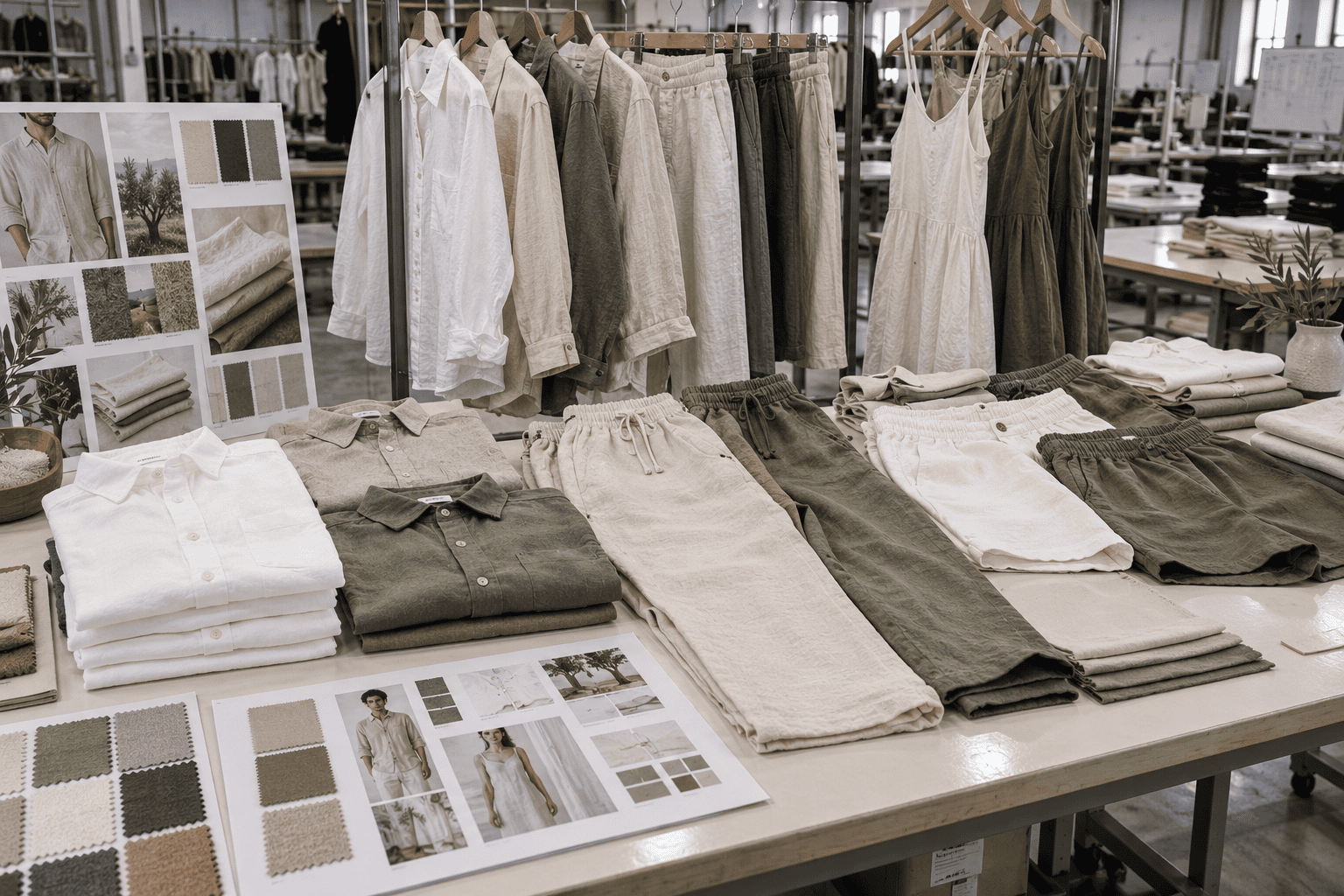
A linen clothing manufacturer can produce shirts, trousers, shorts, skirts, dresses, co-ord sets, relaxed jackets, and other woven summer garments.
Common products include:
Linen Shirts
Typical constructions include:
- Camp collar
- Cuban collar
- Classic shirt collar
- Band collar
- Oversized shirt
- Short-sleeve resort shirt
Linen works especially well when the pattern allows some movement.
Linen Trousers
Popular options include:
- Wide-leg trousers
- Drawstring trousers
- Elastic-waist trousers
- Relaxed tailored pants
- Cropped pants
Linen Shorts
These may use:
- Elastic waist
- Drawcord
- Button-and-zip waist
- Side pockets
- Back welt or patch pockets
Linen Dresses and Skirts
A lighter linen or softer blend can work well for:
- Loose dresses
- Shirt dresses
- Midi skirts
- Resort pieces
Linen Co-Ord Sets
Matching sets are especially natural for linen.
For example:
shirt + trousers
or:
shirt + shorts
The two garments share:
- Fabric
- Color
- Texture
- Wash
and read as one complete outfit.
Common Linen Products
| Product | Typical silhouette | Common use |
|---|---|---|
| Linen shirt | Relaxed / boxy | Summer casualwear |
| Linen trousers | Wide or relaxed | Resort / city wear |
| Linen shorts | Relaxed | Holiday / warm weather |
| Linen dress | Loose / flowing | Women's collections |
| Co-ord set | Matching top + bottom | Resort / modest wear |
| Light jacket | Unstructured | Smart casual |
Linen Usually Benefits From Ease
Linen fabric does not normally stretch the way a jersey T-shirt does.
So extremely tight fits can feel restrictive unless:
- The pattern has enough ease
- The fabric contains stretch fiber
- The construction is designed for movement
Relaxed shirts, wide-leg pants, and flowing dresses naturally work with linen's character.
Our group also handles woven production, so linen shirts, trousers, shorts, and sets can be developed as woven garments rather than being treated like extensions of a knitwear pattern.
The pattern, machines, seams, and pressing requirements are different from hoodies and T-shirts.
Which Linen Fabric Should You Choose?
"Linen" alone is not enough information for a factory quotation.
Two fabrics can both say:
100% linen
and still feel completely different.
The right linen depends on fabric weight, yarn, weave density, finish, transparency, blend, and the silhouette you want to produce.
Practical Linen Weight Ranges
For apparel development, practical ranges may look something like:
| Weight | General character | Possible products |
|---|---|---|
| 110–140 GSM | Light, airy | Shirts, dresses, lining-sensitive pieces |
| 140–170 GSM | Light-medium | Summer shirts, dresses, loose tops |
| 170–220 GSM | Medium | Trousers, shorts, sets |
| 220 GSM+ | More substantial | Structured trousers, jackets |
These are sourcing references.
They are not universal quality standards.
A tightly woven 160 GSM fabric can behave very differently from a loosely woven 160 GSM fabric.
100% Linen
Pure linen gives you the strongest traditional character.
It can feel:
- Crisp
- Dry
- Textured
- Breathable
- Natural
The Alliance for European Flax-Linen & Hemp describes linen as moisture-managing, breathable, and thermoregulating, which helps explain its popularity in warm-weather apparel.
But pure linen can also:
- Wrinkle visibly
- Feel firm when new
- Require careful shrinkage control
Those are not automatically defects.
They are part of the material.
Linen-Cotton
A linen-cotton blend can give a softer, more familiar hand.
Depending on the ratio, cotton can change:
- Drape
- Texture
- Price
- Wrinkling behavior
But do not assume every linen-cotton blend wrinkles dramatically less.
The actual result depends on the percentage and fabric construction.
Linen-Viscose
Linen-viscose blends are popular for softer, more fluid garments.
They can work well for:
- Dresses
- Wide-leg pants
- Women's sets
because viscose can add drape.
But again, the composition needs to be tested because regenerated cellulose fibers can also have their own dimensional-change behavior.
Linen With Elastane
A small amount of elastane may help when the design needs more comfort.
This can be useful for:
- More fitted trousers
- Tailored shorts
- Slimmer silhouettes
But it changes the fabric story and must be reflected correctly on the fiber label.
For U.S. sales, the FTC Textile Fiber Rule requires covered textile products to disclose the generic names and percentages by weight of their constituent fibers, along with other required information.
So:
97% linen / 3% elastane
is not the same labeling claim as:
100% linen.
Check Transparency Before Approving Light Colors
White, cream, pale beige, and pastel linen can become transparent.
This depends on:
- GSM
- Weave density
- Yarn
- Color
- Lighting
For light trousers or dresses, check the actual fabric:
- Against skin
- Against a dark surface
- Under daylight
before approving bulk.
Sometimes the solution is:
- Higher GSM
- Denser construction
- Lining
- Different underwear-color recommendation
not simply "use heavier linen."
Linen Naturally Has Character
Flax yarn may show natural:
- Slubs
- Thick and thin areas
- Small irregularities
A certain amount can contribute to linen's visual identity.
But there is still a difference between:
natural character
and:
poor fabric quality.
Approve an actual swatch or sample yardage.
Do not buy linen based only on a close-up supplier photo.
Why Does Linen Shrink, Wrinkle, and Vary in Color?
This is probably the most important section for first-time linen buyers.
Linen behaves differently from a polyester performance fabric.
You should expect that.
Linen can show dimensional change after washing, visible creasing during wear, and some material or shade variation. The production goal is to understand and control those characteristics rather than pretending they do not exist.
Linen Wrinkles Easily
Flax fibers are relatively stiff and have limited elastic recovery compared with many synthetic fibers.
That is why linen develops visible creases quickly.
But wrinkles are also part of why customers recognize linen.
A premium linen brand often does not try to make the product look permanently pressed like polyester.
It may deliberately photograph the garment with:
- Natural creases
- Soft folds
- Relaxed texture
because that is part of the aesthetic.
Do Not Promise "Wrinkle-Free Linen"
Unless you have a specific tested treatment that supports the claim, this wording creates the wrong expectation.
A better product description might be:
naturally textured
or:
relaxed linen character
rather than promising a perfectly smooth garment.
Shrinkage Needs Measurement, Not Guessing
The original article said linen shrinks more in length than width.
That can happen.
But it should not be presented as a universal rule.
Dimensional change depends on:
- Fabric construction
- Yarn
- Finishing
- Wash conditions
- Drying
- Garment construction
ISO 5077:2007 specifies a method for determining dimensional change in fabrics, garments, and other textile articles after washing and drying.
The standard remains current after ISO review.
That gives us a much better production approach.
Instead of saying:
"Linen normally shrinks X%."
we test the actual fabric.
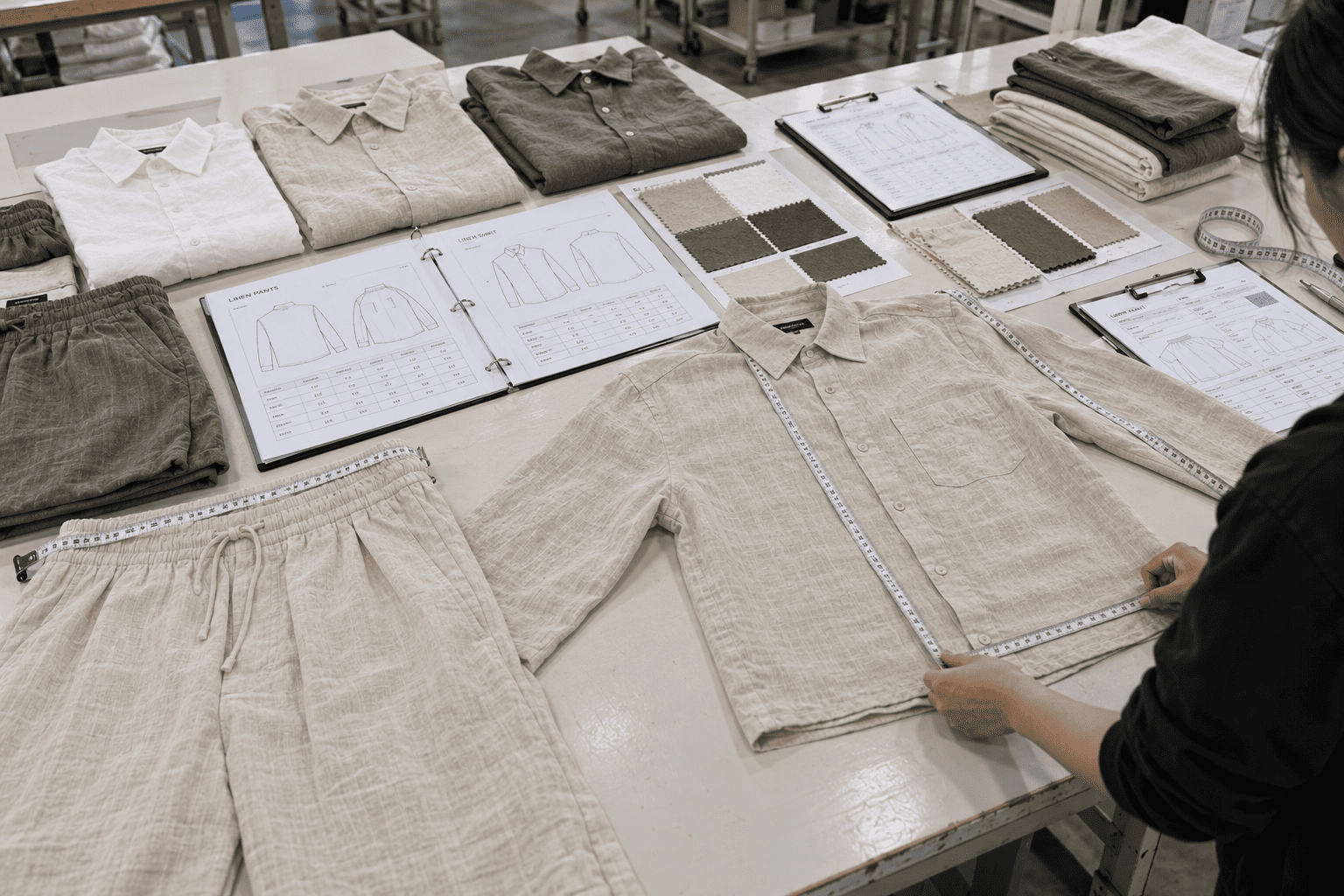
Measure Both Directions
Record:
- Length
- Width
before washing.
Then wash and dry under the agreed test process.
Then measure again.
A sample result might look like:
Length change: -3.2%
Width change: -1.5%
Those numbers can then be used when developing the final pattern.
Your fabric may give completely different results.
That is why it needs to be tested.
Use a Defined Washing Procedure
ISO 6330:2021 provides standardized domestic washing and drying procedures for textile testing.
This matters because:
cold wash + line dry
and:
warm wash + tumble dry
can give different dimensional results.
So when someone says:
"Our linen shrinks 3%."
ask:
"Under what wash and drying condition?"
Without the test condition, the percentage means much less.
What About Color Variation?
Linen can show differences in:
- Fiber texture
- Dye response
- Surface appearance
But I would not simply write:
"Natural flax dyes unevenly."
as if every linen fabric must be patchy.
High-quality linen can be dyed very consistently.
The real issue for a matching set is usually controlling:
- Fabric lot
- Dye lot
- Wash
- Finishing
If the shirt is cut from one batch and the trousers from another, even a small shade difference becomes obvious because they are worn together.
One Dye Lot for Matching Sets
Whenever possible:
shirt + trousers
or:
shirt + shorts
should come from the same approved fabric and dye lot.
Then inspect the pieces together.
Do not judge the shirt in one room and the trousers three days later.
Compare the set:
- Side by side
- Under consistent lighting
before packing.
How Do Washes and Finishes Change Linen?
Raw linen can feel firm.
That does not mean the finished garment has to stay that way.
Washing and finishing can soften linen, relax the surface, alter appearance, and reduce some of the dimensional movement before the customer receives the product. But every finish should be tested because it can also change measurements and color.
Common Linen Finishing Directions
| Finish | Typical result | Suitable for |
|---|---|---|
| No garment wash | Crisp and cleaner | Structured shirts / tailoring |
| Fabric pre-wash | Softer, some dimensional movement already released | General linen garments |
| Softening finish | Softer hand | Shirts / dresses |
| Enzyme-assisted finish | Surface / hand modification depending on recipe | Casual pieces |
| Garment wash | Relaxed, broken-in look | Resort / casual linen |
| Garment dye | Washed color and more variation | Vintage / relaxed collections |
Washing Is Not Only About Softness
A wash can affect:
- Body length
- Chest
- Waist
- Inseam
- Collar
- Hem
- Hand feel
- Shade
So if your bulk garment is going to receive a garment wash, the approval sample should ideally receive the same or equivalent process.
Do not approve final measurements on the unwashed garment.
Pattern Compensation Comes After Testing
Suppose a washed trouser loses:
3% in inseam
and:
1% at hip
You would not necessarily enlarge every measurement by exactly 3%.
Pattern adjustment can be directional.
The same principle we use for garment-dyed hoodies applies here:
test → measure → adjust → test again
rather than:
guess → bulk production
Wash Standards Help Reorders
If a customer orders the same washed beige linen set six months later, the instruction:
"same soft wash as last time"
is not ideal.
Keep:
- Approved garment
- Wash recipe reference
- Color reference
- Measurement sheet
so the next run has something physical to follow.
Garment Washing Can Be Specialist Work
Garment washing may be handled by long-term specialist wash partners because it requires different:
- Machines
- Chemical control
- Water treatment
- Process expertise
The garment manufacturer still needs to manage:
- Input garment
- Wash approval
- Measurement changes
- Final QC
as part of the full order.
Our garment-dyed and vintage-wash guide explains this workflow in more detail.
Which Construction Details Matter in Linen Garments?
Linen construction deserves attention because many apparel linens are woven fabrics.
The fabric may fray.
And some open constructions can be vulnerable to yarn movement around seams.
For linen garments, seam type, seam allowance, stitch density, reinforcement, interfacing, and seam-slippage resistance should be matched to the actual fabric rather than copied automatically from a cotton shirt.
What Is Seam Slippage?
You may see this problem most clearly at:
- Seat seam
- Hip
- Armhole
- Pocket corner
The seam itself may not break.
Instead, the yarns in the fabric move away from the seam, creating a visible opening or gap.
ISO provides a specific family of standards for this issue.
ISO 13936-1 covers determination of the resistance of woven-fabric yarn systems to slippage at a sewn seam using a fixed seam-opening method.
ISO 13936-2 provides a fixed-load method and is applicable to apparel woven fabrics, including stretch woven fabrics.
That is much more precise than simply saying:
"linen has loose weave, so use a bigger seam allowance."
The real risk depends on the fabric.
Construction Details to Check
| Detail | Possible options | What to evaluate |
|---|---|---|
| Side seam | Overlock + stitch, French seam, flat-felled | Strength and clean finish |
| Seam allowance | Depends on fabric | Enough material around stress area |
| Armhole | Standard / enclosed construction | Movement and seam strength |
| Collar | Camp, classic, band | Shape and interfacing |
| Placket | Separate / grown-on | Stability |
| Waist | Elastic, drawcord, tailored | Fit and reinforcement |
| Patch, side seam, welt | Corner reinforcement | |
| Hem | Turned, narrow hem | Clean finish and puckering |
French Seams
French seams are useful for some lightweight linen garments because the raw fabric edge becomes enclosed inside the seam.
They can give:
- Clean interior
- Premium appearance
- Better containment of fraying edges
They are especially suitable for certain:
- Shirts
- Dresses
- Lightweight tops
But they are not automatically the strongest answer for every stress seam.
For a trouser seat, another seam construction may perform better.
Use the seam based on function.
Flat-Felled Seams
Flat-felled seams can give:
- Strength
- Clean inside
- Casual workwear look
and may work well on:
- Shirts
- Shorts
- Utility linen pieces
depending on fabric thickness.
Interfacing Matters
A very stiff interfacing on soft washed linen can look wrong.
It may create:
- Rigid collar
- Bubbling
- Unnatural placket
Choose interfacing that supports the garment while still matching the linen hand.
For a soft camp-collar shirt, the goal is usually different from a tailored linen business shirt.
Reinforce Stress Points
Pay attention to:
- Pocket corners
- Side pocket openings
- Crotch
- Waistband ends
- Belt loops
because linen trousers experience tension there.
Bar tacks or reinforcement may be appropriate depending on design.
Buttons and Trims
Linen pairs naturally with trims such as:
- Shell-style buttons
- Corozo
- Coconut
- Wood-look buttons
- Matte buttons
But the product should not use a trim just because it looks "natural."
Also check:
- Wash durability
- Breakage
- Color transfer
- Supplier MOQ
A high-quality plastic or resin button can sometimes perform better than a fragile decorative natural button.
Function comes first.
What MOQ, Cost, and Timing Should You Expect?
Linen pricing depends heavily on the fabric.
The cost of a custom linen garment is driven by fiber composition, fabric weight, fabric source, construction, washing, trims, order quantity, and how many colors you split the order across.
Main Linen Cost Drivers
| Cost driver | Why it matters |
|---|---|
| 100% linen vs blend | Different yarn and fabric pricing |
| Fabric weight | Changes material consumption |
| Fabric quality / origin | Can change price significantly |
| Fit | Wide garments consume more fabric |
| Washing | Adds specialist processing |
| Seam construction | French or felled seams add operations |
| Interfacing | Needed for collars / plackets |
| Pockets | Increase sewing time |
| Buttons | Specialty trims may cost more |
| Number of colors | Affects fabric purchasing and dye minimums |
Do Not Assume Linen Is Always More Expensive Than Cotton
Often, high-quality pure linen is more expensive than common cotton fabric.
But the price comparison depends on what cotton you are comparing it with.
Premium long-staple cotton fabric may cost more than a basic linen blend.
So the quotation should be based on:
actual fabric specification
not a blanket rule.
Fabric Roll Minimums Matter
Like many woven fabrics, linen is often purchased by:
- Roll
- Meter
- Supplier minimum
Suppose one fabric roll produces approximately 120 shirts.
A 100-piece order in one color may be straightforward.
But:
25 natural
25 olive
25 blue
25 brown
may require the factory to purchase small quantities of four separate fabrics or colors.
That can increase:
- Fabric price
- Waste
- Sourcing time
So always ask:
How much fabric does this style consume?
and:
What is the supplier minimum per color?
Matching Sets Can Help Fabric Utilization
A shirt and trousers made from the same fabric may help use one fabric program more efficiently.
For example:
100 shirts
100 trousers
from the same beige linen
can be easier to organize than developing completely different fabrics for the top and bottom.
It also makes color control simpler.
Sampling
Linen sampling should ideally confirm:
- Fabric
- Transparency
- Fit
- Shrinkage
- Wash
- Seams
- Interfacing
- Buttons
before bulk.
If a special wash is required, sampling takes longer because the sample needs to go through that process before final approval.
Lead Time
Do not calculate linen lead time from sewing alone.
A typical order may include:
Fabric approval
→ Sample
→ Wash test
→ Measurement check
→ Revision
→ Bulk material
→ Cutting
→ Sewing
→ Washing if required
→ Final inspection
→ Packing
If the fabric is custom woven, custom dyed, or imported, material lead time can be much longer than garment sewing time.
Fiber Labeling
For products sold in the United States, the FTC Textile Fiber Rule requires covered textile products to disclose:
- Generic fiber names
- Percentages by weight
- Responsible manufacturer or marketer
- Country of processing or manufacture
So before bulk, confirm that the composition supplied by the fabric mill matches what will appear on the garment label.
Care Labels Should Match Testing
Linen customers often ask:
Can I machine wash it?
Can I tumble dry it?
Will it shrink?
Do not answer those questions based only on what "linen usually does."
Use the actual finished garment and wash testing as the basis for your care recommendation.
The FTC Care Labeling Rule requires covered U.S. apparel to carry appropriate regular-care instructions supported by a reasonable basis.
That is especially important with:
- Linen-viscose
- Garment-washed linen
- Dyed linen
- Special trims
because the weakest component may determine the final care instruction.
How Do You Choose a Linen Clothing Manufacturer?
Linen is a good product for testing whether a factory actually understands woven garments.
Ask technical questions.
Green Flags and Red Flags
| Green flag | Red flag |
|---|---|
| Asks for linen weight and composition | Quotes from "linen shirt" only |
| Checks transparency in light colors | Ignores see-through risk |
| Wash tests before final measurements | Measures only raw sample |
| Keeps matching sets in one fabric lot | Mixes different shade lots |
| Understands seam slippage | Uses same seam on every fabric |
| Chooses interfacing to match linen | Uses very stiff collar construction blindly |
| Explains specialist wash processes | Says every process is done in one place |
| Gives real audit documentation | Uses vague certification claims |
Social Audits Are Separate From Linen Quality
Supplier compliance is useful.
But it answers a different question from product quality.
SMETA, developed by Sedex is a social-audit methodology covering areas such as labour standards and health and safety, with broader 4-Pillar audits also covering environmental performance and business ethics.
Sedex explicitly describes SMETA as an audit methodology rather than a product certification.
So it does not prove that:
- Your linen will not shrink
- Your seam will not slip
- Your trousers match the shirt
Those questions still require:
- Fabric approval
- Wash testing
- Construction testing
- Final inspection
A good supplier should understand both.
Conclusion
Linen rewards careful development.
It also exposes shortcuts quickly.
Start with the actual fabric.
Confirm:
Is it 100% linen or a blend?
What is the GSM?
How transparent is it?
How does it behave after washing?
Then decide the fit.
Linen usually works naturally with:
- Relaxed shirts
- Wide trousers
- Loose dresses
- Resort sets
but the pattern should still match your customer.
Next, test dimensional change.
Do not assume one universal linen shrinkage percentage.
Measure the real material before and after the intended wash and drying process.
If the garment receives a wash or finish, approve the final measurements after that process.
For matching sets, keep the top and bottom in the same approved fabric and lot whenever possible.
Then check construction.
Linen may need extra attention at:
- Armholes
- Side seams
- Seat seams
- Pockets
- Waistbands
especially when the fabric construction is relatively open.
Finally, accept the character of the fiber.
Linen wrinkles.
It develops texture.
That is part of why people buy it.
The goal is not to make linen behave like polyester.
The goal is to control the things that should be controlled:
fit, shrinkage, seam strength, color, construction, and wash performance
while keeping the natural character that makes linen worth using in the first place.