
Custom Shorts Manufacturer: How Do You Make Sweat Shorts and Mesh Shorts That Sell?
Your hoodies sell out.
Your shorts sit on the shelf.
The fabric is good.
The logo is right.
But the shorts still do not feel right when someone puts them on.
Sometimes the problem is only two inches of inseam.
Sometimes it is a waistband that rolls after washing.
Sometimes it is a pocket that drops your phone the moment you sit down.
A custom shorts manufacturer makes sweat shorts, mesh shorts, training shorts, nylon shorts, and other styles according to your fabric, fit, length, construction, and branding. Inseam, waistband, pockets, and fabric usually decide whether a pair of shorts actually feels good to wear.
Shorts are also a meaningful sportswear and streetwear category.
According to Verified Market Reports[^1], the North American sports shorts market is projected to grow from approximately USD 2.3 billion in 2025 to USD 3.2 billion by 2033.
For a streetwear brand, shorts are also the natural warm-weather partner to hoodies, T-shirts, polos, and matching sets.
But a good pair of shorts needs more development than simply cutting a pair of sweatpants shorter.
Here is what matters.
Table of Contents
- What Types of Shorts Can a Custom Shorts Manufacturer Make?
- Which Fabric Should You Choose for Shorts?
- How Do Inseam and Fit Change the Look?
- Which Waistband and Pocket Details Matter?
- How Should You Decorate Custom Shorts?
- What MOQ, Cost, and Timing Should You Expect?
- Conclusion
What Types of Shorts Can a Custom Shorts Manufacturer Make?
"Shorts" is not one product.
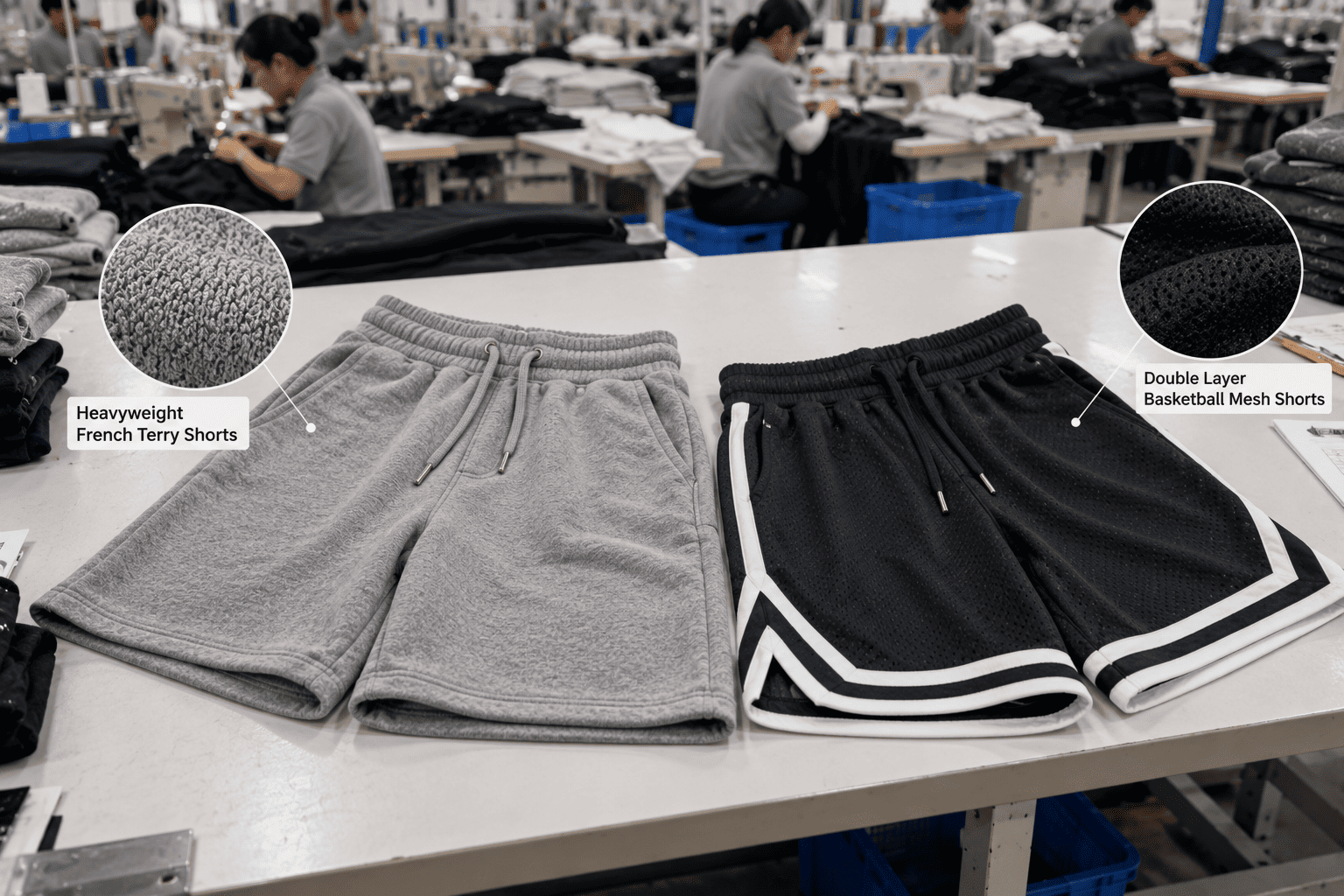
A heavyweight cotton sweat short and a double-layer polyester mesh short may have a similar silhouette, but the fabric, sewing, fit, decoration, and end use are completely different.
A custom shorts manufacturer can produce sweat shorts, mesh shorts, training shorts, two-in-one running shorts, nylon shorts, cargo shorts, and lounge shorts. The right factory needs experience with the construction you actually want.
One of the first distinctions is:
knit vs woven.
Sweat shorts are normally knitted products.
Training shorts may use knitted performance fabric.
Mesh shorts are also knitted.
Nylon shorts and many cargo shorts are generally woven.
Those categories behave differently during:
- Cutting
- Sewing
- Washing
- Stretching
- Pocket construction
- Decoration
Common Types of Custom Shorts
| Type | Typical fabric | Typical customer |
|---|---|---|
| Sweat shorts | French terry or fleece | Streetwear and loungewear brands |
| Mesh shorts | Polyester mesh | Basketball and streetwear brands |
| Training shorts | Polyester-spandex | Gym and sports brands |
| Two-in-one shorts | Woven/knit outer + compression liner | Running and training |
| Nylon shorts | Woven nylon | Summer, outdoor and swim-inspired lines |
| Cargo shorts | Cotton twill or ripstop | Utility and streetwear brands |
| Jersey lounge shorts | Cotton jersey | Basics and sleepwear |
Sweat shorts and mesh shorts are two styles we see frequently from streetwear buyers.
Sweat shorts can share a fabric story with a hoodie or crewneck.
Mesh shorts allow stronger:
- Colors
- Graphics
- Sports references
- Contrast trims
Our core production is knit apparel, so sweat shorts naturally sit alongside the hoodies, T-shirts, sweatpants, and sets we produce.
For woven styles, construction needs to be planned separately rather than treating every pair of shorts as the same product.
Which Fabric Should You Choose for Shorts?
Fabric controls:
- Drape
- Heat
- Breathability
- Structure
- Stretch
- Transparency
- Decoration
- Cost
For streetwear sweat shorts, French terry is usually a strong starting point. For basketball-style shorts, polyester mesh is common. For gym and training shorts, lightweight polyester-spandex or other technical fabrics usually make more sense.
Fabric Options Compared
| Fabric | Typical weight | Character | Best for |
|---|---|---|---|
| French terry | About 280–400 GSM | Structured, looped inside | Premium sweat shorts |
| Brushed fleece | About 300–380 GSM | Soft and warm | Cooler climates / lounge |
| Polyester mesh | Varies by construction | Open, airy | Basketball-style shorts |
| Polyester-spandex | Light to medium | Smooth, flexible | Training and gym |
| Cotton jersey | About 180–260 GSM | Soft and light | Lounge and basic shorts |
| Nylon woven | Light | Crisp, technical | Outdoor and summer styles |
These ranges are practical sourcing references, not universal standards.
Why French Terry Often Works Better Than Fleece for Sweat Shorts
Brushed fleece works very well in hoodies and winter sweatpants.
For shorts, however, warmth is often less important.
French terry keeps the loopback interior unbrushed.
That normally makes it:
- Less bulky
- Easier to wear in warm weather
- Cleaner inside
- Suitable for structured streetwear fits
A heavy French terry can still create a premium boxy silhouette without the plush warmth of winter fleece.
A 350 GSM French terry short can feel very substantial.
So choosing French terry does not mean choosing a lightweight product.
What About Mesh Shorts?
Mesh needs another decision:
How many layers?
Some open mesh constructions can be visually transparent.
Possible solutions include:
- Double-layer mesh
- Mesh outer + jersey liner
- Mesh outer + tricot liner
- Compression liner
The right answer depends on the look.
A loose basketball-style short may use two layers.
A training short may use an outer shell with a lighter liner.
Always test the actual color too.
A white or pale yellow mesh may reveal pocket bags that are completely invisible under black mesh.
Confirm Fiber Composition
Do not ask only:
"Is this mesh?"
Ask:
"What is the exact composition?"
In the United States, the FTC Textile Fiber Rule[^2] requires covered textile products to disclose the generic fiber names and percentages by weight, together with other required identification information.
So if your shorts are:
92% polyester / 8% spandex
that should be treated differently from:
100% polyester
even if both fabrics look similar in a photo.
Material safety can also matter depending on your market and product positioning. OEKO-TEX® STANDARD 100[^3] is one recognized system for testing certified textile products and components for harmful substances.
As always, verify exactly what a supplier certificate covers rather than assuming the whole finished garment is certified.
How Do Inseam and Fit Change the Look?
This is where shorts can change character very quickly.
Two inches sounds small on a tech pack.
On a pair of shorts, it can completely change the silhouette.
Inseam is the length from the crotch seam down to the hem. A shorter inseam produces a more athletic, above-the-knee look, while longer inseams move toward relaxed, baggy, skate, and basketball-inspired silhouettes.
Practical Inseam Guide
| Approx. inseam | General look |
|---|---|
| 5 inches | Short, athletic, mid-thigh |
| 7 inches | Versatile, generally above knee |
| 9 inches | Longer, relaxed |
| 10+ inches | Baggy, basketball or skate-inspired |
These are not rules.
The customer's height and the rest of the pattern matter too.
Inseam Is Only One Measurement
Imagine two shorts that both have a 7-inch inseam.
One has:
- Low rise
- Narrow thigh
- Small leg opening
The other has:
- Long rise
- Wide thigh
- Large leg opening
They will look completely different.
That is why a full shorts fit should also consider:
| Fit point | What it changes |
|---|---|
| Front rise | How high the shorts sit |
| Back rise | Seat comfort and coverage |
| Hip | Overall body volume |
| Thigh width | Slim vs relaxed appearance |
| Leg opening | Straight, tapered or boxy silhouette |
| Outseam | Overall visual length |
| Inseam | Inner-leg length |
| Hem shape | Straight, curved, split or raw |
Fit Trends Are Not Universal
A gym brand may want:
- 5-inch inseam
- Higher side split
- Lightweight stretch fabric
A basketball-inspired label may want:
- Longer inseam
- Wide leg
- Double mesh
- Large graphics
A streetwear brand may want:
- 6–8-inch inseam
- Wide thigh
- Heavy terry
- Oversized silhouette
There is no single "best shorts length."
There is only the length that fits your customer.
Use a Reference Sample When Possible
One of the fastest ways to communicate fit is to send us an existing pair of shorts you already like.
Then tell us:
- Make waist 2 cm wider
- Shorten inseam by 1 inch
- Increase leg opening
- Raise pocket opening
- Make the rise longer
That is much clearer than:
"Make them oversized."
A tech pack converts those fit preferences into measurements so that both sides are working from the same numbers.
Test the Fit While Moving
Shorts should not only look good in a standing photo.
During sampling, test:
- Walking
- Sitting
- Squatting
- Running, if relevant
- Phone inside pocket
- Drawcord tension
- Leg opening movement
That is when problems appear.
Which Waistband and Pocket Details Matter?
A great fabric cannot save a waistband that constantly folds over.
And a beautiful pair of shorts quickly becomes annoying if the customer's phone falls out of the pocket.
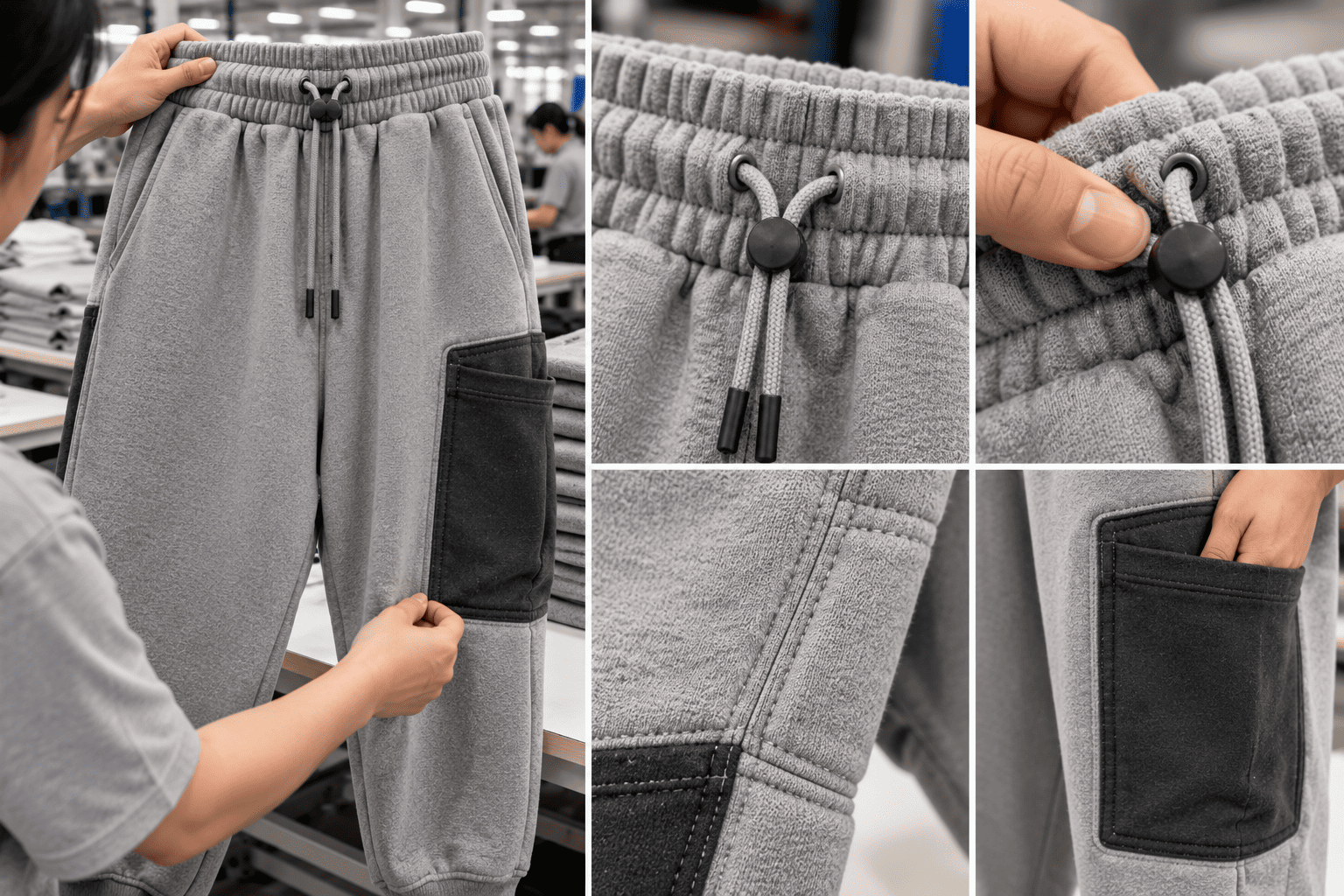
Waistband construction, drawcord security, pocket depth, and pocket angle are some of the most important functional details in custom shorts.
Waistband Options
Common options include:
- Elastic casing waistband
- Ribbed waistband
- Exposed elastic
- Elastic + drawcord
- Internal drawcord
- External drawcord
A waistband should recover after stretching and remain stable after washing.
Multiple rows of stitching are often used to help control elastic inside the casing.
But the exact construction should match:
- Elastic width
- Body fabric
- Design
- Required appearance
Why Waistbands Roll
Possible causes include:
- Elastic too narrow
- Casing too wide
- Weak elastic
- Insufficient securing stitches
- Poor recovery
- Waistband twisting during laundering
The fix is not simply:
"Use more elastic."
The elastic, casing, and stitching need to work together.
Drawcord Details
Specify:
- Flat or round
- Cotton or synthetic
- Internal or external
- Cord diameter
- Color
- Length
- Tip type
Cord ends may use:
- Knot
- Heat-sealed tip
- Dipped tip
- Metal aglet
- Custom branded tip
If the cord is not secured internally, it may disappear inside the waistband during washing.
That is a small construction mistake that creates a very obvious customer complaint.
Pocket Depth Needs a Real Test
Do not approve a pocket only from a measurement chart.
Put a phone inside.
Then sit down.
If the phone slides out, either:
- The opening is too wide
- The angle is wrong
- The pocket bag is too shallow
For today's larger smartphones, pocket dimensions that worked ten years ago may feel too small.
Mesh Shorts Need Special Pocket Planning
Mesh complicates pocket construction.
A contrasting pocket bag may show through.
So the factory may need to:
- Match pocket bag color
- Use full lining
- Use a second mesh layer
- Change the pocket structure
Check this on the physical sample under daylight.
Custom Hardware
Branded:
- Cord tips
- Eyelets
- Drawcords
- Rubber patches
- Woven labels
can all improve the product.
But custom components may have separate supplier minimums and tooling fees.
For low-MOQ production, sometimes a high-quality stock trim is the better first-order decision.
How Should You Decorate Custom Shorts?
Shorts have less visual space than a hoodie.
That makes placement important.
For sweat shorts, embroidery and screen printing work well on stable terry fabrics. Polyester mesh and performance shorts can use heat-transfer, suitable screen-printing systems, or sublimation where the fabric and print process support it.
Decoration by Short Type
| Short type | Common decoration options |
|---|---|
| French terry sweat shorts | Embroidery, screen print, puff print, appliqué |
| Mesh shorts | Heat transfer, suitable screen print, embroidery with stabilization |
| Polyester performance shorts | Heat transfer, reflective print, sublimation |
| Nylon shorts | Heat transfer, embroidery, selected print systems |
| Cotton jersey shorts | Screen print, embroidery |
Placement Matters
A classic logo position is:
lower left leg
or:
upper thigh / hip
But test it on the actual fit.
If the logo sits too close to:
- Hem
- Side seam
- Crotch
the garment movement can make the artwork look distorted.
Embroidery on Sweat Shorts
Heavy French terry provides a stable base for embroidery.
But dense stitching can still distort fabric.
Always consider:
- Stitch count
- Backing
- Logo size
- Thread tension
- Placement
before bulk production.
Printing on Mesh
Mesh has open holes.
That means a print system designed for a flat solid fabric may behave differently.
Ink or transfer can interact with:
- Open structure
- Lining
- Second layer
- Surface texture
So always test your decoration on the actual mesh, not a random polyester swatch.
What About All-Over Print?
Traditional dye sublimation is especially useful for polyester sportswear.
Epson's official dye-sublimation guidance recommends white or light-colored polyester fabrics, explaining that a higher polyester content produces stronger color results.[^4]
You can read Epson's guidance here: Dye-Sublimation Printing for Polyester.[^4]
That makes sublimation particularly useful for:
- Basketball mesh shorts
- Performance shorts
- Team shorts
- Full-pattern sportswear
The dye becomes part of the polyester material rather than forming a thick surface layer.
However, do not write:
"all-over print only works on polyester."
That is too broad.
Cotton can be printed all over using other textile-printing systems.
What is true is:
traditional dye sublimation is principally a polyester process.
For cotton sweat shorts, other systems such as screen printing, pigment printing, reactive printing, or selected digital processes may be more suitable depending on volume and design.
Our all-over print clothing guide explains those differences in more detail.
We Manage Decoration as Part of the Garment Order
We sew the shorts and manage specialist decoration processes through long-term partner workshops where needed.
For each project, the important thing is not pretending every process sits under one roof.
It is making sure one team controls:
- Fabric
- Placement
- Artwork
- Sample approval
- Decoration result
- Final garment QC
before shipment.
What MOQ, Cost, and Timing Should You Expect?
Shorts use less fabric than full-length sweatpants.
But there are still setup costs in:
- Cutting
- Sewing
- Decoration
- Trims
- QC
For our standard custom shorts programs, MOQ typically starts from around 100 pieces per style. Sampling and bulk lead time depend on fabric availability, decoration, custom trims, and the complexity of the style.
Our Typical Shorts MOQ
For:
- Sweat shorts
- Mesh shorts
- Basic training shorts
a common starting MOQ for us is:
100 pcs per style
depending on fabric and customization.
What Drives the Price?
| Cost factor | Effect |
|---|---|
| Fabric composition | Premium performance fibers can cost more |
| GSM | Heavier terry uses more material |
| Mesh layers | Double layer increases consumption |
| Liner | Adds fabric and sewing |
| Pockets | Zip/back pockets add operations |
| Decoration | Embroidery, print, appliqué add cost |
| Custom hardware | Separate MOQ/tooling may apply |
| Number of colors | Affects fabric purchasing |
| Quantity | Larger runs improve efficiency |
Double-Layer Mesh Is Not the Same Price as Single Layer
This sounds obvious.
But buyers often compare two quotations where one supplier uses:
- Single mesh + cheap liner
and another uses:
- Double premium mesh
The garment looks similar in a mockup.
The fabric consumption is not similar.
Always confirm the construction behind the quote.
Color Splits Matter
Suppose you want 100 shorts.
Option A:
100 black
Option B:
25 black
25 grey
25 cream
25 blue
Those two orders may not cost the same.
Fabric suppliers work with:
- Rolls
- Minimum dye quantities
- Stock availability
So splitting a low-volume order into many colors can increase fabric cost significantly.
Matching Shorts and Hoodies
If you are selling:
hoodie + sweat shorts
as one collection, using the same fabric and dye lot makes matching easier.
You can control:
- Color
- Surface
- Hand feel
- GSM
- Shrinkage
more consistently.
That is especially important with neutral colors such as:
- Black
- Washed black
- Grey
- Cream
- Brown
- Navy
where even a small shade difference can look obvious when the garments are worn together.
Wash Test Before Bulk
Cotton and cotton-rich shorts can change dimension after laundering.
ISO 5077[^5] specifies a method for measuring dimensional change in fabrics and garments after defined washing and drying procedures.
The standard remains current.
For shorts, check after washing:
- Waist
- Hip
- Rise
- Inseam
- Leg opening
- Overall length
- Pocket opening
Then wear the sample again.
Shrinkage that seems small on a flat measurement can feel significant when the waistband or rise changes.
Care Labels Should Match the Actual Product
For U.S. apparel, the FTC Care Labeling Rule[^6] requires covered manufacturers and importers to provide regular care instructions.
That means your care label should be based on:
- Fabric
- Decoration
- Elastic
- Liner
- Hardware
- Wash test
not copied from another pair of shorts.
A mesh short with heat transfer decoration may need different care from a 100% cotton French terry short with embroidery.
How Do You Choose a Custom Shorts Manufacturer?
Almost every garment factory can say:
"Yes, we make shorts."
The real question is whether they understand your type of shorts.
Ask technical questions early.
Green Flags and Red Flags
| Green flag | Red flag |
|---|---|
| Asks for inseam and full fit measurements | Uses one "standard shorts" pattern |
| Understands single vs double mesh | Ignores transparency |
| Tests phone pocket depth | Gives no pocket dimensions |
| Secures drawcord and elastic | Waistband twists easily |
| Tests decoration on actual fabric | Uses random test fabric |
| Wash tests cotton-rich styles | No dimensional testing |
| Explains trim minimums before deposit | Adds surprise costs later |
| Shows relevant audit documentation | Cannot explain supplier compliance |
Factory Compliance Is Separate From Product Quality
Social-audit information can help brands evaluate manufacturing sites.
For example, Sedex's SMETA methodology[^7] evaluates conditions and practices at supplier sites, including labour standards and health and safety, with broader 4-Pillar scopes also covering environment and business ethics.
Sedex states that SMETA audits are carried out by approved independent Affiliate Audit Companies.[^7]
But an audit does not prove:
- Your inseam is right
- Your waistband will not roll
- Your phone will stay in the pocket
Those are product-development questions.
A strong sourcing process needs both:
supplier verification + product testing.
For the whole process, our custom clothing manufacturer guide explains how sampling, production, quality control, decoration, and shipping fit together.
Conclusion
Good shorts come down to details that look small on a tech pack.
The inseam changes the whole silhouette.
The rise changes how the garment feels when you sit down.
The waistband determines whether the shorts stay comfortable all day.
The pocket decides whether your phone stays inside.
And the fabric decides whether the product feels like:
- Streetwear
- Sportswear
- Loungewear
- Summer basics
Start by defining exactly what kind of shorts you are making.
Then choose the fabric.
Set the inseam.
Set the rise and leg opening.
Test the pocket with a real phone.
Wear the sample.
Sit down in it.
Wash it.
Then approve bulk.
For sweat shorts, French terry is often a strong choice when you want a structured, premium warm-weather product.
For basketball-style mesh shorts, decide the mesh layers and lining before quoting.
For performance shorts, think about stretch, recovery, moisture, and decoration.
And if you are building shorts to match your hoodies or T-shirts, develop the pieces as one collection rather than two unrelated products.
A pair of shorts may use less fabric than a hoodie.
But customers notice bad shorts just as quickly.
Footnotes & References
[^1]: Verified Market Reports — Sports Shorts Market. The report projects the North American sports shorts market to grow from approximately USD 2.3 billion in 2025 to approximately USD 3.2 billion by 2033.
https://www.verifiedmarketreports.com/product/sports-shorts-market/
[^2]: U.S. Federal Trade Commission — Textile Fiber Rule. Requires covered textile products sold in the United States to disclose the generic names and percentages by weight of constituent fibers, along with manufacturer/marketer identification and country of processing or manufacture.
https://www.ftc.gov/legal-library/browse/rules/textile-fiber-rule
[^3]: OEKO-TEX® — STANDARD 100. Official information on the STANDARD 100 system for textile products and components tested for harmful substances.
https://www.oeko-tex.com/en/our-standards/oeko-tex-standard-100/
[^4]: Epson — Dye-Sublimation Printing Guidance. Epson explains that traditional dye-sublimation works best with white or light-colored polyester fabrics and that higher polyester content generally produces more vibrant results.
https://epson.com/sublimation-printers-for-makers
[^5]: International Organization for Standardization — ISO 5077:2007, Textiles — Determination of Dimensional Change in Washing and Drying. Specifies a method for determining dimensional changes in fabrics, garments, and other textile articles following defined washing and drying procedures.
https://www.iso.org/standard/41877.html
[^6]: U.S. Federal Trade Commission — Care Labeling of Textile Wearing Apparel & Certain Piece Goods. Requires covered textile apparel manufacturers and importers to provide regular-care instructions appropriate to the product.
https://www.ftc.gov/legal-library/browse/rules/care-labeling-textile-wearing-apparel-certain-piece-goods
[^7]: Sedex — SMETA Audit. Official information on the Sedex Members Ethical Trade Audit methodology and its use in assessing supplier-site labour standards, health and safety, environmental management, and business ethics.
https://www.sedex.com/solutions/smeta-audit/