Zip-Up Hoodie Manufacturer: How Do You Make a Custom Zip Hoodie That Hangs Flat?
Your pullover hoodie sold well, so you added a zip version.
The sample arrives.
The fabric is the same.
The fit is similar.
But the front ripples like a wave along the zipper.
What went wrong?
A zip-up hoodie manufacturer has to control more than fabric and fit. The zipper must suit the garment weight, match the front length, stay balanced against a stretchy knit fabric, and remain flat after washing.
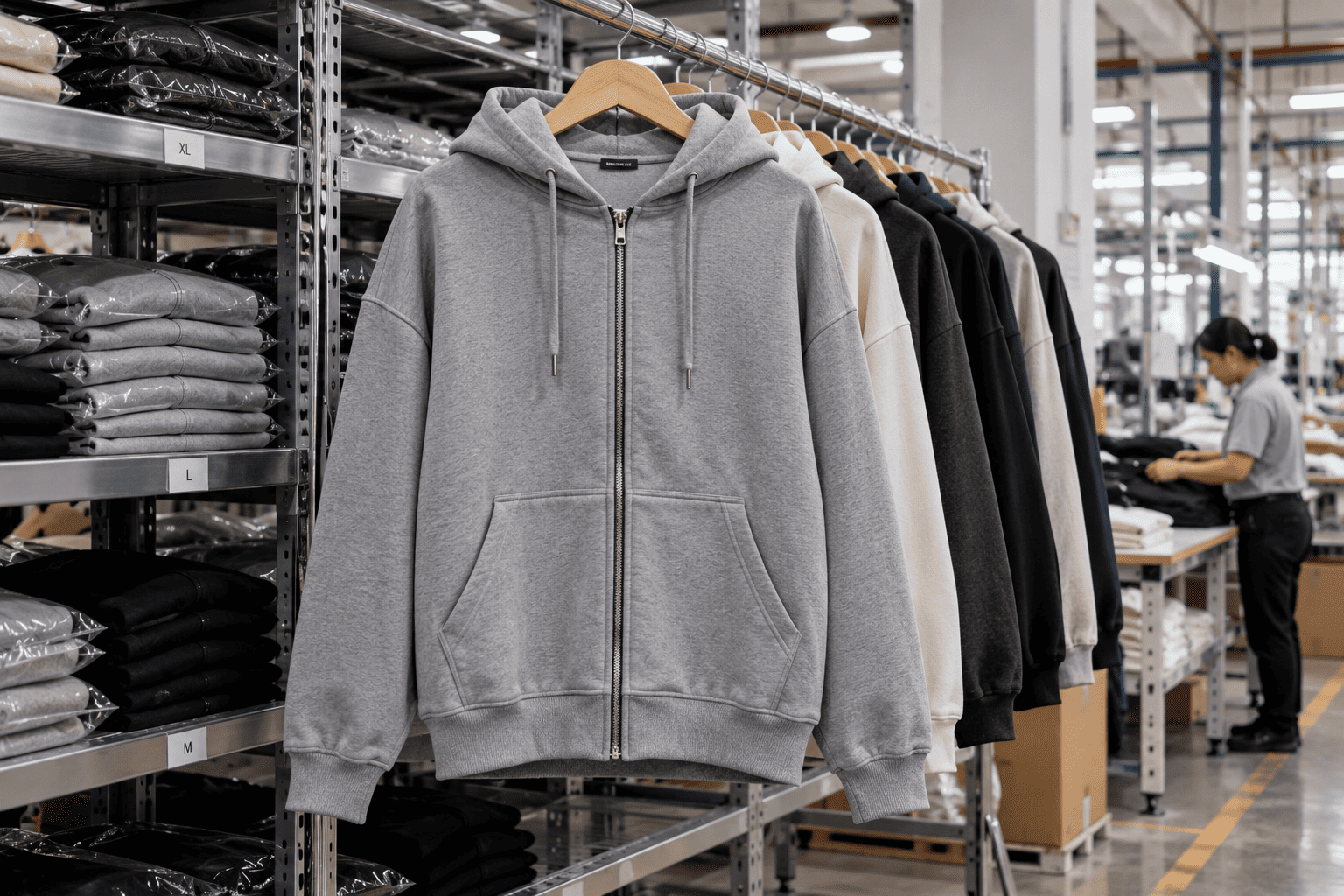
Hoodies remain one of the largest categories in global casualwear.
According to Mordor Intelligence[^1], the global hoodies and sweatshirts market is estimated at approximately USD 221.09 billion in 2026 and is projected to reach about USD 303.62 billion by 2031.
But a zip hoodie is not simply a pullover hoodie with a zipper added.
The zipper changes:
- Pattern construction
- Sewing sequence
- Shrinkage behavior
- Front balance
- Cost
- Trim sourcing
- Size planning
Let me show you where the problems usually start.
Table of Contents
- What Makes a Zip-Up Hoodie Different from a Pullover?
- Which Zipper Should You Choose?
- Can You Customize the Zipper Pull?
- Why Does a Zip Hoodie Wave at the Front?
- Which Fabric and Fit Work Best for a Zip Hoodie?
- What Do You Need for an Accurate Quote?
- Conclusion
What Makes a Zip-Up Hoodie Different from a Pullover?
Many brands expect the zip version to be a small modification.
From a factory point of view, it is a different garment.
A zip-up hoodie has two separate front panels, a full-length zipper, split pockets, finished front edges, and more alignment points. The left and right sides must meet correctly when the zipper closes.
A pullover hoodie normally has:
- One front body panel
- One kangaroo pocket
- No center-front closure
A zip hoodie splits the front body into two.
Now the factory has to control:
- Left/right panel length
- Pocket height
- Pocket angle
- Hem rib alignment
- Hood opening
- Zipper length
- Zipper tape
- Top and bottom stops
Pullover vs Zip-Up Hoodie
| Part | Pullover hoodie | Zip-up hoodie |
|---|---|---|
| Front | One body panel | Two separate panels |
| One kangaroo pocket | Two split pockets | |
| Closure | None | Full-length zipper |
| Front edge | Simple | Zipper tape / facing / reinforcement |
| Hem rib | Continuous | Split at center front |
| Hood | Closed neckline | Opens at front |
| Sewing steps | Fewer | More |
| Alignment risk | Lower | Higher |
| Trim planning | Limited | Zipper must be sourced by specification |
This is why a zip hoodie normally costs more than an otherwise similar pullover.
You are paying for:
- The zipper
- Additional sewing operations
- More pattern pieces
- Extra alignment work
- More QC points
Does Every Size Need a Different Zipper Length?
Often, yes.
A size S and size XL may have different center-front lengths.
That means the zipper specification needs to follow the final garment measurements.
But the correct approach is not simply:
"S gets one zipper, M gets another, L gets another."
The actual zipper lengths depend on:
- Grading
- Body length
- Hem rib height
- Neckline construction
- Hood attachment
- Top finishing
The zipper supplier and pattern maker need to work from the final approved measurements.
If you are still developing the pullover version first, our low MOQ hoodie guide covers the base hoodie construction in more detail.
Which Zipper Should You Choose?
The zipper is one of the first things the customer touches.
It also has a strong visual effect on the front of the garment.
The main zipper categories used in apparel include metal, coil, and molded plastic zippers. The right choice depends on garment weight, look, flexibility, and intended use.
YKK's official zipper guidance divides zippers into three major categories:
- Metal
- Coil
- Molded plastic / VISLON®-type injection-molded zippers
YKK's zipper product guide[^2] lists all three categories along with different slider, pull, finish, and application options.
Main Zipper Options
| Zipper type | Character | Good fit for | Watch out for |
|---|---|---|---|
| Metal | Heavy, premium, classic | Heavyweight streetwear | More rigid and heavier |
| Molded plastic | Bold, sporty, visible teeth | Sportswear, jackets, streetwear | Can look bulky on light fabrics |
| Nylon coil | Flexible, light | Lightweight hoodies, active styles | Less visually substantial |
| Two-way zipper | Opens top and bottom | Long or oversized hoodies | More expensive and technical |
| Reverse zipper | Cleaner exterior | Minimal styles | Requires correct construction |
What Does No.5 or No.8 Mean?
Zipper numbers relate to chain size.
YKK explains that zipper size refers to the width of the chain, with larger numbers representing wider zipper chains.[^2]
Common apparel sizes include:
- No.3
- No.5
- No.8
- No.10
A No.5 zipper is a common starting point for many apparel applications.
A larger No.8 zipper gives a more substantial visual effect.
But bigger is not automatically better.
A large heavy metal zipper on a lightweight knit may:
- Pull the front downward
- Make the garment feel unbalanced
- Increase waviness
- Feel uncomfortable
The zipper should match the garment.
Match Zipper Weight to Fabric Weight
Think of the zipper and fabric as one system.
For a lightweight hoodie, a flexible coil zipper may sit more naturally.
For a 400 GSM structured streetwear hoodie, a heavier metal or molded zipper may look appropriate.
Before approving the sample, check the actual zipper against the actual fabric.
Do not choose only from a supplier catalog.
Look at:
- Tooth size
- Tape color
- Metal finish
- Slider
- Pull shape
- Zipper flexibility
- Overall weight
Metal finishes may include options such as:
- Nickel / silver
- Brass
- Antique brass
- Gunmetal
- Black
- Matte finishes
The zipper tape can also be:
- Matched to the body color
- Slightly darker
- Intentionally contrasted
A small color mismatch at the zipper can be very visible on a solid-color hoodie.
Can You Customize the Zipper Pull?
Yes.
But this is where MOQ and development cost appear.
Custom zipper pulls can carry your logo or use a unique shape, but they normally require tooling, sampling, and a production minimum. For low-volume brands, a standard zipper with a simpler custom pull tab is often the more practical option.
YKK itself offers custom original-design zipper pull services[^3].
Its official guidance states that brands can develop:
- Logo pulls
- Custom shapes
- Original designs
and review samples before production.
However, YKK also states that custom items require a production lot, with specific details handled through the zipper supplier or purchasing channel.[^3]
That is more accurate than saying:
"YKK never does small custom orders."
The real issue is that fully customized zipper programs may not make economic sense for a 50-piece launch.
Ways to Brand the Zipper
| Option | How it works | Development level |
|---|---|---|
| Standard branded zipper + stock pull | Use supplier's normal slider/pull | Lowest |
| Custom metal logo pull | Molded in your brand shape | Higher |
| Rubber / silicone pull tab | Added to standard slider | Medium |
| Woven fabric pull | Branded woven strip | Lower |
| Cord pull | Cord or rope attached to slider | Low |
| Faux-leather tab | Embossed or printed | Medium |
Custom Metal Pulls Need Tooling
A metal pull with a unique shape normally requires:
- Artwork
- Mold / tooling
- Prototype
- Metal finish
- Final approval
- Bulk production
This means the setup cost can feel expensive on 50 pieces.
The same mold cost spread across 2,000 pieces becomes much easier to absorb.
That is why I normally tell new brands:
Spend first on fabric and fit.
Then improve the hardware as the order volume grows.
For example, on an initial order you might use:
- A good stock zipper
- Custom woven zipper tab
- Branded rubber pull
- Custom cord detail
Then move to a fully molded metal pull later.
Why Does a Zip Hoodie Wave at the Front?
This is the classic zip hoodie problem.
The center front does not hang straight.
It ripples.
A wavy zipper usually appears because the knit fabric and zipper tape have different dimensional behavior. Stretch during sewing, fabric shrinkage, incorrect zipper length, feed imbalance, or insufficient stabilization can all distort the front.
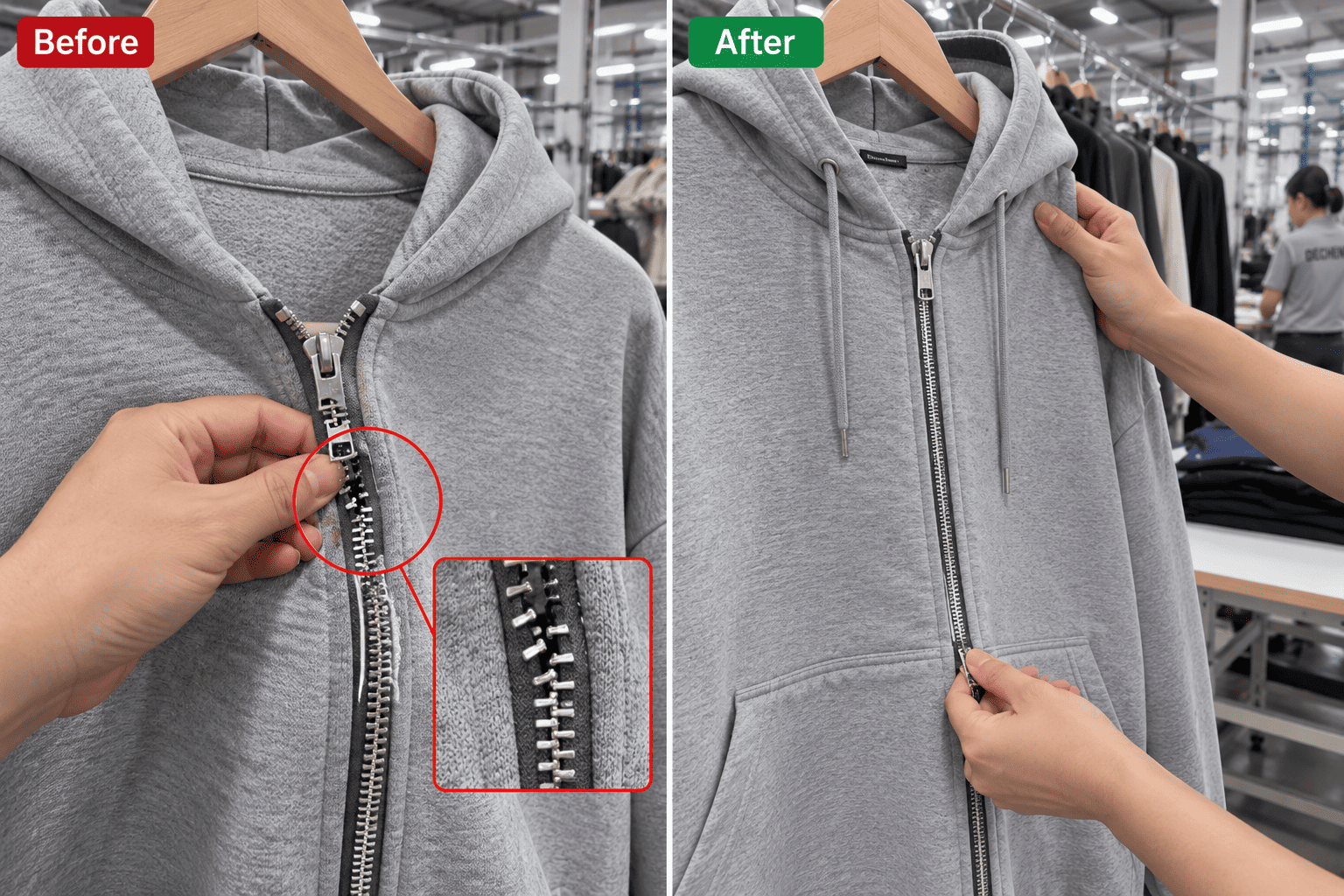
Imagine attaching two materials:
One stretches.
One does not stretch very much.
That is exactly what happens when knit fleece or French terry is sewn to zipper tape.
If the garment fabric stretches while the zipper is being attached, it may relax afterward.
The zipper does not.
You get waves.
Common Causes of Wavy Zippers
| Cause | What happens | Possible solution |
|---|---|---|
| Fabric stretched during sewing | Waves appear immediately | Improve feeding and handling |
| Fabric shrinks after washing | Waves appear after laundering | Control shrinkage before bulk |
| Zipper length incorrect | Front bulges or pulls | Match zipper to approved front length |
| Zipper too heavy | Front drags downward | Use more suitable zipper |
| Front edge too unstable | Fabric rolls or stretches | Add suitable reinforcement |
| Uneven sewing tension | One side becomes longer | Control feed and stitch tension |
| Hem rib misalignment | Bottom does not close evenly | Match both front sides before assembly |
Shrinkage Is a Major Reason to Wash Test
Cotton-rich sweatshirt fabric can shrink.
Zipper tape behaves differently.
That mismatch can turn a flat-looking sample into a wavy garment after washing.
ISO 5077[^4] specifies a method for determining dimensional changes in fabrics and garments after defined washing and drying procedures.
The current ISO 5077:2007 edition remains published and current after review.[^4]
This gives you a useful principle:
Do not judge zipper balance only before washing.
Check it afterward.
Should the Fabric Be Pre-Shrunk?
The aim is to control shrinkage before final bulk production.
Depending on the fabric, that may involve:
- Fabric finishing
- Compacting
- Pre-shrinking
- Wash testing
- Pattern adjustment
I would avoid promising that one factory process "removes all shrinkage."
Cotton fabrics can still have dimensional movement.
The goal is to bring it within the agreed tolerance.
Wash the Complete Garment
The best test is not only the fabric.
Wash the completed zip hoodie.
Then:
- Zip it fully.
- Lay it flat.
- Check the center front.
- Check hem alignment.
- Check both pockets.
- Check hood edges.
- Measure body length.
- Compare left and right front lengths.
ISO also publishes ISO 6330:2021[^5], which specifies domestic washing and drying procedures used in textile testing.
Together, controlled washing procedures and dimensional measurements provide a far better basis for evaluating a zip hoodie than simply saying:
"It looks flat now."
Which Fabric and Fit Work Best for a Zip Hoodie?
A stable fabric makes zip hoodie production easier.
But there is no single mandatory GSM.
For streetwear zip hoodies, dense French terry or brushed fleece often works well because the fabric has enough structure to support the center-front zipper. The best GSM depends on the silhouette, season, zipper, and market.
Example Fabric Options
| Fabric | Example weight | Composition | Character |
|---|---|---|---|
| French terry | 320–350 GSM | Cotton or cotton-rich | Cleaner, easier layering |
| Heavy French terry | 360–400 GSM | Often cotton-rich | Structured, streetwear feel |
| Brushed fleece | 350–400 GSM | Cotton or cotton/poly | Warm, soft, fuller |
| Ultra-heavy fleece | 450 GSM+ | Varies | Very structured and warm |
These are practical development ranges, not universal rules.
A properly engineered 320 GSM zip hoodie can sit flatter than a poorly made 450 GSM one.
Stability Matters More Than the Number
Look at:
- Stretch
- Knit density
- Shrinkage
- Recovery
- Surface finish
- Composition
not only GSM.
A very stretchy knit can be more difficult to attach cleanly to a rigid zipper.
A dense, stable fabric usually gives the sewing operator more control.
French Terry vs Fleece
French terry often gives a slightly cleaner, less bulky front.
Brushed fleece gives:
- More warmth
- More interior softness
- More loft
But composition also matters.
A cotton-poly blend may behave differently from 100% cotton in shrinkage and dimensional stability.
Our French terry vs fleece guide explains those differences in more detail.
What Fit Works Best?
Oversized zip hoodies are popular, but "oversized" is not one measurement.
A proper oversized fit may include:
- Dropped shoulder
- Wider chest
- Wider sleeve
- Larger armhole
- Shorter or boxier body
- Larger hood
- Wider hem
The zipper has to follow the body length correctly.
A very long hoodie with a rigid one-way zipper can also feel restrictive at the hem.
That is one reason some brands use two-way zippers on longer or oversized styles.
The bottom slider allows the wearer to open the lower part of the hoodie while keeping the top closed.
What Do You Need for an Accurate Quote?
A logo is not enough.
Neither is a Pinterest photo.
To quote a custom zip-up hoodie accurately, the manufacturer needs the garment construction, fabric, zipper specification, decoration, quantity, and approximate measurements.
Send These Details
| Information | Why it matters |
|---|---|
| Front and back mockups | Shows construction |
| Size chart or reference measurements | Helps estimate pattern and consumption |
| Fabric composition | Changes fabric cost |
| GSM | Changes consumption and garment weight |
| French terry or fleece | Changes sourcing |
| Zipper type | Changes trim cost |
| Zipper size | Changes appearance and price |
| Zipper color / finish | May require custom sourcing |
| One-way / two-way | Changes hardware |
| Decoration | Adds print/embroidery cost |
| Quantity | Determines material pricing |
| Number of colors | Changes fabric minimum planning |
Why Fit Changes Price
An oversized hoodie uses more fabric than a fitted hoodie.
A double-layer hood uses more fabric than a single-layer hood.
Large split pockets use more fabric.
An extra-wide sleeve uses more fabric.
So a factory cannot calculate a real price from the word:
"500 GSM zip hoodie."
It needs to know how much fabric each garment consumes.
Our Typical Hoodie MOQ
For our standard hoodie programs, the MOQ can start from:
50 pieces per style
depending on:
- Fabric
- Color
- Custom trims
- Decoration
- Size spread
If the order uses stock fabric, low-volume development is easier.
If you request:
- Custom knitted fabric
- Unique zipper
- Custom metal pull
- Special wash
- Custom dyeing
the material suppliers may have their own minimums.
What Our EXW Price Normally Covers
| Usually included | Usually separate |
|---|---|
| Pattern making | Freight |
| Standard grading | Import duty |
| Cutting and sewing | Custom trim tooling |
| Basic QC | Premium custom packaging |
| Standard packing | Special testing if requested |
Final scope depends on the actual project, so the quotation should state clearly what is included.
Green Flags and Red Flags
| Green flag | Red flag |
|---|---|
| Asks for construction details before quoting | Gives final price from one photo |
| Explains zipper options | "Any zipper, no problem" |
| Discusses shrinkage | Never mentions wash testing |
| Checks zipper against actual fabric | Chooses trims without fabric |
| Confirms front length by size | Uses one fixed assumption |
| Wash tests the sample | Approves only before washing |
| Shares relevant compliance information | Cannot explain factory audits |
How Do You Verify the Factory Behind the Zip Hoodie?
Zip hoodies combine garment construction and trim sourcing.
That makes supplier management important.
You need to know who controls:
- Fabric
- Pattern
- Zipper
- Sewing
- Decoration
- Washing
- Inspection
Factories often use outside specialist partners for processes such as:
- Embroidery
- Screen printing
- Garment washing
- Custom hardware
That is normal.
The important issue is whether the manufacturer manages those partners properly.
Factory social compliance can also be one part of supplier verification.
Sedex's SMETA methodology[^6] evaluates supplier sites in areas including labour standards and health and safety, with 4-Pillar audits also covering environment and business ethics.
Sedex also makes clear that SMETA is an audit methodology rather than a product certification.[^6]
So a social audit does not prove that your zipper sits flat.
You still need:
- Sample approval
- Wash testing
- Inline QC
- Final inspection
Both matter, but they answer different questions.
Conclusion
A good zip hoodie depends on more than fabric.
The zipper changes the entire front of the garment.
To get it right:
Choose the zipper type first.
Match its weight to the fabric.
Confirm the actual zipper length by size.
Control fabric shrinkage.
Avoid stretching the front during sewing.
Wash test the finished sample.
Then check that the zipper, pockets, hood, and hem still align.
If you want a custom zipper pull, plan the MOQ and tooling early.
And if your first order is small, do not force an expensive hardware development just because it looks premium on a mockup.
A good stock zipper on a great-fitting hoodie usually creates a better product than an expensive custom pull attached to a badly balanced front.
For zip hoodies, the detail that looks smallest on the tech pack often creates the biggest production problem.
That detail is the zipper.
Footnotes & References
[^1]: Mordor Intelligence — Hoodies and Sweatshirts Market Size & Share Analysis. The global hoodies and sweatshirts market is estimated at approximately USD 221.09 billion in 2026 and projected to reach approximately USD 303.62 billion by 2031, representing a CAGR of around 6.55%.
https://www.mordorintelligence.com/industry-reports/hoodies-and-sweatshirts-market
[^2]: YKK Fastening Products Group — Zipper Product Categories and Sizing. YKK's official product information identifies metal, coil, and molded plastic/VISLON® zipper categories and explains that zipper size refers to chain width, with larger numbers representing larger chain sizes.
https://www.ykkfastening.com/products/search/detail.html
https://lyncs.ykkfastening.com/shop/pages/about_products_02.aspx
[^3]: YKK — Custom Original Design Zipper Pulls. YKK's official customization service states that customers can develop original zipper pulls with brand logos or custom shapes. Custom products require production lots, with exact requirements handled through the zipper ordering channel or supplier.
https://lyncs.ykkfastening.com/shop/c/cFOD01/
[^4]: International Organization for Standardization — ISO 5077:2007, Textiles — Determination of Dimensional Change in Washing and Drying. Specifies a method for determining dimensional change in fabrics, garments, and other textile articles after specified washing and drying procedures.
https://www.iso.org/standard/41877.html
[^5]: International Organization for Standardization — ISO 6330:2021, Textiles — Domestic Washing and Drying Procedures for Textile Testing. Specifies standardized domestic washing and drying procedures used for testing textile fabrics and garments.
https://www.iso.org/standard/75934.html
[^6]: Sedex — SMETA Audit. Official information on the Sedex Members Ethical Trade Audit methodology, covering labour standards and health and safety, with the 4-Pillar scope also including environmental performance and business ethics. Sedex states that SMETA is an audit methodology rather than a certification.
https://www.sedex.com/solutions/smeta-audit/