

Fabric GSM Guide: What GSM Should Your T-Shirt or Hoodie Be?
You ordered a "heavyweight 300 GSM" T-shirt.
It arrives, and it feels like any other shirt.
You have no scale, no test result, and no idea whether that 300 GSM number was ever real.
GSM means grams per square meter. It measures how much one square meter of fabric weighs. A higher GSM means more fabric mass per unit area, but it does not automatically mean better cotton, softer yarn, stronger construction, or a better garment.
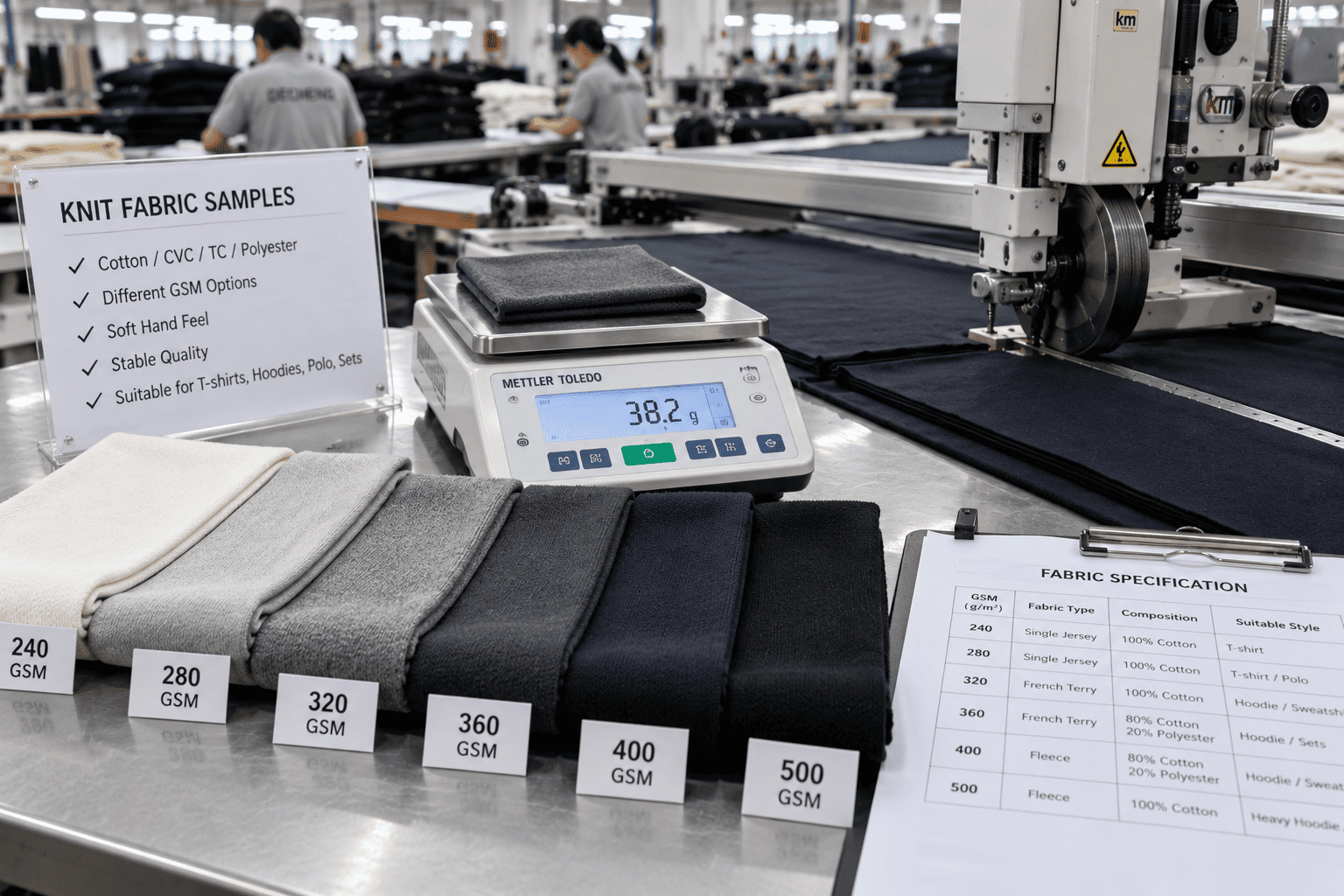
GSM has become one of the first numbers buyers ask about when sourcing custom clothing.
I understand why.
It is simple.
180 GSM sounds lighter than 280 GSM.
500 GSM sounds more premium than 300 GSM.
But GSM only tells you fabric weight per unit area.
It does not tell you the whole story about fabric quality.
That is why you need to understand both the number and how to verify it.
Table of Contents
- What Is GSM in Fabric?
- What GSM Should a T-Shirt Be?
- What GSM Should a Hoodie or Sweatpants Be?
- Does Higher GSM Mean Better Quality?
- How Do You Verify the GSM You Are Paying For?
- How Do You Choose the Right GSM for Your Brand?
- Conclusion
What Is GSM in Fabric?
GSM is one of the most quoted numbers in clothing sourcing.
It is also one of the most misunderstood.
GSM means grams per square meter. It describes the mass of one square meter of fabric. It tells you fabric weight, not finished garment weight, cotton quality, softness, or durability by itself.
The basic principle is simple:
If one square meter of fabric weighs 200 grams, the fabric is 200 GSM.
If the same area weighs 400 grams, it is 400 GSM.
Formal textile standards use the same concept of measuring fabric mass per unit area. ASTM D3776[^1], for example, covers methods for determining the mass per unit area of fabric.
For woven textiles, ISO 3801[^2] also defines methods for determining fabric mass per unit length and unit area.
GSM and Ounces Compared
US buyers may see fabric weight expressed as ounces per square yard, usually written as oz/yd².
The two measurements describe the same basic characteristic using different units.
| GSM | Approx. oz/yd² | Typical feel |
|---|---|---|
| 150 GSM | 4.4 oz | Light |
| 180 GSM | 5.3 oz | Standard/light tee |
| 200 GSM | 5.9 oz | Mid-weight |
| 240 GSM | 7.1 oz | Heavy tee |
| 300 GSM | 8.8 oz | Very heavy tee / lighter sweatshirt fabric |
| 330 GSM | 9.7 oz | Premium heavyweight |
| 400 GSM | 11.8 oz | Heavy hoodie fabric |
| 450 GSM | 13.3 oz | Ultra-heavy fleece |
A practical conversion is:
oz/yd² ≈ GSM ÷ 33.9
For example:
200 ÷ 33.9 ≈ 5.9 oz/yd².
But there is one important point:
GSM describes the fabric, not the finished garment.
A size XL oversized T-shirt will weigh much more than a size S fitted T-shirt even if both are cut from exactly the same 240 GSM fabric.
The XL simply uses more square meters of fabric.
So you cannot reliably confirm GSM by putting an entire finished shirt on a scale.
You need to measure a known area of the fabric.
What GSM Should a T-Shirt Be?
There is no single "best" GSM for a T-shirt.
The right weight depends on:
- Climate
- Fit
- Brand positioning
- Fabric construction
- Retail price
- Decoration
- Intended season
As a practical sourcing guide, lightweight tees often sit around 140–160 GSM, everyday tees around 180–200 GSM, heavyweight tees around 220–260 GSM, and structured streetwear tees around 280–330 GSM.
These are useful ranges, not universal quality standards.
T-Shirt Weight Classes
| Weight class | Typical GSM | Common use |
|---|---|---|
| Lightweight | 140–160 | Summer tees, layering, promotional products |
| Standard | 180–200 | Everyday retail basics |
| Heavyweight | 220–260 | Premium basics, structured tees |
| Premium heavyweight | 280–330 | Boxy streetwear T-shirts |
| Ultra-heavy | 350+ | Statement products and niche heavyweight styles |
Weight changes how the garment behaves.
A lightweight jersey tends to:
- Drape more
- Follow the shape of the body
- Feel cooler
- Dry faster
- Use less fabric by weight
A heavyweight jersey tends to:
- Hold a boxier silhouette
- Feel more substantial
- Hide the body shape more
- Support dense decoration better
- Cost more to manufacture and ship
That structured silhouette is one reason heavyweight jersey has become popular in streetwear.
Our commonly used heavyweight options include fabrics around the 300–330 GSM range, while heavier custom specifications can also be developed when the project justifies a separate fabric run.
If a brand wants a non-stock weight, however, the knitting or fabric supplier may have its own minimum quantity.
That affects both MOQ and lead time.
Decoration Also Changes the Decision
A very thin T-shirt may distort around dense embroidery.
The stitches pull against the fabric.
A heavier and more stable jersey normally provides a stronger base for embroidery, appliqué, thick screen prints, or other substantial decoration.
But again, heavier does not automatically mean better.
The yarn and construction still matter.
If you want the full picture on heavyweight tees, our heavyweight T-shirt manufacturing guide goes deeper into fabric, fit, shrinkage, and construction.
What GSM Should a Hoodie or Sweatpants Be?
Hoodies and sweatpants normally use heavier knit fabrics than T-shirts.
The exact range depends on whether the fabric is French terry, brushed fleece, double-face knit, or another sweatshirt construction.
As a practical sourcing guide, lightweight hoodies may sit around 250–300 GSM, standard styles around 300–350 GSM, heavyweight streetwear hoodies around 380–450 GSM, and ultra-heavy styles around 450–500 GSM or more.
Hoodie and Sweatpants Weight Classes
| Weight class | Typical GSM | Best for |
|---|---|---|
| Lightweight | 250–300 | Spring, layering, warmer climates |
| Standard | 300–350 | Everyday hoodies and joggers |
| Heavyweight | 380–450 | Premium streetwear, structured fits |
| Ultra-heavy | 450–500+ | Statement hoodies and cold-weather products |
Two of the most common sweatshirt fabrics are French terry and brushed fleece.
French terry normally has visible loops on the inside.
Brushed fleece starts from a knit construction whose inner surface is brushed to create a softer, fluffy layer.
At a similar GSM, the hand feel and thermal behavior can still be very different.
That is why saying:
"I need a 400 GSM hoodie"
is not enough information for a factory.
You should also specify:
- Fiber composition
- French terry or fleece
- Cotton/poly ratio
- Yarn type
- Surface finish
- Desired hand feel
- Garment wash
- Fit
Should Hoodie and Sweatpants Use the Same GSM?
For a matching sweatsuit, using the same body fabric for the hoodie and pants is usually the easiest way to create a consistent appearance.
That helps keep:
- Color
- Surface
- Hand feel
- Shrinkage behavior
- Overall visual weight
consistent across the set.
But it is not an absolute rule.
Some designs intentionally use different constructions or weights.
What matters is that the difference is planned.
If the hoodie feels dense and premium while the pants feel noticeably thin, customers often read that as a quality mismatch.
Climate matters too.
A 450 GSM brushed fleece hoodie can work very well for a winter streetwear collection.
But it may be uncomfortable for most of the year in hot markets.
For warmer climates, a 300–330 GSM French terry may be much easier to wear.
So the heaviest available fabric is not automatically the best choice.
Our low MOQ hoodie guide and sweatpants manufacturing guide cover the product-specific decisions in more detail.
Does Higher GSM Mean Better Quality?
This is the misconception I most want buyers to understand.
Higher GSM means heavier fabric. It does not automatically mean higher-quality fabric.
A fabric mill can create a heavy fabric using lower-grade yarn.
It may look impressive on a specification sheet because the number says 300 GSM or 400 GSM.
But the finished fabric may still:
- Pill quickly
- Feel rough
- Twist
- Shrink badly
- Lose shape
- Have uneven yarn
- Develop a poor surface after washing
A well-made 240 GSM T-shirt can be better than a poorly made 300 GSM one.
What Actually Drives Fabric Quality?
| Factor | Why it matters |
|---|---|
| Fiber quality | Fiber length and consistency affect yarn performance |
| Combed vs. carded cotton | Combing removes more short fibers |
| Yarn spinning method | Changes softness, strength, evenness, and cost |
| Knit structure | Affects stretch, stability, appearance, and drape |
| Knit density | Influences structure and shape retention |
| Finishing | Changes shrinkage, softness, and surface appearance |
| GSM | Controls weight and structure, not quality by itself |
This is where yarn knowledge matters.
CottonWorks[^3], an industry education platform developed by Cotton Incorporated, explains that ring spinning remains a benchmark yarn system and is especially known for producing fine yarn counts and a soft fabric hand.
It also explains that open-end or rotor spinning offers much higher production efficiency and lower manufacturing cost, while producing a different yarn structure.
Neither term should be treated as a magic quality label.
The right yarn depends on the product.
But they are not identical.
Combing also changes the yarn.
According to CottonWorks' fiber preparation guidance[^4], combing removes short fibers and can result in yarns and fabrics with improved softness, drape, appearance, and durability.
So when I am checking a heavyweight fabric, I do not only ask:
"What is the GSM?"
I also want to know:
"What is the composition?"
"What yarn are you using?"
"Is it combed?"
"Is it ring-spun or open-end?"
"What finishing has been applied?"
That gives a much better picture.
Higher GSM Has Trade-Offs Too
More fabric weight usually means:
- Higher fabric cost
- Higher freight cost
- More heat retention
- More bulk in packaging
- More stress at thick seam intersections
- Different sewing-machine requirements
- Longer drying time
A 500 GSM hoodie can be a great product if that is what your customer wants.
But choosing 500 GSM simply because "500 sounds more premium than 400" is not a product strategy.
It is just chasing a number.
Material safety should also be evaluated separately from GSM.
A heavier textile is not automatically safer or more compliant.
OEKO-TEX® STANDARD 100[^5], for example, evaluates certified textile articles and components for harmful substances.
That is a completely different measurement from fabric GSM.
How Do You Verify the GSM You Are Paying For?
You do not have to trust the number on a quotation sheet.
Fabric mass per unit area can be measured.
To verify GSM, take a fabric specimen with a known area, weigh it accurately, and convert that weight to grams per square meter.
This is exactly the type of measurement addressed by fabric weight standards such as ASTM D3776[^1].
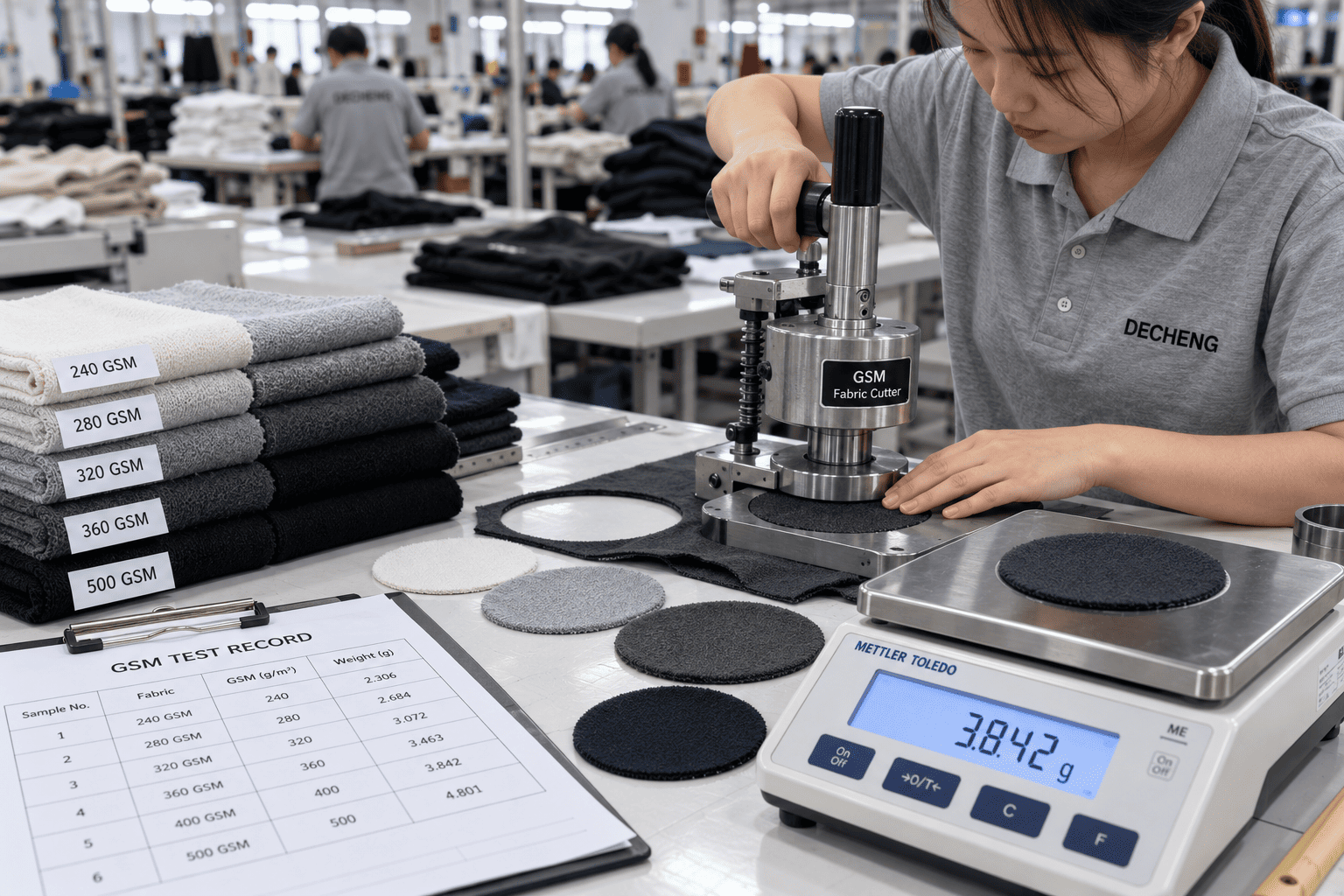
Using a GSM Cutter
A common factory method uses a circular GSM cutter.
One common cutter size produces a specimen of 100 cm².
Since:
1 square meter = 10,000 cm²,
a 100 cm² specimen represents one-hundredth of a square meter.
So:
GSM = specimen weight in grams × 100
Example:
If the specimen weighs 3.3 grams:
3.3 × 100 = 330 GSM
That gives you a quick practical check.
How to Check GSM Before Bulk
| Step | What to do |
|---|---|
| 1 | Take a representative fabric sample |
| 2 | Cut a specimen of known area |
| 3 | Weigh it using an accurate scale |
| 4 | Convert the weight to GSM |
| 5 | Compare the result with your approved specification |
| 6 | Repeat the test on bulk fabric before cutting if GSM is critical |
Do not rely on only one tiny specimen when making an important bulk decision.
Fabric can vary slightly across a roll.
A better QC process samples representative areas and follows the agreed test method.
Be Careful With GSM Tolerance
No bulk fabric production lands on exactly the same number at every point of every roll.
Some variation is normal.
However, there is no universal rule saying every clothing fabric automatically receives a ±5% GSM tolerance.
The acceptable tolerance should be agreed between buyer and supplier based on:
- Fabric type
- Test method
- Mill standard
- Brand specification
- End use
So instead of writing only:
330 GSM
in your tech pack, you can write something such as:
Target GSM: 330 GSM — tolerance subject to approved bulk specification
or state a specific agreed tolerance after discussing it with your fabric supplier.
The important thing is that both sides use the same rule.
Can You Test GSM at Home?
Yes, approximately.
If you have a representative fabric swatch, cut a known area and weigh it accurately.
For example, a 10 cm × 10 cm square has an area of 100 cm².
The same ×100 calculation can therefore be used.
But the smaller the sample and the less precise the scale, the larger the potential measurement error.
A kitchen scale that only measures whole grams is not useful for this.
For meaningful testing, you want a scale capable of reading much smaller increments.
Factory or laboratory testing is better when the specification is commercially important.
Washing Can Change Fabric Dimensions
Another detail buyers sometimes miss:
Fabric dimensions can change after washing.
When a textile shrinks, its mass is distributed across a smaller area, which can affect the measured mass-per-area result.
That is why your specification should make clear whether you are discussing fabric before or after washing or finishing.
ISO 5077[^6] specifies a method for determining dimensional change in fabrics, garments, and other textile articles after specified washing and drying procedures.
For clothing brands, this matters because fabric weight and shrinkage should not be treated as unrelated numbers.
A fabric can meet the target GSM and still have unacceptable shrinkage.
Our clothing quality-control guide explains how specifications like fabric weight, measurements, shrinkage, stitching, and decoration are checked before shipment.
How Do You Choose the Right GSM for Your Brand?
The right GSM is a business and product decision.
It is not a competition to find the highest number.
Choose fabric weight based on your customer's climate, desired silhouette, retail positioning, decoration, shipping method, and target cost. Then confirm the choice with a physical fabric swatch or finished sample before bulk production.
Start with the customer.
Where do they live?
When will they wear the garment?
Then think about your fit.
Do you want:
- Soft and drapey?
- Regular and easy?
- Heavy and structured?
- Oversized and boxy?
Then consider the business side.
A heavier fabric can support a premium hand feel and a higher retail price.
But it also costs more to manufacture and transport.
Practical Decision Guide
| If your brand is... | Consider |
|---|---|
| Boxy streetwear | 280–330 GSM tees, 380–450 GSM hoodies |
| Everyday premium basics | 180–240 GSM tees, 300–350 GSM hoodies |
| Selling mainly in hot climates | Lighter tees and French terry |
| Shipping mostly by air | Avoid unnecessary weight |
| Using dense embroidery | Stable mid-to-heavy fabrics |
| Testing a new style at low MOQ | Existing factory stock fabrics |
| Building a unique signature fabric | Custom-developed GSM and construction |
These ranges are starting points.
They are not rules.
Stock GSM vs. Custom GSM
Stock fabric is often the smartest option for a first order.
Why?
Because the mill has already made it.
That usually means:
- Faster sampling
- Lower development risk
- Lower minimum quantity
- Easier repeat ordering
- Known fabric behavior
Custom fabric gives you more control.
You can specify:
- GSM
- Composition
- Yarn
- Knit density
- Color
- Finish
- Surface
- Hand feel
But a custom knitting or dyeing run normally comes with a fabric MOQ and additional lead time.
For a startup ordering 50 pieces, a custom 365 GSM fabric may not make sense if a good 360 GSM stock fabric already exists.
For an established brand ordering thousands of units, that custom development may be worthwhile.
Always Judge the Physical Fabric
This is the final rule.
Do not buy fabric from an Excel sheet.
A specification can say:
100% cotton, 300 GSM
and still tell you very little about how the fabric actually feels.
Ask for swatches.
Compare two or three weights.
Stretch them.
Look at the surface.
Feel the hand.
Wash them.
Then decide.
Our clothing manufacturing cost guide explains how fabric choice affects the garment price, while our custom clothing manufacturer guide shows how fabric sourcing fits into sampling and bulk production.
Conclusion
GSM tells you fabric weight per unit area.
It does not tell you fabric quality by itself.
A higher GSM can give you more structure, a heavier hand feel, and better support for certain decorations.
But a high number cannot compensate for poor fiber, weak yarn, bad knitting, excessive shrinkage, or poor finishing.
So when choosing fabric, ask more than one question.
Ask:
What is the GSM?
Then ask:
What is the composition?
What yarn is used?
How is it knitted?
How much does it shrink?
What does it feel like after washing?
And if GSM is important to your product, verify it.
Take a known fabric area.
Weigh it.
Compare the result with your approved specification.
For a clothing brand, the goal is not to make the heaviest T-shirt or hoodie possible.
The goal is to choose the fabric weight that gives your customer the right look, comfort, durability, price, and wearing experience.
That is what makes GSM useful.
Footnotes & References
[^1]: ASTM International — ASTM D3776, Standard Test Methods for Mass Per Unit Area (Weight) of Fabric. ASTM D3776 covers measurement of fabric mass per unit area and includes methods applicable to full fabric pieces, full-width samples, small swatches, and narrow fabrics.
https://store.astm.org/standards/d3776/d3776m.htm
[^2]: International Organization for Standardization — ISO 3801:1977, Textiles — Woven Fabrics — Determination of Mass Per Unit Length and Mass Per Unit Area. Official ISO standard covering determination of mass per unit area and mass per unit length for woven fabrics.
https://www.iso.org/standard/9335.html
[^3]: CottonWorks / Cotton Incorporated — Yarn Spinning. Industry education resource explaining ring, rotor/open-end, and other spinning systems. CottonWorks notes that ring spinning remains a benchmark for yarn quality and produces fabrics known for a particularly soft hand.
https://cottonworks.com/learning-hub/yarn-manufacturing/yarn-spinning/
[^4]: CottonWorks / Cotton Incorporated — Fiber Preparation for Spinning. Explains the cotton combing process, including the removal of short fibers and its effects on yarn fineness, softness, drape, appearance, and durability.
https://cottonworks.com/learning-hub/yarn-manufacturing/fiber-preparation-for-spinning/
[^5]: OEKO-TEX® — STANDARD 100. Official certification system for textile products tested for harmful substances. The standard can apply from yarn through finished textile articles and accessories.
https://www.oeko-tex.com/en/our-standards/oeko-tex-standard-100/
[^6]: International Organization for Standardization — ISO 5077:2007, Textiles — Determination of Dimensional Change in Washing and Drying. Specifies a method for determining dimensional changes in fabrics, garments, and other textile products after specified washing and drying procedures.
https://www.iso.org/standard/41877.html