
Polo Shirt Manufacturer: How Do You Make a Custom Polo That Looks Premium?
Your polo sample fits well and the color is right.
Then you wash it twice.
The collar curls up at the tips, the placket twists, and the shirt suddenly looks like a cheap uniform.
A polo shirt manufacturer makes collared knit shirts with a buttoned or zipped placket, usually using pique, jersey, interlock, or performance fabrics. A premium polo depends on the fabric, a collar that keeps its shape, and a clean, stable placket.
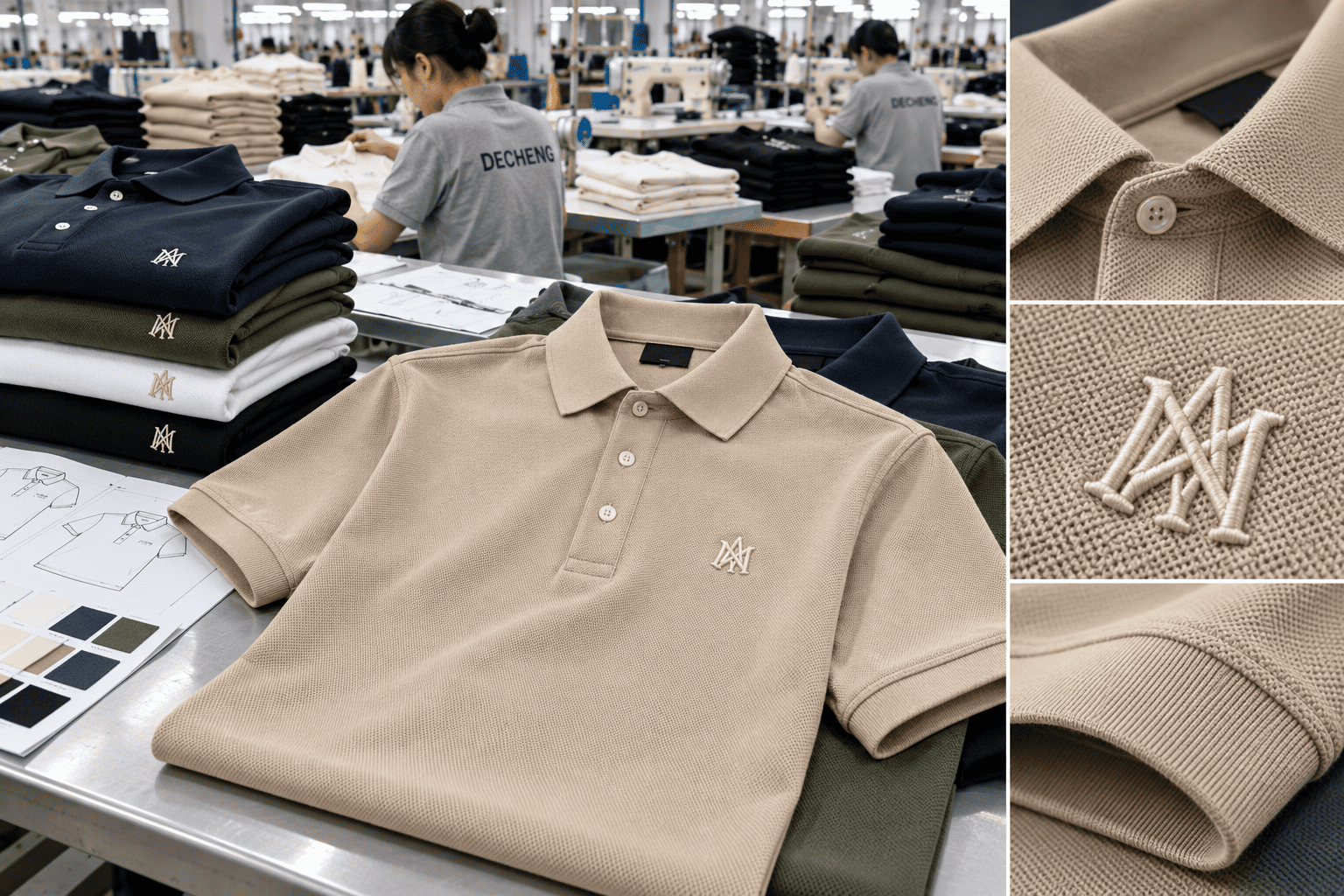
The polo remains a significant global apparel category.
According to Verified Market Reports[^1], the global polo shirt market was valued at about USD 8.9 billion in 2025 and is projected to reach approximately USD 14.9 billion by 2034, representing an estimated CAGR of around 6.1%.
Polos sell across fashion, golf, sportswear, corporate uniforms, lifestyle brands, and promotional apparel.
But a polo is harder to make well than a basic T-shirt.
Let me show you why.
Table of Contents
- What Does a Polo Shirt Manufacturer Make?
- Which Fabric Should You Choose for a Polo Shirt?
- Why Are the Collar and Placket the Hardest Parts?
- How Should You Brand a Custom Polo Shirt?
- What MOQ, Lead Time, and Cost Should You Expect?
- How Do You Choose a Polo Shirt Manufacturer?
- Conclusion
What Does a Polo Shirt Manufacturer Make?
"Polo shirt" sounds like one product.
In practice, it covers several completely different products.
Each one suits a different customer and requires different fabric and construction knowledge.
A polo shirt manufacturer may produce classic pique polos, performance and golf polos, heavyweight streetwear polos, knitted polos, long-sleeve rugby styles, and modern zip polos.
A polo is technically a knit garment, like a T-shirt.
But compared with a basic tee, it adds several construction points that create extra quality risk:
- Collar
- Placket
- Buttons or zipper
- Side vents
- Sometimes knitted cuffs
- Sometimes collar tipping
Those details are what separate a premium polo from a cheap one.
Common Polo Types
| Polo type | Typical fabric | Typical buyer |
|---|---|---|
| Classic pique polo | Cotton or cotton-poly pique | Lifestyle brands, corporate wear |
| Performance or golf polo | Polyester or poly-spandex | Golf and sports brands |
| Heavyweight streetwear polo | Heavy cotton jersey or pique | Streetwear brands |
| Knitted polo | Fine-gauge sweater knit | Premium menswear |
| Long-sleeve or rugby polo | Heavy cotton jersey | Heritage and streetwear brands |
| Zip polo | Jersey or pique with zip placket | Modern lifestyle brands |
Decide which polo you are making before contacting a factory.
A lightweight moisture-wicking golf polo and a boxy 280 GSM streetwear polo share the same product name but almost nothing else.
The fit is different.
The fabric is different.
The collar may be different.
The decoration is different.
Even the factory specialization can be different.
Our core is heavyweight knitwear, so heavier cotton polos, oversized polos, and streetwear-style polos sit closest to what we manufacture every day.
If your range also includes T-shirts, our heavyweight T-shirt guide goes deeper into fabric weight, cotton construction, and fit.
Which Fabric Should You Choose for a Polo Shirt?
Fabric determines how a polo looks, feels, breathes, drapes, shrinks, and holds its shape.
The classic fabric is pique.
But pique is not always the right answer.
Choose cotton pique for a traditional textured polo, jersey for a smoother casual look, interlock for a heavier premium hand feel, and polyester or poly-spandex for sports and golf applications.
Pique has a visible textured structure.
That texture is one of the characteristics people associate most strongly with a traditional polo.
Jersey is smoother and feels closer to a T-shirt.
Interlock has a denser, smoother structure on both sides.
Performance polos often use synthetic blends because stretch, moisture management, weight, and drying speed matter more than the traditional cotton feel.
Polo Fabrics Compared
| Fabric | Feel | Best for | Watch out for |
|---|---|---|---|
| Cotton pique | Textured, breathable | Classic polos | Shrinkage and twisting |
| Cotton-poly pique | Textured, more stable | Corporate and uniform polos | Less natural hand feel |
| Cotton jersey | Smooth, soft | Casual and streetwear polos | Can lose structure if too light |
| Interlock | Thick and smooth | Premium polos | Higher fabric cost |
| Polyester / poly-spandex | Light, stretchy | Golf and sport | Snagging and odor management |
| Mercerized cotton | Smooth, silky appearance | Luxury polos | Higher cost |
Weight changes the character of the garment too.
A light polo around 180–200 GSM feels cooler and more athletic.
A mid-weight polo around 220–240 GSM gives a more traditional substantial feel.
A polo above 260 GSM can feel much more structured and boxy, which works well for contemporary streetwear.
Material safety can also matter when brands are choosing fabric, thread, buttons, labels, and other garment components. OEKO-TEX® STANDARD 100[^2] is an international textile certification system covering testing for harmful substances from yarn through finished textile products and accessories.
But weight alone never tells you whether the fabric is good.
Two 240 GSM pique fabrics can behave very differently depending on:
- Yarn quality
- Fiber composition
- Knitting density
- Dyeing
- Finishing
- Shrinkage control
- Mercerization
- Silicone treatment
- Washing
Ask for composition and performance details, not only GSM.
Why Wash Testing Matters
Pique can twist or shrink after washing.
When that happens, the side seams may move toward the front or back of the body.
The collar may also change shape.
A good factory checks this before bulk production.
ISO 5077[^3] provides an internationally recognized method for determining dimensional change in fabrics, garments, and other textile products after specified washing and drying procedures.
You do not need to put an ISO number in every tech pack.
But your factory should understand the basic principle:
Measure the garment before washing, wash it under controlled conditions, measure it again, and record the change.
Always request a wash test on your approved polo sample.
Why Are the Collar and Placket the Hardest Parts?
Two polos can use the exact same body fabric and still look completely different.
Usually, the difference is the collar and placket.
The collar is difficult because it often uses a separately knitted construction that must match the body in color, proportion, shrinkage, and structure. The placket is difficult because it needs accurate sewing and sufficient stabilization to remain straight and flat.
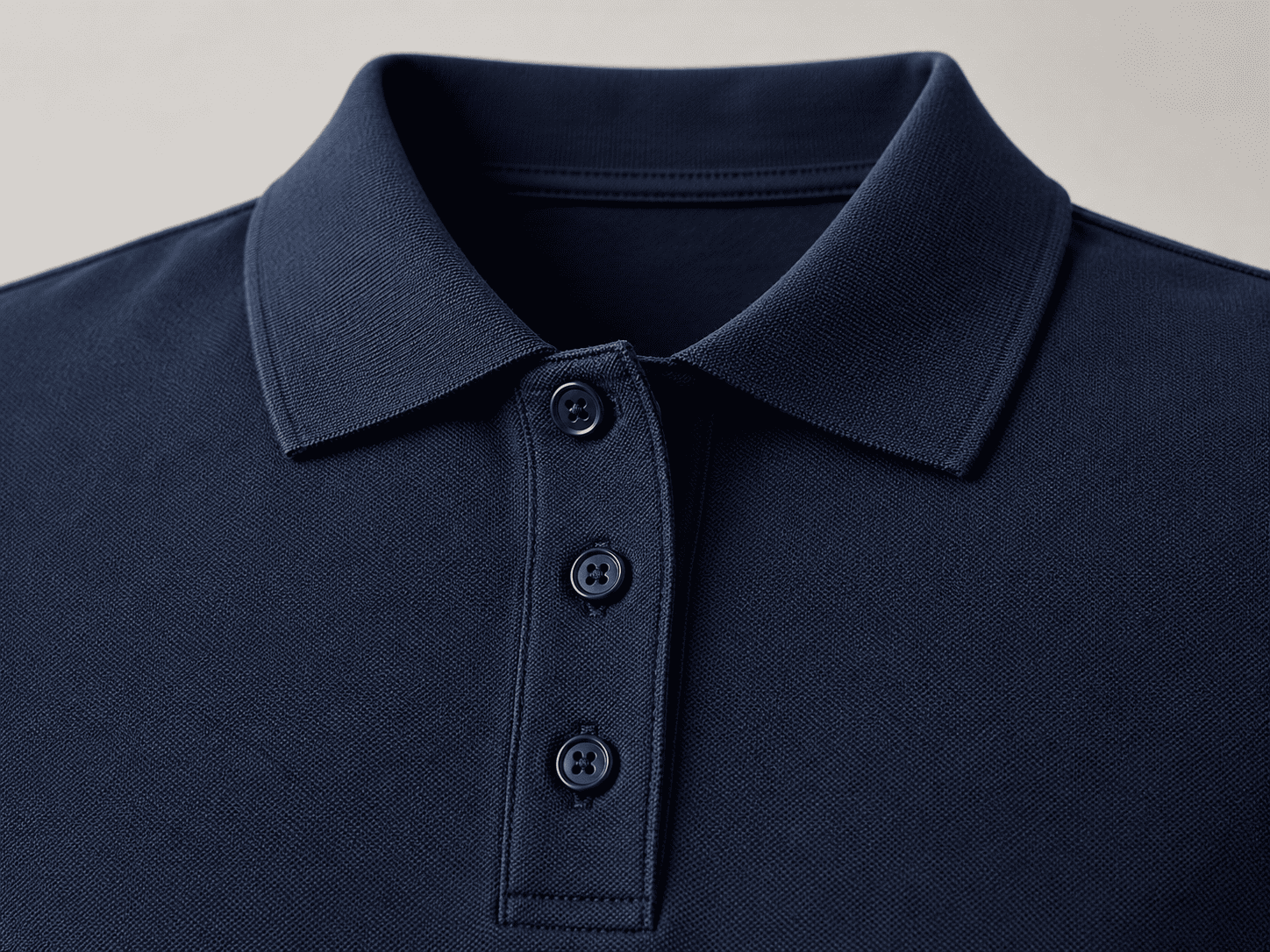
Most traditional polos use a flat-knit collar.
This collar is not simply cut from the same piece of pique fabric as the body.
It is knitted separately.
That creates extra variables.
The collar has to match:
- Body color
- Body shrinkage
- Garment size
- Design proportion
- Rib density
- Cuff construction, if applicable
Collar and Placket Options
| Part | Options | What to check |
|---|---|---|
| Collar | Flat-knit rib, self-fabric, tipped, Johnny collar | Lies flat and matches body |
| Collar stand | With or without | Helps structure certain designs |
| Placket | Two-button, three-button, hidden, zip | Straight and flat |
| Interfacing | Fusible or reinforcing layer | Controls stretching and distortion |
| Buttons | Plastic, shell-style, rubber, custom logo | Size and secure stitching |
| Side vents | Standard or drop-tail | Even, clean construction |
What Is a Tipped Polo Collar?
Tipping means adding contrast stripes around the edge of a knitted collar or cuff.
It is a popular detail.
But it is not simply printed onto the collar.
The contrasting yarn is normally built into the knitted collar construction.
That means tipped collars often require:
- Custom yarn colors
- Separate collar development
- Minimum quantities
- Longer preparation time
Plan this before sampling.
Do not approve the body fabric first and only later tell the factory you want a custom three-color striped collar.
Why Do Polo Collars Curl?
Collar curl is one of the classic polo quality problems.
The collar looks flat during sampling.
After washing, the tips lift upward.
Possible causes include:
- Weak collar structure
- Incorrect knitting density
- Poor finishing
- Mismatch between collar and body shrinkage
- Incorrect pressing
- Construction imbalance
A heavier or better-structured collar can help.
A collar stand may help certain designs.
Some fashion polos instead use a self-fabric collar with internal stabilization.
The right solution depends on the style.
Ask your factory:
"What will stop this collar from curling after washing?"
A factory that regularly produces polos should have a technical answer.
Why Does the Polo Placket Twist?
The placket has another challenge.
It is built into the front opening of a flexible knit garment.
Without proper stabilization, sewing tension and fabric stretch can distort it.
A premium placket should look:
- Straight
- Flat
- Symmetrical
- Evenly stitched
- Free from puckering
A visibly wavy or twisted placket is one of the fastest ways to make an expensive fabric look cheap.
That is why the sample should always be reviewed after washing, not only when it first comes off the sewing line.
How Should You Brand a Custom Polo Shirt?
The polo is a good garment for subtle branding.
The classic decoration is a small chest embroidery.
But brands have many more options.
Common polo branding includes chest embroidery, sleeve embroidery, back-neck embroidery, woven hem labels, customized buttons, neck labels, and selected printed graphics.
Embroidery works particularly well on pique and heavier jersey because the fabric has enough structure to support the stitches.
But pique also creates a challenge.
Its textured surface can swallow very fine details.
Small lettering that looks clean on a flat computer screen may disappear into the fabric texture.
So your embroidery file should be tested on the actual polo fabric before bulk production.
Branding Options for Polos
| Branding | Placement | Notes |
|---|---|---|
| Embroidered logo | Left chest | Classic polo branding |
| Sleeve embroidery | Sleeve | Good secondary branding |
| Back-neck embroidery | Below collar | Subtle brand detail |
| Woven hem tag | Side seam or hem | Simple brand identifier |
| Logo buttons | Placket | Usually requires supplier MOQ |
| Screen / heat transfer print | Chest or back | Better on smoother fabrics |
| Neck label | Inside neck | Woven or printed |
Print can work too.
But a detailed printed graphic often looks cleaner on jersey than on deeply textured pique.
We manufacture the base garments in our own factory.
Embroidery and specialist decoration are handled by long-term partner workshops that we manage directly.
The key point for us is testing the branding on the actual production fabric, then approving it before bulk.
Color communication matters here too.
If you need the collar, body, embroidery thread, tipping, or trims to match a specific brand color, a standardized color reference is much safer than saying "dark navy" or sending a phone screenshot.
For textiles and apparel, Pantone recommends its Fashion, Home + Interiors system[^4]. Pantone specifically identifies the TCX system for textile and apparel applications.
Our embroidery and screen-printing guide explains decoration methods in more detail, while our custom clothing-label guide covers neck labels, woven labels, and hem tags.
What MOQ, Lead Time, and Cost Should You Expect?
A polo usually costs more than a T-shirt made from the same weight of fabric.
The extra operations explain why.
Our typical MOQ for custom polo shirts is 100 pieces per style. Standard samples normally take around 10–14 days, while bulk production generally takes several weeks after sample approval and deposit. Custom collars, tipping, buttons, or special fabrics can extend the schedule.
A polo has more production operations than a basic tee.
The factory needs to:
- Prepare the collar
- Build the placket
- Add reinforcement
- Attach buttons
- Finish side vents
- Match the collar and body
- Add embroidery or branding
- Check final pressing and shape
Each of those steps adds time and labor.
What Drives Polo Cost?
| Cost driver | Effect on price |
|---|---|
| Fabric type | Mercerized, premium cotton, or performance fabrics cost more |
| Fabric weight | Heavier fabric uses more material |
| Flat-knit collar | Requires separate knitting and matching |
| Tipped collar | Custom yarn colors and added development |
| Placket style | Hidden or zip plackets require more work |
| Embroidery | Depends on stitch count and size |
| Custom buttons | Separate accessory supplier MOQ |
| Garment washing | Adds processing and testing |
| Number of colors | Can increase material and collar sourcing cost |
Color planning matters.
Fabric is normally ordered or dyed by color.
Collars need to match the body.
Custom cuffs may also need to match.
So a 100-piece order split across five custom colors is very different from 100 pieces in one color.
The factory may need to buy smaller fabric quantities at higher prices.
The collar supplier may also have separate minimums for each color.
Ask about this before paying for the sample.
Typical Production Terms
| Stage | Typical arrangement |
|---|---|
| Sample | Development fee paid before sampling |
| MOQ | Usually 100 pcs per style for our polo programs |
| Standard sample | Around 10–14 days |
| Bulk production | Around 23–28 days after approval and deposit for standard programs |
| Deposit | Typically 50% for new clients |
| Balance | Remaining 50% before shipment |
Custom components can change that timeline.
For example:
- Custom knitted tipping
- Special buttons
- Custom zipper pullers
- Special dyeing
- Garment washing
- Unique yarns
may all require their own supplier lead times.
Our low MOQ clothing guide explains how garment minimums, fabric minimums, color quantities, and accessory minimums work together.
How Do You Choose a Polo Shirt Manufacturer?
Almost every knitwear factory will say:
"Yes, we can make polos."
That does not mean every factory makes them well.
The collar and placket expose the difference quickly.
Choose a polo manufacturer that shows real polo production, understands collar construction and matching, controls placket quality, wash tests shrinkage and appearance, and clearly explains custom-component minimums before production.
The best first question is:
"How do you stop the collar from curling after washing?"
Then ask:
"How do you test twisting and shrinkage?"
A supplier with real experience should be able to explain its process.
A weak answer is:
"Don't worry. No problem."
Green Flags and Red Flags
| Green flag | Red flag |
|---|---|
| Shows its own polo samples and production | Uses only stock catalog images |
| Explains collar construction | Says only "collar no problem" |
| Discusses placket reinforcement | Cannot explain placket structure |
| Wash tests samples | Does not test after washing |
| Explains collar and trim minimums early | Adds surprise minimums after deposit |
| Tests embroidery on actual fabric | Shows embroidery only on random swatches |
| Provides relevant audit information | Cannot explain factory compliance |
Inspect the Polo After Washing
Do not judge the sample only when it first arrives.
Wash it.
Then check:
- Does the collar still lie flat?
- Have the collar points curled?
- Is the placket still straight?
- Have the side seams twisted?
- Did the garment shrink?
- Did the collar and body shrink at different rates?
- Did the embroidery distort the fabric?
- Are the buttons still secure?
ISO 15487[^5] specifically addresses evaluating the appearance of apparel and textile products after domestic washing and drying, including effects such as seam appearance, smoothness, color change, pilling, and component damage.
That makes post-wash appearance a real quality-control issue, not just a cosmetic preference.
For products sold into markets such as the United States, care labeling also matters.
The U.S. Federal Trade Commission Care Labeling Rule[^6] requires covered textile apparel to carry regular care instructions, and manufacturers or importers need a reasonable basis for those instructions.
That is another reason you should test the actual finished polo rather than copying generic washing instructions from another garment.
What About Factory Compliance?
Compliance does not guarantee a good collar.
But it is still useful when evaluating a long-term manufacturing partner.
For example, Sedex's SMETA methodology is widely used to assess supplier-site labour standards, health and safety, environmental performance, and business ethics.
We use factory-audit information as one part of supplier verification.
Product quality is then controlled separately through:
- Fabric approval
- Sample approval
- Wash testing
- Inline QC
- Final inspection
For the complete process of working with a garment manufacturer, our custom clothing manufacturer guide explains how sourcing, sampling, production, decoration, QC, and shipping fit together.
Conclusion
A premium polo comes down to much more than adding a collar to a T-shirt.
The fabric needs to hold its shape.
The collar needs to remain flat.
The body and collar need to match.
The placket needs to stay straight.
The buttons need to feel intentional.
The branding needs to suit the texture of the fabric.
And the whole garment needs to survive washing without twisting or losing its shape.
Choose the polo type first.
Then choose the fabric.
Confirm the collar construction.
Plan custom tipping and buttons early.
Test embroidery on the actual fabric.
Wash the sample.
And only then approve bulk production.
For buyers, one of the easiest ways to judge a polo manufacturer is to stop looking at the front photo and start inspecting the details.
Look at the collar.
Look at the placket.
Then wash it.
Those three steps tell you far more about the factory than any sales brochure.
Footnotes & References
[^1]: Verified Market Reports — Polo Shirt Market Size, Industry Share & Forecast 2026–2034. The report lists the global polo shirt market at approximately USD 8.9 billion in 2025 and projects a market value of approximately USD 14.9 billion by 2034, with an estimated CAGR of 6.1%.
https://www.verifiedmarketreports.com/product/polo-shirt-market/
[^2]: OEKO-TEX® — STANDARD 100. Official information on the STANDARD 100 textile certification system, covering testing for harmful substances in yarns, fabrics, finished textile articles, buttons, threads, and other garment components.
https://www.oeko-tex.com/en/our-standards/oeko-tex-standard-100
[^3]: International Organization for Standardization — ISO 5077:2007, Textiles — Determination of Dimensional Change in Washing and Drying. Specifies a method for determining dimensional change of fabrics, garments, and textile products following specified washing and drying treatments.
https://www.iso.org/standard/41877.html
[^4]: Pantone — Fashion, Home + Interiors. Pantone's official color system for fashion, textiles, apparel, and soft goods. Pantone identifies TCX as the appropriate system for textile and apparel applications.
https://www.pantone.com/na/en-us/fashion-home-interiors
[^5]: International Organization for Standardization — ISO 15487:2018, Textiles — Method for Assessing Appearance of Apparel After Domestic Washing and Drying. Covers evaluation of apparel appearance after washing and drying, including fabric smoothness, seams, pilling, color change, and component damage.
https://www.iso.org/standard/67602.html
[^6]: U.S. Federal Trade Commission — Care Labeling of Textile Wearing Apparel & Certain Piece Goods. Official U.S. rule requiring covered manufacturers and importers to provide regular care instructions for textile apparel and maintain a reasonable basis for those instructions.
https://www.ftc.gov/legal-library/browse/rules/care-labeling-textile-wearing-apparel-certain-piece-goods