
Custom Clothing Labels and Packaging: What Does Your Garment Need Before It Can Sell?
Your 500 hoodies are finished.
The sewing is done.
The embroidery is approved.
The garments are pressed and ready to pack.
Then the factory asks:
Where is your care label artwork?
You have not made it yet.
Now the production line has a problem.
Some labels need to be sewn into the garment during construction. Retail packaging may need barcodes or size stickers. The fiber content needs to match the actual bulk fabric. The country-of-origin information needs to suit your sales market.
Suddenly, a tiny label is holding up a much larger order.
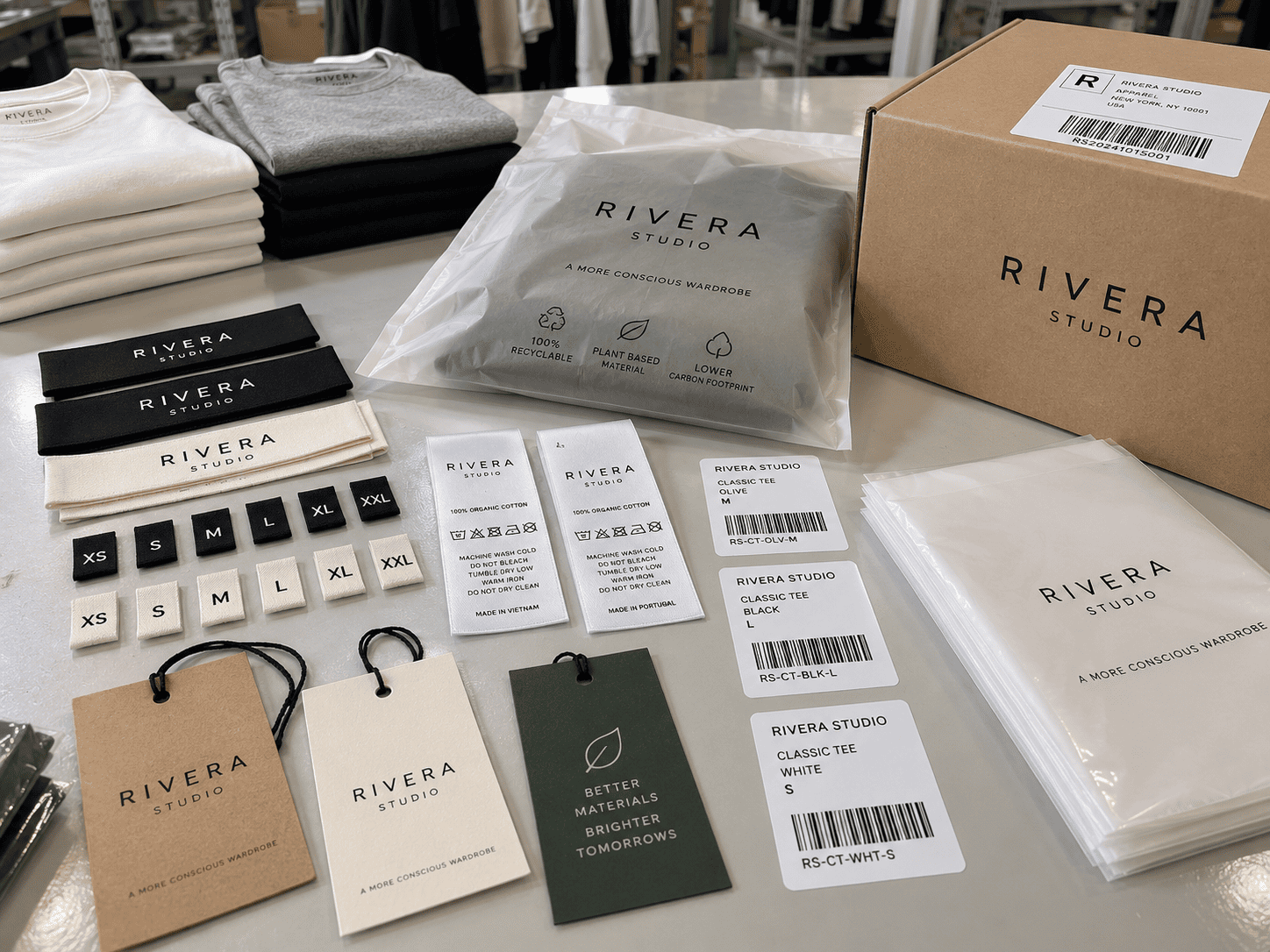
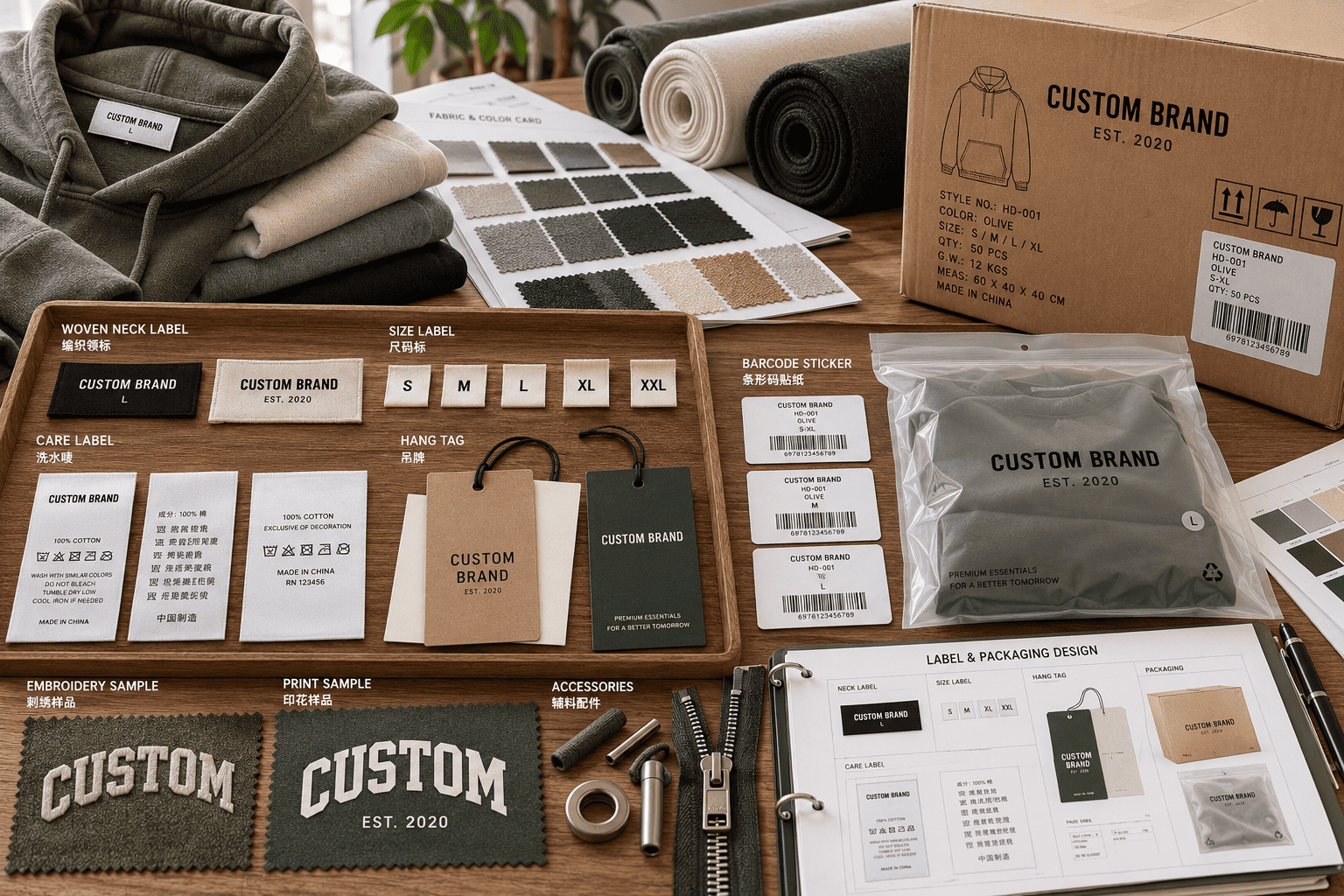
Custom clothing labels and packaging have two different jobs: they communicate your brand and they carry product information required by your market or sales channel. A finished garment may use a brand label, size label, fiber/care label, country-of-origin information, hang tag, barcode, polybag and shipping carton—but the exact legal requirements depend on where the garment is sold.
I work with custom garment production in Dongguan, and I prefer discussing labels before bulk production starts.
Not when the cartons are waiting.
Because once the garment is sewn, changing a label can mean:
- Opening a seam
- Removing the old label
- Sewing a new one
- Rechecking the garment
- Repacking it
That is expensive compared with getting the artwork right before production.
Table of Contents
- Which Labels Does a Garment Need?
- What Is the Difference Between a Brand Label and a Legal Label?
- What Does a U.S. Clothing Label Need?
- Where Should “Made in China” Go on a U.S. Garment?
- Does a Foreign Manufacturer Need an RN?
- What Does the EU Require on Textile Labels?
- What Does the UK Require?
- What Does Canada Require?
- What Does Australia Require?
- Which Label Type Should You Choose?
- How Should You Design a Care Label?
- What Packaging Does Custom Clothing Need?
- Do You Need a Barcode or GTIN?
- What MOQ Should You Expect for Custom Labels and Packaging?
- When Should You Order Labels?
- Which Label and Packaging Mistakes Delay Shipments?
- What Should Go in Your Tech Pack?
- How Should Labels and Packaging Be Checked Before Shipment?
- Conclusion
- Footnotes & References
Which Labels Does a Garment Need?
There is no universal rule saying every garment needs five separate physical labels.
Different information can sometimes be combined.
But a branded garment commonly uses some combination of:
| Label / Item | Main Purpose |
|---|---|
| Brand label | Shows your brand identity |
| Size label | Identifies garment size |
| Fiber/content label | States textile composition |
| Care label | Gives washing/care instructions |
| Country-of-origin information | Identifies manufacturing origin where required |
| Responsible company information | Identifies manufacturer/importer/dealer where required |
| Hem tag / patch | Extra branding |
| Hang tag | Marketing, price, story or retail data |
| Barcode sticker | Retail / inventory identification |
For example, a hoodie might have:
Woven brand label at the neck
plus:
Printed care/content label in the side seam.
Or the neck label could combine:
Brand
Size
Made in China
while the side-seam label contains:
100% Cotton
Washing instructions
Responsible company information
The correct arrangement depends on your target market.
What Is the Difference Between a Brand Label and a Legal Label?
This distinction makes planning much easier.
Brand Information
Usually optional from a regulatory perspective.
Examples:
- Logo
- Brand name
- Collection name
- Slogan
- Decorative patch
Required Product Information
Depends on the market.
It may include:
- Fiber composition
- Country of origin
- Company/dealer identity
- Care instructions
Do not assume your woven logo label automatically satisfies these requirements.
A label saying:
DECHOREAL
may look good.
It does not tell the consumer:
100% cotton
or:
Made in China.
What Does a U.S. Clothing Label Need?
For most covered textile products in the United States, the Federal Trade Commission's textile labeling guidance[^1] requires disclosure of:
- Fiber content
- Country of origin
- Manufacturer, importer or another responsible dealer identity
The business identity can generally be provided using:
- Company name
or:
- FTC Registered Identification Number, or RN
where applicable.
Fiber Content
Use accepted generic fiber names and percentages.
For example:
80% Cotton
20% Polyester
rather than:
Premium Cotton Blend.
If the actual bulk material changes after the label has been printed, the label may need to change too.
That is why I recommend confirming the bulk fabric composition before mass-producing care labels.
Care Instructions Are a Separate Requirement
The FTC's Care Labeling Rule[^2] requires manufacturers and importers of covered apparel to provide appropriate regular-care instructions.
The care information also needs a reasonable basis.
In other words:
Machine wash cold
should not simply be copied from another hoodie because it looks familiar.
It should be suitable for the actual:
- Fabric
- Dye
- Embroidery
- Trims
- Construction
Where Should “Made in China” Go on a U.S. Garment?
This is one area where the U.S. rule is quite specific.
For a garment with a neck, FTC guidance states that the country-of-origin disclosure should appear on a label at or near the inside center of the neck.[^1]
For example:
Made in China
can appear on the front of the neck label.
The fiber-content and responsible-company information can appear on that same label or another conspicuous and accessible label.
Do Not Hide the Origin
The country-of-origin information should not be covered or obscured by another label.
So if you use:
Large brand label
plus:
Small origin label
make sure the construction does not accidentally hide the required information.
Does a Foreign Manufacturer Need an RN?
Not necessarily.
This is another common misunderstanding.
The FTC explains that RN numbers are issued to eligible U.S. businesses, not foreign companies.[^1]
For imported garments, the label can identify, depending on the situation:
- Foreign manufacturer/distributor
- U.S. importer
- Wholesaler
- Retailer
using the appropriate company name or eligible RN.
The RN is therefore not:
a factory certification.
And a Chinese garment factory does not need its own FTC RN simply because it manufactures clothes sold in the U.S.
What Does the EU Require on Textile Labels?
The European Union uses a different framework.
Regulation (EU) No 1007/2011[^3] focuses on textile-fiber names and fiber-composition labeling.
Textile products made available on the market generally need their fiber composition indicated.
For example:
80% Cotton
20% Polyester
The Regulation requires the fiber information to be:
- Durable
- Easily legible
- Visible
- Accessible
- Securely attached where a label is used
Language Matters
The regulation provides that labeling or marking should be in the official language or languages of the EU Member State where the textile product is offered to the consumer, unless that Member State provides otherwise.[^3]
So:
English only
may not be sufficient for every EU sales market.
Do Not Treat EU Rules as U.S. Rules
Regulation 1007/2011 is primarily about textile fiber composition.
It does not mean the EU uses the same:
- FTC RN
- U.S. neck-origin rule
- U.S. Care Labeling Rule
as the United States.
Always build labels for the destination market.
What Does the UK Require?
For Great Britain, official UK textile-labelling guidance[^4] states that textile products must show their fiber content.
If a product contains different textile components with different compositions, additional disclosure may be required.
For example:
Body: 100% Cotton
Lining: 100% Polyester
depending on the product and applicable rules.
The important point is:
do not simply print a U.S. care label and assume it automatically meets UK requirements.
Your retailer, importer and sales channel may also specify additional product information.
What Does Canada Require?
Canada has another system.
The Canadian Competition Bureau explains that textile labels generally need two key types of information:
- Fiber information
- Dealer information[^5]
Dealer information may be shown using:
- Company name and mailing address
or:
- Eligible Canadian CA Identification Number
Fiber Information Is Generally Bilingual
The Canadian Competition Bureau states that required fiber information generally needs to appear in:
English and French
except in certain areas where only one official language is used in consumer transactions.[^5]
For example:
80% Cotton / Coton
20% Polyester
Dealer Identity
Dealer information itself does not have the same bilingual requirement.
Canada also has additional considerations in Quebec, so brands selling there should check current Quebec language requirements separately.
This is why I would not recommend copying a U.S. label directly for a Canadian program.
What Does Australia Require?
Australia is especially important for care labeling.
The Australian Competition and Consumer Commission's current Care Labelling for Clothing and Textiles mandatory standard[^6] applies to many clothing and textile products.
The current mandatory standard allows appropriate care information using:
- Written English instructions
- Recognized international care symbols
- Or both
depending on compliance with the standard.[^6]
This is a good example of why global brands should not use one simplified statement such as:
All countries require the same care label.
They do not.
Which Label Type Should You Choose?
Once the legal content is defined, choose the physical label.
Woven Label
Good for:
- Hoodies
- Sweatshirts
- Jackets
- Pants
- Streetwear
Advantages:
- Premium appearance
- Durable
- Good brand presentation
But woven labels have physical limitations.
Extremely small text may lose clarity.
Printed Satin Label
Common for:
- Care/content information
Advantages:
- Smooth surface
- Good for detailed text
- Multiple lines possible
Printed Cotton Label
Useful when the brand wants a:
- Natural
- Matte
- Lifestyle
appearance.
Heat-Transfer Neck Label
Useful for:
- T-shirts
- Activewear
- Lightweight garments
because there is no physical tag against the neck.
But the transfer needs to be compatible with:
- Fabric
- Press temperature
- Washing
Screen-Printed Neck Label
Another tagless option for suitable garments.
External Patch
Options can include:
- Woven patch
- Embroidered patch
- Rubber patch
- Leather-style patch
These are mainly branding elements rather than replacements for required content labels.
How Should You Design a Care Label?
Start from the actual finished garment.
Confirm:
Fiber Composition
For example:
100% Cotton
or:
80% Cotton / 20% Polyester.
Country of Origin
For garments made in our production:
Made in China
where required and appropriate.
Care Instructions
These should reflect:
- Main fabric
- Rib
- Decoration
- Zipper
- Wash finish
A print may require gentler care than the body fabric alone.
Company / Dealer Information
This depends on the sales market.
Size
This can appear on:
- Separate size tab
- Brand label
- Printed neck transfer
Size is often operationally essential even where it is not part of the same legal labeling rule as fiber composition.
What Packaging Does Custom Clothing Need?
Packaging depends heavily on your sales channel.
For normal factory shipment, a common structure is:
Individual Packaging
Garment folded into:
Individual polybag
often with:
Size sticker.
Master Carton
Multiple packed garments go into export cartons.
Carton marks may identify:
- Style
- Color
- Size
- Quantity
- Carton number
Retail / E-Commerce Packaging
You may add:
- Hang tag
- Barcode
- Branded sticker
- Tissue
- Custom mailer
Marketplace or Retailer Orders
The buyer may issue its own packing manual specifying:
- Barcode position
- Polybag size
- Warning text
- Carton dimensions
- Carton assortment
- Shipping labels
These are customer/channel requirements.
They should not automatically be presented as universal clothing laws.
Do You Need a Barcode or GTIN?
Not every garment is legally required to carry a retail barcode simply because it is clothing.
But barcodes are extremely common when selling through:
- Retailers
- Marketplaces
- Warehouses
GS1 provides the global GTIN identification system used for retail products and states that its barcodes are widely required by major online and traditional retailers.[^7]
For apparel, different variants can require separate product identifiers.
For example:
Black / M
and:
Black / L
are different sellable variants.
Do not simply print one identical barcode on every size.
Who Supplies the Barcode?
Usually the brand or retailer supplies:
- GTIN
- UPC/EAN artwork or data
- SKU
The garment factory should not randomly invent retail barcode numbers.
We can print and apply the barcode.
The product identifier should come from the responsible brand/retail system.
What MOQ Should You Expect for Custom Labels and Packaging?
Accessory MOQ is separate from garment MOQ.
This is important for low-volume brands.
For example, our garment MOQ may begin around:
50 hoodies
while the accessory supplier may have another minimum.
For some of our current sourcing:
| Item | Typical Starting Structure |
|---|---|
| Custom woven label | Around 100 pcs |
| Custom hang tag | Around 500 pcs |
| Custom box | Around 100 pcs |
| Standard polybag | Easier at low quantity |
| Generic size sticker | Easy to source at low quantity |
Exact prices and supplier minimums can change according to:
- Size
- Material
- Printing
- Finish
- Shape
Leftover Labels Are Not Necessarily Waste
If you order:
500 hang tags
for:
100 garments
you can often keep the balance for your next production run if the information remains valid.
That is another reason to keep the main brand tag relatively universal.
Do not print:
Spring 2027
on 500 tags unless you actually want them limited to that season.
When Should You Order Labels?
Not at the end.
I prefer this sequence:
- Approve the garment design.
- Confirm fabric composition.
- Confirm sales market.
- Prepare label artwork.
- Approve label sample or artwork.
- Produce labels before the sewing stage that needs them.
Some Labels Go Into the Garment During Sewing
A side-seam care label is normally inserted while that seam is constructed.
If it arrives after all garments are finished, the factory may need to reopen the seam.
That creates:
- Extra labor
- More handling
- Additional QC risk
So label timing should be part of the production calendar.
Which Label and Packaging Mistakes Delay Shipments?
These are some of the most common.
1. Wrong Fiber Composition
Tech pack says:
100% Cotton.
Bulk fabric changes to:
80% Cotton / 20% Polyester.
Old labels are now incorrect.
2. Missing Country of Origin
Especially important where the destination market requires it.
3. Wrong Label Placement
For example, U.S. country-of-origin information on a necked garment placed somewhere inconsistent with FTC placement guidance.
4. Care Instructions Copied From Another Style
A rhinestone hoodie and a plain cotton tee may not need the same care.
5. Brand Label Too Heavy
A thick woven label can be uncomfortable on a lightweight tee.
6. Tiny Text
A beautiful design file may become unreadable once woven.
7. Wrong Size Label
An M garment with an L label creates an inventory and customer-service problem.
8. Barcode Does Not Match the Variant
The sticker may scan correctly but identify:
Black / M
while the bag contains:
Grey / L.
That is still wrong.
9. Label Artwork Arrives Too Late
Production waits.
10. Overcomplicated First-Order Packaging
A startup orders:
- Custom rigid box
- Foil printing
- Tissue
- Ribbon
- Custom mailer
for 50 garments.
The packaging minimum can become more complicated than the garment.
Start with what the customer actually needs.
What Should Go in Your Tech Pack?
Labels and packaging deserve their own section.
Do not simply write:
Custom labels.
Specify them.
Brand Label
Include:
- Artwork
- Width × height
- Material
- Fold
- Color
- Position
Size Label
Include:
- Size values
- Material
- Position
Care/Content Label
Include final approved:
- Fiber content
- Origin
- Care instructions
- Required company information
Hang Tag
Include:
- Artwork
- Dimensions
- Paper/finish
- Hole location
- String/fastener
Packaging
Include:
- Folding method
- Polybag
- Size sticker
- Barcode
- Quantity per carton
- Carton marks
Version control matters here too.
Do not let the sewing department use:
Care Label V1
after:
Care Label V3
has been approved.
How Should Labels and Packaging Be Checked Before Shipment?
QC should check labels just like it checks sewing.
Garment Label Check
Confirm:
- Correct brand label
- Correct size
- Correct fiber content
- Correct country of origin
- Correct care instructions
- Correct placement
- Correct orientation
Packaging Check
Confirm:
- Correct garment in bag
- Correct size sticker
- Correct barcode
- Correct hang tag
- Correct carton assortment
- Correct carton marks
Scan the Barcode
Do not only look at it.
If barcode scanning is part of the customer's requirement, test a production barcode before printing the full quantity.
Compare Against the Approved Packing Standard
For a retailer order, QC should have the customer's packing instructions.
Otherwise:
packaging looks fine
is too subjective.
Conclusion
Custom clothing labels and packaging are small components with a large effect on the finished product.
They influence:
- Branding
- Compliance
- Comfort
- Warehousing
- Retail
- Shipping
But the most important lesson is:
there is no single worldwide clothing-label template.
For the United States, most covered textile garments need to address:
- Fiber content
- Country of origin
- Responsible business identity
- Care instructions
and necked garments have specific FTC guidance for origin-label placement.
For the EU, Regulation 1007/2011 focuses on textile fiber composition and requires suitable language for the Member State where the product is sold.
For Great Britain, textile fiber-content labeling remains a core requirement.
For Canada, fiber information and dealer identity matter, and fiber-content information generally needs English and French.
For Australia, mandatory care labeling is especially important.
Then your retailer or marketplace may add another layer:
- GTIN
- Barcode
- SKU
- Size sticker
- Polybag instructions
- Carton labels
So before printing labels, confirm:
- Where will the garment be sold?
- What is the final fabric composition?
- What country made the garment?
- Who is the responsible business?
- What care method is appropriate?
- What does the retailer require?
- Which labels must be sewn in during production?
Do not wait until 500 finished garments are sitting in the packing department.
And do not treat:
Woven logo label
as the same thing as:
Legal textile labeling.
Your logo makes the garment yours.
The regulatory information helps make sure the garment is ready for the market where you plan to sell it.
A good clothing manufacturer should ask about both before bulk production begins.
Footnotes & References
[^1]: U.S. Federal Trade Commission — Threading Your Way Through the Labeling Requirements Under the Textile and Wool Acts. FTC guidance explains U.S. requirements for fiber content, country of origin, manufacturer/importer/dealer identity, RN use, label placement and garment country-of-origin labeling.
https://www.ftc.gov/business-guidance/resources/threading-your-way-through-labeling-requirements-under-textile-wool-acts
[^2]: U.S. Federal Trade Commission — Care Labeling Rule. FTC requires manufacturers and importers of covered textile wearing apparel to provide regular-care instructions that remain available to consumers and to possess a reasonable basis for those instructions.
https://www.ftc.gov/business-guidance/resources/clothes-captioning-complying-care-labeling-rule
https://www.ftc.gov/legal-library/browse/rules/care-labeling-textile-wearing-apparel-certain-piece-goods
[^3]: European Union — Regulation (EU) No 1007/2011 on Textile Fibre Names and Related Labelling. EU rules require covered textile products to disclose their fiber composition using recognized fiber names and require labeling to be durable, legible, visible and accessible. The required fiber information must generally be presented in the official language or languages of the Member State where the product is offered to consumers.
https://eur-lex.europa.eu/eli/reg/2011/1007/2018-02-15/eng
[^4]: UK Government — Textile Labelling. UK government guidance for England, Scotland and Wales requires textile products to display appropriate fiber-content information and assigns responsibility for correct textile labeling to manufacturers and retailers.
https://www.gov.uk/guidance/textile-labelling
[^5]: Competition Bureau Canada — Textile Labelling Requirements. Canadian guidance requires covered textile products to disclose fiber information and dealer identity. Required fiber-related information generally needs to appear in English and French, while dealer identity and country-of-origin information, when required, do not have the same bilingual requirement.
https://competition-bureau.canada.ca/en/labelling/textile-labelling/labelling-textile-requirements-nutshell
https://competition-bureau.canada.ca/en/labelling/textile-labelling/detailed-requirements-textile-labelling-requirements-fibre-down-and-feather-content
[^6]: Australian Competition and Consumer Commission — Care Labelling for Clothing and Textiles Mandatory Standard. Australia's current mandatory care-labelling standard applies to many clothing and textile products and permits compliant written English care instructions, international care symbols, or both.
https://www.productsafety.gov.au/business/search-mandatory-standards/care-labelling-for-clothing-and-textiles-mandatory-standard
[^7]: GS1 — Barcodes and Global Trade Item Numbers. GS1 provides the globally recognized GTIN system used to uniquely identify products for retail, e-commerce and supply-chain applications, including apparel variants.
https://www.gs1.org/standards/get-barcodes