
Clothing Manufacturers in China: How Do You Find a Factory You Can Trust?
You search "clothing manufacturer China" and get ten thousand results.
Every supplier says the same things:
"Factory direct."
"Best quality."
"Low MOQ."
But some of them have never owned a sewing machine.
To find a trustworthy clothing manufacturer in China, match the factory's specialty and region to your product, confirm that it is a real manufacturing business, check its audits and production capability, and test it with a sample before you commit to bulk production.
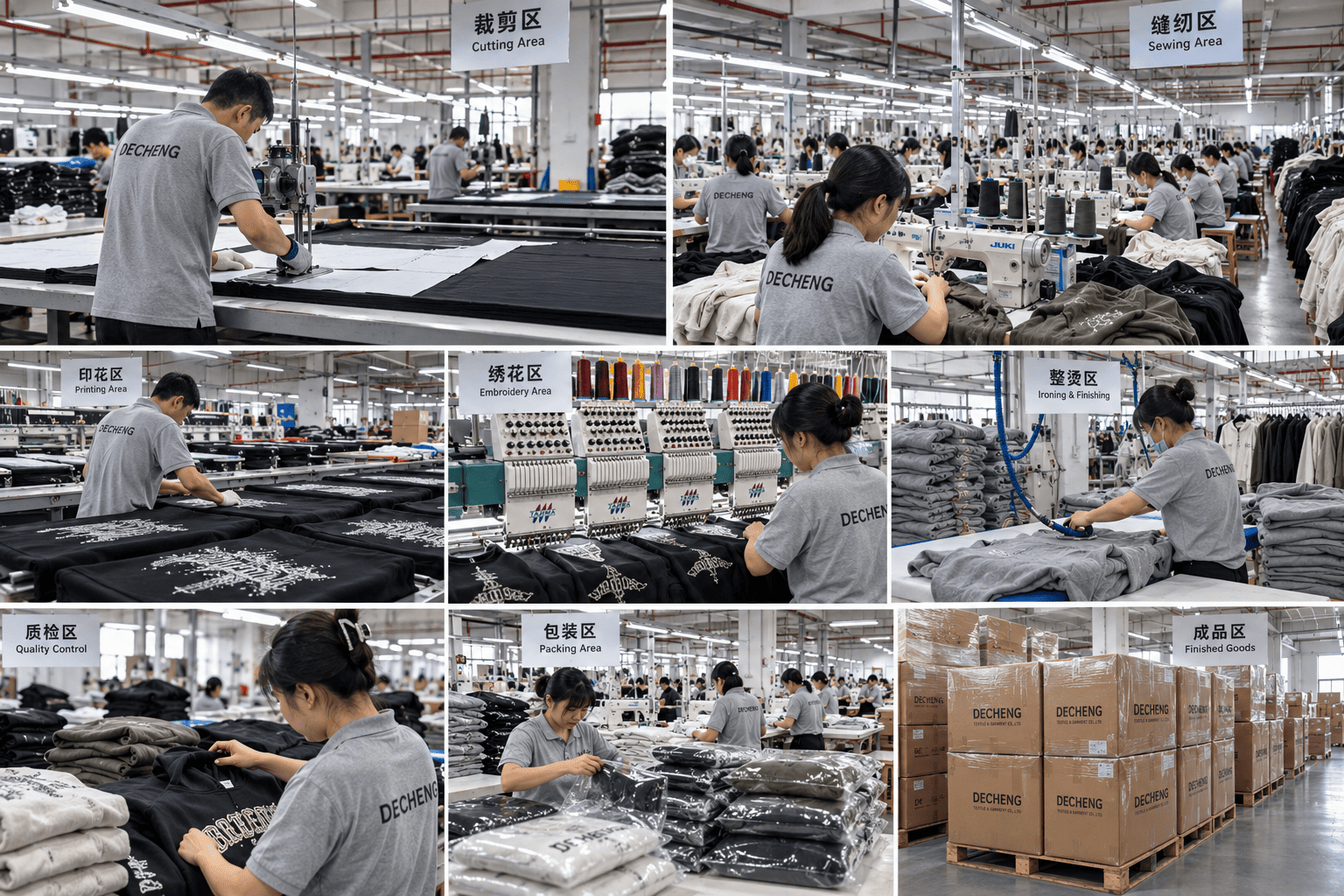
China remains one of the world's most important apparel manufacturing bases.
According to World Trade Organization data reported in 2025, China exported approximately USD 165 billion of apparel in 2024, accounting for around 29.6% of global clothing exports.[^1]
That share is lower than China's peak of about 36.9% in 2010, but China still holds a major position in the global apparel supply chain, especially when textiles, fabrics, trims, development capability, and custom manufacturing are considered.
So where does China still win?
And more importantly, how do you find the right factory instead of just another supplier profile?
Let me explain from the inside.
Table of Contents
- Why Do Brands Still Choose Clothing Manufacturers in China?
- Where Are China's Clothing Manufacturing Hubs?
- Factory or Trading Company: Who Are You Really Talking To?
- How Do You Verify a Chinese Clothing Manufacturer?
- What Should You Know About MOQ, Timing, and Payment?
- How Do You Work Smoothly With a Chinese Factory?
- Conclusion
Why Do Brands Still Choose Clothing Manufacturers in China?
Cheaper manufacturing countries exist.
Bangladesh and Vietnam can both be highly competitive for large apparel programs.
So why do so many new and growing clothing brands still start in China?
Brands choose China for its deep supply chain, wide material selection, flexible development capability, relatively low minimums, and fast sampling. China may not always be the cheapest option for very large basic orders, but it remains especially competitive for custom, small-batch, and technically complicated products.
The real advantage is not only sewing cost.
It is the supply chain around the sewing factory.
In a major Chinese garment hub, a factory may have fabric mills, dye houses, zipper suppliers, embroidery workshops, printing facilities, label factories, packaging suppliers, and washing facilities within the same region.
That makes product development much faster.
China Compared With Other Sourcing Options
| Factor | China | Bangladesh / Vietnam | Local (US, EU, AU) |
|---|---|---|---|
| Minimum order | Often flexible for custom programs | Usually stronger at larger volumes | Often low |
| Unit cost | Medium | Highly competitive at volume | Highest |
| Fabric and trim choice | Very wide | Depends on local supply chain and imports | More limited |
| Sampling speed | Often fast in major hubs | Can be slower for custom development | Fast |
| Complex or custom designs | Strong | Strongest where factory specialization matches product | Strong but costly |
| Import duty | Depends on destination and HS code | Depends on trade agreements and origin | None for domestic production |
China's importance also goes beyond finished garments.
While its share of global clothing exports has declined, its upstream textile position remains very strong. This means many factories in other countries may still rely on Chinese yarn, fabric, trims, machinery, or accessories.
That is part of the reason China's apparel supply chain can respond quickly to custom development.
I will also be honest about the downside.
For a million basic T-shirts, China may not be the lowest-cost option.
Import duties can also materially change your landed cost depending on the product and destination country.
So never compare factories on FOB or EXW price alone.
Compare:
- Garment price
- Duty
- Freight
- Sampling cost
- MOQ
- Defect risk
- Development time
- Reorder speed
That gives you the real cost.
But for a new brand ordering 50 to 500 pieces of a customized heavyweight hoodie, tracksuit, T-shirt, or streetwear design, China's combination of supply-chain depth, flexible development, and material options remains difficult to match.
If you are still deciding how to work with a factory at all, our OEM versus ODM guide explains the main production models.
Where Are China's Clothing Manufacturing Hubs?
China is not one giant clothing factory.
Different regions developed different specialties over decades.
Choosing the right region can save you weeks of searching.
Major Chinese garment manufacturing regions include Guangdong for fashion, streetwear, knits, and rapid development; Zhejiang for knitwear and fashion; Jiangsu for outerwear and woven garments; and Fujian for sportswear and performance products.
A manufacturing hub is more than a group of sewing factories.
It is an ecosystem.
The factory is only one part.
Around it are:
- Fabric suppliers
- Dyeing mills
- Rib suppliers
- Embroidery workshops
- Printing factories
- Zipper manufacturers
- Label suppliers
- Washing factories
- Packaging suppliers
- Freight forwarders
When all of these suppliers are nearby, sampling becomes much easier.
Major Hubs and Their Typical Strengths
| Region | Known for | Good fit for |
|---|---|---|
| Guangdong — Dongguan, Guangzhou, Shenzhen | Fashion, streetwear, knits, rapid development | Custom hoodies, tees, sets, small batches |
| Zhejiang — Hangzhou, Ningbo | Fashion, knitwear, sweaters | Fashion brands, knit basics |
| Jiangsu — Suzhou, Changshu | Outerwear and woven apparel | Jackets, coats |
| Fujian — Quanzhou, Xiamen | Sportswear, performance apparel, footwear | Activewear and sportswear |
| Shandong — Qingdao | Large-volume knit production | Export knit programs |
| Jiangxi | Growing sewing and knit manufacturing base | Larger production programs |
Our headquarters is in Humen, Dongguan.
Humen is one of China's well-known garment manufacturing and trading areas, with fabric and trim suppliers located close to local garment factories.
Our group also runs production in Jiangxi.
That combination is useful.
Development, sourcing, sampling, and smaller customized orders can stay close to Guangdong's dense supplier network, while additional production capacity can support larger programs.
Location also affects logistics.
Factories in the Pearl River Delta have convenient access to major South China ports and logistics networks, including Shenzhen.
We normally ship through Shenzhen.
Factory or Trading Company: Who Are You Really Talking To?
This is one of the most important questions in China sourcing.
And it is also one that suppliers sometimes answer vaguely.
A garment factory owns or operates production equipment and actually manufactures your products. A trading company manages orders and places production with external factories. Both models can work, but you need to know which one you are dealing with.
A trading company is not automatically bad.
A good trading company can manage communication, purchasing, quality control, and multiple product categories extremely well.
The problem is when a trader claims to be the factory.
That creates a transparency problem.
Your order may be passed to a workshop you have never seen.
Then when something goes wrong, you do not know who actually made the garment.
How to Tell Them Apart
| Signal | Real factory | Trading company |
|---|---|---|
| Product range | Usually focused on specific categories | Often extremely broad |
| Business license | Manufacturing-related scope | Trading or wholesale may dominate |
| Video call | Can show production areas live | Often shows office or showroom |
| Technical answers | Usually specific | May need to ask another supplier |
| Audit reports | Factory/site name should match | May belong to another company |
| Sample production | Often made or directly controlled by factory | Usually sourced externally |
One useful first step is checking the company's legal registration.
China's official National Enterprise Credit Information Publicity System[^2] allows users to search registered Chinese companies by company name or Unified Social Credit Code and review public business-registration information.
That does not prove manufacturing quality.
But it helps confirm that the legal company actually exists.
Even genuine factories use subcontractors for certain processes.
That is normal.
Printing, embroidery, special washing, laser work, coating, or niche decoration techniques are often handled by specialist partner factories.
The important point is transparency.
We have operated our own garment production since 2005.
Most of our garment manufacturing runs through our own production system, while some specialist processes such as printing, embroidery, and garment washing are handled by long-term partner workshops.
So ask a potential supplier directly:
"Which parts of my order will you produce in your own factory, and which parts will you outsource?"
A detailed answer is a good sign.
A defensive answer is not.
How Do You Verify a Chinese Clothing Manufacturer?
A website proves very little.
A beautiful Alibaba page also proves very little.
Verification needs several layers.
Verify a Chinese clothing manufacturer by checking its legal company information, reviewing audit documents, requesting a live factory tour, examining recent production examples, ordering a sample, and keeping the option of third-party inspection before shipment.
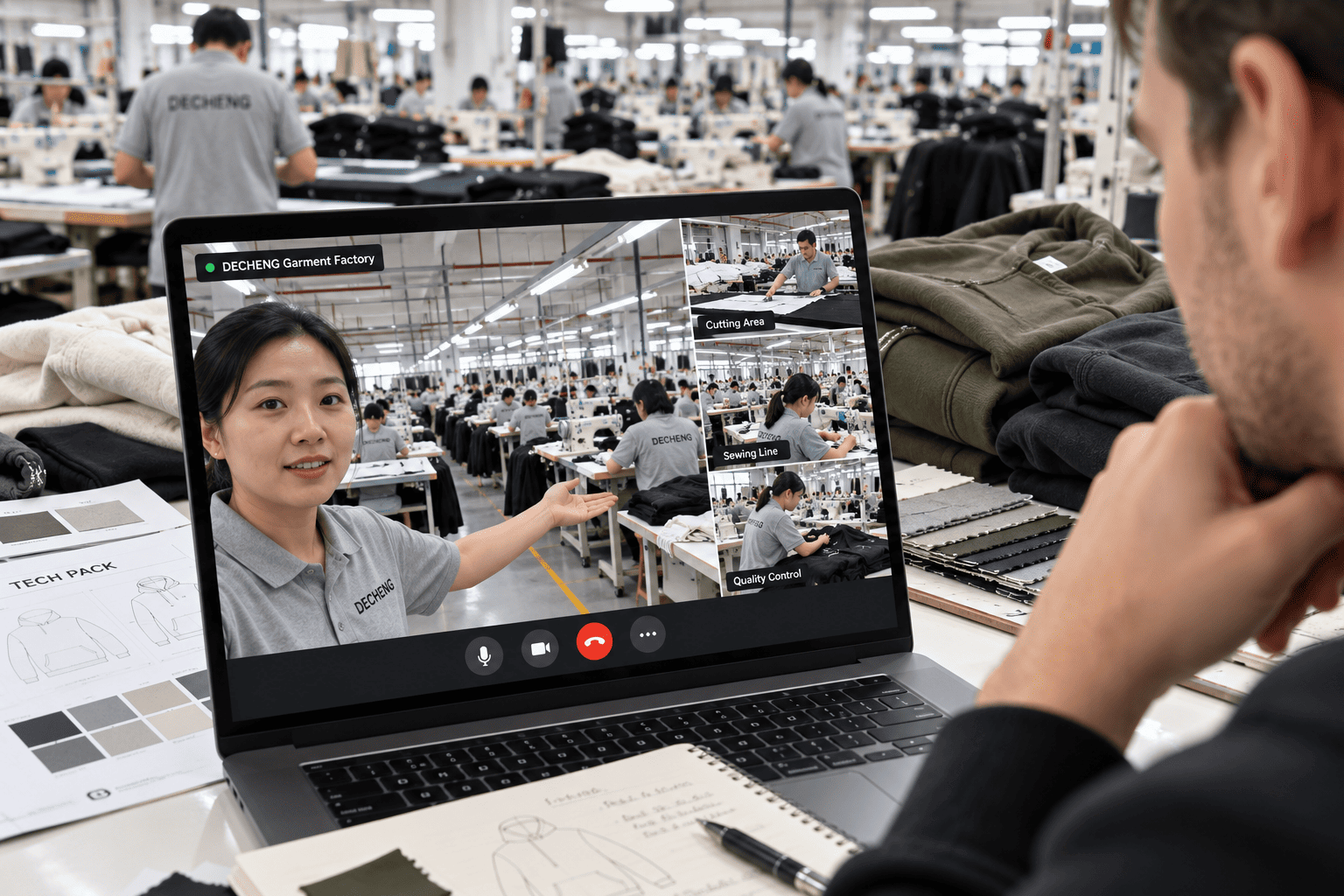
Start with documents.
Then use your eyes.
Then test the supplier with your own product.
Each step filters out a different kind of risk.
Verification Checklist
| Step | What to ask for | What it helps verify |
|---|---|---|
| Business registration | Company name and registration details | Legal entity |
| Social audit | SMETA, BSCI, auditor, site name, audit date | Factory-site assessment |
| Live video tour | Cutting, sewing, QC, warehouse | Active production facility |
| Recent production photos | Similar products | Category experience |
| Sample | Your design and chosen fabric | Development ability |
| Third-party inspection | Permission to inspect before shipment | Quality transparency |
When reviewing an audit report, check the company and site names carefully.
The report should correspond to the manufacturing site you are actually using.
For social-compliance verification, Sedex's SMETA methodology[^3] is one of the most widely used supplier social-audit systems globally.
SMETA evaluates areas including labour standards and health and safety, with 4-Pillar audits also covering environmental performance and business ethics.
One important detail:
SMETA is an audit methodology, not a product-quality certification.
Sedex also requires SMETA audits to be carried out by approved independent Affiliate Audit Companies.[^3]
Similarly, amfori BSCI is commonly used as part of social-performance monitoring and responsible sourcing.
A social audit does not automatically mean the garments are high quality.
It tells you something different:
whether the factory has been assessed against certain workplace and management standards.
For product quality, the sample is still one of your best tests.
Before bulk production, you should also consider third-party inspection.
A factory that is comfortable allowing an independent inspection generally has little reason to hide its production.
Green Flags and Red Flags
| Green flag | Red flag |
|---|---|
| Specialty matches your product | "We make everything" |
| Audit matches the legal manufacturing site | Report belongs to another company |
| Allows a live factory tour | Only sends edited marketing videos |
| Asks technical questions before quoting | Gives final price from one photo |
| Shows recent relevant production | Only uses catalog images |
| Accepts third-party inspection | Refuses external inspection |
| Refuses unauthorized trademark copying | Offers to copy any brand logo |
The sample is the final filter before bulk.
Our clothing sample guide explains how to manage this stage, while our clothing quality-control guide explains what to inspect before shipment.
What Should You Know About MOQ, Timing, and Payment?
Chinese clothing factories work around production schedules, fabric minimums, supplier lead times, and national holidays.
First-time buyers often underestimate this.
Expect MOQ to vary by product, sampling to take roughly one to two weeks for many custom styles, bulk production to take several weeks after approval, and payment to normally involve a deposit before production.
These are the working terms we commonly use.
Our Working Terms
| Item | Our standard |
|---|---|
| MOQ — hoodies, sets, jackets | 50 pcs per style |
| MOQ — tees and shorts | 100 pcs per style |
| MOQ — children's clothing | 200 pcs per style |
| Standard sample | About 10–14 days |
| Bulk production | About 23–28 days after approval and deposit |
| Payment | Bank transfer, typically 50% deposit and 50% balance for new clients |
| Sample fee | Credited to bulk only if that style reaches 300 pcs or more |
Minimum quantity is only one number.
A factory may also have separate minimums for:
- Fabric dyeing
- Custom rib
- Zippers
- Woven labels
- Hangtags
- Packaging
- Custom hardware
- Special washes
That is why a 50-piece garment MOQ does not necessarily mean every customized component can also be ordered in quantities of 50.
Ask before sampling.
The production calendar matters too.
Chinese New Year is the biggest disruption.
Factories can close for several weeks around the holiday because workers travel back to their hometowns, upstream suppliers also close, and production lines need time to restart.
National Day in early October also affects factory and logistics schedules.
The brands that struggle are usually the ones that plan only around the factory's quoted sewing lead time.
Instead, plan backwards from your launch date.
Include:
- Fabric sourcing
- Sample development
- Sample revisions
- Bulk material preparation
- Production
- Inspection
- Shipping
- Customs clearance
Then add some buffer.
If you need spring inventory, waiting until just before Chinese New Year to confirm production creates unnecessary risk.
Our clothing manufacturing cost guide explains how EXW, FOB, freight, and import costs affect the total landed cost.
How Do You Work Smoothly With a Chinese Factory?
Most factory problems are not caused by bad sewing.
They are caused by unclear information.
Work smoothly with a Chinese clothing factory by putting specifications in writing, using measurements and annotated images, communicating color clearly, grouping feedback together, and confirming final approvals in writing.
Your sales contact normally translates your requirements into instructions for several people:
- Pattern maker
- Sample room
- Fabric purchaser
- Printing workshop
- Embroidery team
- Cutting department
- Sewing line
- QC team
Every vague sentence creates another opportunity for misunderstanding.
Numbers survive translation better than adjectives.
Photos survive translation better than long paragraphs.
Communication Habits That Prevent Mistakes
| Habit | Why it works |
|---|---|
| Send a tech pack or reference garment | Reduces guessing |
| Give exact measurements | Creates measurable standards |
| Mark images with arrows and notes | Faster to understand |
| Combine revision comments | Prevents scattered changes |
| Confirm approvals in writing | Creates a production record |
| Use clear color references | Reduces color misunderstanding |
| Keep one main approval channel | Prevents lost decisions |
Color is one area where brands often create unnecessary confusion.
Instead of saying:
"dark green"
or:
"vintage blue"
give the factory a physical or standardized color reference.
For apparel and textile products, Pantone recommends its Fashion, Home + Interiors color system[^4], with TCX references designed specifically for textiles and apparel.
Pantone also notes that using shared color standards helps brands and manufacturers aim at the same target across different suppliers and production runs.[^4]
That is much clearer than sending a screenshot from Instagram.
Keep one main communication channel for everyday questions.
But important approvals should also be easy to trace.
Many buyers use WhatsApp for quick communication and email or shared documents for:
- Tech packs
- Size charts
- Artwork
- Purchase orders
- Sample approvals
- Bulk approvals
Avoid making one important decision on WhatsApp, another on Instagram, another inside Alibaba, and another by email.
Eventually something will be missed.
Also be clear about intellectual property.
Factories should not assume that every logo a customer sends is legally authorized.
The World Intellectual Property Organization[^5] explains that trademarks give owners legal rights over protected marks and their authorized use.
A factory that is willing to copy any famous brand logo without asking questions is not necessarily doing you a favor.
That behavior can create risk for both parties.
We work from customer designs and artwork, while supporting pattern making, grading, sampling, garment engineering, costing, and production.
The design direction still belongs to the customer.
Our tech pack guide explains exactly what to prepare before sampling.
For products sold into markets such as the United States, product labeling should also be discussed before bulk production.
For example, the U.S. Federal Trade Commission Care Labeling Rule[^6] requires covered textile apparel sold in the U.S. to carry appropriate care instructions and requires manufacturers or importers to have a reasonable basis for those instructions.
This is why wash testing, fabric composition, shrinkage, and decoration durability should be confirmed before the final care label is printed.
Conclusion
China is not automatically the best manufacturing location for every apparel order.
And the cheapest Chinese supplier is not automatically the right factory.
The better question is:
Which factory has the right supply chain, product knowledge, equipment, quality-control process, and communication ability for my specific product?
Start by matching the manufacturing region to your category.
Then verify the legal company.
Check the manufacturing site.
Review relevant audit reports.
Take a live factory tour.
Order a sample.
Test the sample.
Confirm every specification in writing.
And inspect the bulk order before shipment.
That process removes a large part of the risk.
China's real advantage today is not simply low-cost sewing.
It is the combination of fabric sourcing, product development, trims, decoration, sampling, manufacturing, and logistics that can happen within one connected supply chain.
For a custom clothing brand, especially one producing small or medium quantities with complicated fabrics, washes, embroidery, printing, or private-label details, that ecosystem can still be extremely valuable.
The goal is not simply to find a clothing manufacturer in China.
It is to find the right manufacturer for your product.
Footnotes & References
[^1]: World Trade Organization data / Global Apparel Trade Statistics. WTO data reported for 2024 shows Chinese apparel exports at approximately USD 165 billion, representing around 29.6% of global clothing exports, compared with approximately 36.9% in 2010.
https://www.wto.org/
Supporting industry reporting:
https://www.modaes.com/global/markets/china-loses-hegemony-as-the-worlds-fashion-factory-down-30-of-global-market-share
[^2]: National Enterprise Credit Information Publicity System — China. China's official public system for searching registered enterprises using company names, Unified Social Credit Codes, or registration numbers.
https://www.gsxt.gov.cn/
[^3]: Sedex — SMETA Audit. Official Sedex information on the SMETA social-audit methodology, covering labour standards, health and safety, environmental performance, and business ethics. Sedex also explains that approved independent Affiliate Audit Companies conduct SMETA audits.
https://www.sedex.com/solutions/smeta-audit/
[^4]: Pantone — Fashion, Home + Interiors. Pantone's official color system for fashion, textiles, apparel, and soft goods. TCX references are intended for textile applications and help manufacturers and designers communicate color consistently.
https://www.pantone.com/na/en-us/fashion-home-interiors
[^5]: World Intellectual Property Organization — Trademarks. Official overview of trademarks, trademark ownership, registration, protection, and authorization of trademark use.
https://www.wipo.int/en/web/trademarks
[^6]: U.S. Federal Trade Commission — Care Labeling of Textile Wearing Apparel and Certain Piece Goods. Official U.S. requirements concerning care instructions for covered textile wearing apparel and the requirement to have a reasonable basis for those instructions.
https://www.ftc.gov/legal-library/browse/rules/care-labeling-textile-wearing-apparel-certain-piece-goods