

Leggings Manufacturer: How Do You Get Squat-Proof, Not See-Through?
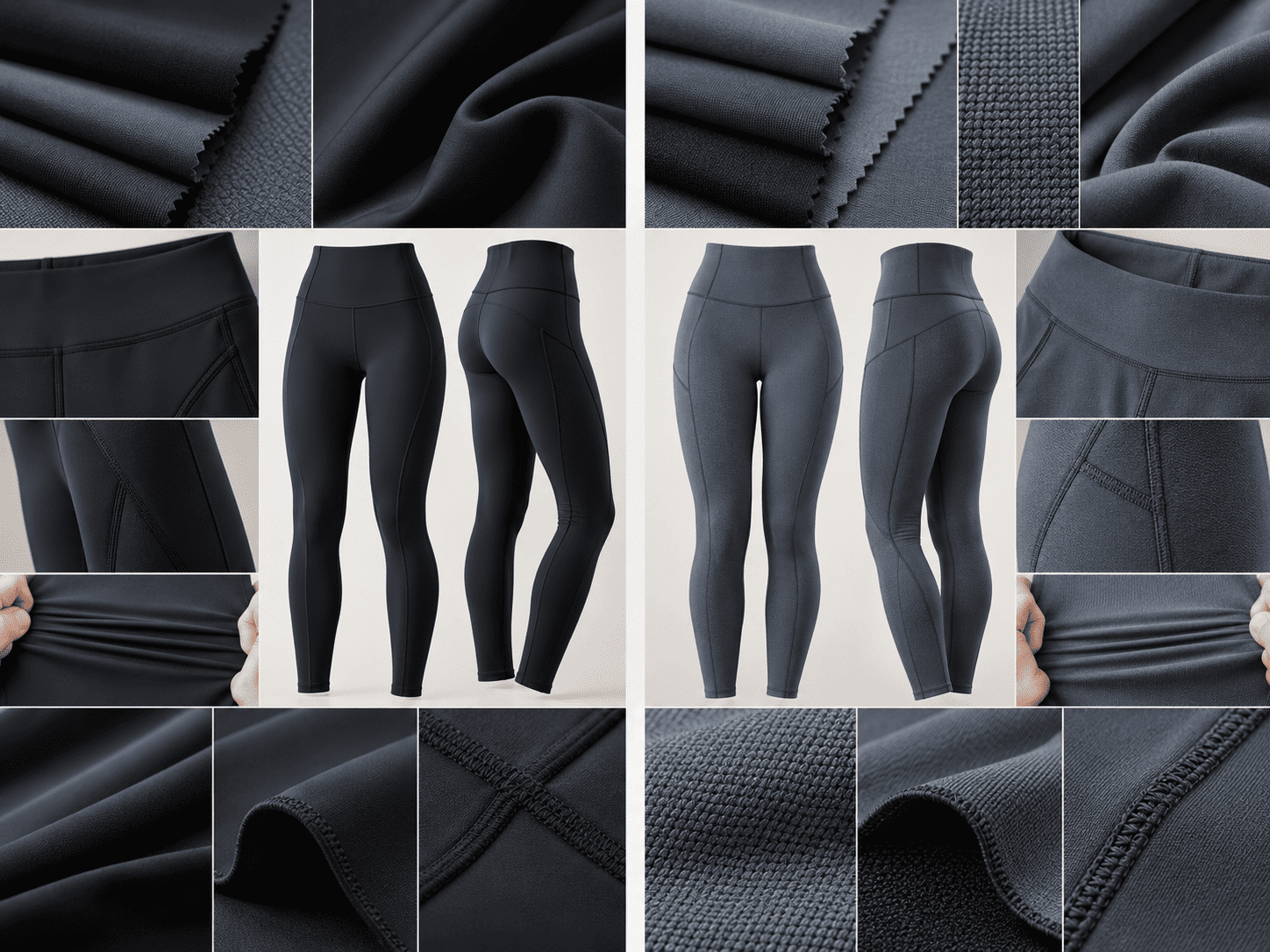
You have probably seen the review that can damage a legging brand very quickly:
They become see-through when I squat.
The garment may look perfect when standing.
The color may be beautiful.
The waistband may feel comfortable.
But once the fabric stretches across the hips and thighs, the problem appears.
That is why I do not treat “squat-proof” as a simple marketing word.
A good squat-resistant legging needs enough fabric coverage under stretch, suitable knit density, appropriate fabric weight, strong stretch recovery, correct pattern tension, and a fit that does not overstretch the material. The waistband, gusset, seams, and size grading also matter, but no single GSM or elastane percentage can guarantee opacity by itself.
I work with knit garments in Dongguan, and leggings are one of those products where a fabric specification on paper is not enough.
You need to stretch it.
You need to put it on a body.
You need to squat.
You need to check it under real lighting.
Then wash it and test it again.
That is how I would develop leggings before bulk production.
Table of Contents
- What Does Squat-Proof Actually Mean for Leggings?
- What Makes Leggings Go See-Through?
- What Fabric Should Custom Leggings Use?
- Nylon vs Polyester: Which Is Better for Leggings?
- How Much Elastane Should Leggings Have?
- How Important Are Stretch and Recovery?
- What GSM Should You Choose for Leggings?
- How Does Color Affect Legging Opacity?
- Why Does the Legging Pattern Affect Opacity?
- Does a Gusset Make Leggings Better?
- What Seam Construction Works Best for Leggings?
- How Should a Legging Waistband Be Built?
- What Pocket Options Can You Add?
- Cut-and-Sew vs Seamless Leggings: What Is the Difference?
- What Decoration Works on Stretch Leggings?
- How Should You Test Leggings Before Bulk Production?
- What MOQ Should You Expect for Custom Leggings?
- What Affects Custom Legging Cost?
- What Should You Send a Leggings Manufacturer?
- How Do You Choose a Reliable Leggings Manufacturer?
- Conclusion
- Footnotes & References
What Does Squat-Proof Actually Mean for Leggings?
In practical product development, I use “squat-proof” to describe leggings that maintain acceptable coverage when the fabric is stretched over the body during movements such as:
- Squatting
- Bending
- Lunging
- Sitting
- Stretching
It is not enough to hold an unstretched fabric swatch against a table and say:
It is opaque.
The fabric behaves differently once it is stretched.
Opacity needs to be evaluated at the amount of stretch the garment will actually experience when worn.
That is why one of the first things I want to know is:
How much is this fabric being stretched by the pattern?
The same fabric may work well in one legging pattern and become noticeably more transparent in a smaller, tighter pattern.
What Makes Leggings Go See-Through?
See-through leggings are not caused by only one factor.
Usually several variables interact.
Fabric Is Stretched Too Far
As knitted fabric stretches, the spaces between yarns can become larger.
If the pattern is too small for the intended body measurements, even a good fabric may be overstretched.
Fabric Construction Is Too Open
Two fabrics can both be:
240 GSM
but one can be more densely knitted than the other.
GSM measures mass per unit area.
It does not directly tell you how closed or open the knitted structure is.
Fabric Is Too Light for the Application
A very lightweight fabric may work well for a running top but not provide the coverage expected from gym leggings.
Color Can Affect Visual Coverage
Light colors such as:
- White
- Cream
- Pastel pink
- Light grey
can reveal more than black or navy.
This means a black sample passing the squat test does not automatically prove that the same fabric in white will perform identically.
Fit Can Be Too Tight
This is extremely important.
Sometimes buyers try to solve opacity by immediately ordering heavier fabric.
But the real issue is the pattern.
If the fabric is being stretched beyond the intended range, correcting the fit may solve more than simply increasing GSM.
What Fabric Should Custom Leggings Use?
Two of the most common fiber combinations are:
- Nylon + elastane
- Polyester + elastane
You may also find:
- Recycled polyester + elastane
- Brushed nylon + elastane
- Polyester/nylon/elastane blends
The right choice depends on the product.
A Legging Fabric Needs More Than Stretch
I normally look at:
- Hand feel
- GSM
- Knit density
- Stretch
- Recovery
- Opacity
- Pilling
- Shrinkage
- Colorfastness
- Surface appearance
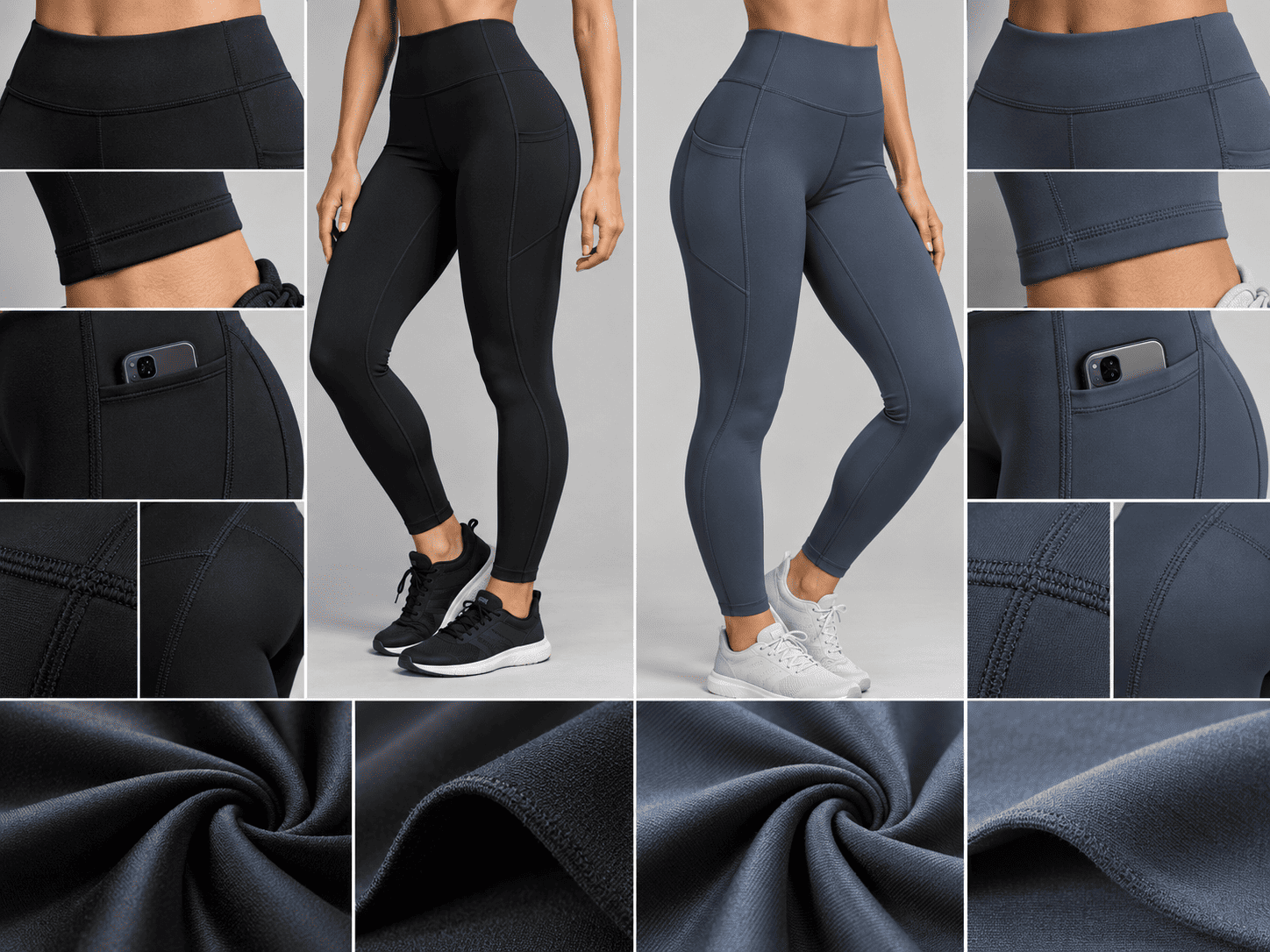
If a buyer tells me only:
80% nylon / 20% spandex.
I still do not know whether the fabric is suitable.
I need to see and test the actual knit.
Nylon vs Polyester: Which Is Better for Leggings?
Neither is automatically better.
They create different product characteristics.
Nylon-Elastane
Nylon blends are frequently chosen when brands want:
- Smooth surface
- Soft hand feel
- Premium touch
- Close-to-skin comfort
- Fitted leggings
Some brushed nylon fabrics can create the soft “buttery” hand feel many buyers ask for.
Polyester-Elastane
Polyester blends are commonly used for:
- Training leggings
- Printed leggings
- Performance bottoms
- More price-sensitive collections
Polyester can offer:
- Good durability
- Relatively low moisture absorption
- Fast drying
- Good print compatibility
But fiber name alone does not guarantee performance.
A premium polyester fabric may outperform a poor-quality nylon fabric.
How Much Elastane Should Leggings Have?
There is no universal correct percentage.
You may see leggings containing:
- 10% elastane
- 15% elastane
- 20% elastane
- 25% elastane
- Higher percentages in some constructions
Many fitted leggings use roughly 15–25% elastane, but this should be treated as a sourcing range, not a performance guarantee.
Elastane percentage alone does not tell you how much the finished fabric stretches or how well it recovers.
Fabric performance also depends on:
- Yarn specification
- Knit structure
- Fabric density
- Heat setting
- Finishing
Two fabrics both labeled:
80% Nylon / 20% Elastane
can behave very differently.
Spandex and Elastane
For U.S. labeling, the FTC recognizes spandex as the generic fiber name and also permits elastane as an ISO alternative name.
The FTC textile labeling guidance[^1] explains that either name may be used.
So:
80% Nylon
20% Spandex
and:
80% Nylon
20% Elastane
can both be acceptable terminology in the U.S. when they accurately describe the product.
But LYCRA® is a trademark, not a generic name for all elastane fibers.
How Important Are Stretch and Recovery?
Very important.
Stretch determines how much the fabric can extend.
Recovery determines how well it returns toward its original dimensions afterward.
For leggings, you need both.
A fabric may stretch beautifully but recover poorly.
After several hours of wear, you may see:
- Bagging at the knees
- Loose seat
- Waistband sagging
- Wrinkling
- Loss of compression
That is why I do not ask only:
Does this fabric stretch?
I also ask:
How does it recover?
The official ASTM D2594/D2594M test method[^2] covers measurement of fabric stretch and fabric growth for knitted fabrics under defined conditions.
ASTM specifically notes that stretch and growth information can be useful when selecting fabrics that need to stretch and return toward their original shape.
For technical products, that kind of measurable data is more useful than a supplier saying:
Very stretchy, very good quality.
What GSM Should You Choose for Leggings?
There is no official “squat-proof GSM.”
But practical sourcing ranges can help.
| GSM | Practical Application |
|---|---|
| 160–190 GSM | Lightweight lifestyle / layering |
| 180–220 GSM | Light training leggings |
| 200–240 GSM | General activewear |
| 220–260 GSM | Substantial gym leggings |
| 250–300 GSM | Compression / premium heavy leggings |
| 300 GSM+ | Specialized or winter styles |
These are examples, not universal rules.
Higher GSM Can Help, But It Does Not Guarantee Opacity
A heavier fabric often provides more material coverage.
But opacity still depends on:
- Knit density
- Yarn
- Color
- Stretch
- Pattern tension
A dense 220 GSM fabric might perform better than a loose 260 GSM fabric.
That is why I always want to test the real fabric.
How Does Color Affect Legging Opacity?
Color approval matters more in leggings than many buyers expect.
A fabric may look perfect in:
Black.
Then become noticeably more transparent in:
Ivory.
The same base fabric can behave visually differently across colors.
Test Every Important Light Color
For:
- White
- Cream
- Beige
- Pastels
I recommend checking the actual production color under stretch.
Do not assume the black sample represents every color.
Use a Textile Color Standard
For custom dyeing, a standardized textile reference helps reduce confusion.
Pantone Fashion, Home + Interiors[^3] specifies TCX for soft surfaces such as textiles and apparel.
For example:
Pantone 18-1664 TCX
is much more useful than:
Make it the same red as this screenshot.
Why Does the Legging Pattern Affect Opacity?
This is one of the most overlooked points.
Imagine a fabric that performs well at moderate stretch.
Now make the garment significantly smaller.
The fabric must stretch further to fit the same body.
As stretch increases:
- Knit openings may enlarge
- Color may appear lighter
- Opacity may decrease
- Seam tension increases
So the question is not only:
Is the fabric squat-proof?
It is:
Is this fabric squat-proof at the stretch level created by this pattern and size?
Grading Matters Too
A size S and a size XL should not simply be treated as the same garment scaled mechanically in every direction.
A good grading plan considers:
- Waist
- Hip
- Rise
- Thigh
- Knee
- Calf
- Inseam
Poor grading can cause one size to fit well and another to overstretch.
Does a Gusset Make Leggings Better?
A gusset can be useful.
Common shapes include:
- Diamond
- Triangle
- Extended panel
A gusset can help:
- Redistribute seams
- Improve mobility
- Reduce seam concentration at the crotch
- Improve fit
But I would not say:
Gusset = squat-proof.
Opacity still comes mainly from fabric coverage and how the garment stretches.
A good gusset helps construction.
It does not fix an unsuitable fabric.
What Seam Construction Works Best for Leggings?
Common options include:
- Overlock
- Flatlock
- Coverstitch
- Bonded construction
Flatlock
Flatlock can create a flatter seam profile.
That can help reduce:
- Bulk
- Raised seam edges
- Friction points
on close-fitting garments.
But I would avoid promising:
Flatlock is completely chafe-free.
Comfort also depends on:
- Seam position
- Thread
- Fit
- Activity
- Skin sensitivity
Seam Placement Matters
Even a technically strong seam can be uncomfortable if it sits in a high-friction area.
During sampling, I prefer testing the garment during:
- Squats
- Lunges
- Running
- Stretching
instead of only checking the garment while standing.
How Should a Legging Waistband Be Built?
The waistband is one of the biggest reasons customers either love or dislike leggings.
A good waistband should feel supportive without constantly rolling or sliding.
Common options include:
- High rise
- Mid rise
- Ultra-high rise
- Wide double-layer waistband
- Internal elastic
- Hidden drawcord
Common Waistband Problems
Rolling
The waistband folds downward during movement.
Sliding
The leggings slowly move down while training.
Digging
Too much compression creates discomfort around the waist.
Gaping
The waist is too loose compared with the hip.
These are pattern and fabric problems, not simply styling problems.
Waistband Fabric Can Be Different
Some brands use:
- Double-layer self fabric
- Additional elastic
- Power mesh
depending on the level of support required.
Again, this needs to be tested on a body.
What Pocket Options Can You Add?
Functional pockets are very popular in leggings.
Common choices include:
- Side phone pocket
- Back waistband pocket
- Hidden key pocket
- Zipper pocket
Side Phone Pocket
This sounds simple.
But I still check:
- Width
- Depth
- Opening
- Stretch
- Phone movement
A pocket that looks correct when standing may let the phone bounce during running.
Hidden Waist Pocket
Useful for:
- Key
- Card
- Small item
but less suitable for a large phone.
The function should match the intended activity.
Cut-and-Sew vs Seamless Leggings: What Is the Difference?
These are two different manufacturing systems.
Cut-and-Sew Leggings
Fabric is produced first.
Then the factory:
- Spreads fabric
- Cuts panels
- Sew panels together
- Finishes seams
This allows a lot of control over:
- Panel shapes
- Seams
- Gussets
- Pockets
- Mixed fabrics
Seamless Leggings
Seamless products are generally knitted closer to garment shape using specialized circular knitting equipment.
They can reduce some traditional cut-and-sew seams and create:
- Engineered zones
- Rib structures
- Compression zones
- Different knit textures
But seamless production has its own:
- Machine setup
- Yarn requirements
- Development process
- MOQ
Not every cut-and-sew activewear factory has seamless knitting machines.
So always ask:
Is this cut-and-sew or seamless production?
before assuming they are interchangeable.
What Decoration Works on Stretch Leggings?
Decoration needs to stretch with the garment.
Common options include:
- Heat-transfer logo
- Silicone transfer
- Reflective transfer
- Sublimation
- Small embroidery in suitable locations
Heat Transfer
Works well for small logos when:
- Adhesive is suitable
- Transfer stretches adequately
- Temperature and pressure are controlled
Sublimation
Useful for polyester-based fabrics and all-over printed designs.
The artwork becomes part of the dyed fabric surface rather than forming a thick print layer.
Large Thick Screen Prints
These need more caution.
A rigid print applied across a highly stretched area can:
- Crack
- Restrict stretch
- Feel uncomfortable
That does not mean screen print is impossible.
It means placement and ink system should match the fabric.
How Should You Test Leggings Before Bulk Production?
This is probably the most important section of this article.
Do not approve leggings based only on a fabric swatch and flat measurements.
1. Perform a Squat Test
Wear the actual sample.
Check from behind under realistic lighting.
Test:
- Standing
- Half squat
- Full squat
2. Use Contrasting Underlayers When Checking Opacity
A contrasting underlayer can make transparency easier to detect during development.
The purpose is not to create an unrealistic test.
It is to identify weakness before customers do.
3. Test Multiple Sizes
Do not test only the sample size.
If possible, check how the fabric behaves across the graded size range.
4. Check Stretch and Recovery
The ASTM D2594/D2594M method[^2] provides a standardized way to evaluate stretch and fabric growth in suitable knitted fabrics.
For high-compression or support garments, other methods may be more appropriate, so the laboratory should select the test based on the fabric and end use.
5. Wear-Test the Waistband
Squat.
Run.
Sit.
Bend.
Check whether the waistband:
- Rolls
- Slides
- Folds
- Gapes
6. Wash the Sample
Then evaluate the garment again.
AATCC TM135[^4] provides standardized procedures for determining dimensional changes in fabrics after home laundering.
For finished garments, appropriate garment-level laundering evaluation can also be used.
After washing, I would check:
- Measurements
- Waistband
- Recovery
- Seams
- Surface
- Pilling
- Logo
- Color
A good first sample is useful.
A good sample after washing tells you much more.
What MOQ Should You Expect for Custom Leggings?
MOQ depends on the fabric and construction.
For cut-and-sew leggings, around 100 pieces per style can be a realistic starting point for some flexible factories.
More technical projects may require:
- 100–200 pieces
- Higher fabric quantity
- Higher color minimum
depending on the mill.
Fabric MOQ Matters
The garment factory might accept:
100 leggings.
But the fabric supplier may require more material for:
260 GSM nylon/elastane
Brushed finish
Custom Pantone color
Now the material becomes the limiting factor.
Color Splits Matter
100 black leggings are easier than:
20 black
20 white
20 pink
20 blue
20 green
especially when those colors need custom dyeing.
What Affects Custom Legging Cost?
The unit price depends on:
- Nylon or polyester
- Elastane percentage
- GSM
- Fabric finish
- Custom dyeing
- Pattern complexity
- Gusset
- Seam construction
- Waistband
- Pockets
- Decoration
- Quantity
- Labels
- Packaging
A simple training legging and a premium compression legging should not have the same quotation.
Sampling Has Real Development Cost
The sample may require:
- Pattern development
- Special fabric sourcing
- Cutting
- Sewing
- Heat-transfer setup
- Fit revisions
- Wear testing
This is why the sample price should not be compared directly with the bulk price.
For new bulk customers, payment may commonly be structured as:
50% deposit before production
50% balance before shipment
Exact terms should always be confirmed for the individual order.
What Should You Send a Leggings Manufacturer?
A useful inquiry might look like this:
| Item | Requirement |
|---|---|
| Product | Women's gym leggings |
| Quantity | 150 pcs |
| Fabric | Nylon / elastane |
| GSM | 240–260 GSM |
| Fit | Medium compression |
| Waist | High-rise wide waistband |
| Length | Full length |
| Side phone pocket | |
| Gusset | Yes |
| Sizes | XS–XL |
| Color | Black |
| Logo | Small heat-transfer logo |
| Target use | Strength training |
| Market | United States |
Now I can check:
- Fabric
- Stretch
- Recovery
- Opacity
- Pattern
- MOQ
- Sample cost
- Production cost
Tell the Factory the Activity
Instead of:
Women's leggings.
write:
Squat-resistant gym leggings for strength training.
That one line changes the way I think about the fabric.
How Do You Choose a Reliable Leggings Manufacturer?
I would start by asking:
How do you evaluate opacity under stretch?
The answer can tell you a lot.
A technical supplier may discuss:
- Fabric density
- Stretch
- Recovery
- Color
- GSM
- Pattern tension
- Wear testing
A weaker supplier may simply say:
Don't worry, 100% squat-proof.
I prefer the first answer.
Ask About Stretch Testing
If stretch and recovery are important, ask whether the fabric has measured performance or whether a third-party lab can test it.
The ASTM D2594/D2594M standard[^2] is one recognized reference for stretch and growth testing of suitable knitted fabrics.
Ask About Wash Testing
Wear performance changes after laundering.
AATCC maintains standardized laundering and dimensional-change methods[^4] that can be used where formal testing is required.
Check Textile Safety Separately
OEKO-TEX® STANDARD 100[^5] is a certification for textile products and components tested for harmful substances.
That is different from:
- Opacity
- Stretch
- Recovery
A fabric may have STANDARD 100 certification and still be unsuitable for leggings.
The certification answers a different question.
Check Social-Compliance Claims Correctly
Sedex describes SMETA[^6] as a social audit used to evaluate areas including labour standards, health and safety, environmental performance, and business ethics.
SMETA is not a squat-proof test and not a textile performance certification.
Again, different documents answer different questions.
Verify Labels for the Target Market
For products sold in the United States, the FTC textile labeling guidance[^1] explains requirements including:
- Fiber content
- Country of origin
- Responsible manufacturer or marketer
The care label should also be planned before bulk production.
Green Flags and Red Flags
| Green Flag | Red Flag |
|---|---|
| Discusses opacity under stretch | Simply promises “squat-proof” |
| Understands recovery | Only talks about elastane percentage |
| Can explain pattern tension | Blames every issue on GSM |
| Tests waistband during movement | Checks garment only flat |
| Understands gusset construction | Says gusset guarantees opacity |
| Clear about cut-and-sew vs seamless | Treats them as the same process |
| Can provide relevant fabric information | Calls every stretch fabric “premium” |
| Explains audit/certification correctly | Uses unrelated certificates as performance proof |
A good leggings manufacturer should be comfortable saying:
We need to test this color before confirming opacity.
That is not weakness.
That is responsible product development.
Conclusion
A good pair of leggings is much more complicated than:
80% nylon, 20% spandex.
The fiber composition matters.
But so do:
- Knit density
- GSM
- Stretch
- Recovery
- Color
- Pattern
- Size grading
- Waistband
- Gusset
- Seams
- Pockets
- Washing
Most importantly, opacity must be checked while the actual fabric is under realistic stretch.
That is why I would never approve a new legging only from:
- A fabric color card
- A digital mockup
- A supplier promise
Make a physical sample.
Wear it.
Squat in it.
Stretch it.
Check the light colors.
Test the waistband.
Put a phone in the pocket.
Wash it.
Wear it again.
Then decide whether it is ready for bulk production.
For a new activewear brand, I would prioritize:
- Opacity under stretch
- Stretch and recovery
- Fit
- Waistband stability
- Seam comfort
- Pocket function
- Wash performance
- Consistent bulk fabric
And remember:
More elastane does not automatically mean better leggings.
Higher GSM does not automatically mean squat-proof leggings.
A gusset does not automatically mean squat-proof leggings.
The product works only when the fabric and pattern work together.
That is what I would look for in a leggings manufacturer: not someone willing to promise “100% squat-proof” before seeing the product, but a factory willing to test the fabric, develop the fit, evaluate the sample during movement, and correct the weak points before repeating them across the bulk order.
Footnotes & References
[^1]: U.S. Federal Trade Commission — Threading Your Way Through the Labeling Requirements Under the Textile and Wool Acts. Official FTC guidance on textile fiber names, fiber-content disclosure, country of origin, manufacturer/marketer identification, and the permitted use of “elastane” as an alternative name for spandex.
https://www.ftc.gov/business-guidance/resources/threading-your-way-through-labeling-requirements-under-textile-wool-acts
[^2]: ASTM International — ASTM D2594/D2594M, Standard Test Method for Stretch Properties of Knitted Fabrics Having Low Power. Standardized method covering measurement of fabric stretch and fabric growth for applicable knitted fabrics.
https://store.astm.org/d2594_d2594m-21.html
[^3]: Pantone — Fashion, Home + Interiors (FHI). Official Pantone color system for fashion and textile development; TCX is intended for soft surfaces such as textiles and apparel.
https://www.pantone.com/na/en-us/fashion-home-interiors
[^4]: AATCC — TM135 and Standard Textile Testing Methods. AATCC TM135 provides standardized evaluation of dimensional changes in fabrics after home laundering, while AATCC maintains additional methods for garment and textile performance testing.
https://members.aatcc.org/store/tm135/543/
https://www.aatcc.org/testing/standards
[^5]: OEKO-TEX® — STANDARD 100. Official certification covering textiles and textile components tested for harmful substances.
https://www.oeko-tex.com/en/our-standards/oeko-tex-standard-100
[^6]: Sedex — SMETA Audit. Official Sedex information describing SMETA as a social audit methodology covering labour standards, health and safety, environmental performance, and business ethics.
https://www.sedex.com/solutions/smeta-audit/