
Activewear Manufacturer: How Do You Get Performance Fabric Right?
You want gym wear that stretches with the body, handles sweat, recovers after movement, and still looks good after repeated washing.
That sounds simple until you start sourcing it.
A factory can be excellent at heavyweight cotton hoodies and still struggle with technical leggings.
Why?
Because activewear is not only about sewing a garment in a sporty shape.
The fabric, stretch, recovery, seam construction, fit, waistband, decoration, and performance claims all need to work together.
A good activewear manufacturer starts with the intended activity and fabric performance. Polyester, nylon, and elastane blends are common, but the correct composition depends on the product. Moisture management, stretch, recovery, drying performance, compression, and abrasion resistance should be treated as measurable fabric properties rather than marketing words.
In my experience, this is the biggest difference between lifestyle sportswear and truly technical activewear.
A sweatshirt can still work if the fabric is slightly different from the original idea.
A compression legging may fail completely if:
- The stretch is wrong
- Recovery is weak
- The waistband rolls
- The fabric becomes transparent during a squat
- The seam stretches poorly
- The print cracks
That is why activewear development needs more testing than a normal casual garment.
Table of Contents
- What Makes Activewear Different From Regular Clothing?
- What Fabric Makes Good Activewear?
- What Is the Difference Between Polyester, Nylon, and Elastane?
- Does Polyester Automatically Mean Moisture-Wicking?
- What Does Four-Way Stretch Actually Mean?
- What GSM Should You Choose for Activewear?
- How Important Is Stretch Recovery?
- What Seam Construction Works for Activewear?
- How Do You Get Activewear Fit Right?
- What Waistband and Pocket Details Matter?
- What Printing and Branding Work on Stretch Fabric?
- How Should Performance Claims Be Tested?
- What MOQ Should You Expect for Custom Activewear?
- What Affects the Cost of Custom Activewear?
- Why Is Sampling Especially Important for Activewear?
- What Should You Send an Activewear Manufacturer?
- How Do You Choose a Reliable Activewear Manufacturer?
- Conclusion
- Footnotes & References
What Makes Activewear Different From Regular Clothing?
Activewear needs to function while the wearer is moving.
That changes the product-development priorities.
Compared with basic casual clothing, technical activewear may need controlled stretch, recovery, moisture movement, quick drying, low-bulk seams, functional waistbands, stable pockets, and patterns designed around body movement.
A basic cotton T-shirt mainly needs:
- Good fit
- Good hand feel
- Stable measurements
- Good decoration
A pair of training leggings may need:
- High stretch
- Strong recovery
- Opacity
- Compression
- Waistband support
- Sweat management
- Low seam bulk
A running top may need:
- Lightweight fabric
- Moisture movement
- Fast drying
- Breathability
- Low-friction seams
That is why I first ask:
What activity is the garment designed for?
A yoga legging and a running short are both “activewear.”
But their fabric specifications should not automatically be the same.
What Fabric Makes Good Activewear?
There is no single best activewear fabric.
The fabric should match the function.
Common fiber combinations include:
- Polyester + elastane
- Nylon + elastane
- Polyester
- Nylon
- Polyester + cotton
- Recycled polyester blends
For stretch leggings and fitted products, elastane is often added to provide stretch and recovery.
Practical compositions may include:
75% nylon / 25% elastane
or:
80% polyester / 20% elastane
or:
88% polyester / 12% elastane
These are examples, not mandatory formulas.
The correct ratio depends on:
- Fabric structure
- Yarn
- Knitting
- Target compression
- Product weight
- Stretch requirement
Two fabrics both containing 20% elastane can still perform very differently.
What Is the Difference Between Polyester, Nylon, and Elastane?
Understanding the fibers makes sourcing much easier.
Polyester
Polyester is widely used in performance apparel because it can offer:
- Durability
- Dimensional stability
- Low moisture absorption
- Relatively fast drying
- Easy care
Textile Exchange's polyester resource[^1] describes polyester as strong, durable, crease-resistant, and quick to dry.
That makes it useful for:
- Training T-shirts
- Running tops
- Shorts
- Jerseys
- Tracksuits
But polyester alone does not automatically guarantee excellent moisture management.
Fabric structure and finishing also matter.
Nylon
Nylon is also common in technical stretch garments.
It is often selected when the buyer wants:
- Smooth hand feel
- Soft surface
- Stretch applications
- Premium leggings
- Fitted garments
Nylon/elastane fabrics are especially common for products where hand feel against the skin matters.
Elastane / Spandex
Elastane provides stretch and recovery.
In U.S. terminology, spandex is the recognized generic fiber name, while elastane is an ISO alternative name accepted by the FTC.
The FTC's textile-labeling guidance[^2] specifically notes that elastane may be used as an alternative name for spandex.
One important detail:
LYCRA® is a brand/trademark, not the generic name of every elastane fiber.
So a material should not automatically be called “Lycra” unless the actual fiber is supplied under that brand.
Does Polyester Automatically Mean Moisture-Wicking?
No.
This is one of the biggest oversimplifications in activewear sourcing.
A polyester fabric can dry relatively quickly, but moisture-wicking performance depends on the interaction between fiber, yarn, knit structure, surface treatment, capillary action, and fabric design.
A supplier saying:
100% polyester, therefore moisture-wicking.
is not enough if the brand intends to make a real performance claim.
The fabric needs to be evaluated.
Moisture may need to:
- Move away from the skin-facing surface
- Spread across the outer surface
- Evaporate efficiently
Different fabrics achieve this differently.
Performance Claims Can Be Tested
The AATCC TM195 test method[^3] is specifically designed to measure and classify liquid moisture-management properties of textile fabrics.
AATCC also maintains methods for:
- Vertical wicking
- Horizontal wicking
- Drying time
- Drying rate
This is important for brands.
If your product page says:
Advanced moisture management
or:
High-performance quick-dry fabric
it is much stronger when the claim comes from actual fabric data rather than a supplier repeating a marketing phrase.
What Does Four-Way Stretch Actually Mean?
This phrase is also used loosely.
Normally, four-way stretch describes a fabric capable of meaningful stretch in both major directions:
- Lengthwise
- Widthwise
rather than mainly stretching in one direction.
But simply writing:
Four-way stretch
does not tell me how much it stretches or how well it recovers.
One fabric may stretch dramatically.
Another may stretch moderately.
Both may be described as four-way stretch.
Ask for Actual Stretch Performance
For technical garments, it is more useful to consider:
- Stretch percentage
- Recovery
- Direction
- Force required to stretch
- Performance after repeated wear
A fabric that stretches easily but never fully returns to its original dimensions is not a good choice for compression leggings.
What GSM Should You Choose for Activewear?
GSM still matters, but activewear weights vary more than heavyweight casualwear.
A practical sourcing guide might look like this:
| Fabric Weight | Possible Application |
|---|---|
| 120–160 GSM | Lightweight running tops |
| 150–190 GSM | Training tees / mesh |
| 180–220 GSM | Shorts / fitted tops |
| 200–250 GSM | Leggings / cycling shorts |
| 240–300 GSM | Compression or premium leggings |
| 280 GSM+ | Heavy structured activewear / layers |
These are practical examples, not official performance standards.
A 220 GSM fabric can feel:
- Thin
- Dense
- Soft
- Compressive
depending on its structure.
GSM alone does not define compression.
How Important Is Stretch Recovery?
Very important.
Stretch allows the garment to move.
Recovery allows it to return.
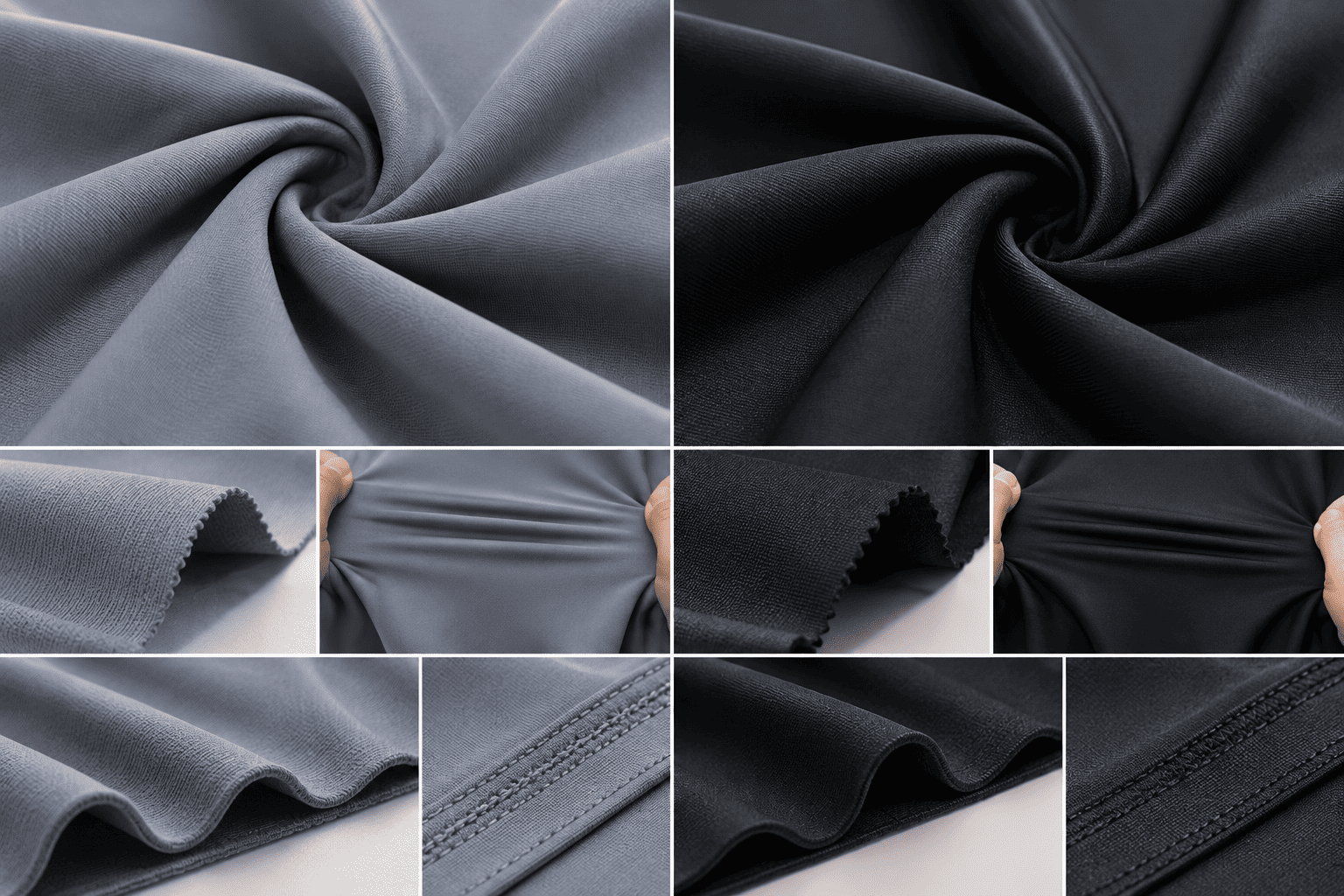
A legging with poor recovery can develop:
- Bagging at the knees
- Loose seat
- Sagging waistband
- Distorted seams
after wear.
Compression Needs Balance
More compression is not automatically better.
Too little compression may feel loose.
Too much can feel uncomfortable and restrict movement.
The right result comes from:
- Pattern
- Negative ease
- Fabric stretch
- Fabric recovery
- GSM
- Elastane content
- Waistband design
That is why I do not approve a compression garment from fabric specifications alone.
It needs to be worn.
What Seam Construction Works for Activewear?
Seam construction matters because fitted garments put more tension on seams.
Overlock
Overlock is common because it can work well with stretch knit fabric.
It is efficient and practical.
Flatlock
Flatlock construction can reduce seam bulk and create a flatter surface against the body.
That may help reduce friction in garments worn close to the skin.
But I would avoid promising:
Flatlock = zero chafing.
Skin sensitivity, garment fit, seam placement, activity duration, and fabric all affect comfort.
Coverstitch
Coverstitch is commonly used for:
- Hems
- Necklines
- Stretch openings
It creates a neat finish while allowing stretch.
Bonded Seams
Some technical garments use bonded construction.
This can create a very clean appearance but requires:
- Suitable fabric
- Correct adhesive
- Proper equipment
- Process control
It is not automatically better than sewing.
It is simply another construction method.
How Do You Get Activewear Fit Right?
Fit needs to match the activity.
Common activewear fits include:
- Compression
- Fitted
- Athletic
- Regular
- Relaxed
Leggings
For leggings, I look at:
- Waist
- Hip
- Front rise
- Back rise
- Thigh
- Knee
- Calf
- Inseam
- Leg opening
The pattern normally needs negative ease because the fabric stretches on the body.
Sports Tops
For fitted training tops:
- Chest
- Waist
- Shoulder
- Armhole
- Sleeve
- Body length
all interact with stretch.
Test Movement, Not Only Appearance
During sampling, the wearer should:
- Squat
- Bend
- Stretch
- Run
- Sit
- Raise arms
A garment may look perfect standing still and fail immediately during movement.
What Waistband and Pocket Details Matter?
The waistband is one of the most important parts of leggings and training shorts.
Common options include:
- High rise
- Mid rise
- Wide waistband
- Double-layer waistband
- Internal elastic
- Drawcord
- Back pocket
- Hidden key pocket
A Good Waistband Should Stay Stable
Problems may include:
- Rolling
- Sliding down
- Cutting into the waist
- Stretching out
The correct result depends on:
- Pattern
- Fabric recovery
- Waistband height
- Elastic
- Construction
Phone Pockets
Side phone pockets are popular because they provide real function.
But the pocket needs to be checked while moving.
A good pocket should:
- Hold a normal phone
- Stay close to the body
- Avoid excessive bouncing
- Maintain enough opening width
A pocket that works only while standing still is not really a performance pocket.
What Printing and Branding Work on Stretch Fabric?
Decoration needs to move with the fabric.
This is why activewear cannot always use the same decoration methods as a heavyweight hoodie.
Common options include:
- Heat transfer
- Sublimation
- Silicone transfer
- Reflective transfer
- Small embroidery
- Screen printing in suitable applications
Sublimation
Sublimation can be useful for polyester-based fabrics because the design becomes integrated into the material rather than sitting as a thick layer on top.
It works especially well for:
- Jerseys
- All-over prints
- Gradient designs
- Performance tops
The exact fabric composition and color need to be suitable for the process.
Heat Transfer
Heat-transfer logos can work well because they can be:
- Thin
- Clean
- Lightweight
But the transfer still needs to survive:
- Stretch
- Washing
- Heat
- Repeated use
Heavy Print Is Not Always Ideal
A very thick large print may reduce flexibility and breathability in the printed area.
That does not mean screen printing can never be used.
It means the process should match:
- Artwork size
- Fabric
- Stretch
- End use
How Should Performance Claims Be Tested?
This is one of the most important sections for a serious activewear brand.
Words like:
- Moisture-wicking
- Quick-dry
- Anti-odor
- UPF
- Cooling
- Compression
should not be treated as decorative marketing terms.
If the claim matters to the product, ask what evidence supports it.
The evidence might come from:
- Fabric mill test report
- Independent laboratory
- Brand testing
- Recognized test method
For moisture-management claims, the AATCC testing system[^3] includes methods covering liquid moisture management, wicking, and drying performance.
Do Not Confuse a Fabric Feature With a Factory Capability
A sewing factory may not create the moisture-management chemistry.
The fabric mill may provide it.
So I prefer being clear:
This fabric has mill test data.
rather than:
Our sewing factory guarantees moisture-wicking.
The supply chain should support the claim.
What MOQ Should You Expect for Custom Activewear?
MOQ depends strongly on the product.
A practical range might look like:
| Product | Possible Starting MOQ |
|---|---|
| Training T-shirt | Around 100 pcs |
| Sports top | 100–200 pcs |
| Shorts | Around 100 pcs |
| Leggings | 100–200 pcs |
| Performance set | Around 100 sets |
| Lifestyle sweatsuit | 50–100 sets |
| Technical compression wear | Project dependent |
These are working ranges, not universal rules.
Fabric MOQ Can Be the Real Limitation
A sewing factory might accept:
100 leggings.
But the mill may have a minimum for:
75% nylon / 25% elastane
260 GSM
Special brushed finish
Custom Pantone color
That can raise the real order quantity.
Stock Colors Help
If black fabric is already available, a smaller run becomes easier.
If the buyer requests six custom colors, each color may have a separate dyeing minimum.
For textile colors, Pantone Fashion, Home + Interiors[^4] specifies TCX for soft surfaces such as textiles and apparel.
A physical textile standard is much more useful than approving color from a phone screenshot.
What Affects the Cost of Custom Activewear?
Cost can change significantly based on:
- Polyester vs nylon
- Elastane percentage
- GSM
- Fabric finish
- Custom dyeing
- Pattern complexity
- Flatlock construction
- Mesh panels
- Bonded seams
- Waistband construction
- Pockets
- Heat transfers
- Reflective details
- Labels
- Packaging
A basic polyester training T-shirt is a very different product from:
260 GSM nylon/elastane leggings
Wide double-layer waistband
Flat seams
Side phone pockets
Heat-transfer logo
Those products should not be compared only on unit price.
Development Cost
The sample may require:
- Pattern development
- Special fabric sourcing
- Sewing setup
- Transfer setup
- Wear testing
- Revisions
That is why the sample fee is separate from bulk pricing.
For new bulk customers, payment may commonly follow:
50% deposit
50% balance before shipment
Specific conditions should always be confirmed for the actual order.
Why Is Sampling Especially Important for Activewear?
Activewear needs to be tested on the body.
A mannequin or flat garment measurement is not enough.
Check Fit
Try the sample while:
- Squatting
- Stretching
- Walking
- Running
- Sitting
Check Opacity
This matters especially for leggings.
Stretch the fabric.
Perform a squat test.
Check it under normal lighting.
Check Waistband Stability
Does it:
- Roll?
- Slide?
- Fold?
- Dig into the waist?
Check Recovery
Wear it for some time.
Check whether:
- Knees bag
- Waist loosens
- Seat stretches
Wash the Sample
Then check:
- Measurements
- Seam condition
- Logo
- Surface
- Pilling
- Elastic recovery
- Color
A sample that looks good for ten minutes is not enough.
What Should You Send an Activewear Manufacturer?
A useful inquiry might look like:
| Item | Requirement |
|---|---|
| Product | Women's training leggings |
| Quantity | 150 pcs |
| Fabric | Nylon / elastane |
| GSM | 240–260 GSM |
| Stretch | Four-way preferred |
| Fit | Fitted / medium compression |
| Waist | High-rise wide waistband |
| Side phone pocket | |
| Sizes | XS–XL |
| Color | Black |
| Logo | Heat transfer |
| Label | Printed care label |
| Market | United States |
Now the manufacturer can check:
- Fabric availability
- Stretch
- Recovery
- MOQ
- Pattern
- Sample price
- Bulk price
- Lead time
Tell the Factory the Actual Activity
Instead of:
Women's sportswear.
write:
High-rise gym leggings for strength training.
or:
Lightweight running T-shirt for hot weather.
That immediately improves fabric recommendations.
How Do You Choose a Reliable Activewear Manufacturer?
A good activewear manufacturer should be able to discuss more than:
Polyester + spandex.
I would ask about:
- Fabric structure
- GSM
- Stretch
- Recovery
- Opacity
- Seams
- Waistband
- Pilling
- Shrinkage
- Decoration
Ask Where Performance Claims Come From
If the supplier says:
Anti-odor.
ask:
Is this inherent in the fiber, a fabric finish, or a treatment?
If they say:
Moisture-wicking.
ask:
Is there a test report?
This does not mean every simple training T-shirt needs laboratory testing.
It means a brand should know what supports the marketing claim it plans to make.
Check Social-Compliance Claims Correctly
Sedex describes SMETA[^5] as a social audit methodology used to assess areas including labour standards, health and safety, environmental performance, and business ethics.
It should not be described as a textile performance certification.
Check Textile Safety Separately
OEKO-TEX® STANDARD 100[^6] addresses a different area: textile products and components tested for harmful substances.
A social audit and a textile safety certification answer different questions.
Label Fiber Content Correctly
For U.S. products, the FTC Textile Fiber Rule[^2] requires covered textile products to disclose generic fiber names and percentages, along with other required labeling information.
For example:
80% Polyester
20% Spandex
or where applicable:
80% Polyester
20% Elastane
should reflect the actual tested/specified fiber composition.
Green Flags and Red Flags
| Green Flag | Red Flag |
|---|---|
| Understands stretch and recovery | Talks only about composition |
| Can discuss GSM and structure | Only says “premium fabric” |
| Tests fit during movement | Checks only flat measurements |
| Explains mill performance claims | Guarantees every claim without proof |
| Understands stretch decoration | Uses same print method on everything |
| Knows waistband construction | Treats leggings like normal pants |
| Offers sample revisions | Pushes directly to bulk |
| Explains audit/certification correctly | Uses logos without documents |
A good factory does not need to claim it can do everything.
For very technical compression wear, sometimes the correct answer is:
This product needs a specialist stretch-knit facility.
That is better than promising something the production line cannot control.
Conclusion
Good activewear starts with the end use.
Not with the logo.
Not even with the fiber composition alone.
Before choosing fabric, I want to know:
What activity?
What level of stretch?
What compression?
What climate?
What level of sweat?
What type of movement?
Then I can think about:
- Polyester
- Nylon
- Elastane
- GSM
- Knit structure
- Stretch
- Recovery
- Moisture management
- Seams
- Waistband
- Pockets
- Decoration
The biggest mistake is treating performance terms like marketing decoration.
“Moisture-wicking” should mean something.
“Quick-dry” should mean something.
“Four-way stretch” should mean something.
“Anti-odor” should mean something.
If those features are important to the product, ask the mill or manufacturer how they are supported.
For a startup activewear brand, I would prioritize:
- Fabric performance
- Stretch and recovery
- Fit during movement
- Waistband stability
- Functional seams
- Opacity
- Durable decoration
- Testing where claims matter
Then make a sample.
Wear it.
Stretch it.
Squat in it.
Wash it.
Measure it again.
Only after that would I move into bulk production.
A strong activewear manufacturer should not only tell you:
We have nylon/spandex fabric.
It should be able to explain how that fabric works with the pattern, recovery, waistband, seam construction, printing, washing, and intended activity.
That is the difference between manufacturing something that looks like sportswear and developing activewear that actually performs like sportswear.
Footnotes & References
[^1]: Textile Exchange — Polyester. Textile Exchange explains key characteristics of polyester including durability, crease resistance, and relatively quick drying, while also discussing conventional and recycled polyester sourcing.
https://textileexchange.org/polyester/
[^2]: U.S. Federal Trade Commission — Textile Labeling Guidance / Textile Fiber Rule. FTC guidance explains U.S. generic textile fiber names and permits “elastane” as an alternative to “spandex.” The Textile Fiber Rule also covers required disclosure of fiber content and other labeling information.
https://www.ftc.gov/business-guidance/resources/threading-your-way-through-labeling-requirements-under-textile-wool-acts
https://www.ftc.gov/legal-library/browse/rules/textile-fiber-rule
[^3]: AATCC — TM195 Liquid Moisture Management Properties of Textile Fabrics / Textile Testing Standards. AATCC TM195 provides objective measurement and classification of liquid moisture-management properties, while AATCC also maintains test methods for wicking and drying performance.
https://members.aatcc.org/store/tm195/591/
https://www.aatcc.org/testing/standards
[^4]: Pantone — Fashion, Home + Interiors (FHI). Pantone identifies TCX as the appropriate color system for soft surfaces such as textiles and apparel.
https://www.pantone.com/na/en-us/fashion-home-interiors
[^5]: Sedex — SMETA Audit. Sedex describes SMETA as a social-audit methodology covering labour standards, health and safety, environmental performance, and business ethics.
https://www.sedex.com/solutions/smeta-audit/
[^6]: OEKO-TEX® — STANDARD 100. OEKO-TEX describes STANDARD 100 as certification for textile products and components tested for harmful substances.
https://www.oeko-tex.com/en/our-standards/oeko-tex-standard-100