Cut and Sew Manufacturer: How Do You Build a Garment From Scratch?
You have a garment idea that no ready-made blank really matches.
Maybe the body needs to be wider.
Maybe the shoulder needs to drop further.
Maybe you want a 500 GSM hoodie, a hidden pocket, an unusual panel shape, or a completely different collar.
At that point, printing your logo on an existing blank is no longer enough.
You need the garment itself to be developed.
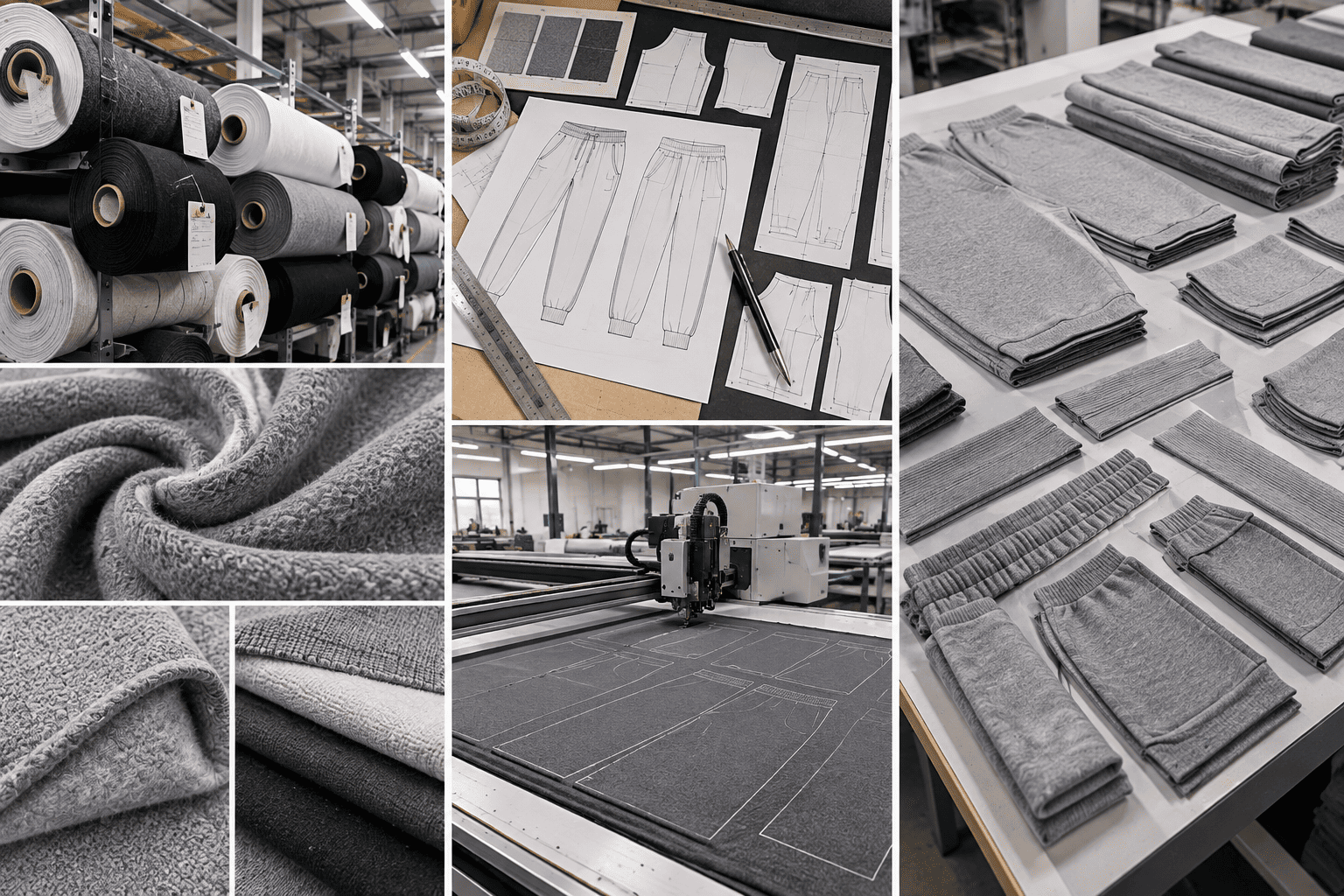
A cut and sew manufacturer builds clothing from fabric rather than starting with an already finished blank. The process normally involves pattern development, fabric sourcing, sampling, cutting individual garment panels, sewing, decoration, finishing, quality control, and packaging. This gives a brand much more control over fabric, fit, measurements, construction, and branding.
I work with both knit and woven garments in Dongguan, and cut-and-sew development is where manufacturing becomes much more than sewing.
The sewing machine is only one part of the process.
Before the first seam is made, somebody has already made decisions about:
- Fabric
- GSM
- Pattern
- Measurements
- Seam allowance
- Shrinkage
- Pocket shape
- Collar
- Hood
- Rib
- Trims
- Artwork
That is why a good cut-and-sew project starts long before bulk production.
Table of Contents
- What Does Cut and Sew Actually Mean?
- How Is Cut and Sew Different From Blank Printing and Private Label?
- What Is the Difference Between CMT, Full-Package, OEM, and ODM?
- What Do You Need to Provide for a Cut and Sew Order?
- How Important Is the Tech Pack?
- How Does Pattern Making Work?
- How Does the Cut and Sew Process Work Step by Step?
- How Does Fabric Choice Affect Cut and Sew Production?
- Why Is Sampling So Important?
- What MOQ Should You Expect From a Cut and Sew Manufacturer?
- What Affects Cut and Sew Manufacturing Cost?
- How Should Artwork, Labels, and Branding Be Prepared?
- What Compliance and IP Issues Should Brands Check?
- How Do You Choose a Good Cut and Sew Manufacturer?
- What Red Flags Should You Watch For?
- Can a Cut and Sew Factory Scale With Your Brand?
- Conclusion
- Footnotes & References
What Does Cut and Sew Actually Mean?
At its simplest, cut and sew means the garment begins as fabric.
The factory takes that fabric, cuts it into the required panels according to a pattern, then assembles those panels into the final garment.
Cut and sew gives the buyer control over the garment itself rather than only the surface decoration.
For example, a blank T-shirt already has:
- A fixed fabric
- A fixed GSM
- A fixed shoulder
- A fixed length
- A fixed collar
- A fixed sleeve
- A fixed fit
You can print something on it.
But you cannot easily turn it into a completely different garment.
With cut and sew, I can develop:
280 GSM 100% cotton
Oversized boxy T-shirt
62 cm chest
60 cm shoulder
Wide sleeve
Heavy 2×2 rib collar
Custom front embroidery
Large back screen print
Custom woven label
The garment is built around that specification.
That is the real value of cut and sew.
How Is Cut and Sew Different From Blank Printing and Private Label?
These terms often get mixed together.
The easiest distinction is to look at where the product starts.
| Production Method | Starting Point | Product Control |
|---|---|---|
| Blank printing | Finished blank garment | Mainly artwork |
| White label | Existing finished product | Branding / limited changes |
| Private label | Can be existing or custom product | Branding + varying customization |
| Cut and sew | Fabric + pattern | Full garment development |
| OEM | Buyer's specification | High customization |
| ODM | Manufacturer's base design | Modified existing development |
Blank Printing
You select an existing T-shirt or hoodie.
Then you add:
- Screen print
- DTG
- DTF
- Embroidery
This is useful for:
- Merch
- Graphic testing
- Very small quantities
- Quick launches
But product control is limited.
Private Label
Private label mainly describes whose brand appears on the finished product.
It does not automatically mean the garment started from a blank.
A private-label product can also be fully cut and sewn.
For example:
Custom 450 GSM hoodie
Developed from your measurements
Custom labels
Your logo
Your packaging
That is both:
cut and sew
and:
private label.
Cut and Sew
Cut and sew describes the manufacturing process.
The product begins with fabric and a pattern.
This is normally the better route when the brand's selling point depends on:
- Unique fit
- Fabric
- Construction
- Weight
- Panel design
- Special pockets
- Original silhouette
What Is the Difference Between CMT, Full-Package, OEM, and ODM?
These describe different ways a factory can work with a brand.
CMT
CMT means:
Cut, Make, Trim.
In a typical CMT project, the buyer provides much of the production input.
That may include:
- Fabric
- Pattern
- Trims
- Specifications
The factory mainly handles:
- Cutting
- Sewing
- Assembly
This is useful for established brands that already manage their own sourcing.
Full-Package Manufacturing
In a full-package project, the manufacturer handles more of the supply chain.
The buyer may provide:
- Design
- Tech pack
- Artwork
- Target specifications
The factory may handle:
- Pattern development
- Fabric sourcing
- Trims
- Sampling
- Printing
- Embroidery
- Cutting
- Sewing
- Labels
- Packaging
- QC
This is often easier for smaller brands because they do not need to manage every supplier independently.
A Note About “FOB Manufacturing”
In apparel sourcing, people sometimes casually call full-package production “FOB production.”
But technically, FOB means Free On Board, an Incoterms® delivery term that defines where delivery and transport risk transfer between seller and buyer.[^1]
So I prefer to separate the two ideas:
Full-package = manufacturing responsibility
FOB = commercial delivery term
They may appear in the same order, but they do not mean the same thing.
OEM
OEM normally starts with the buyer's specification.
For example:
- Original tech pack
- Custom pattern
- Measurements
- Artwork
- Fabric specification
The manufacturer turns that specification into production.
ODM
ODM begins with more existing factory development.
For example, the manufacturer already has:
- A hoodie pattern
- Base construction
- Sample
The buyer changes:
- Fabric
- Fit
- Color
- Logos
- Labels
- Packaging
ODM can reduce development time when the buyer does not need a completely original construction.
What Do You Need to Provide for a Cut and Sew Order?
A cut-and-sew project needs more information than blank printing.
But you do not necessarily need a perfect professional tech pack before talking to a factory.
The minimum starting information is usually a clear product idea, reference images or a physical sample, approximate fabric requirements, target measurements, branding, quantity, and the details you want changed.
A stronger development package may contain:
| Input | Why It Helps |
|---|---|
| Front/back sketch | Shows garment design |
| Tech pack | Centralizes specifications |
| Size chart | Defines fit |
| Sample size | Defines first development size |
| Fabric composition | Narrows sourcing |
| GSM | Defines weight |
| Pantone | Defines color |
| Logo artwork | Supports decoration |
| Logo dimensions | Controls placement |
| Construction notes | Controls sewing |
| Reference sample | Shows real fit and hand feel |
A Physical Reference Sample Can Be Extremely Useful
Sometimes a buyer says:
I want this exact fit, but use heavier fabric and replace all branding.
That physical garment can answer many questions immediately.
I can check:
- Chest
- Shoulder
- Length
- Sleeve
- Armhole
- Fabric
- Stretch
- Stitching
- Rib
- Trims
Then we can develop changes from something real.
How Important Is the Tech Pack?
Very important.
A tech pack gives different departments one production reference.
A useful tech pack may include:
- Technical sketches
- Measurements
- Tolerances
- Fabric
- GSM
- Colors
- Construction
- Artwork
- Logo dimensions
- Trims
- Labels
- Packaging
One Master Version Is Better Than Ten Messages
One of the easiest ways to create a production mistake is to have:
- Tech Pack V2
- Email correction
- WhatsApp correction
- Screenshot
- Voice message
all describing different versions.
I prefer one updated master file.
If a measurement changes from:
Chest 60 cm
to:
Chest 62 cm
the new approved tech pack should become the production reference.
This becomes especially important once:
- Pattern making
- Printing
- Embroidery
- Cutting
- Sewing
are happening in different departments.
How Does Pattern Making Work?
The pattern converts a design into actual garment pieces.
A hoodie may require separate patterns for:
- Front body
- Back body
- Sleeve
- Hood
- Rib
- Facing
Pants may require:
- Front leg
- Back leg
- Waistband
- Pocket bag
- Cuff
Fit Comes From the Pattern
A buyer may write:
Oversized hoodie.
But I still need to know what oversized means.
For example:
- Chest 68 cm?
- Shoulder 65 cm?
- Body length 70 cm?
- Sleeve 59 cm?
Two brands can both call a hoodie oversized and use completely different measurements.
Grading Comes After the Base Size
Usually, one sample size is developed first.
For example:
Size L.
Once that size is approved, the pattern can be graded into:
- S
- M
- L
- XL
The grading rules matter.
Simply adding the same number of centimeters to every measurement does not always create a good size range.
How Does the Cut and Sew Process Work Step by Step?
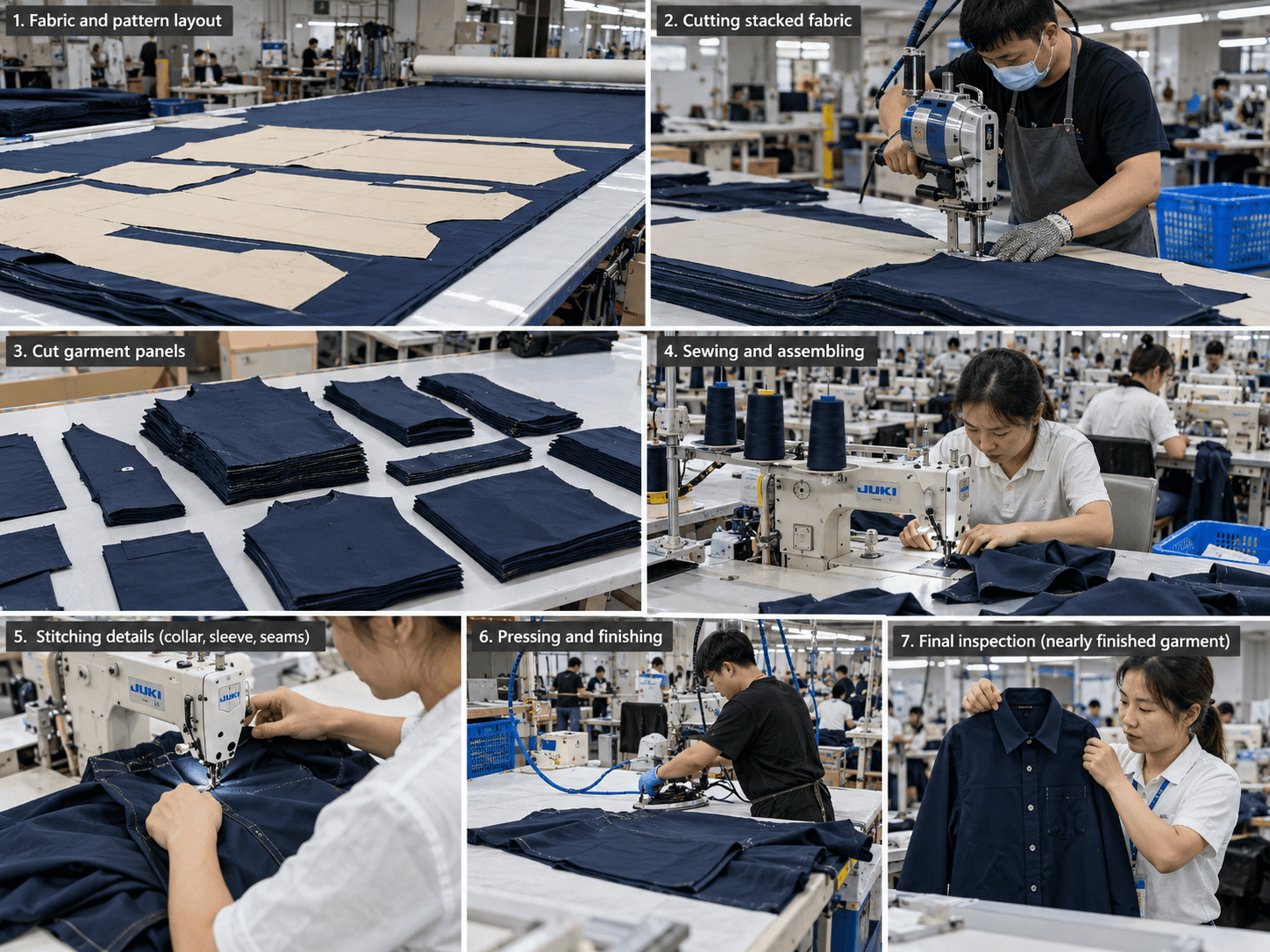
A typical custom project may follow this sequence:
1. Product Brief
The buyer provides:
- Design
- References
- Quantity
- Fabric direction
- Branding
2. Fabric Sourcing
The factory checks:
- Composition
- GSM
- Structure
- Color
- Availability
- MOQ
3. Pattern Development
Measurements are converted into garment patterns.
4. First Sample
A sample is cut and sewn.
The buyer checks:
- Fit
- Measurements
- Fabric
- Details
5. Revision
If something is wrong, we adjust it.
For example:
Shoulder +2 cm
Body length -2 cm
Logo width 28 cm instead of 32 cm
6. Approval Sample / Pre-Production Reference
Once the product is approved, we lock the production version.
7. Bulk Fabric Preparation
Fabric is:
- Purchased
- Knitted if necessary
- Dyed
- Finished
- Inspected
8. Cutting
Fabric is spread and cut according to the approved patterns and markers.
9. Printing / Embroidery
Depending on construction, decoration may happen before or after sewing.
Large panel prints are often easier before assembly.
10. Sewing
Panels become garments.
11. Washing / Finishing
If required:
- Enzyme wash
- Acid wash
- Vintage wash
- Garment dye
may follow.
12. Quality Control
The factory checks:
- Measurements
- Sewing
- Artwork
- Defects
- Labels
- Packing
13. Packing and Shipment
Only after the garment is finished does the logistics stage begin.
How Does Fabric Choice Affect Cut and Sew Production?
Fabric can be one of the biggest factors controlling:
- MOQ
- Price
- Sample speed
- Bulk lead time
Stock Fabric
If the manufacturer already has access to:
400 GSM black cotton fleece
the project can move quickly.
Custom Fabric
If the buyer requires:
470 GSM
Custom loop structure
Custom Pantone olive
Special cotton blend
the fabric mill may need to:
- Prepare yarn
- Knit fabric
- Dye fabric
- Finish fabric
- Check GSM
- Check shrinkage
Now a separate fabric MOQ may apply.
Garment MOQ and Fabric MOQ Are Different
This matters a lot.
A cut-and-sew factory may say:
Hoodie MOQ: 50 pcs.
That does not guarantee a textile mill will custom-knit fabric for only 50 hoodies.
Sometimes the practical solution is to choose a stock fabric close to the original specification.
Color References
For custom textile colors, I prefer standardized physical references.
Pantone's Fashion, Home + Interiors system identifies TCX for soft surfaces such as textiles and apparel.[^2]
For example:
Pantone 19-4006 TCX
is a much clearer production reference than:
Use the black from this phone screenshot.
Why Is Sampling So Important?
The sample is the first time the design becomes a physical product.
A digital drawing cannot tell you:
- How fabric drapes
- Whether the hood is too large
- Whether the sleeve feels short
- Whether a pocket is functional
- Whether embroidery feels too stiff
- Whether the body is too long
That is why I treat sampling as development rather than a formality.
Check More Than Appearance
When reviewing a sample, I recommend checking:
- Chest
- Length
- Shoulder
- Sleeve
- Waist
- Rise
- Collar
- Hood
- Fabric
- Stretch
- Logo size
- Logo position
Wash Testing Can Matter
For cotton and washed products, the sample should sometimes be checked after washing.
A garment that measures correctly before washing but shrinks badly afterward is not properly developed.
Lock the Approved Version
Once approved, record:
- Pattern
- Measurements
- Fabric
- Color
- Artwork
- Trims
- Labels
Then use that as the bulk reference.
Changing fit after hundreds of panels have been cut is much harder than changing the sample.
What MOQ Should You Expect From a Cut and Sew Manufacturer?
Cut-and-sew MOQ depends on product type and material.
For flexible custom manufacturing, practical starting quantities might look like:
| Product | Possible MOQ |
|---|---|
| Hoodie | 50–100 pcs |
| Sweatshirt | 50–100 pcs |
| Joggers | 50–100 pcs |
| Matching set | Around 50 sets |
| T-shirt | Around 100 pcs |
| Shorts | Around 100 pcs |
| Activewear | Often higher |
| Kidswear | Often higher |
These are working ranges.
They are not universal industry rules.
Complexity Matters
Fifty pieces using:
- One color
- Four sizes
- Stock fabric
- Simple embroidery
is very different from:
- Five colors
- Seven sizes
- Custom fabric
- Custom hardware
- Three decorations
MOQ is created by the entire production structure.
What Affects Cut and Sew Manufacturing Cost?
Custom production cost depends on:
- Fabric
- GSM
- Quantity
- Pattern complexity
- Number of panels
- Printing
- Embroidery
- Washing
- Zippers
- Labels
- Packaging
Development Cost
Before bulk production, there may be costs for:
- Pattern making
- Sample sewing
- Embroidery setup
- Printing setup
- Special templates
- Molds
Bulk Cost
Bulk cost then includes:
- Fabric
- Cutting
- Sewing
- Decoration
- Trims
- QC
- Packaging
Small production quantities usually have a higher unit cost because setup work is spread across fewer garments.
Sample Fee Policies Differ
A factory may have a rule such as:
Sample fee can be credited when bulk reaches an agreed quantity.
Another factory may treat sample development as a completely separate service.
Neither is automatically wrong.
What matters is that the condition is clear before payment.
Payment
A common new-customer structure may be:
50% deposit before production
50% balance before shipment
Exact terms should always be confirmed for the actual order.
How Should Artwork, Labels, and Branding Be Prepared?
Cut and sew gives you control over branding, but files still need to be production-ready.
For artwork, useful files include:
- AI
- EPS
- SVG
- Vector PDF
Adobe lists AI, PDF, EPS, and SVG among Illustrator's supported formats.[^3]
A screenshot can show me the design concept.
It may not be suitable as the actual print or embroidery production file.
Logo Dimensions Matter
Do not write:
Large back print.
Write:
32 cm wide
Centered
6 cm below neckline
That removes interpretation.
Labels
Common private-label components include:
- Woven neck label
- Size label
- Care label
- Hangtag
- Packaging
If the product will be sold in the United States, the FTC states that covered textile products generally need fiber content, country of origin, and identification of the manufacturer or responsible marketer.[^4]
The FTC Care Labeling Rule also requires manufacturers and importers of covered textile apparel to provide appropriate care instructions.[^5]
That is why I like to know the target market before producing final labels.
What Compliance and IP Issues Should Brands Check?
A custom manufacturing project often includes confidential or valuable brand information.
That may include:
- Logo
- Artwork
- Tech pack
- Measurements
- Original construction
- Packaging
Trademark and Brand Ownership
A professional factory should be careful when somebody asks it to reproduce third-party trademarks without authorization.
WIPO explains that trademarks can be protected through national or regional registration systems, with international filing also available through the Madrid System.[^6]
For a legitimate brand, clear ownership or authorization protects everyone involved.
SMETA
Compliance terminology also needs to be accurate.
Sedex describes SMETA as a social audit methodology covering areas including:
- Labour standards
- Health and safety
- Environmental performance
- Business ethics
Sedex also explicitly states that SMETA is a continuous-improvement methodology rather than a certification.[^7]
So I would not describe SMETA as a product certificate.
OEKO-TEX STANDARD 100
OEKO-TEX® STANDARD 100 serves a different purpose.
OEKO-TEX describes it as a label for textiles tested for harmful substances, covering components from yarn to finished articles.[^8]
A social factory audit and textile safety certification answer different questions.
Buyers should always ask:
- What does the document cover?
- Which production site?
- Which product or material?
- Is it currently valid?
How Do You Choose a Good Cut and Sew Manufacturer?
A true cut-and-sew partner needs more than sewing machines.
The factory should understand development.
I would check these areas:
| Area | What to Check |
|---|---|
| Pattern | Can they draft and modify patterns? |
| Sampling | Do they have development capability? |
| Fabric | Can they explain stock vs custom? |
| Specialty | Do they regularly make your product? |
| Decoration | Can they coordinate print and embroidery? |
| QC | How are measurements controlled? |
| Communication | Are answers specific? |
| Compliance | Can documents be verified? |
| Scaling | Can they repeat the approved style? |
Ask About Pattern Development
If you provide only a reference garment, can the factory:
- Measure it?
- Draft a pattern?
- Modify the fit?
- Grade sizes?
That is real development capability.
Ask About Sampling
A manufacturer should be able to explain:
- Sample cost
- Sample size
- Sample timeline
- Revision process
Ask What They Make Regularly
If you want:
500 GSM streetwear hoodies
I prefer a factory already working with heavyweight knits.
If you want:
Stretch compression leggings
I prefer a factory experienced with activewear.
Specialty matters.
What Red Flags Should You Watch For?
Several things make me cautious.
“We Do Cut and Sew” But Only Show Blank Printing
Look for actual:
- Patterns
- Cutting
- Sewing
- Sample development
not only finished blanks with logos.
No Pattern Capability
Some factories only sew patterns supplied by the customer.
That can be fine for CMT.
But it is not the same as full product development.
Firm Price Before Specifications
If the supplier does not know:
- Fabric
- GSM
- Quantity
- Decoration
a final quotation is difficult to justify.
No Sample Recommended
For a completely original garment, skipping development is risky.
Says Yes to Everything
A useful manufacturer sometimes says:
That fabric will increase MOQ.
or:
This construction needs another sample.
Technical honesty is more valuable than automatic agreement.
Can a Cut and Sew Factory Scale With Your Brand?
The first order may be:
50 hoodies.
Later it may become:
500 hoodies.
Then:
2,000 hoodies.
Scaling only works if the product is properly recorded.
Keep:
- Approved sample
- Pattern
- Grading
- Size chart
- Fabric specification
- Pantone
- Artwork
- Labels
- Trim details
Repeatability Matters More Than One Perfect Sample
A factory can sometimes make one beautiful sample by hand.
The real test is whether it can reproduce that result across bulk production.
That means controlling:
- Fabric
- Cutting
- Measurements
- Sewing
- Artwork
- Washing
- QC
This is why I think the best cut-and-sew factory is not only the one that can develop the first garment.
It is the one that can reproduce the same garment after the brand starts selling.
Conclusion
Cut and sew is what you need when the product itself—not only the logo—needs to be customized.
The process begins with:
- Fabric
- Pattern
- Measurements
- Construction
Then moves through:
- Sampling
- Cutting
- Decoration
- Sewing
- Finishing
- QC
For a startup, the biggest mistake is often trying to rush directly to production.
I would rather spend more time getting:
- The pattern right
- The fabric right
- The measurements right
- The sample right
before cutting the bulk order.
If you only remember one thing, remember this:
Cut and sew is not mainly about sewing. It is about controlling the product before sewing begins.
The quality of the final garment depends on decisions made much earlier:
- Which fabric?
- What GSM?
- Which pattern?
- Which measurements?
- Which trims?
- Which artwork?
- Which approved version?
That is why I would choose a cut-and-sew manufacturer based on development capability, not only production capacity.
Ask whether they can:
- Develop patterns
- Source appropriate fabric
- Make and revise samples
- Control measurements
- Coordinate decoration
- Keep one approved production standard
- Scale the style later
If the factory can do those things well, then your original sketch can become more than a one-time sample.
It can become a repeatable product your brand can continue producing as it grows.
Footnotes & References
[^1]: International Chamber of Commerce — Incoterms® 2020, FOB (Free On Board). ICC defines FOB as a delivery term for sea or inland waterway transport in which delivery and risk transfer when the goods are placed on board the nominated vessel.
https://library.iccwbo.org/content/tfb/BOOKS/BK_0049/BK_0049_05_RulesSea.htm
[^2]: Pantone — Fashion, Home + Interiors (FHI). Official Pantone information explaining that TCX is used for soft surfaces such as textiles and apparel.
https://www.pantone.com/na/en-us/fashion-home-interiors
[^3]: Adobe — Supported File Formats in Illustrator. Official Adobe documentation covering production artwork formats including AI, PDF, EPS, and SVG.
https://helpx.adobe.com/illustrator/desktop/get-started/learn-the-basics/supported-file-formats.html
[^4]: U.S. Federal Trade Commission — Apparel and Labeling. FTC guidance explaining fiber-content, country-of-origin, and responsible-business labeling requirements for covered textile products.
https://www.ftc.gov/news-events/topics/tools-consumers/apparel-labeling
[^5]: U.S. Federal Trade Commission — Care Labeling Rule. Official rules requiring manufacturers and importers of covered textile wearing apparel to provide appropriate regular-care instructions.
https://www.ftc.gov/legal-library/browse/rules/care-labeling-textile-wearing-apparel-certain-piece-goods
[^6]: World Intellectual Property Organization (WIPO) — Trademarks. Official information explaining national, regional, and international approaches to trademark protection and registration.
https://www.wipo.int/en/web/trademarks
[^7]: Sedex — SMETA Audit. Official Sedex information describing SMETA as a social-audit and continuous-improvement methodology rather than a certification.
https://www.sedex.com/solutions/smeta-audit/
[^8]: OEKO-TEX® — STANDARD 100. Official information describing STANDARD 100 as certification for textiles and textile components tested for harmful substances.
https://www.oeko-tex.com/en/our-standards/oeko-tex-standard-100