Private Label Clothing Manufacturer: How Do You Launch Your Own Brand?
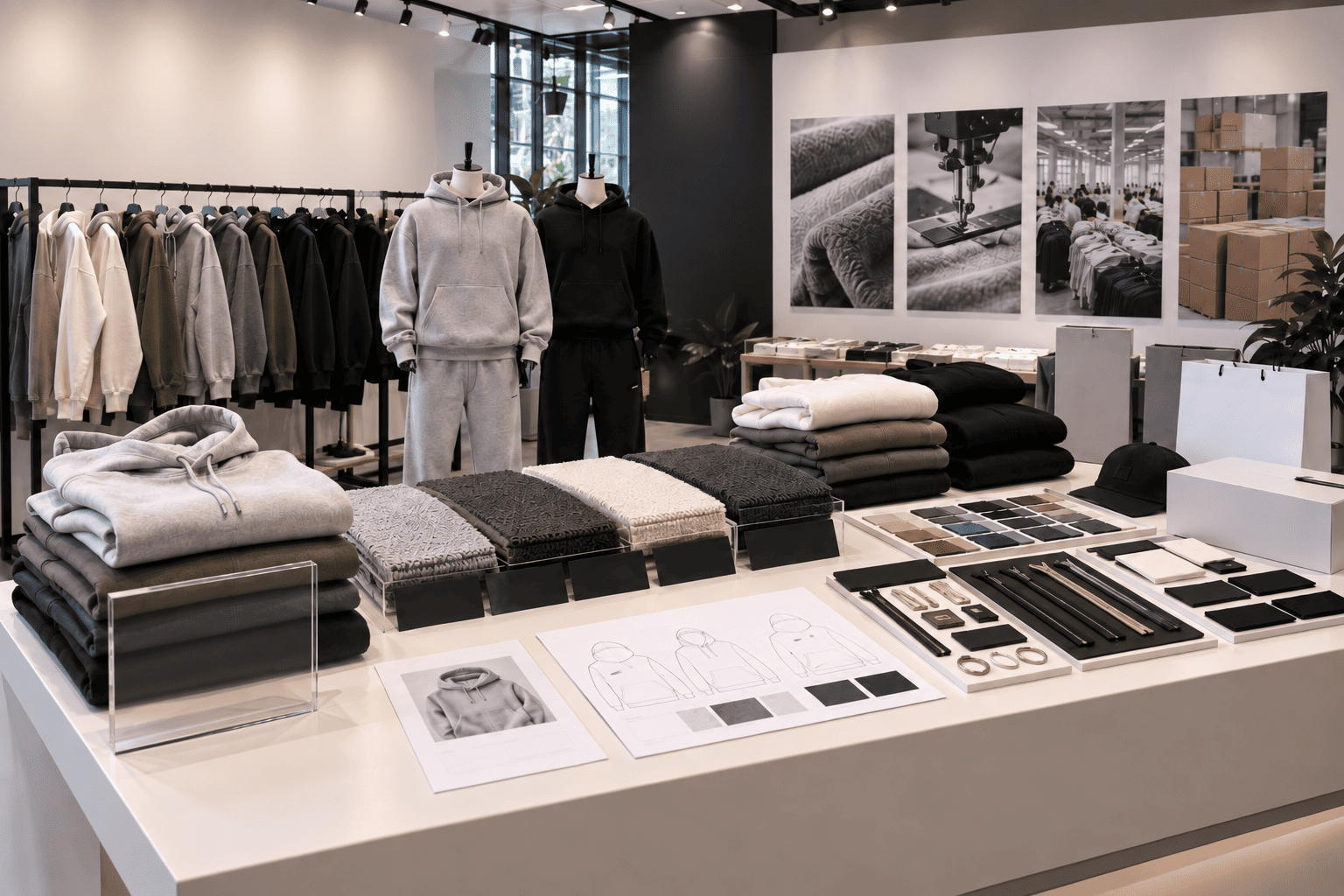
You do not want to sell someone else's blank with a sticker on it.
You want customers to open the package and see your brand, your labels, your fit, your fabric, and your design.
The difficult part is figuring out how to turn that idea into an actual garment.
A private label clothing manufacturer produces garments that are sold under your brand rather than the factory's brand. Depending on the manufacturing model, you may customize fabric, fit, measurements, colors, printing, embroidery, labels, trims, and packaging, or begin with an existing ODM style and modify it for your brand.
I work with buyers who are building new clothing brands, and one thing I notice is that many founders focus on the logo first.
The logo matters.
But a real private label product is much more than a logo.
The product itself has to feel like your brand.
That starts with the garment.
Table of Contents
- What Is a Private Label Clothing Manufacturer?
- What Is the Difference Between Private Label, White Label, OEM, and ODM?
- What Can You Customize on Private Label Clothing?
- What Private Label Branding Can Be Added to a Garment?
- How Do You Start a Private Label Clothing Line?
- What Should You Send a Private Label Manufacturer?
- What MOQ Should a Startup Expect?
- How Much Does Private Label Clothing Production Cost?
- Why Should You Make a Sample Before Bulk Production?
- How Should a Clothing Brand Protect Its Logo and Designs?
- What Compliance and Certification Documents Should You Check?
- How Do You Choose a Private Label Manufacturer You Can Trust?
- What Red Flags Should Startup Clothing Brands Watch For?
- Can a Private Label Manufacturer Grow With Your Brand?
- Conclusion
- Footnotes & References
What Is a Private Label Clothing Manufacturer?
The term “private label” is used in different ways across the apparel industry.
At its simplest, it means the product is sold under your brand, not the manufacturer's brand.
A private label clothing manufacturer helps produce garments that carry the buyer's branding. Depending on the project, the brand may start from an existing factory style or develop a completely custom product. The finished garment can include custom fabric, measurements, logos, labels, hangtags, packaging, and other brand-specific details.
For example, a buyer may come to me with:
I want an oversized heavyweight hoodie for my new streetwear brand.
From there, we may discuss:
- 100% cotton or cotton/polyester
- French terry or fleece
- 400 GSM or 500 GSM
- Oversized measurements
- Hood shape
- Pocket design
- Embroidery
- Back print
- Woven neck label
- Care label
- Hangtag
- Packaging
By the time those decisions are finished, the garment is no longer simply “a hoodie.”
It is a product built around that brand.
What Is the Difference Between Private Label, White Label, OEM, and ODM?
These terms are often mixed together.
They overlap, but they do not describe exactly the same thing.
Private label mainly describes whose brand the product is sold under. OEM and ODM describe how the product is developed and manufactured. White label usually refers to a more standardized existing product that multiple sellers can brand as their own.
A simple comparison looks like this:
| Model | Starting Point | Customization Level | Final Brand |
|---|---|---|---|
| White label | Existing standard product | Low | Buyer's brand |
| Private label | Existing or custom product | Medium to high | Buyer's brand |
| OEM | Buyer's design / tech pack | High | Buyer's brand |
| ODM | Factory's existing design base | Medium | Buyer's brand |
| Wholesale | Existing finished product | Usually none | Existing brand |
Private Label + ODM
Imagine I already have an oversized hoodie pattern.
The buyer likes:
- Fit
- Hood
- Construction
But changes:
- Fabric
- Color
- Logo
- Labels
- Packaging
That is a very practical private-label ODM project.
Private Label + OEM
Now imagine the buyer sends:
- Full tech pack
- Custom measurements
- Original pattern details
- Special pockets
- Custom artwork
- Custom trims
The factory develops the garment according to those specifications.
That is much closer to OEM.
For a startup, neither method is automatically better.
ODM can reduce development time.
OEM gives more design control.
The right choice depends on how unique the product needs to be.
What Can You Customize on Private Label Clothing?
Private label clothing can go far beyond changing a neck label.
Depending on the factory and MOQ, buyers may customize:
- Fabric composition
- GSM
- Fabric structure
- Color
- Garment wash
- Fit
- Measurements
- Sleeves
- Pockets
- Hood construction
- Waistbands
- Printing
- Embroidery
- Zippers
- Drawcords
- Rib
- Labels
- Hangtags
- Packaging
Fabric
For example, a hoodie could use:
100% cotton
450 GSM French terry
Black
Enzyme washed
while another hoodie might use:
80% cotton / 20% polyester
500 GSM brushed fleece
Vintage charcoal wash
Those two garments may use almost the same pattern but feel completely different.
Fit
Fit can also be customized.
Options may include:
- Regular
- Oversized
- Boxy
- Cropped
- Drop shoulder
- Slim
- Relaxed
A brand that wants a specific silhouette should provide actual garment measurements rather than simply writing:
Oversized.
Decoration
Common options include:
- Screen printing
- DTG
- DTF
- Standard embroidery
- Puff print
- Appliqué
- Chenille embroidery
- Towel embroidery
- Rhinestones
- Silicone
- Reflective transfer
- Patches
The technique should match the fabric and the design.
A lightweight sports top and a 500 GSM streetwear hoodie should not automatically use the same decoration method.
What Private Label Branding Can Be Added to a Garment?
This is where a private label product begins to feel complete.
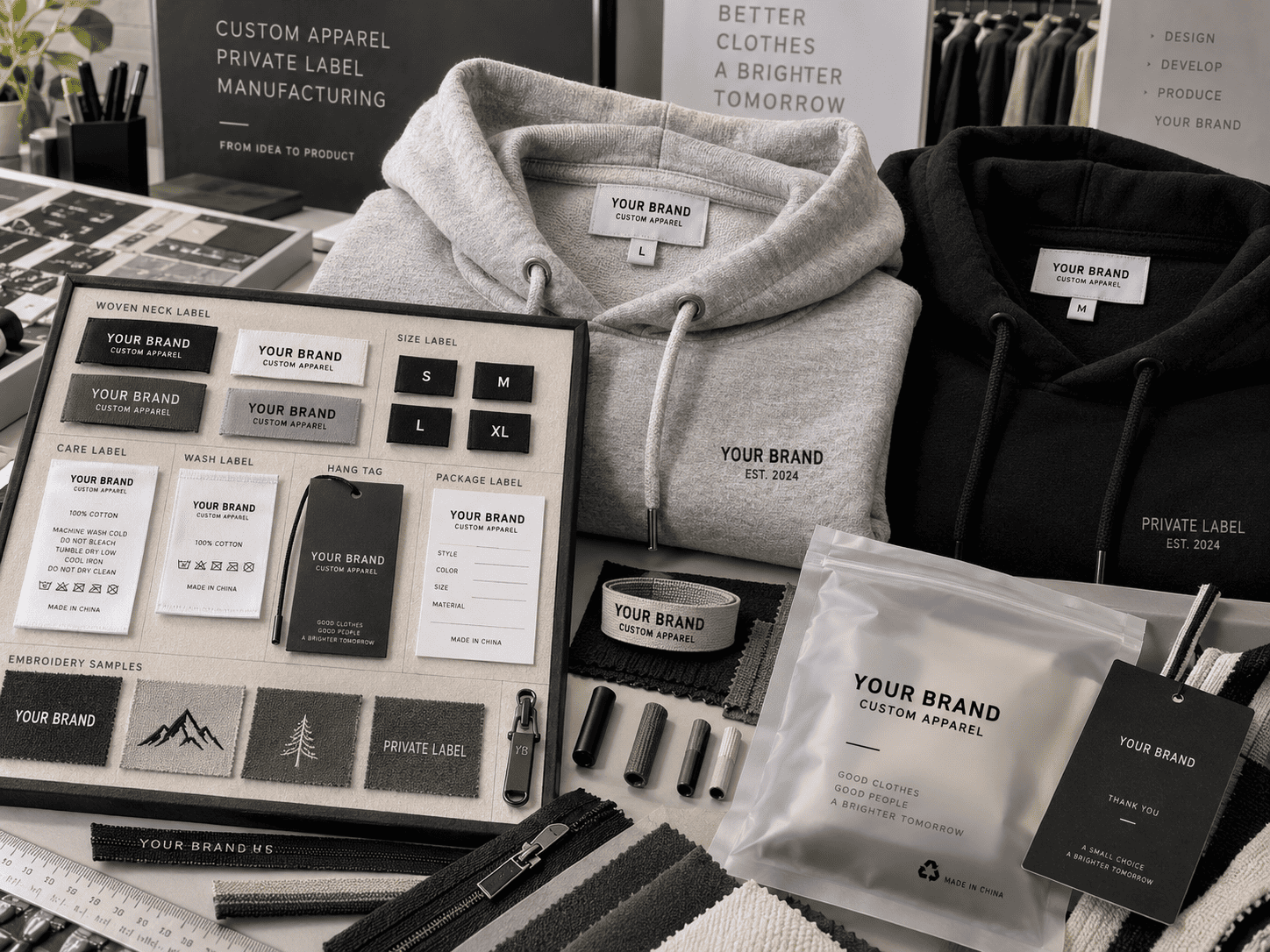
Private label branding can include woven neck labels, printed labels, heat-transfer labels, size labels, care labels, hangtags, zipper bags, polybags, stickers, boxes, and branded garment details.
A typical branding package might include:
| Branding Element | Example |
|---|---|
| Neck label | Woven logo label |
| Size label | XS–XXL |
| Care label | Fiber + washing information |
| Hangtag | Logo + website + product information |
| Polybag | Standard or custom logo |
| Sticker | Logo / barcode |
| Packaging | Zipper bag or box |
Care Labels Are Not Only Branding
This is especially important.
A founder may think the care label is simply another place to put a logo.
It is also part of product compliance.
For products sold in the United States, the U.S. Federal Trade Commission explains that most covered textile products need labeling identifying information such as fiber content, country of origin, and the manufacturer or another responsible business.[^1]
The FTC's Care Labeling Rule also requires manufacturers and importers of covered textile apparel to provide appropriate care instructions.[^2]
That means I prefer knowing the target market before the final label artwork is produced.
A beautiful care label with incorrect information still needs to be remade.
How Do You Start a Private Label Clothing Line?
Founders sometimes make this process more complicated than it needs to be.
I prefer to break it into a controlled sequence.
To start a private label clothing line, choose a focused product, define your specifications, find a manufacturer that specializes in the category, develop and approve a sample, finalize branding, then move into bulk production.
Step 1: Choose the First Product
Do not start with ten categories unless you have the budget and team to manage them.
A startup might begin with:
- One heavyweight hoodie
- One T-shirt
- One matching set
That is enough to test:
- Product
- Price
- Fit
- Customers
- Factory
Step 2: Define the Product
At minimum, decide:
- Product type
- Fabric
- Approximate GSM
- Fit
- Color
- Size range
- Decoration
- Quantity
The more clearly you define the product, the more useful factory quotations become.
Step 3: Choose the Right Factory
Match the product to the supplier.
If you want heavyweight streetwear, look for a manufacturer experienced with:
- Hoodies
- Sweatshirts
- Heavyweight T-shirts
- Joggers
- Knit sets
If you want performance activewear, the supplier should understand:
- Stretch fabrics
- Compression
- Heat transfer
- Mesh
- Flatlock or technical stitching
- Functional trims
Step 4: Develop the Sample
This is where you check:
- Fit
- Fabric
- Measurements
- Logo
- Decoration
- Construction
- Labels
- Trims
Do not rush this stage.
Step 5: Lock Branding and Bulk Specifications
After the product is approved, confirm:
- Final tech pack
- Final measurements
- Final artwork
- Labels
- Hangtags
- Packaging
- Size breakdown
- Quantity
Then bulk production can begin from one approved reference.
What Should You Send a Private Label Manufacturer?
A factory cannot give an accurate quotation from:
How much for this hoodie?
with one Instagram screenshot.
A useful private-label inquiry should include product type, quantity, fabric, GSM, size range, sample size, colors, logo artwork, decoration technique, labels, packaging, target market, and shipping destination.
A good inquiry may look like this:
| Item | Requirement |
|---|---|
| Product | Oversized hoodie |
| Quantity | 100 pcs |
| Fabric | 100% cotton French terry |
| GSM | 450 GSM |
| Color | Black |
| Sizes | S–XL |
| Sample size | L |
| Front logo | 8 cm embroidery |
| Back logo | 32 cm screen print |
| Neck label | Custom woven |
| Care label | Custom |
| Packaging | Individual polybag |
| Target market | United States |
Now I can check:
- MOQ
- Fabric availability
- Sample price
- Bulk price
- Sample time
- Production time
Send Proper Artwork
For logos and printed branding, I prefer original artwork files.
Useful formats include:
- AI
- EPS
- SVG
- Vector PDF
Adobe's official Illustrator documentation confirms support for formats including AI, PDF, EPS, and SVG.[^3]
A high-resolution PNG can sometimes work for digital printing.
A screenshot copied from social media is much less useful.
Good artwork helps reduce unnecessary redrawing and sampling delays.
What MOQ Should a Startup Expect?
There is no universal private label MOQ.
It changes by product and supply chain.
For flexible private label clothing production, a practical starting range may be around 50–100 pieces for selected styles, while some categories require higher quantities because of fabric, sizing, trims, or construction.
A practical example might look like:
| Product | Possible MOQ |
|---|---|
| Pullover hoodie | 50–100 pcs |
| Sweatshirt | 50–100 pcs |
| Zip hoodie | 50–100 pcs |
| Tracksuit / set | Around 50 sets |
| Joggers | 50–100 pcs |
| T-shirt | Around 100 pcs |
| Shorts | Around 100 pcs |
| Activewear | 100–200 pcs |
| More complex categories | Project dependent |
These are not universal industry rules.
A different manufacturer may have different numbers.
The Fabric MOQ Can Be Higher Than the Garment MOQ
This is what startups often miss.
The sewing factory may accept 50 garments.
But if the buyer requires a custom fabric, the mill may want much more material.
For example:
Stock 400 GSM black fleece
may support a small order.
But:
Custom-knitted 467 GSM cotton fleece in Pantone color
may require:
- Yarn preparation
- Knitting
- Dyeing
- Finishing
- Minimum fabric quantity
The real MOQ comes from the whole supply chain.
How Much Does Private Label Clothing Production Cost?
There is no useful universal unit price.
A quotation depends on:
- Fabric
- GSM
- Quantity
- Construction
- Printing
- Embroidery
- Washing
- Labels
- Zippers
- Trims
- Packaging
A startup should think about total development and production cost rather than only the garment unit price. The first order may include a sample fee, sample shipping, bulk deposit, setup charges, accessories, packaging, bulk freight, and import costs.
Sample Cost
A one-piece custom sample may require:
- Pattern making
- Fabric sourcing
- Cutting
- Sewing
- Print setup
- Embroidery digitizing
- Trim development
- QC
That is why a sample can cost much more per piece than bulk production.
Bulk Payment
A typical new-customer structure may be:
50% deposit before production
50% balance before shipment
Exact payment terms should always be confirmed with the supplier before production.
Labels and Packaging Have Their Own Minimums
For example:
- Garment order: 50 pcs
- Woven label supplier: 100 pcs minimum
- Hangtag supplier: 500 pcs minimum
- Custom packaging: separate MOQ
That does not mean the buyer needs to order 500 garments.
Unused branded accessories can sometimes be saved for a future production run.
Why Should You Make a Sample Before Bulk Production?
I would not recommend approving a completely new custom garment from digital mockups alone.
A physical sample lets the brand verify fit, measurements, fabric hand feel, garment weight, logo size, decoration quality, construction, trims, and overall appearance before those details are repeated across the bulk order.
A photo cannot fully tell you:
- How the fabric feels
- Whether the hood sits correctly
- Whether the sleeve is too long
- How heavy the garment feels
- Whether the embroidery is too stiff
- Whether the rib tension is right
Sampling also tells you something about the factory.
How does it handle corrections?
How clearly does it communicate?
How quickly does it solve problems?
For a new brand, the first sample tests both:
the garment
and:
the supplier.
How Should a Clothing Brand Protect Its Logo and Designs?
Private label production means you are giving a supplier valuable brand assets.
That deserves some attention.
A clothing brand should keep clear records of its original artwork and specifications, control who receives production files, use written agreements where appropriate, and consider trademark protection for important brand names and logos in relevant markets.
The World Intellectual Property Organization explains that trademarks are generally protected through registration with national or regional IP offices, although rights can also arise through use in some jurisdictions.[^4]
A manufacturer also needs to respect third-party rights.
If a buyer sends me another brand's logo and asks:
Can you copy this exactly?
that creates a different situation from producing the buyer's own original artwork.
For licensed or co-branded products, factories may need authorization before production.
This protects:
- The brand
- The factory
- The legitimate trademark owner
A good manufacturer should not see intellectual-property discipline as an inconvenience.
It is part of professional private-label production.
What Compliance and Certification Documents Should You Check?
This is another area where startup brands often see many logos but do not know what they mean.
Different documents cover different issues.
They are not interchangeable.
SMETA Is a Social Audit Methodology
Sedex explains that SMETA[^5] is a social-audit methodology covering topics including labor standards, health and safety, environmental performance, and business ethics.
Sedex specifically describes SMETA as a continuous-improvement methodology rather than a certification.
So I would not say:
We have a Sedex product certificate.
That is not the right description.
I would ask for the relevant audit information and confirm which production site it covers.
OEKO-TEX STANDARD 100 Has a Different Purpose
OEKO-TEX® STANDARD 100[^6] relates to testing textile products and their components for harmful substances.
That answers a different question from a social audit.
Organic Claims Require Separate Attention
If a brand wants to market an item as organic or use a certification mark, it needs to understand the applicable certified supply chain rather than simply buying “organic cotton.”
GOTS provides requirements for certified organic textile processing and related supply-chain controls.[^7]
This is why I recommend that startups ask:
- What exactly is certified?
- Which factory or mill does the document cover?
- Is it currently valid?
- Does it apply to this material or product?
- What claim can I put on my final garment?
Do not choose a manufacturer because its website has the largest collection of certification logos.
Ask for evidence relevant to your actual order.
How Do You Choose a Private Label Manufacturer You Can Trust?
Trust is not created by one nice sample photo.
I look for a combination of signals.
A reliable private label clothing manufacturer should have relevant product experience, transparent MOQ and sample policies, clear communication, traceable production information, quality-control procedures, appropriate compliance documentation, and the ability to repeat an approved sample during bulk production.
Product Specialty
Ask:
What do you manufacture every day?
A knitwear factory should be able to show:
- Hoodies
- T-shirts
- Sweatshirts
- Joggers
- Knit sets
A specialist factory usually understands the product's common problems before they happen.
Real Production Evidence
Ask to see:
- Cutting
- Sample room
- Sewing
- Printing
- Embroidery
- QC
- Finished goods
A website can be beautiful.
Production ability has to exist behind it.
Clear Answers
A useful factory will ask you questions.
For example:
What GSM?
What composition?
Sample size?
How many colors?
What logo dimensions?
Where is the product being sold?
The supplier should not be afraid to say:
This is possible, but it will increase MOQ.
or:
This process may not work well on that fabric.
I trust that more than automatic agreement.
What Red Flags Should Startup Clothing Brands Watch For?
Several things make me cautious.
“We Make Everything”
No factory is equally strong at every category.
A factory that specializes in knitted casualwear may not be the right choice for tailored suits.
Final Price From One Photo
If the supplier does not know:
- Fabric
- GSM
- Quantity
- Printing
- Labels
- Packaging
the price is still an estimate.
No Sample Recommended
For a completely custom product, moving directly into bulk is risky.
Certification Logos With No Documents
Ask for evidence.
No Questions About Your Target Market
Labels and requirements can change depending on where the product is being sold.
Copies Other Brands Without Concern
If a factory is willing to reproduce another brand's protected logo casually, ask yourself how seriously it will protect your designs later.
Can a Private Label Manufacturer Grow With Your Brand?
A startup may begin with:
50 hoodies.
If the product succeeds, the next order might be:
300 hoodies.
Then:
1,000 pieces.
A good production partner should be able to scale without losing the product.
That means reproducing:
- Fabric
- Color
- Fit
- Measurements
- Printing
- Embroidery
- Labels
- Packaging
Keep Approved Production Records
Once a style works, keep:
- Approved sample
- Pattern
- Size chart
- Tech pack
- Artwork
- Pantone references
- Trim specifications
- Label files
This makes repeat orders much easier.
Do Not Change Successful Details Without a Reason
If customers like the fit, do not automatically redesign it.
If the fabric works, keep it.
If the logo placement works, record it.
Use customer feedback to improve specific problems instead of starting from zero each season.
That is how a product becomes repeatable.
And repeatable products are much easier to scale.
Conclusion
Launching a private label clothing brand is not simply a matter of putting your logo on a garment.
A real brand is built through dozens of connected decisions:
- Fabric
- GSM
- Fit
- Measurements
- Construction
- Colors
- Printing
- Embroidery
- Labels
- Trims
- Packaging
- Quality control
For a startup, I recommend keeping the first collection focused.
Start with one or two products.
Find a manufacturer that already understands those products.
Develop a real physical sample.
Correct the fit.
Confirm the fabric.
Lock the artwork.
Then finalize the labels and packaging before bulk production.
Also understand what type of manufacturing relationship you are using.
If you want to customize an existing factory style, ODM may be efficient.
If you have your own technical design and specifications, OEM may give you more control.
Both can still become private label products because the final garment is sold under your brand.
And do not judge a manufacturer only by:
Lowest price.
or:
Lowest MOQ.
Look at whether the factory can answer more important questions:
- Can it actually make your product?
- Can it source the correct fabric?
- Can it communicate clearly?
- Can it protect your artwork?
- Can it support your labels and target market?
- Can it reproduce the approved sample?
- Can it scale when the brand grows?
The right private label manufacturer does more than sew your name into a garment.
It helps turn a design into a product that customers can recognize, reorder, and eventually associate with your brand rather than the factory that made it.
Footnotes & References
[^1]: U.S. Federal Trade Commission — Apparel and Labeling. Official FTC guidance explaining labeling requirements for most textile and wool products, including fiber content, country of origin, and identification of the manufacturer or responsible marketer.
https://www.ftc.gov/news-events/topics/tools-consumers/apparel-labeling
[^2]: U.S. Federal Trade Commission — Care Labeling Rule. Official U.S. requirements covering regular care instructions for textile wearing apparel and certain textile goods.
https://www.ftc.gov/legal-library/browse/rules/care-labeling-textile-wearing-apparel-certain-piece-goods
[^3]: Adobe — Supported File Formats in Illustrator. Official Adobe documentation covering AI, PDF, EPS, SVG, and other artwork formats used in design and production workflows.
https://helpx.adobe.com/illustrator/desktop/get-started/learn-the-basics/supported-file-formats.html
[^4]: World Intellectual Property Organization (WIPO) — How to Protect a Trademark. Official WIPO guidance explaining trademark protection, registration, distinctiveness, and the role of national or regional intellectual-property offices.
https://www.wipo.int/en/web/trademarks/protection
[^5]: Sedex — SMETA Audit. Official Sedex information describing SMETA as a social-audit and continuous-improvement methodology rather than a certification.
https://www.sedex.com/solutions/smeta-audit/
[^6]: OEKO-TEX® — STANDARD 100. Official information about testing and certification of textiles and textile components for harmful substances.
https://www.oeko-tex.com/en/our-standards/oeko-tex-standard-100
[^7]: Global Organic Textile Standard (GOTS) — GOTS Standard. Official GOTS resources covering requirements for certified organic textile processing and certified supply-chain controls.
https://global-standard.org/