You have a design, some savings, and a launch date.
Then you hit a wall.
There are thousands of clothing suppliers to choose from, but one wrong manufacturing partner can turn your first collection into months of delays, unexpected costs, and inventory you cannot sell.
The best clothing manufacturers for startups usually combine realistic low MOQs, proper sampling before bulk production, OEM or private-label capability, clear pricing, and strong communication. Just as important, the factory should already specialize in the type of product you want to make instead of treating it as an occasional side project.
I have spent more than 20 years inside garment manufacturing. Most startup founders I speak with ask the same questions before placing their first real order:
- What MOQ can I actually get?
- How much will the sample cost?
- Can the factory make my design?
- Should I manufacture locally or overseas?
- What certificates should I check?
- How much money do I need before production starts?
- Can the factory still support me if the brand grows?
Those are the questions I will answer here from the factory side.
Table of Contents
- Why Is It So Hard for Startups to Find a Clothing Manufacturer?
- What Should a Startup Look for in a Clothing Manufacturer?
- What MOQ Can a Startup Actually Get?
- Why Does Factory Specialty Matter So Much?
- Why Should Startups Always Make a Sample First?
- Domestic or Overseas: Which Is Better for a Startup?
- What Certifications and Audits Should a Startup Check?
- What Does It Really Cost to Start With a Manufacturer?
- What Information Should You Send Before Asking for a Quote?
- What Red Flags Should Startup Brands Watch For?
- Can the Same Factory Grow With Your Brand?
- Conclusion
- Footnotes & References
Why Is It So Hard for Startups to Find a Clothing Manufacturer?
You send twenty inquiries.
Five reply.
Two stop answering after the first question.
Another supplier sends a price without asking what fabric you need.
The problem is not that there are no clothing manufacturers.
The problem is matching your stage of business with the right type of factory.
Startups often struggle because many garment factories are built around repeat volume rather than first orders. A new brand may need only 50–100 pieces, while a factory's production system is designed around hundreds or thousands of pieces per style.
That mismatch creates most of the frustration.
The Three Walls Startups Usually Hit
The first wall is MOQ.
Some large-volume factories may want 500, 1,000, or several thousand pieces per style.
That number is not always arbitrary.
A factory has setup costs for:
- Pattern making
- Fabric sourcing
- Cutting
- Printing
- Embroidery
- Sewing-line preparation
- Quality control
- Packaging
Many of those costs still exist whether the factory makes 50 garments or 500.
The second wall is sampling.
Some factories are very efficient at repeating existing high-volume products but are not structured for frequent development work.
A startup normally needs more communication and more revisions.
The third wall is product mismatch.
A factory may be excellent at woven shirts but weak at heavyweight streetwear.
Another may be great at basic T-shirts but have little experience with technical activewear.
| Startup Problem | Why It Happens | What to Look For |
|---|---|---|
| High MOQ | Factory is optimized for volume | Product-specific MOQ tiers |
| Slow samples | Development gets low priority | Dedicated sample room and clear timeline |
| Weak product result | Wrong factory specialty | Factory already making similar products |
| Unclear pricing | Specifications are incomplete | Quote based on confirmed specs |
| Poor communication | Startup needs more support | Fast, technically useful responses |
I think founders should stop asking only:
Are you a manufacturer?
and start asking:
Do you regularly manufacture my type of product at my order quantity?
That is a much more useful question.
What Should a Startup Look for in a Clothing Manufacturer?
A cheap quotation means very little if the factory cannot actually produce the product correctly.
Before I send money to a new supplier, I would look at several things.
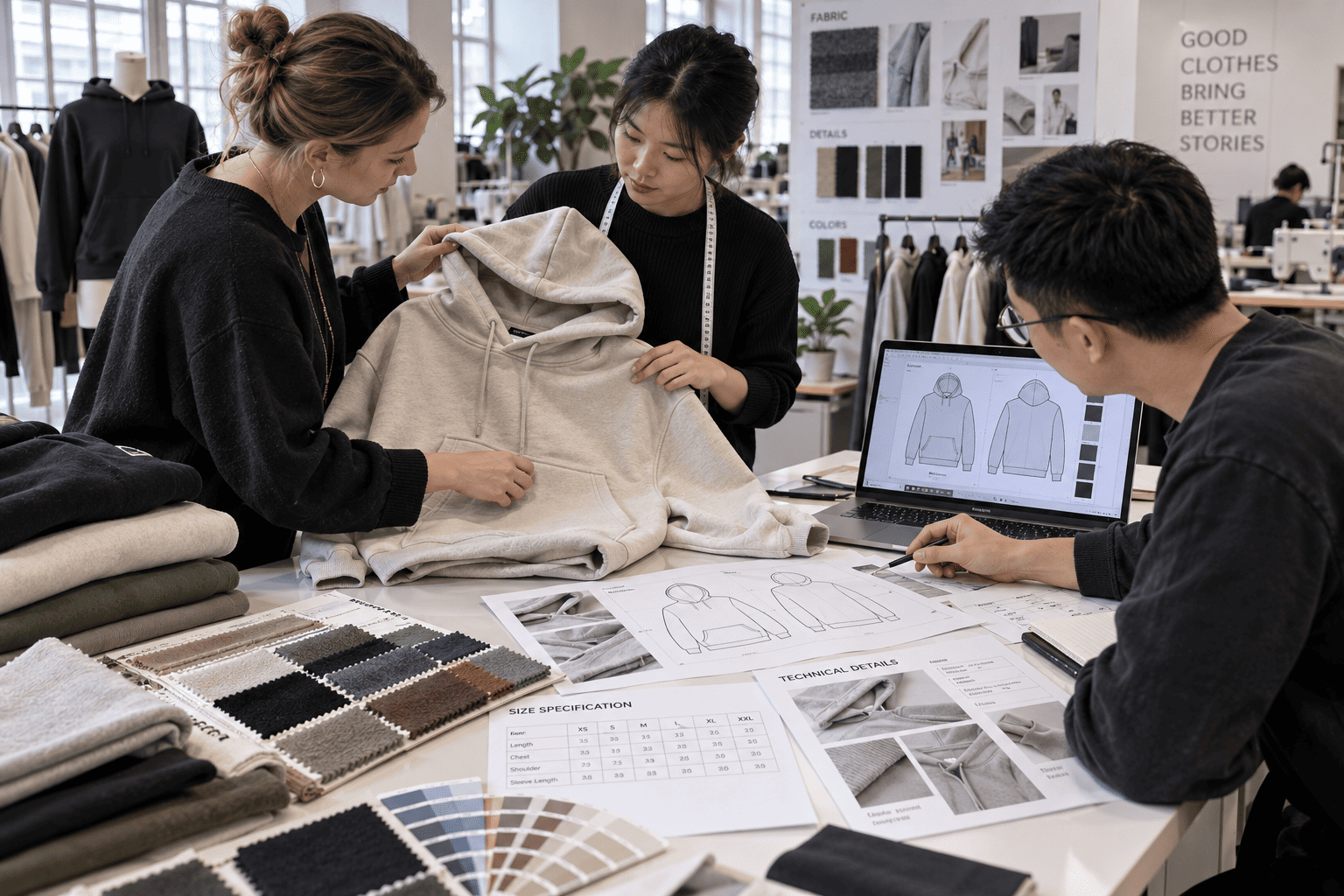
A startup should compare factory specialty, MOQ structure, sample policy, communication, material sourcing, quality control, compliance documentation, pricing clarity, and the ability to reproduce an approved sample during bulk production.
Start With Product Specialty
Ask the factory:
What products do you manufacture every week?
That question is more useful than looking at a catalog with 200 unrelated products.
If I am developing a 500 GSM oversized hoodie with garment washing and large appliqué embroidery, I want a factory that understands:
- Heavy knit fabrics
- Oversized patterns
- Rib construction
- Hood structure
- Garment washing
- Large embroidery
- Print placement
- Shrinkage control
I do not want the factory learning all of that on my order.
Check the Sample Policy
A legitimate custom manufacturer should be able to explain:
- Sample fee
- Sample lead time
- What the sample fee includes
- Whether shipping is separate
- How revisions are handled
- Whether any sample fee can be credited toward bulk production
The terms do not need to be the same at every factory.
They just need to be clear before development begins.
Look at Communication Quality
Fast replies are useful.
But speed alone is not enough.
I pay more attention to whether the factory asks good questions.
For example:
What GSM do you need?
French terry or fleece?
What is the sample size?
Is the Pantone reference TCX?
What is the actual logo width?
Is this zipper standard or custom?
Those questions show that someone is thinking about production rather than only trying to close the order.
Compare More Than Price
I would compare:
| Check | Why It Matters | Warning Sign |
|---|---|---|
| Product specialty | Determines technical experience | “We make everything” |
| MOQ structure | Determines startup feasibility | One unexplained high minimum |
| Sample policy | Protects first development spend | No clear terms |
| Fabric sourcing | Affects quality and speed | No material details |
| Communication | Prevents mistakes | Long delays or vague answers |
| QC process | Protects bulk consistency | No inspection explanation |
| Compliance documents | Supports buyer requirements | Logos without documents |
| Pricing clarity | Reduces disputes | Firm price before specs are known |
| Scaling ability | Supports future growth | Only sample-level production |
The lowest quotation is only useful when you are comparing the same product.
What MOQ Can a Startup Actually Get?
MOQ is usually one of the first questions a startup asks.
But there is no single clothing-industry MOQ.
For flexible custom knitwear production, a practical startup MOQ can be around 50–100 pieces for selected products. Other garments may require 100–200 pieces or more depending on fabric, size range, color quantity, trims, decoration, and construction.
A practical example might look like this:
| Product Type | Possible Startup MOQ |
|---|---|
| Pullover hoodie | 50–100 pcs |
| Sweatshirt | 50–100 pcs |
| Zip hoodie | 50–100 pcs |
| Hoodie + jogger set | Around 50 sets |
| Joggers | 50–100 pcs |
| T-shirts | Around 100 pcs |
| Heavyweight T-shirts | Around 100 pcs |
| Shorts | Around 100 pcs |
| Activewear | 100–200 pcs |
| Children's clothing | Usually higher depending on size range |
These are working ranges, not universal industry rules.
Why Can a Hoodie Have a Lower MOQ Than a T-Shirt?
This surprises some founders.
A heavyweight hoodie may be more complicated than a basic tee, but it also has a higher unit value.
For certain factories, that makes a shorter production run commercially more practical.
A basic T-shirt is more price-sensitive.
The factory may need more units to spread:
- Cutting setup
- Fabric purchasing
- Printing setup
- Sewing preparation
- QC
over enough pieces.
Fabric Can Override the Garment MOQ
Suppose a factory agrees to make 50 hoodies.
That does not automatically mean every possible fabric is available for 50 garments.
If the buyer selects:
400 GSM stock black fleece
the order may be relatively easy.
If the buyer wants:
487 GSM custom-knitted 100% cotton French terry in a custom color
the fabric mill may have its own MOQ.
This is why I always separate:
garment MOQ
from:
fabric MOQ
The real order minimum comes from the entire supply chain.
Why Does Factory Specialty Matter So Much?
A lot of startup sourcing mistakes begin with this sentence:
They said they can make it.
“Can make” and “makes regularly” are not the same thing.
A factory that produces heavyweight hoodies every week already understands many of the problems before the order starts.
It knows:
- Which fabrics hold the shape
- How much shrinkage to expect
- Which rib works
- How to control thick seams
- Which needles and machines are suitable
- Which decoration techniques work on the fabric
- What commonly goes wrong during washing
That experience reduces development risk.
The same logic applies to:
- Activewear
- Kidswear
- Jackets
- Denim
- Polo shirts
- Pajamas
- Technical outdoor garments
I would rather work with a specialist factory charging slightly more than a general supplier learning my product for the first time.
Why Should Startups Always Make a Sample First?
A startup is often trying to protect cash.
So I understand the temptation to skip sampling and move directly into 50 or 100 pieces.
I do not recommend it.
A physical sample allows the buyer to check fit, fabric, construction, logo size, decoration quality, labels, trims, and overall appearance before those decisions are repeated across an entire bulk order.
Photos cannot fully confirm:
- Fabric hand feel
- Fabric thickness
- Stretch
- Hood shape
- Rib tension
- Actual garment measurements
- Embroidery density
- Print hand feel
- Zipper quality
Sampling also tests the supplier.
You learn how the factory handles:
- Questions
- Technical feedback
- Corrections
- Shipping
- Deadlines
- Problem solving
For a startup, the sample is not only a product test.
It is also a manufacturer test.
Domestic or Overseas: Which Is Better for a Startup?
There is no universal answer.
I run an overseas manufacturing business, but I still do not think overseas production is automatically better for every startup.
Domestic and overseas manufacturers solve different problems. Domestic production may offer easier communication, shorter shipping distance, and a local-origin story. Overseas production can offer broader supply chains, competitive unit economics, extensive material options, and scalable production capacity.
Domestic Manufacturing
A domestic factory may offer:
- Same or similar timezone
- Easier factory visits
- Faster local shipping
- Simpler communication
- “Made locally” positioning
The trade-off is often higher unit cost.
For very small quantities, that may be completely acceptable.
Overseas Manufacturing
A manufacturer in China or elsewhere in Asia may offer:
- Broader fabric sourcing
- More decoration techniques
- Large trim supply chains
- Flexible OEM/ODM development
- Better economics as volume increases
The trade-off is international shipping and longer communication distance.
That does not automatically create communication problems.
A responsive factory with a good export team can manage the timezone difference well.
Why China Still Matters for Apparel Sourcing
China remains one of the most important apparel manufacturing bases in the world.
According to the World Trade Organization's 2022 clothing trade data, China exported about US$182 billion of clothing and accounted for 31.7% of world clothing exports.[^1]
That scale matters because apparel manufacturing does not depend only on sewing factories.
It also depends on:
- Yarn suppliers
- Knitting mills
- Dyeing factories
- Printing suppliers
- Embroidery suppliers
- Zipper manufacturers
- Label factories
- Packaging suppliers
- Washing factories
The depth of that supply chain is one reason many startups and established brands continue sourcing from China.
What Certifications and Audits Should a Startup Check?
This is an area where I see a lot of confusing marketing language.
Factories may put several logos on a website.
That does not tell you exactly what has been audited or certified.
Buyers should separate social-compliance audits, product-safety certifications, organic textile certifications, and recycled-material standards because they verify different things.
SMETA Is an Audit Methodology
Sedex describes SMETA[^2] as a social-audit methodology used to evaluate areas such as labor standards, health and safety, environmental practices, and business ethics.
That is different from a product certificate.
If a supplier says it has completed SMETA, I would ask to see the relevant audit information rather than treating “Sedex” as a product certification.
OEKO-TEX STANDARD 100 Is About Harmful Substances
OEKO-TEX® STANDARD 100[^3] is a certification for textiles tested for harmful substances.
It can apply to textile materials and components from yarn through finished products.
This is different from a social audit.
Organic Claims Need the Correct Certification
If a brand plans to market a garment as GOTS certified, it needs to understand the actual certified supply chain.
The Global Organic Textile Standard[^4] covers certified organic textile processing and requires certification through applicable stages of the manufacturing supply chain.
Using GOTS-certified fabric does not automatically mean every finished garment can be marketed however the brand wants without checking certification and labeling requirements.
Recycled Claims Also Need Documentation
For recycled materials, Textile Exchange's Global Recycled Standard (GRS)[^5] provides requirements relating to recycled material claims and certified supply chains.
The important lesson for startups is simple:
Do not ask only, “Do you have certificates?”
Ask:
- What exactly is certified?
- Which production site does it cover?
- Is the certificate still valid?
- Does it cover this product or material?
- Can I see the document?
- What claims am I legally allowed to make on my final product?
An honest supplier should be comfortable explaining the difference.
What Does It Really Cost to Start With a Manufacturer?
Your first manufacturing cost is not one number.
It comes in stages.
For a startup, the first spend normally includes sample development, sample shipping, the bulk deposit, the remaining production balance, and eventually bulk freight. Custom fabric, printing setups, embroidery digitizing, molds, labels, trims, and packaging may create additional development costs.
Sample Fee
A custom sample is usually a one-off garment.
The factory may need to:
- Source a small fabric quantity
- Make a new pattern
- Cut one garment
- Set up printing
- Digitize embroidery
- Develop trims
- Sew the sample
- Inspect it
- Pack it
That is why the sample price should not be compared directly with the bulk unit price.
For our own projects, sample-credit terms depend on the final bulk quantity.
If the agreed policy is that the sample fee is credited only when bulk reaches a certain volume, that condition should be confirmed before the sample starts.
For example:
Sample fee credited when bulk order for that style reaches 300 pieces.
If the bulk order remains below the agreed threshold, the original sample fee remains a development cost.
The important thing is transparency.
Bulk Deposit
A common structure for a new client is:
50% deposit before production
50% balance before shipment
The deposit allows the factory to purchase:
- Fabric
- Rib
- Zippers
- Labels
- Packaging
- Other production materials
After several successful orders, payment terms may sometimes be renegotiated.
But I would not expect extended credit terms on the first order.
Think About Total Landed Cost
Startups sometimes compare only the factory unit price.
That is not the full cost of the product.
You may also need to budget for:
- Sample
- Sample shipping
- Fabric development
- Custom trims
- Packaging
- Bulk freight
- Duties or import taxes
- Local delivery
A $1 cheaper factory quotation may not actually be cheaper after everything is included.
What Information Should You Send Before Asking for a Quote?
One of the easiest ways to receive inaccurate pricing is to send a photo and ask:
How much?
The factory does not have enough information.
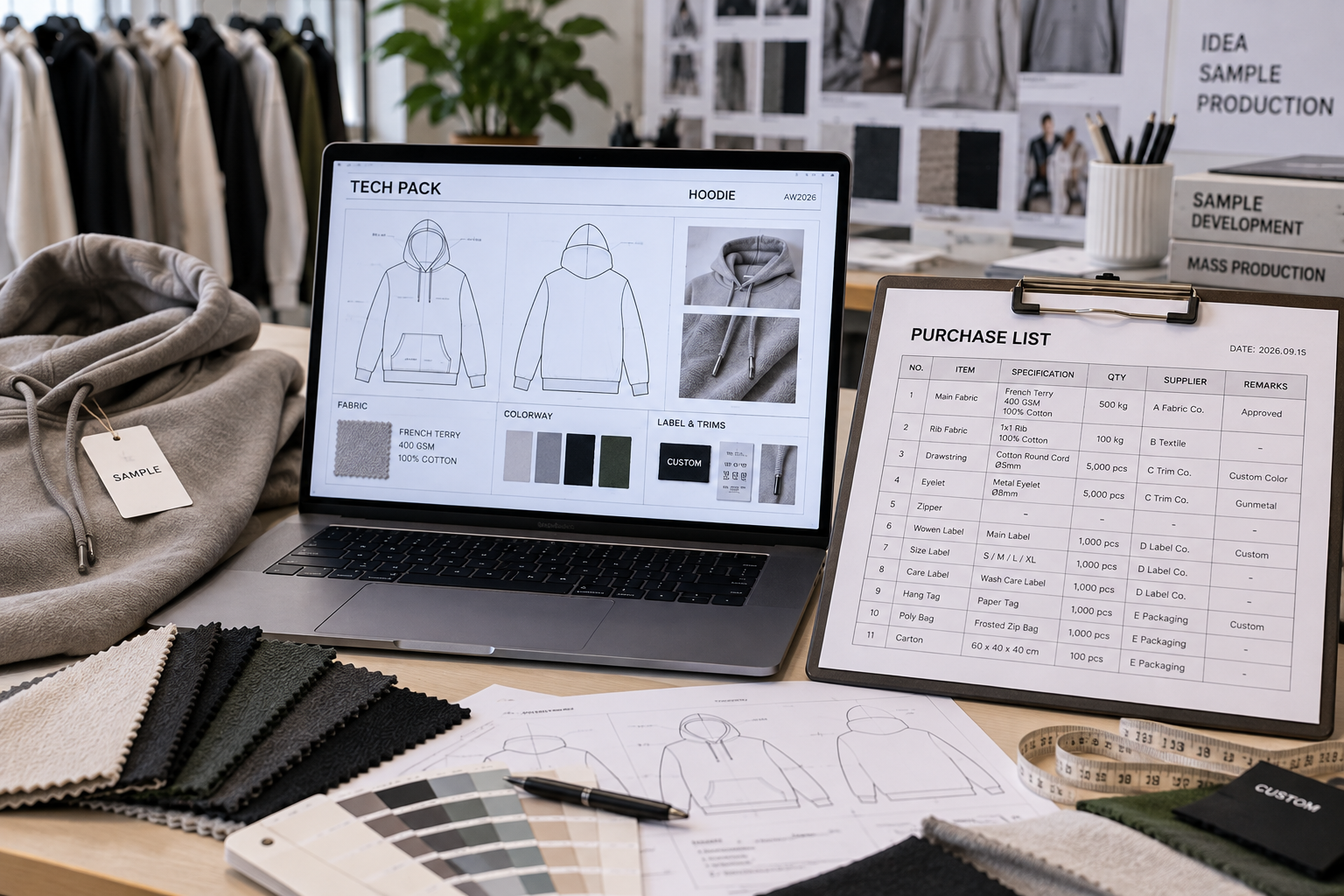
A useful clothing manufacturing inquiry should include the product type, quantity, fabric composition, GSM, colors, size range, logo artwork, decoration method, label requirements, packaging, sample size, target market, and shipping destination.
For example:
| Item | Requirement |
|---|---|
| Product | Oversized pullover hoodie |
| Quantity | 100 pcs |
| Fabric | 100% cotton French terry |
| GSM | 400 GSM |
| Color | Black |
| Sizes | S–XL |
| Front | 8 cm embroidery |
| Back | 30 cm screen print |
| Neck label | Custom woven |
| Care label | Custom |
| Packaging | Individual polybag |
| Sample size | L |
| Market | United States |
Now the factory can check:
- Fabric availability
- MOQ
- Sample cost
- Decoration cost
- Bulk price
- Lead time
Target Market Matters Too
If a startup plans to sell in the United States, product labeling needs to be considered during development rather than after the garments are finished.
The U.S. Federal Trade Commission's Apparel and Labeling guidance[^6] explains that most covered textile products need information such as fiber content, country of origin, and identification of the responsible manufacturer or marketer. Care labeling requirements also apply to covered apparel.
This is why I ask where the product will be sold.
The market can affect the label specification.
Tell the Factory What Is Flexible
This is one of the most useful things a startup can do.
For example:
I prefer 450 GSM, but 420–480 GSM is acceptable if you have stock fabric.
Or:
The fit must stay the same, but I can use your standard zipper.
Now I know where I can offer an alternative without changing the product concept.
That can reduce:
- MOQ
- Cost
- Sample time
- Production lead time
What Red Flags Should Startup Brands Watch For?
I would be cautious when a supplier says yes to everything immediately.
Examples:
Any MOQ is okay.
Any fabric is available.
Sample in two days.
We can make exactly the same from one photo.
No need for a tech pack.
Sometimes those statements may be true for a simple product.
But for a fully custom garment, I want more questions.
Quote Before Understanding the Product
If the factory gives a final price before confirming:
- Fabric
- GSM
- Quantity
- Decoration
- Labels
- Packaging
then the quotation is probably based on assumptions.
Those assumptions may change later.
No Real Sample Process
If a supplier pushes directly into bulk without discussing sampling, I would ask why.
A new custom product needs an approval reference.
Vague Compliance Claims
If the supplier writes:
Certified factory
ask:
Certified for what?
Then ask for the actual document.
No Explanation of Problems
No factory can make every design exactly as drawn without occasionally identifying production risks.
I trust a supplier more when they say:
This detail is possible, but here is the risk.
than when they say yes to everything.
Can the Same Factory Grow With Your Brand?
A startup does not always stay small.
That is why low MOQ should not be the only thing you evaluate.
Suppose your first order is:
50 hoodies.
The product sells well.
Your next order may be:
300 hoodies.
Then:
1,000 hoodies.
Now the questions change.
Can the factory reproduce:
- The same fabric?
- The same wash?
- The same color?
- The same measurements?
- The same print?
- The same embroidery?
Can it manage larger volumes without changing the product?
That is important.
The First Order Is Also a Supply-Chain Test
I think a startup's first production run should test two things:
1. The product
Did customers like:
- Fit
- Fabric
- Color
- Size distribution
- Packaging
- Quality?
2. The factory
Did the supplier:
- Communicate clearly?
- Follow the sample?
- Deliver on schedule?
- Solve problems?
- Maintain measurements?
- Pack correctly?
The second order should use what you learned from the first one.
Do Not Rebuild a Successful Product Every Time
If customers love the fit, keep the fit.
If the fabric performs well, keep the fabric.
If the print is durable, keep the process.
Improve the details that actually need improvement.
That creates a stable product.
And stable products are much easier to scale.
Conclusion
Finding the right clothing manufacturer for a startup is not about finding the cheapest factory on Alibaba, the factory with the lowest advertised MOQ, or the supplier promising the fastest sample.
The better question is:
Does this factory's production system match the stage of my brand?
For an early-stage clothing business, I would prioritize:
- Product specialty — Does the factory regularly manufacture what you are designing?
- Realistic MOQ — Can you test the market without buying dangerous amounts of inventory?
- Sampling — Can you physically approve the product before bulk production?
- Communication — Does the factory ask useful technical questions?
- Fabric sourcing — Can it explain stock versus custom material options?
- Quality control — Can bulk production reproduce the approved sample?
- Pricing clarity — Are sample, setup, bulk, packaging, and other costs explained?
- Compliance documentation — Can the supplier prove the relevant audits or certifications?
- Scaling ability — Can the same supplier move from 50 pieces to 500 or 2,000?
For many startups, the first order does not need to be perfect or extremely complicated.
It needs to be controlled.
A strong first product might use:
- One main style
- One or two colors
- A manageable size range
- Available quality fabric
- Clear branding
- One approved sample
- A realistic first production quantity
That allows the brand to launch, collect real feedback, and improve the next order without taking unnecessary inventory risk.
A good clothing manufacturer should help you do more than produce your first 50 or 100 pieces.
The right manufacturing partner should give you a practical path from first sample → first production run → repeat orders → larger-scale production without losing the product quality that helped the brand grow in the first place.
Footnotes & References
[^1]: World Trade Organization — World Trade Statistical Review 2023. WTO data for 2022 reported China as the world's largest clothing exporter, with approximately US$182 billion in clothing exports and a 31.7% share of world clothing exports.
https://www.wto.org/english/res_e/booksp_e/wtsr_2023_ch5_e.pdf
[^2]: Sedex — SMETA Audit Guide. Official Sedex information describing SMETA as a widely used social-audit methodology for evaluating supply-chain working conditions and responsible business practices.
https://www.sedex.com/reports_whitepapers/smeta-audit-guide/
[^3]: OEKO-TEX® — STANDARD 100. Official information about STANDARD 100 certification for textiles and textile components tested for harmful substances.
https://www.oeko-tex.com/en/our-standards/oeko-tex-standard-100
[^4]: Global Organic Textile Standard (GOTS) — Version 8.0. Official GOTS requirements covering certified organic textile processing, manufacturing, certification, and supply-chain controls.
https://global-standard.org/images/resource-library/documents/standard-and-manual/GOTS_v8.0_signed.pdf
[^5]: Textile Exchange — Global Recycled Standard (GRS). Official Textile Exchange standard and resources covering recycled-material certification and chain-of-custody requirements.
https://textileexchange.org/knowledge-center/documents/global-recycled-standard-grs/
[^6]: U.S. Federal Trade Commission — Apparel and Labeling. Official FTC guidance covering textile and apparel labeling requirements, including fiber content, country of origin, responsible business identification, and care labeling.
https://www.ftc.gov/news-events/topics/tools-consumers/apparel-labeling