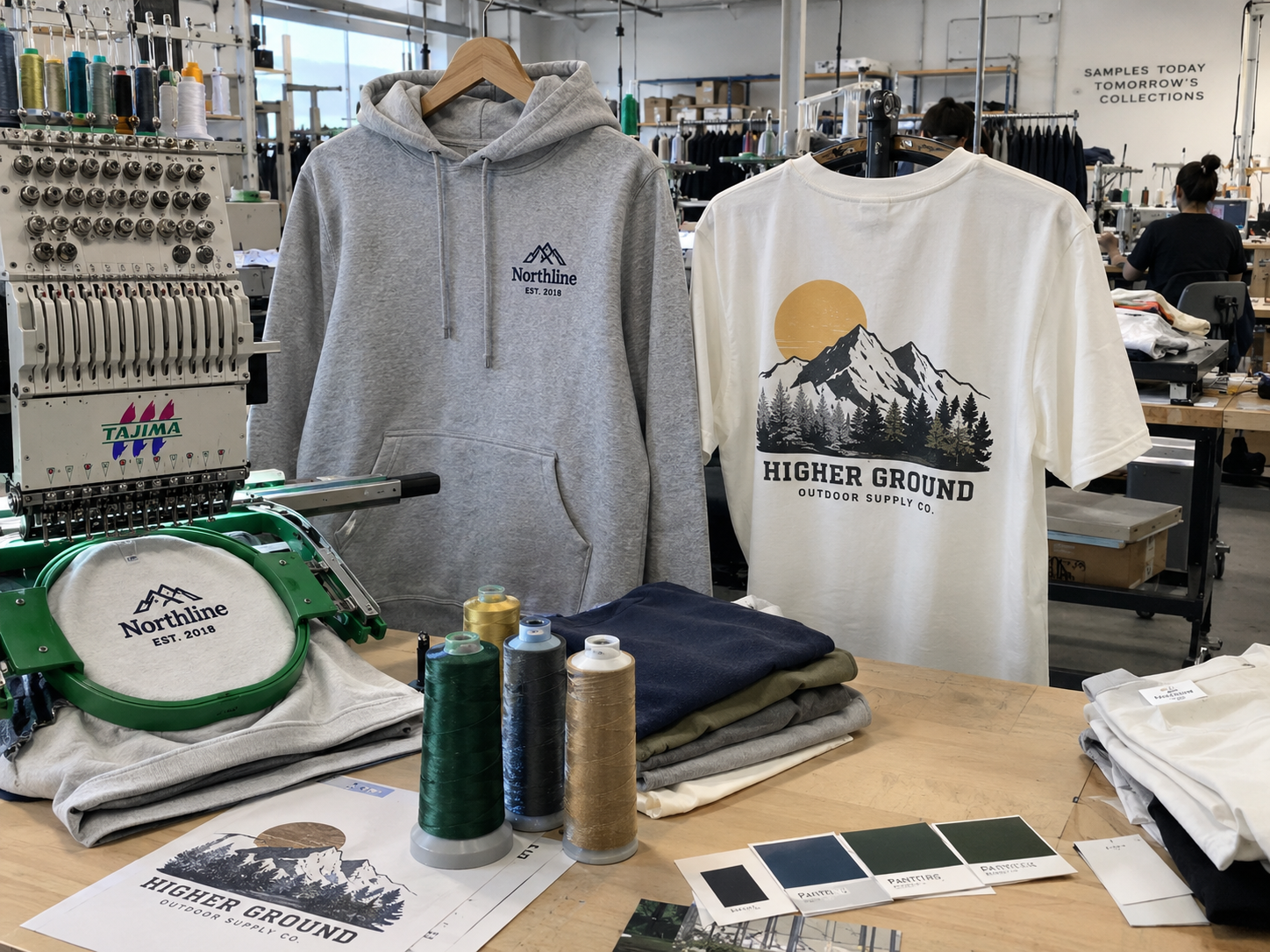
When a buyer starts a private label clothing project, the logo is often the first thing they think about. But the decoration method affects much more than appearance. It can change the hand feel, durability, MOQ, sample cost, production time, and even which fabric works best.
The main decoration options for private label apparel include screen printing, DTG, DTF, heat transfer, puff print, silicone print, standard embroidery, appliqué embroidery, chenille embroidery, towel embroidery, and mixed techniques. The best option depends on fabric type, artwork size, color count, order quantity, desired texture, budget, and the overall style of the brand.
I have worked on projects where a buyer starts with one logo file and later realizes that the same artwork can look completely different depending on the process. A flat screen print can feel clean and commercial, while embroidery can feel premium. Puff print adds dimension. Appliqué can completely change the identity of a streetwear piece.
Table of Contents
- What Are the Main Printing Options for Private Label Apparel?
- How Does Screen Printing Work for Custom Clothing?
- When Should a Brand Choose DTG Printing?
- What Is DTF Printing and When Does It Make Sense?
- What Is the Difference Between Heat Transfer and Direct Printing?
- What Is Puff Printing and Why Is It Popular in Streetwear?
- What Is Silicone Printing?
- What Embroidery Options Are Available for Private Label Garments?
- What Is Standard Embroidery?
- What Is Appliqué Embroidery?
- What Is Chenille or Towel Embroidery?
- How Do Mixed Decoration Techniques Work?
- Which Decoration Method Works Best on T-Shirts, Hoodies, and Activewear?
- How Do Printing and Embroidery Affect MOQ and Sample Cost?
- How Should a Startup Choose the Right Decoration Method?
- What Information Should Buyers Send to the Factory?
- Conclusion
- Footnotes & References
What Are the Main Printing Options for Private Label Apparel?
Printing is usually the first decoration category buyers ask me about because it works across many products and price levels.
The most common printing methods for private label apparel are screen printing, DTG, DTF, heat transfer, puff print, silicone print, and specialty effects. Screen printing works well for volume and strong colors, DTG suits detailed artwork and small runs, while DTF offers flexibility across many fabrics and order sizes.
Each method has its own strengths.
| Printing Method | Best For | Main Advantage |
|---|---|---|
| Screen printing | Medium to large orders | Strong color and durability |
| DTG | Detailed cotton graphics | Fine detail and low setup |
| DTF | Small runs and mixed fabrics | Flexible and easy to apply |
| Heat transfer | Names, numbers, simple logos | Good for personalization |
| Puff print | Streetwear graphics | Raised 3D effect |
| Silicone print | Technical or premium branding | Clean rubber-like texture |
| Specialty print | Fashion and statement pieces | Unique visual effect |
The best method is not always the most expensive one.
It is the method that fits the garment and the brand.
How Does Screen Printing Work for Custom Clothing?
Screen printing is still one of the most common decoration methods I use for T-shirts, hoodies, sweatshirts, and streetwear.
Screen printing pushes ink through a prepared mesh screen onto the fabric. Each color usually requires its own screen, which means setup cost increases with the number of colors. It works especially well for bold graphics, large logos, and medium to large production runs where the setup cost can be spread across more pieces.
Professional textile screen-printing systems range from manual equipment to automated production lines. Manufacturers such as M&R Printing Equipment[^1] produce equipment specifically for textile and garment screen-printing workflows.
Why Screen Printing Is So Popular
Screen printing has several advantages:
- Strong color
- Good durability
- Large print areas
- Competitive bulk pricing
- Many special ink options
- Reliable repeat production
It also works very well on common knit fabrics such as cotton jersey, French terry, and fleece.
Where Screen Printing Becomes Expensive
A four-color artwork usually needs more setup than a one-color logo.
For one sample, that matters a lot.
If I need to prepare several screens just to make one sample, the unit cost becomes high.
For 500 pieces, the setup cost becomes much smaller per garment.
That is why screen printing often becomes more attractive as quantity increases.
Screen Print Can Also Use Special Effects
Screen printing does not always mean a flat ink surface.
It can include:
- High-density print
- Crack print
- Distressed print
- Water-based print
- Plastisol print
- Puff print
- Reflective print
- Foil effects
The artwork and fabric decide which effect is practical.
When Should a Brand Choose DTG Printing?
DTG is often useful when the artwork has many colors or fine details.
DTG, or Direct-to-Garment printing, prints ink directly onto the garment using digital equipment. It is well suited to detailed graphics, gradients, photographic artwork, and small production runs. DTG works best on cotton-rich fabrics and does not require separate screens for every color.
Modern garment-printing equipment can also combine multiple digital workflows. For example, Brother's official GTXpro B[^2] is designed for both direct-to-garment and direct-to-film printing applications.
I usually consider DTG when the design has:
- Many colors
- Fine lines
- Shading
- Gradients
- Photo-style artwork
- Low sample quantity
Why DTG Works Well for Samples
If a buyer wants to test one or two pieces, DTG can be more practical than screen printing.
There is less setup.
That makes it useful for:
- Prototypes
- First samples
- Low-volume drops
- Artwork testing
DTG Has Limits
DTG is not always the best choice for every fabric.
It usually performs better on cotton than on high-polyester fabrics.
Very thick fleece surfaces can also affect print sharpness.
White ink can sometimes require extra control on dark garments.
I usually look at the fabric first before recommending DTG.
What Is DTF Printing and When Does It Make Sense?
DTF has become a very common option for flexible private label production.
DTF, or Direct-to-Film printing, prints the artwork onto a transfer film and then applies it to the garment using heat and adhesive powder. It can work on cotton, polyester, blends, and many other fabrics. It is especially useful for smaller orders, multi-color logos, and designs that need consistent application across different products.
Why Buyers Like DTF
DTF is flexible.
It does not need the same screen setup as screen printing.
It can handle:
- Fine detail
- Multiple colors
- Small logos
- Large back graphics
- Short runs
It also works on many fabric types.
What Does DTF Feel Like?
The print sits more on top of the fabric.
That can create a slightly stronger surface feel than DTG.
For a small logo, this may not matter.
For a very large back graphic, the hand feel can become more noticeable.
This is one reason I always think about artwork size before choosing DTF.
DTF Is Not Automatically Better Than Screen Printing
For a 30-piece test run, DTF may make sense.
For 2,000 one-color T-shirts, screen printing may be more economical and give a better hand feel.
The right method depends on the full order, not only the artwork.
What Is the Difference Between Heat Transfer and Direct Printing?
Buyers sometimes use “heat transfer” as a general term, but several processes can fall under that category.
Heat transfer applies a pre-made graphic, film, vinyl, or transfer material to the garment using heat and pressure. Direct printing applies ink more directly to the fabric. Heat transfers are useful for small orders, sports numbers, personalized names, and certain specialty finishes, while direct methods can feel more integrated into the garment.
Heat-transfer materials also vary significantly in thickness, stretch, finish, and compatible fabrics. STAHLS' publishes technical information for heat transfer vinyl and printable transfer materials[^3], including recommended application temperatures, fabrics, and pressing conditions.
Common heat transfer applications include:
- Vinyl logos
- Sports names
- Jersey numbers
- Reflective transfers
- Metallic transfers
- Small branding elements
When I Recommend Heat Transfer
Heat transfer makes sense when buyers need:
- Individual names
- Different numbers
- Small quantities
- Reflective effects
- Quick customization
It is common in sportswear and teamwear.
When I Avoid Large Heat Transfers
A very large transfer can feel heavy.
It can also affect breathability.
For a large streetwear back design, I may recommend screen printing or DTG instead.
What Is Puff Printing and Why Is It Popular in Streetwear?
Puff print is popular because it creates depth without using embroidery.
Puff print is a screen-printing technique that uses an additive that expands when heated, creating a raised, three-dimensional surface. It is popular on hoodies, heavyweight T-shirts, and streetwear because it gives simple logos and lettering a stronger visual impact without adding separate fabric or embroidery panels.
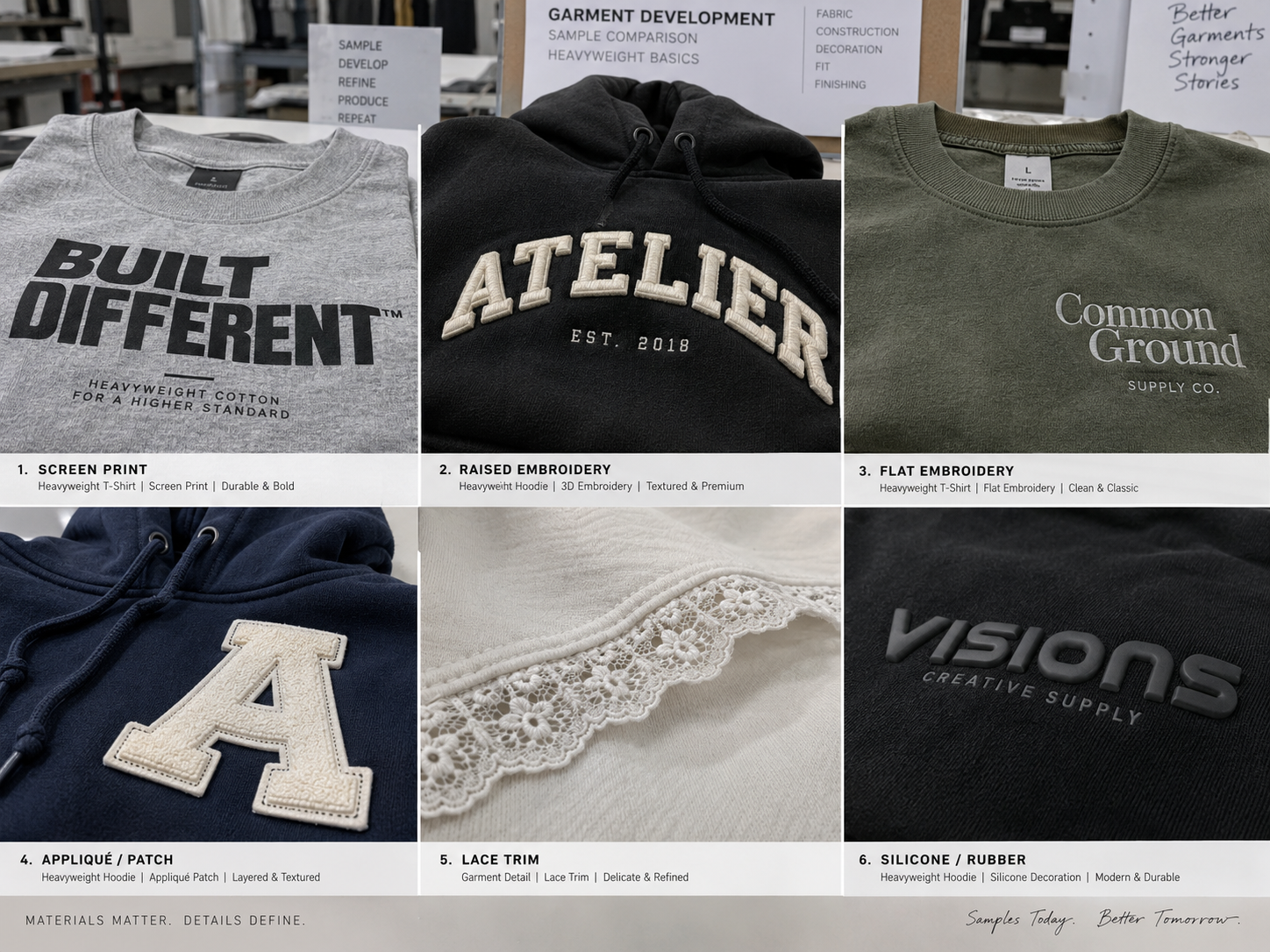
I see puff print often on:
- Large brand names
- Chest logos
- Back text
- College-style graphics
- Minimal streetwear designs
Why Puff Print Looks Premium
The raised surface catches light differently.
Even a one-color design can feel more expensive.
A flat white logo and a white puff logo can look very different.
Puff Print Needs the Right Artwork
Very thin lines may not puff evenly.
Tiny details can lose definition.
Bold letters and simple shapes usually work better.
Fabric also matters.
A smooth heavyweight cotton surface generally gives better results than a very loose or textured surface.
What Is Silicone Printing?
Silicone printing is often used when a brand wants a clean technical finish.
Silicone printing creates a soft, rubber-like raised surface on the garment. It can be used for logos, small branding details, grip elements, and modern sportswear decoration. It is often chosen for premium activewear and technical apparel because it can create a clean, durable, three-dimensional appearance.
I see silicone most often on:
- Activewear
- Sports tops
- Jackets
- Technical garments
- Minimal logo branding
Silicone Can Feel More Technical Than Screen Print
A silicone logo normally feels more structured.
That can work very well on a performance garment.
It may not match a soft vintage T-shirt.
Again, decoration needs to fit the product.
Molds or Setup May Be Required
Some silicone processes require additional setup.
This can raise sample cost and MOQ.
For one small order, I always confirm whether the visual effect is worth the extra development.
What Embroidery Options Are Available for Private Label Garments?
Embroidery is one of the easiest ways to make a garment feel more premium, but there are several different types.
Private label embroidery options include standard flat embroidery, 3D embroidery, appliqué embroidery, chenille embroidery, towel embroidery, chain-stitch embroidery, and mixed embroidery. Each creates a different texture, thickness, and visual style, so the choice should match the garment weight, logo size, and brand identity.
The most common options include:
| Embroidery Type | Look | Common Use |
|---|---|---|
| Standard embroidery | Clean and flat | Chest logos, caps, polos |
| 3D embroidery | Raised | Bold lettering, caps |
| Appliqué | Layered fabric | Streetwear and varsity styles |
| Chenille | Soft and thick | Varsity and premium streetwear |
| Towel embroidery | Textured loop effect | Fashion logos |
| Chain stitch | Vintage stitched look | Retro branding |
| Mixed embroidery | Multiple textures | Statement pieces |
What Is Standard Embroidery?
Standard embroidery is the most common type and works well for simple logos.
Standard embroidery uses thread to stitch the artwork directly into the garment. It is durable and works especially well for chest logos, small graphics, text, and premium branding. The final cost depends mainly on logo size, stitch count, thread colors, and artwork complexity.
Before production, artwork normally needs to be digitized into information the embroidery system can interpret. Wilcom's official documentation on embroidery file formats[^4] explains the distinction between editable embroidery design files and machine stitch formats used for production.
Why Standard Embroidery Works So Well
It offers:
- Strong durability
- Premium appearance
- Clean edges
- Good color stability
- Strong brand recognition
It works on many products, including:
- Hoodies
- Sweatshirts
- Polo shirts
- Jackets
- Caps
- Joggers
Small Details Can Be a Problem
Embroidery uses physical thread.
Very tiny text or very fine lines may not reproduce clearly.
If a logo has extremely small details, I may recommend simplifying it.
Sometimes printing gives a more accurate result.
What Is Appliqué Embroidery?
Appliqué is very common in premium streetwear.
Appliqué embroidery uses separate fabric pieces that are cut into a shape, placed on the garment, and stitched around the edges. It creates a layered, dimensional effect while reducing the number of embroidery stitches needed for very large graphics. It works especially well for large letters, numbers, crosses, badges, and varsity-style designs.
Why Appliqué Works for Large Graphics
Imagine a 30 cm cross on the back of a hoodie.
If I fill the entire cross with embroidery thread, it becomes:
- Heavy
- Expensive
- Stiff
- High in stitch count
Appliqué solves this by using fabric as the main fill.
The embroidery secures the edges.
Appliqué Gives Brands More Material Options
The insert fabric can be:
- Twill
- Felt
- Fleece
- Leather-like material
- Denim
- Contrast cotton
That creates many design possibilities.
Large Appliqué Needs Pattern Accuracy
The placement must be controlled carefully.
If the appliqué crosses seams or panels, the result becomes more complex.
This is especially important on hoodie backs and sleeves.
What Is Chenille or Towel Embroidery?
Chenille and towel-style techniques create much more texture than standard embroidery.
Chenille embroidery creates a soft, raised yarn surface similar to varsity patches, while towel embroidery creates a looped, textured effect. Both methods work well for bold logos and large lettering on heavyweight garments, but they usually require thicker designs and can cost more than standard embroidery.
Where I See Chenille Most Often
Chenille is common on:
- Varsity jackets
- Heavy hoodies
- College-style logos
- Large initials
- Streetwear branding
It gives the garment a strong visual identity.
Towel Embroidery Has a Softer Look
Towel embroidery can feel more casual and tactile.
It works well when the buyer wants visible texture but does not want the structured varsity look of chenille.
Fine Detail Is Not the Strength of These Methods
These techniques work best with:
- Large text
- Bold shapes
- Simple logos
Tiny details usually do not reproduce well.
How Do Mixed Decoration Techniques Work?
Some of the strongest private label designs use more than one decoration method.
Mixed decoration combines techniques such as screen printing, embroidery, appliqué, chenille, puff print, or silicone on the same garment. This can create a more premium and distinctive product, but it also increases development complexity, sample cost, production time, and the number of suppliers involved.
For example, a hoodie may use:
- Small front embroidery
- Large back screen print
- Appliqué sleeve patch
- Puff text
- Woven hem label
That is a much more complex garment than one with a single chest logo.
Mixed Techniques Need Order
I try to plan the production sequence carefully.
Some decoration must happen before sewing.
Some should happen after sewing.
Some processes cannot be placed over thick seams.
A good tech pack should clearly show:
- Technique
- Size
- Color
- Position
- Production order if needed
Complexity Should Support the Design
I do not recommend adding five techniques just to make the garment look expensive.
A clean one-color embroidery can sometimes look more premium than a garment overloaded with decoration.
The design should decide the process, not the other way around.
Which Decoration Method Works Best on T-Shirts, Hoodies, and Activewear?
The garment itself should guide the decoration choice.
T-shirts usually work well with screen print, DTG, DTF, and light embroidery. Hoodies and sweatshirts can support heavier embroidery, appliqué, chenille, puff print, and mixed techniques. Activewear often works better with silicone, heat transfer, reflective transfer, DTF, or lightweight printing that does not reduce stretch and comfort.
A simple guide looks like this:
| Garment | Good Decoration Options |
|---|---|
| Basic T-shirt | Screen print, DTG, DTF |
| Heavyweight T-shirt | Screen print, puff print, embroidery |
| Hoodie | Embroidery, screen print, puff, appliqué |
| Sweatshirt | Embroidery, chenille, screen print |
| Joggers | Embroidery, DTF, silicone print |
| Polo shirt | Standard embroidery |
| Activewear top | Silicone, heat transfer, DTF |
| Leggings | Heat transfer, silicone, reflective print |
| Jacket | Embroidery, patch, silicone, appliqué |
Fabric Weight Matters
A thin 160 GSM T-shirt may not support a large heavy embroidery well.
The fabric can distort.
A 500 GSM hoodie can support much more embroidery.
The decoration should match the fabric structure.
Stretch Matters Too
Activewear fabric stretches.
A large rigid print may crack or restrict movement.
I normally use decoration methods that can move with the fabric.
How Do Printing and Embroidery Affect MOQ and Sample Cost?
Decoration can change both MOQ and development cost, even when the garment itself is simple.
Printing and embroidery affect cost because many techniques require setup before production begins. Screen printing needs screens, embroidery requires digitizing, appliqué needs templates, and silicone or metal components may require molds. Simple DTF or DTG can support smaller runs, while specialized techniques are usually more economical at higher quantities.
Sample Cost Is Often Higher Than Buyers Expect
A buyer may ask:
Why does one hoodie sample cost $150 when the bulk hoodie costs much less?
The answer may include:
- Embroidery programming
- Print screen setup
- Appliqué cutting
- Special thread
- Supplier minimum charges
- One-piece handling
These costs are concentrated into one sample.
MOQ Depends on the Decoration Supplier
The garment factory may accept 50 pieces.
The printing supplier may also accept 50.
But a custom silicone patch supplier may want a larger quantity.
A custom metal badge supplier may need a mold and a minimum production run.
That is why I always check all decoration components before confirming the final MOQ.
How Should a Startup Choose the Right Decoration Method?
Startup brands sometimes choose a decoration method because they saw it on another brand.
That is not always the best approach.
A startup should choose decoration based on the artwork, garment fabric, desired hand feel, expected order quantity, target retail price, and brand identity. I recommend starting with one or two core techniques that can be reproduced consistently instead of using too many complex methods in the first collection.
I normally ask five questions.
1. What Should the Garment Feel Like?
Do you want:
- Soft and minimal?
- Heavy and premium?
- Vintage?
- Technical?
- Streetwear?
- Luxury?
The answer changes the decoration.
2. How Large Is the Artwork?
A 5 cm chest logo and a 40 cm back graphic should not automatically use the same method.
3. How Many Pieces Are You Ordering?
Small quantities may favor DTG or DTF.
Larger quantities may make screen printing more attractive.
4. How Much Can the Product Retail For?
A $25 T-shirt cannot carry the same decoration cost as a $150 premium hoodie.
Production choices must fit the business model.
5. Can the Factory Repeat the Effect?
This is very important.
The sample may look good, but the factory needs to reproduce that effect across the bulk order.
Consistency matters more than creating one perfect sample.
What Information Should Buyers Send to the Factory?
Clear artwork information makes sampling much faster.
Buyers should provide vector artwork, exact logo dimensions, decoration method, Pantone colors, placement measurements, garment size, fabric information, and reference images where useful. Each artwork should be clearly labeled so the factory knows exactly which design goes on the front, back, sleeve, leg, or other position.
For textile and apparel color communication, Pantone's official Fashion, Home + Interiors system[^5] uses TCX references for soft surfaces such as textiles and apparel.
I like to receive something like this:
| Item | Specification |
|---|---|
| Garment | 450 GSM oversized hoodie |
| Front logo | 8 cm wide embroidery |
| Back design | 32 cm screen print |
| Sleeve detail | 20 cm appliqué |
| Front color | Pantone Black C |
| Back colors | White + grey |
| Logo position | 4 cm below neckline |
| Artwork format | AI + PDF |
| Sample size | L |
That is much better than receiving several screenshots with arrows added in a chat.
Send Separate Artwork Files
I normally recommend:
- AI
- EPS
- SVG
- Vector PDF
Adobe's official Illustrator supported file formats[^6] include AI, PDF, EPS, and SVG in common open, save, or export workflows.
High-resolution PNG may also work for some print methods.
For embroidery, the factory still needs to digitize the artwork into an embroidery file.
Give Placement Measurements
Do not only write:
Put it in the middle.
Use clear references.
For example:
Back logo top edge: 4 cm below neckline seam.
Or:
Left chest logo center: 9 cm from center front.
This reduces interpretation.
One Lesson I Have Learned From Decoration Development
One issue I see again and again is buyers deciding the decoration too late.
The garment sample is already almost finished.
Then the buyer decides they want a large embroidery crossing the sleeve seam.
Now the process becomes much harder.
Some decoration should happen before garment assembly.
Some artwork also needs flat fabric to achieve good placement.
That is why I prefer to confirm decoration before cutting whenever possible.
I also prefer to test difficult artwork before using it on the final sample.
A small test can tell me whether:
- The puff height is correct
- The embroidery density is too high
- The print color is accurate
- The fabric puckers
- The appliqué edge looks clean
One test can prevent remaking the entire garment.
Conclusion
Private label apparel can use screen printing, DTG, DTF, heat transfer, puff print, silicone printing, standard embroidery, appliqué, chenille, towel embroidery, chain stitch, and mixed decoration techniques.
I do not think there is one decoration method that is automatically “best.”
The right choice depends on the garment.
A lightweight T-shirt and a 500 GSM hoodie should not necessarily use the same decoration method. A 5 cm chest logo and a 40 cm back graphic may also need completely different processes.
Order quantity matters too. DTG or DTF may make sense for a small test run, while screen printing can become more practical as production volume increases. Heavy embroidery and appliqué can create a premium streetwear look, but they also add weight, development work, and setup cost.
For startups, I usually recommend beginning with one or two decoration techniques that fit the brand and can be reproduced consistently.
Most importantly, confirm the decoration early.
Give the factory clear artwork files, exact dimensions, Pantone references, placement measurements, fabric information, and the required production technique before the final sample is completed.
A decoration method should not be chosen only because it is fashionable.
It should support the fabric, artwork, price point, order quantity, hand feel, and identity of the garment.
Footnotes & References
[^1]: M&R Printing Equipment — Textile Screen Printing Equipment. Official M&R resource covering manual and automatic textile screen-printing equipment and production systems.
https://www.mrprint.com/
[^2]: Brother DTG — GTXpro B. Official Brother information for its hybrid garment printer supporting both direct-to-garment (DTG) and direct-to-film (DTF) printing applications.
https://brotherdtg.com/gtxpro-b/
[^3]: STAHLS' International — Premium Plus Heat Transfer Vinyl. Official technical information covering heat-transfer material composition, recommended fabrics, application temperature, pressing time, and other production specifications.
https://www.stahlsinternational.com/heat-transfer-vinyl-premium-plus/
[^4]: Wilcom — Embroidery Files. Official Wilcom documentation explaining native embroidery design files and machine stitch formats used in embroidery production workflows.
https://help.wilcom.com/portal/en/kb/wilcom-international/wilcom-truesizer/getting-started/articles/embroidery-files-20-7-2026
[^5]: Pantone — Fashion, Home + Interiors (FHI). Official Pantone color system for fashion, textiles, and apparel; TCX references are designed for soft surfaces such as textiles.
https://www.pantone.com/na/en-us/fashion-home-interiors
[^6]: Adobe — Supported File Formats in Illustrator. Official Adobe documentation covering AI, PDF, EPS, SVG, and other artwork formats used in design and production workflows.
https://helpx.adobe.com/illustrator/desktop/get-started/learn-the-basics/supported-file-formats.html