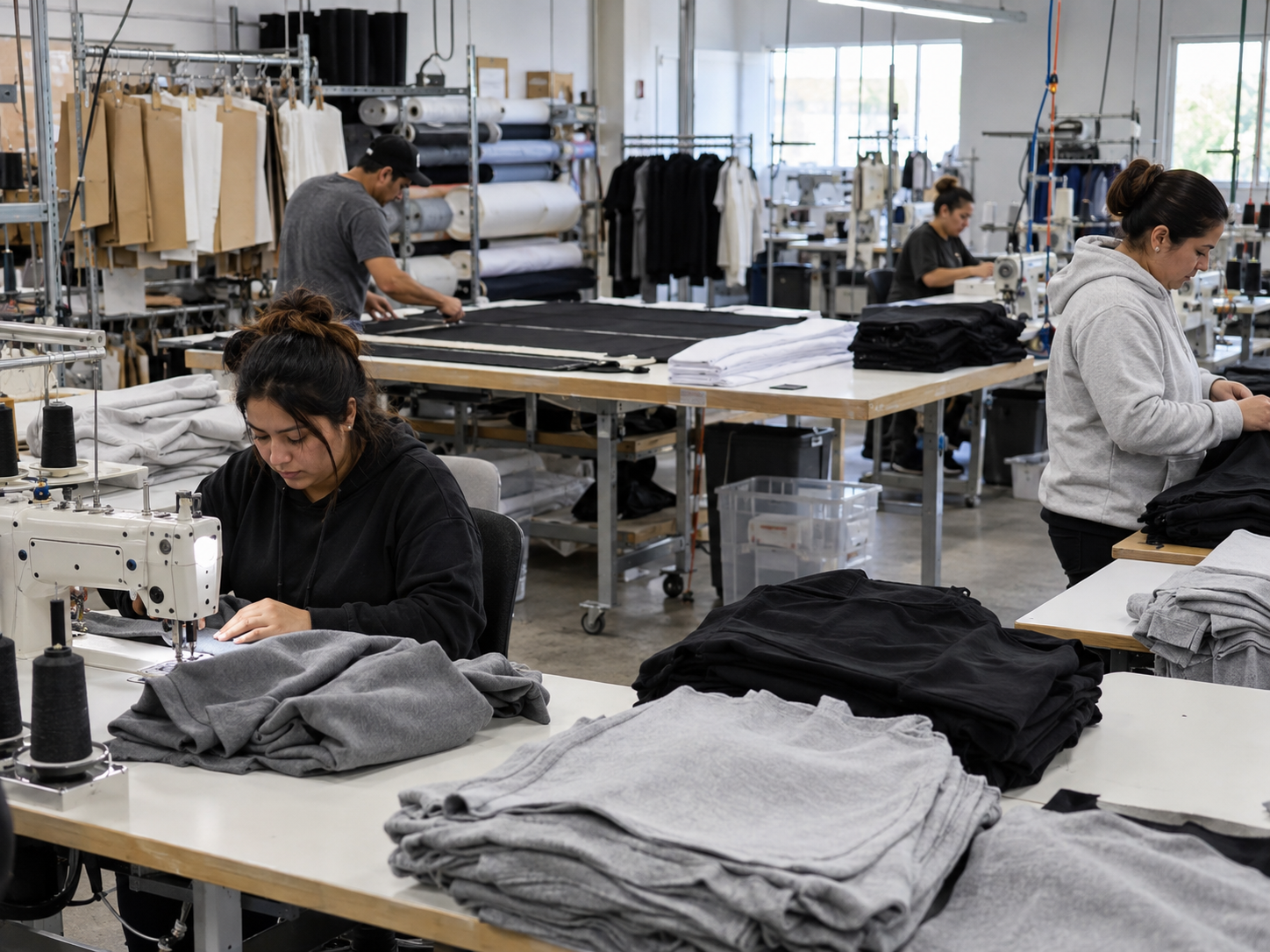
MOQ can become frustrating very quickly. A buyer may only need 50 hoodies for a first launch, while one supplier asks for 300 pieces and another says 1,000. The problem is that MOQ is not only about how many garments a sewing factory wants to make. Fabric, colors, sizes, printing, labels, and trims all affect the real minimum.
For custom clothing manufacturers in China, MOQ commonly starts around 50–100 pieces per style for basic knit garments, although some factories require 200–500 pieces or more. In my own work, some hoodies and sweatshirt programs can start around 50 pieces, while T-shirts, shorts, complex fabrics, kidswear, or highly customized products may need higher quantities.
I have learned that asking only “What is your MOQ?” rarely gives a buyer enough information. I prefer to ask what product, fabric, color count, size range, and customization level the buyer needs. Once I know those details, the MOQ becomes much easier to explain.
Table of Contents
- What Does MOQ Mean in Clothing Manufacturing?
- What Is a Normal MOQ for Custom Clothing in China?
- Why Do Clothing Factories Have MOQ Requirements?
- How Does Fabric Affect Garment MOQ?
- How Do Colors and Sizes Change the MOQ?
- Does Printing or Embroidery Affect MOQ?
- Do Labels and Custom Packaging Have Their Own MOQ?
- Why Are Low-MOQ Clothing Orders More Expensive?
- Can Buyers Negotiate a Lower MOQ?
- Is a 50-Piece Clothing MOQ Realistic?
- How Does MOQ Change for Different Garment Categories?
- Should Buyers Choose the Factory with the Lowest MOQ?
- What Should Buyers Ask Before Confirming an MOQ?
- Conclusion
- Footnotes & References
What Does MOQ Mean in Clothing Manufacturing?
MOQ sounds simple, but buyers and factories do not always use the term in exactly the same way.
MOQ means Minimum Order Quantity. In clothing manufacturing, it is the smallest quantity a supplier can economically produce under a certain set of specifications. MOQ may apply per style, per color, per fabric, per logo, or per total order. Buyers should always ask exactly how the supplier calculates the minimum before comparing quotations.
This basic definition is also used more broadly in retail and sourcing. Shopify's guide to Minimum Order Quantity (MOQ)[^1] describes MOQ as the minimum number of units a supplier is willing to sell or produce in one order, while also explaining how supplier economics and inventory costs influence that number.
For example, a supplier may say:
MOQ: 100 pieces.
That answer still leaves several questions.
Does that mean 100 pieces in one color?
Can the buyer make 50 black and 50 brown?
Can those 100 pieces include five sizes?
Does one hoodie and one sweatpant count as one style or two?
These details can completely change whether an MOQ works for a brand.
MOQ per Style Is Different from MOQ per Color
Imagine that a buyer wants 100 hoodies.
The order includes:
| Color | Quantity |
|---|---|
| Black | 25 pcs |
| Grey | 25 pcs |
| Brown | 25 pcs |
| Navy | 25 pcs |
| Total | 100 pcs |
The total order is 100 pieces.
However, each color only has 25 pieces.
The garment factory may be able to sew that quantity, but the fabric supplier may not be willing to dye four custom colors at such small volumes.
This is one reason MOQ becomes more complicated than one number.
What Is a Normal MOQ for Custom Clothing in China?
There is no universal MOQ across Chinese garment factories. Different factories target different customers.
A common MOQ for custom clothing manufacturers in China is around 50–100 pieces per style for flexible small-batch knitwear suppliers. Medium and larger factories may require 200–500 pieces per style or color, while mills and highly automated production facilities may require even larger quantities. The actual minimum depends on the garment and its materials.
For the type of knitwear projects I normally work with, practical starting points often look like this:
| Product | Common Small-Batch MOQ Range |
|---|---|
| Basic T-shirt | 100 pcs |
| Heavyweight T-shirt | 100 pcs |
| Pullover hoodie | 50–100 pcs |
| Sweatshirt | 50–100 pcs |
| Zip hoodie | 50–100 pcs |
| Joggers | 50–100 pcs |
| Shorts | Around 100 pcs |
| Hoodie + jogger set | Around 50 sets |
| Activewear set | 100–200 sets |
| Kidswear | Around 150 pcs or more |
| Complex custom jacket | 100–300 pcs |
| Fully custom fabric program | Often 300+ pcs |
These are practical working ranges, not industry rules.
A factory may accept fewer pieces when stock fabric is available.
The same factory may require a much higher quantity when the buyer needs custom-developed fabric.
Why Do Clothing Factories Have MOQ Requirements?
Some buyers think MOQ exists because factories simply do not want small customers. That is only part of the picture.
Clothing factories use MOQ because every order has fixed setup costs. Pattern making, fabric purchasing, cutting, printing setup, embroidery programming, line preparation, labels, packaging, quality control, and administration all require work before production begins. When the quantity becomes too small, those costs make each garment expensive and inefficient to produce.
Imagine I am making 500 hoodies.
The cutting team prepares the fabric once.
The print supplier creates the screens once.
The embroidery supplier sets up the file once.
The production line is arranged once.
Those setup costs can be divided across 500 garments.
Now imagine making 20 hoodies.
Many of the same setup steps still exist.
But the cost is divided across only 20 garments.
Sewing Is Often Not the Main MOQ Problem
This surprises many buyers.
Sometimes I can technically sew 20 garments.
The problem is everything around the sewing.
Fabric suppliers may have minimum quantities.
Dyeing factories may have minimum dye lots.
Printing suppliers may charge minimum setup fees.
Label factories may require 100 labels.
Hangtag suppliers may require hundreds of pieces.
Custom zipper manufacturers may require molds or large production quantities.
The sewing line may be willing to make the garments, but the entire supply chain has to work together.
How Does Fabric Affect Garment MOQ?
Fabric is probably the biggest factor behind garment MOQ.
Stock fabric can allow much lower garment MOQs because the supplier can sell a small quantity from existing inventory. Custom fabric usually raises the MOQ because knitting, dyeing, brushing, finishing, and special fiber blends require production minimums. A custom Pantone color can also create a higher minimum than standard black, white, or grey fabric.
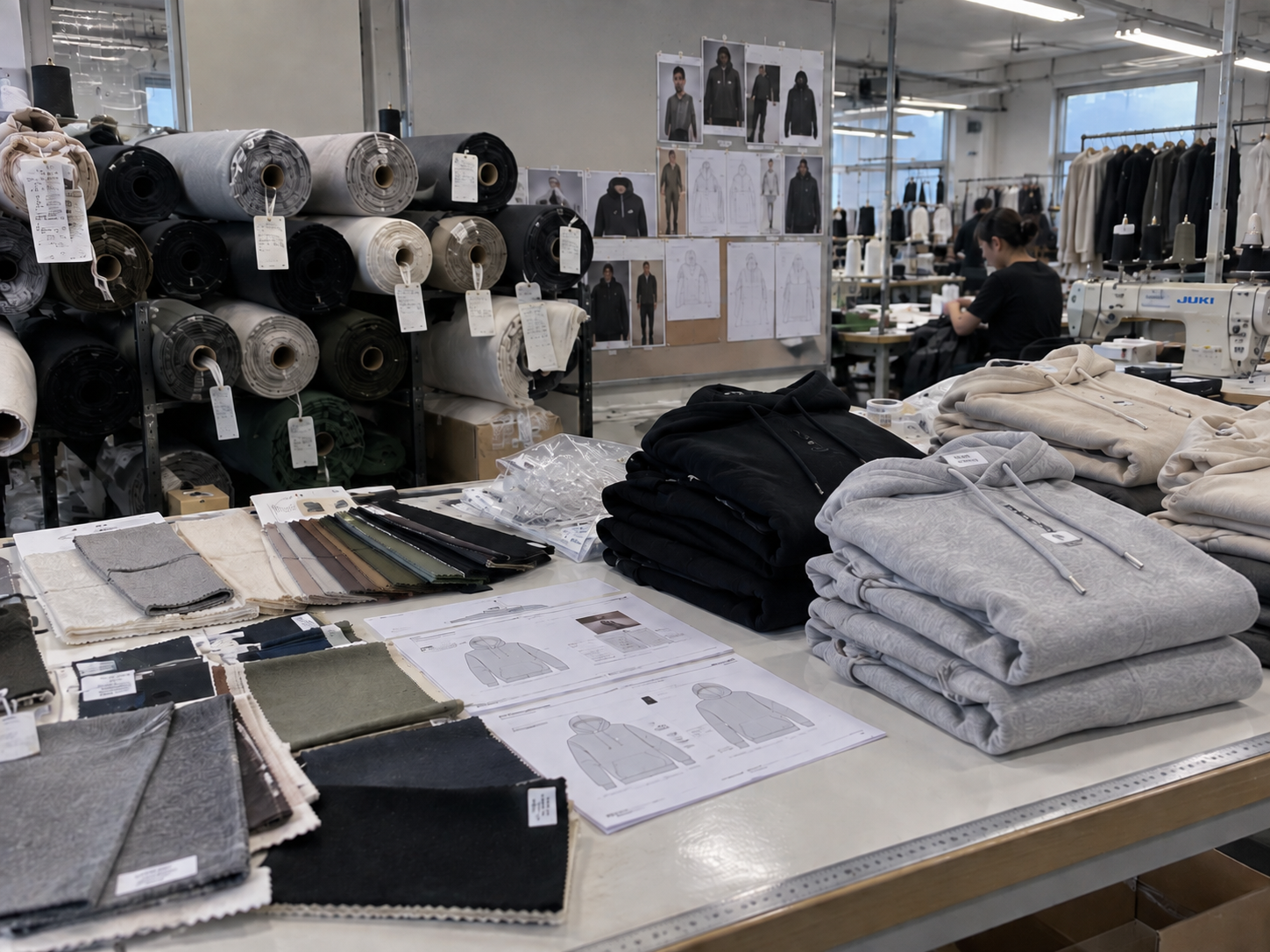
For custom color development, it also helps to use the correct color standard. Pantone's official Fashion, Home + Interiors system[^2] explains that TCX references are intended for soft surfaces such as textiles and apparel.
I normally think about fabric in three levels.
Stock Fabric
Stock fabric gives buyers the most flexibility.
If a supplier already has 400 GSM black cotton fleece available, I may only need to buy enough fabric for 50 hoodies.
That makes a small order much easier.
Existing Fabric with Custom Color
The fabric structure already exists, but the buyer wants a specific Pantone color.
This creates another problem.
A dyeing factory usually cannot dye only enough fabric for 20 garments.
There is a minimum dye lot.
Even if the garment factory accepts 50 pieces, the buyer may need to pay for extra fabric.
Fully Custom Fabric
Now imagine a buyer requests:
92% cotton, 8% polyester, 470 GSM, custom loop structure, special wash, custom Pantone green.
This may require yarn sourcing, knitting, dyeing, finishing, testing, and shrinkage checks.
At that point, garment MOQ becomes closely connected to the fabric mill's MOQ.
That is why I always ask about fabric before I promise a very low garment MOQ.
How Do Colors and Sizes Change the MOQ?
A total order quantity does not tell the whole story. The way that quantity is divided matters just as much.
More colors usually make a low-MOQ order harder because each color requires separate fabric purchasing, cutting, and production management. More sizes also reduce the number of units in each size. A 50-piece order across four sizes is manageable for some factories, while 50 pieces divided across eight sizes and four colors can become inefficient.
For example, consider two orders.
| Order | Colors | Sizes | Quantity |
|---|---|---|---|
| Order A | 1 | 4 | 50 pcs |
| Order B | 5 | 8 | 50 pcs |
Both orders contain 50 pieces.
But Order B is much harder.
The factory may end up making only one or two pieces for certain color-size combinations.
That increases cutting complexity and production risk.
Why Size Distribution Matters
For a small hoodie order, I often prefer a controlled size range.
For example, 50 pieces divided across four sizes is much easier than dividing them across seven or eight sizes.
When a buyer needs more sizes, increasing the total quantity usually makes production more practical.
This does not mean larger size ranges are impossible.
It simply means the order needs enough units to support them.
Does Printing or Embroidery Affect MOQ?
Decoration can affect MOQ, but the impact depends on the technique.
Printing and embroidery do not always create a garment MOQ by themselves, but they create setup costs that make very small orders expensive. Screen printing needs screens, embroidery requires programming, and processes such as appliqué, silicone printing, chenille embroidery, puff printing, or special patches may require templates or molds.
A simple small embroidery logo is relatively easy.
A complex streetwear hoodie may include:
| Process | MOQ Impact |
|---|---|
| Small standard embroidery | Low |
| DTG print | Low for samples and small runs |
| DTF transfer | Low to medium |
| Screen printing | Medium due to screen setup |
| Puff print | Medium |
| Large appliqué embroidery | Medium to high |
| Chenille embroidery | Medium to high |
| Silicone patch | Higher if mold is needed |
| Custom metal logo | Higher if mold is needed |
| Rhinestone design | Higher if template is needed |
This is why two visually similar hoodies may have very different MOQs.
One may use a small digital print.
The other may need four different suppliers.
Do Labels and Custom Packaging Have Their Own MOQ?
Yes. Buyers often focus on garment MOQ and forget that branding suppliers usually have their own minimums.
Custom woven labels, hangtags, polybags, boxes, zipper pulls, patches, and other branded accessories often have separate MOQs. A garment factory may accept 50 pieces, but a label supplier may require 100 labels and a hangtag supplier may require several hundred pieces. Buyers can often keep the unused accessories for future production.
Zippers are a good example of why trim sourcing can create its own minimums. YKK's official fastening product search[^3] shows the wide range of zipper constructions, sliders, hardware, and fastening options that may need to be specified before sourcing.
This happens frequently on low-volume orders.
For example, the buyer orders 50 hoodies.
The woven label supplier requires 100 labels.
We may make 100 labels and use 50.
The remaining 50 can be stored for the next order if the design does not change.
Packaging Can Create Unexpected Costs
Custom boxes are especially important.
A buyer may want only 50 garments but also request 50 fully custom rigid boxes.
The packaging manufacturer may have a much higher minimum because box production needs printing plates, cutting dies, setup, and assembly.
In that situation, I normally separate the garment decision from the packaging decision.
The buyer may use a simpler package for the first production run and upgrade later when volume increases.
Why Are Low-MOQ Clothing Orders More Expensive?
Low MOQ is useful, but it almost always comes with a higher unit cost.
Low-MOQ clothing orders cost more per piece because fixed development and setup costs are divided across fewer units. Small fabric purchases are also more expensive, cutting efficiency is lower, production lines spend more time changing styles, and suppliers have less room to negotiate material prices.
Suppose a print setup costs $100.
At 50 garments, that adds $2 per garment.
At 500 garments, it adds only $0.20 per garment.
The same logic applies to many other costs.
Small Orders Also Create More Production Changes
A sewing line works most efficiently when it can repeat the same operation for a long period.
If the factory makes only 50 garments, the team may need to change to another product shortly after setup is complete.
That change has a cost.
For this reason, low MOQ and low price do not always fit together.
I tell buyers that there are usually three things they want:
- Low quantity
- High customization
- Low price
Getting all three at the same time is difficult.
Can Buyers Negotiate a Lower MOQ?
Sometimes yes, but the buyer needs to understand what is causing the MOQ first.
Buyers can often reduce MOQ by using stock fabric, reducing the number of colors, limiting the size range, using standard trims, simplifying decoration, or accepting a higher unit price. A factory is more likely to offer flexibility when the requested materials are already available and the order is technically simple.
For example, imagine the factory quotes 100 pieces.
The buyer needs only 50.
Instead of simply asking, “Can you do 50?” I prefer discussing what can change.
If the buyer accepts stock black fabric instead of a custom Pantone color, 50 pieces may become possible.
If the buyer removes the custom zipper pull, it may become easier again.
If the buyer accepts four sizes instead of seven, production becomes simpler.
This is real MOQ negotiation.
The buyer is not only asking the factory to accept less volume.
Both sides are changing the production structure.
Is a 50-Piece Clothing MOQ Realistic?
Yes, for some products and some factories.
A 50-piece MOQ is realistic for certain custom knit garments when the factory focuses on small-batch production and can use available fabrics and standard production methods. Hoodies, sweatshirts, zip hoodies, and sets can sometimes begin around this level. However, custom fabric, many colors, complex trims, and large size ranges may require a higher quantity.
In my own projects, 50 pieces can work well for certain hoodies and sweatshirts.
But I normally want the order to stay reasonably simple.
For example, 50 hoodies across four sizes is much more workable.
If the same buyer asks for five colors, seven sizes, custom-developed fabric, custom zipper pulls, special boxes, and multiple embroidery techniques, I would need to review the MOQ again.
Low MOQ Does Not Mean No Rules
A factory that specializes in flexible production still has to protect quality.
If every garment in a 50-piece order is different, production can become closer to sample making than bulk manufacturing.
That increases the chance of mistakes.
I prefer a realistic low MOQ that we can reproduce well.
How Does MOQ Change for Different Garment Categories?
Construction and material requirements change from product to product.
Simple knit garments generally support lower MOQs than highly structured or technical garments. Hoodies, sweatshirts, and basic knitwear can often be produced in smaller batches. Technical activewear, custom jackets, kidswear, highly engineered garments, and products using special fabrics may require larger quantities.
A practical comparison looks like this:
| Category | Relative MOQ | Main Reason |
|---|---|---|
| Hoodie | Low to medium | Common fabrics and construction |
| Sweatshirt | Low to medium | Simple knit construction |
| T-shirt | Medium | Price-sensitive and fabric volume matters |
| Joggers | Low to medium | Common knit construction |
| Shorts | Medium | Small order efficiency |
| Activewear | Medium to high | Technical stretch fabrics |
| Yoga sets | Medium to high | Multiple pieces and fabric requirements |
| Kidswear | Medium to high | Size range and compliance needs |
| Jackets | Medium to high | More trims and construction |
| Fully custom knit fabric | High | Mill production minimums |
For kidswear, the extra complexity is not only about size distribution. Depending on the destination market and product category, additional safety and testing requirements can also affect development and production planning. For example, the U.S. Consumer Product Safety Commission publishes specific children's sleepwear regulations[^4], including flammability, sizing, testing, and labeling requirements for covered products.
The garment category gives me a starting point.
The final specifications decide the real minimum.
Should Buyers Choose the Factory with the Lowest MOQ?
A low MOQ is attractive, especially for new brands. Still, MOQ should not be the only thing a buyer compares.
The lowest MOQ does not automatically mean the best manufacturing partner. Buyers should also compare sample quality, fabric sourcing, communication, quality control, production capacity, lead time, certification, pricing, and the factory's ability to reproduce the approved sample during bulk production.
I have seen buyers get excited because one supplier says:
No MOQ.
That sounds excellent.
But I immediately want to know what “no MOQ” means.
Is the supplier using existing blank garments?
Are they producing from stock products?
Can they actually customize the pattern?
Can they control fabric composition and GSM?
Are they a manufacturer or a trading company?
Can they repeat the same product six months later?
A low MOQ is useful only when the supplier can still deliver the product you need.
Where certification matters, buyers should also understand what a certificate actually covers. OEKO-TEX® STANDARD 100[^5], for example, covers textiles tested for harmful substances, while the Global Organic Textile Standard (GOTS)[^6] sets requirements for certified organic textile processing and production.
These standards address different sourcing requirements, so I do not think buyers should treat certification logos as interchangeable.
MOQ Should Match the Brand's Stage
A new brand testing its first collection should not necessarily start with 1,000 pieces per style.
That creates inventory risk.
At the same time, a brand selling thousands of garments every month should not choose a factory only because it can make 30 pieces.
The buyer needs a supplier whose production structure matches the business.
I think about MOQ as part of the sourcing strategy, not as an isolated number.
What Should Buyers Ask Before Confirming an MOQ?
I recommend getting the MOQ structure in writing before paying for samples or starting production.
Buyers should confirm whether the MOQ applies per style, per color, per fabric, or per total order. They should also ask about size limits, fabric minimums, decoration minimums, label requirements, packaging MOQs, unit-price changes at low quantities, and whether leftover fabric or accessories can be used in future orders.
A simple MOQ discussion should clarify these points:
| Question | Why It Matters |
|---|---|
| Is the MOQ per style or per color? | Prevents quantity misunderstandings |
| How many colors can I use? | Affects fabric minimums |
| How many sizes are allowed? | Affects cutting efficiency |
| Is stock fabric available? | Can reduce MOQ |
| Does custom Pantone dye have a minimum? | Often raises fabric MOQ |
| Does printing have a setup minimum? | Affects decoration cost |
| Do labels have their own MOQ? | Adds branding cost |
| Does packaging have a separate MOQ? | Important for small orders |
| Will 50 pcs cost more per piece than 100 pcs? | Helps calculate real budget |
| Can unused labels or trims be stored? | Useful for repeat orders |
I prefer discussing these points before giving the buyer a final answer.
A simple “MOQ 50” may look good in a sales message, but it does not help if every important component requires 500 pieces.
Conclusion
Custom clothing MOQs in China often start around 50–100 pieces for flexible knitwear production, but the real minimum depends on much more than the number of garments.
Fabric availability, custom dyeing, color count, size distribution, decoration methods, labels, trims, packaging, and compliance requirements can all change the final MOQ.
That is why I recommend treating MOQ as a supply-chain question, not just a factory number.
For a new brand, a low MOQ can reduce inventory risk and make it easier to test the market. But the lowest possible MOQ is not always the best target. If the order becomes too fragmented or customized, unit costs rise and production becomes harder to control.
The right MOQ should balance customization, cost, quality, production efficiency, and inventory risk.
Before confirming an order, I would always ask exactly what the MOQ applies to—style, color, fabric, logo, or total order—and which materials or accessories have their own minimum requirements.
That conversation usually tells you much more than a supplier simply saying, “Our MOQ is 50 pieces.”
Footnotes & References
[^1]: Shopify — MOQ: Definition and Negotiation Tactics. Overview of Minimum Order Quantity, why suppliers use MOQs, and common approaches to negotiating and managing minimum quantities.
https://www.shopify.com/blog/minimum-order-quantity
[^2]: Pantone — Fashion, Home + Interiors (FHI). Official Pantone color system for fashion, textiles, apparel, and other soft goods; TCX references are intended for textile applications.
https://www.pantone.com/na/en-us/fashion-home-interiors
[^3]: YKK Fastening Products Group — Product Search. Official YKK resource covering zipper constructions, sliders, hardware, and other fastening products.
https://www.ykkfastening.com/products/search/
[^4]: U.S. Consumer Product Safety Commission — Children's Sleepwear Regulations. Official guidance covering applicable children's sleepwear flammability, sizing, testing, labeling, and recordkeeping requirements.
https://www.cpsc.gov/Business--Manufacturing/Business-Education/Business-Guidance/Childrens-Sleepwear-Regulations-OLD
[^5]: OEKO-TEX® — STANDARD 100. Official information about textiles tested for harmful substances and STANDARD 100 product classes and certification requirements.
https://www.oeko-tex.com/en/our-standards/oeko-tex-standard-100
[^6]: Global Organic Textile Standard (GOTS) — Version 8.0. Official GOTS standard covering requirements for certified organic textile processing and production.
https://gotslive.global-standard.org/images/resource-library/documents/standard-and-manual/GOTS_v8.0_signed.pdf