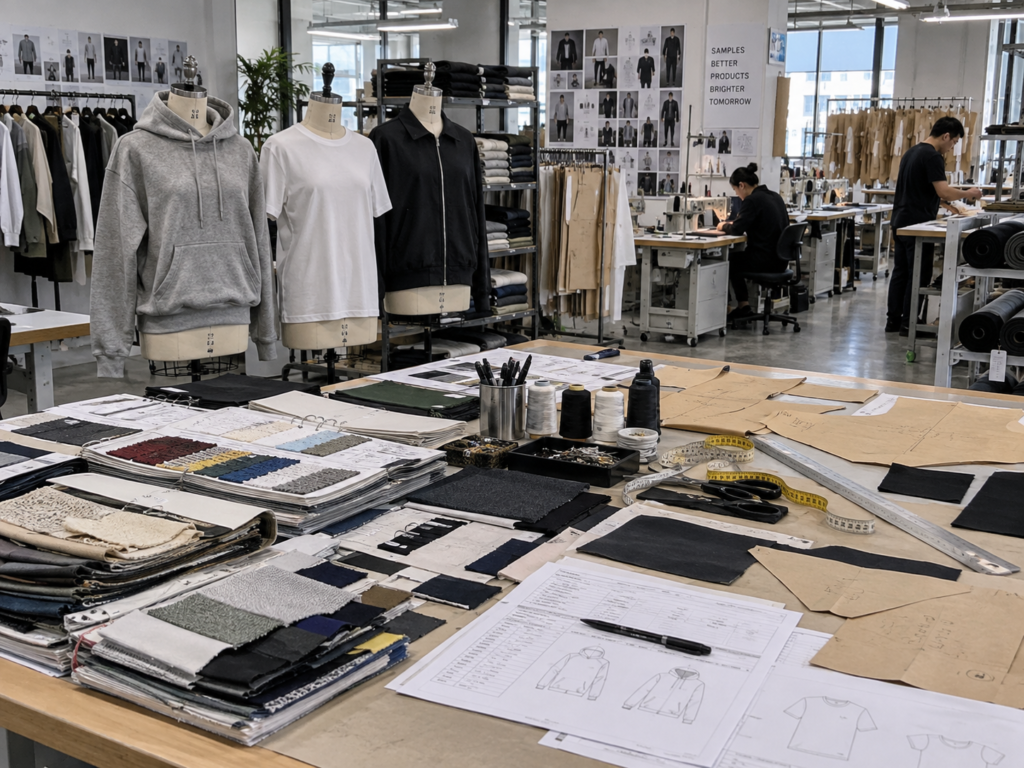
When buyers first contact a clothing factory in China, sample cost is often one of the first questions they ask. The problem is that one factory may quote $60 while another quotes $180 for what looks like the same garment. Without understanding the cost structure, it is very easy to compare the wrong things.
In my experience, a custom clothing sample from a China garment manufacturer usually costs around $50–$200 per piece. Simple T-shirts can be lower, while heavyweight hoodies, jackets, activewear, washed garments, embroidery, custom fabric, and special trims can cost $150–$300 or more. International shipping is normally charged separately.
I have worked on samples where the sewing itself was not expensive at all. The real cost came from buying small quantities of fabric, making print screens, preparing embroidery files, opening molds, and asking suppliers to accept a one-piece order. Once I explain these details, the sample price usually makes much more sense.
Table of Contents
- Why Do Clothing Samples Cost More Than Bulk Garments?
- What Is the Normal Clothing Sample Price in China?
- What Costs Are Included in a Clothing Sample?
- How Much Do Different Garment Samples Cost?
- Why Does Custom Fabric Increase Sample Cost?
- How Much Do Printing and Embroidery Add to Sample Cost?
- Do Labels, Zippers, and Packaging Increase the Sample Cost?
- How Much Does Sample Shipping from China Cost?
- Is the Clothing Sample Fee Refundable?
- Why Do Different Chinese Factories Quote Very Different Sample Prices?
- How Can Buyers Reduce Clothing Sample Costs?
- Should Buyers Choose the Cheapest Clothing Sample?
- What Should Buyers Prepare Before Asking for a Sample Quote?
- Conclusion
- Footnotes & References
Why Do Clothing Samples Cost More Than Bulk Garments?
Many buyers are surprised when one sample costs more than the expected unit price of a bulk order. I understand why. If a hoodie may cost $18 in production, paying $120 or $150 for one sample can feel strange.
A clothing sample costs more than a bulk garment because the factory must complete many one-time development tasks for only one or two pieces. Pattern making, fabric sourcing, cutting, artwork setup, printing tests, embroidery programming, special trims, washing, and quality checking are divided over a very small quantity instead of hundreds of garments.
This is the biggest difference between sampling and mass production.
When I produce 500 hoodies, I can spread many costs across 500 pieces.
When I produce one hoodie, I still need to prepare:
- The pattern
- The fabric
- The cutting marker
- The embroidery file
- The print setup
- The labels
- The sewing process
- The finishing process
- The quality check
The factory may only ship one garment, but the development work behind it is much bigger than one garment.
Sample Cost vs. Bulk Unit Cost
A simple example makes this easier to understand.
| Cost Item | 1 Sample | 500-Piece Bulk Order |
|---|---|---|
| Pattern development | Paid for 1 piece | Spread across 500 pieces |
| Fabric purchase | Small-quantity premium | Bulk fabric price |
| Print setup | Paid once for 1 piece | Spread across 500 pieces |
| Embroidery setup | Paid once for 1 piece | Spread across 500 pieces |
| Sewing | Sample-room rate | Production-line rate |
| QC | Individual checking | Batch checking |
| Unit cost | High | Much lower |
This is why I never recommend using the sample price to estimate the bulk unit price directly.
They are two different cost structures.
What Is the Normal Clothing Sample Price in China?
There is no single standard price for every garment. Still, I can give buyers a useful range based on the type of product and level of customization.
For custom garment development in China, I usually see simple samples around $50–$100, standard custom hoodies and sweatshirts around $80–$180, and complex streetwear, jackets, activewear, washed products, or garments with several special processes around $150–$300 or more. Shipping and special mold charges may be separate.
A general working range looks like this:
| Product Type | Typical Sample Cost |
|---|---|
| Basic T-shirt | $50–$90 |
| Heavyweight T-shirt | $60–$110 |
| Tank top | $50–$90 |
| Sweatshirt | $70–$130 |
| Pullover hoodie | $80–$160 |
| Zip hoodie | $90–$180 |
| Joggers / sweatpants | $70–$130 |
| Hoodie + jogger set | $130–$250 |
| Activewear top | $70–$140 |
| Leggings | $70–$140 |
| Yoga set | $120–$220 |
| Garment-washed streetwear | $120–$220 |
| Complex embroidered hoodie | $150–$300+ |
| Custom jacket | $150–$350+ |
These numbers are not fixed price lists.
I use them as a realistic reference.
The final cost depends on what the buyer actually wants.
What Costs Are Included in a Clothing Sample?
When I calculate a sample price, I am not only calculating fabric plus sewing. I am calculating the complete development process needed to turn a design into a physical garment.
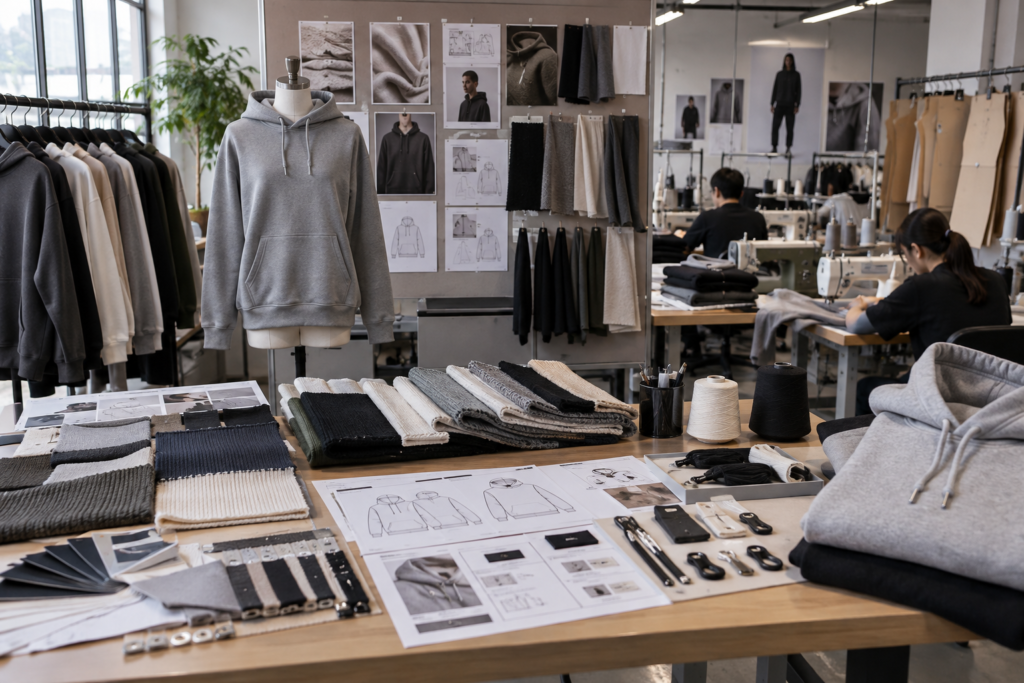
A clothing sample price may include fabric sourcing, fabric purchase, pattern making, cutting, sewing, printing, embroidery, washing, labels, trims, finishing, quality inspection, and sample-room labor. Some factories include these costs in one quote, while others list setup charges, molds, or custom accessories separately.
Pattern Making
A pattern is one of the most important parts of sample development.
If the buyer provides a complete pattern, this cost may be lower.
Most buyers do not.
They normally provide:
- A tech pack
- A size chart
- A reference garment
- Photos
- Design drawings
Then my pattern maker needs to create the pattern from that information.
This takes time because the pattern needs to match:
- Fit
- Shoulder shape
- Sleeve shape
- Chest width
- Body length
- Hood shape
- Neckline
- Waistband
- Leg opening
A good pattern affects the final garment much more than many buyers realize.
Sample-Room Sewing
Bulk production uses a production line.
Sample production normally uses experienced sample makers.
A sample maker may need to sew a complete garment from beginning to end.
The worker also has to solve construction details that have not yet been standardized.
That makes sample sewing more expensive than bulk-line sewing.
Development and Communication
There is also development work before physical production starts.
I may need to discuss with:
- Fabric suppliers
- Printing suppliers
- Embroidery suppliers
- Zipper suppliers
- Label suppliers
- Washing factories
- Packaging suppliers
For one custom garment, several companies may be involved.
The buyer sees one finished hoodie.
I may see ten separate development steps behind it.
How Much Do Different Garment Samples Cost?
Different garments create different levels of work. I would never expect a simple jersey T-shirt to cost the same as a double-layer heavyweight hoodie with appliqué embroidery.
T-shirts are normally among the cheapest garments to sample because their construction is simple. Hoodies, zip jackets, activewear, and streetwear cost more because they use more fabric, more pattern pieces, more trims, or more decoration. Complex outerwear and highly customized garments are usually the most expensive samples.
T-Shirt Samples
A simple T-shirt may only require:
- Jersey fabric
- Rib collar
- Front and back patterns
- Sleeves
- Basic printing
- Labels
That keeps development relatively simple.
A heavyweight fashion T-shirt can cost more if the buyer asks for:
- 280–320 GSM cotton
- Garment dyeing
- Vintage washing
- Oversized construction
- Large screen printing
- Puff print
- Distressing
- Custom neck rib
The product is still called a T-shirt, but the development is no longer basic.
Hoodie Samples
Hoodies usually cost more because they consume more fabric and have more construction details.
I may need to consider:
- Hood shape
- Double-layer hood
- Kangaroo pocket
- Rib cuffs
- Rib waistband
- Drawstrings
- Metal eyelets
- Zippers
- Embroidery
- Large back printing
- Garment washing
A 500 GSM or 600 GSM streetwear hoodie also uses much more fabric than a basic T-shirt.
Activewear Samples
Sportswear and activewear can look simple, but fit is very important.
For leggings, sports bras, compression tops, and yoga sets, I need to pay close attention to:
- Stretch direction
- Fabric recovery
- Seam strength
- Waistband tension
- Body fit
- Flatlock seams
- Moisture management
- Elastic
- Lining
A mistake of one or two centimeters can affect comfort much more than it would on an oversized hoodie.
That extra fitting work can increase sample development cost.
Why Does Custom Fabric Increase Sample Cost?
Fabric is often one of the biggest variables in a sample quote.
Custom fabric increases sample cost because fabric mills usually prefer bulk orders, not one-garment quantities. If a buyer needs a special GSM, composition, knit structure, Pantone color, brushing, finish, or wash, the factory may need to pay small-quantity surcharges, development fees, or minimum fabric charges before making the garment.
For textile color communication, using a standardized reference can reduce unnecessary back-and-forth. Pantone's official Fashion, Home + Interiors system[^1] includes TCX references specifically used for textiles and apparel.
I normally separate fabric into three categories.
Stock Fabric
This is the cheapest option for sampling.
The fabric already exists.
For example:
- 100% cotton jersey
- Cotton-polyester fleece
- French terry
- Rib fabric
- Standard activewear fabric
If the right weight and color are available, I can buy a few meters.
That keeps the cost under control.
Similar Fabric for Fit Sampling
Sometimes the buyer's exact fabric is not available in a small quantity.
For example, the buyer may request:
380 GSM, 100% cotton French terry, custom Pantone brown.
I may have a 400 GSM stock brown that is close enough for a fit sample.
If the buyer mainly wants to test:
- Fit
- Measurements
- Construction
- Logo placement
using the available fabric may be a smart first step.
The exact fabric can be developed later.
Fully Custom Fabric
This becomes more expensive.
The mill may need to:
- Buy yarn
- Knit greige fabric
- Dye it
- Finish it
- Wash it
- Check shrinkage
- Check GSM
- Send it to the garment factory
A mill normally does not want to perform all of that work for three meters of fabric.
That is why small custom fabric development can become expensive very quickly.
How Much Do Printing and Embroidery Add to Sample Cost?
Logo decoration is another area where buyers often underestimate sample cost.
Printing and embroidery can add around $10–$100 or more to a clothing sample, depending on the technique, size, number of colors, artwork complexity, and setup requirements. Screen printing, appliqué, chenille embroidery, silicone printing, puff printing, and mixed techniques usually cost more than a small standard logo.
Why Screen Printing Costs More on Samples
Screen printing usually needs a screen or plate for each color.
Imagine a back graphic with four colors.
The printer may need to prepare four screens.
For 500 garments, that setup cost is small per garment.
For one sample, the full setup cost is attached to one piece.
That is why a printed sample can look expensive.
Embroidery Also Has Setup Work
Before an embroidery machine can start, the artwork needs to be converted into a machine-readable embroidery file.
The technician needs to decide:
- Stitch direction
- Stitch density
- Thread sequence
- Underlay
- Edge treatment
- Placement
A small chest logo is normally easy.
A large appliqué cross covering the back of a hoodie is not.
Some Processes Need Templates or Molds
Special decoration can require additional development charges.
Examples include:
- Rhinestone templates
- Silicone molds
- Rubber patches
- Custom zipper pull molds
- Metal logo molds
- Appliqué templates
I always prefer to separate these charges clearly so the buyer understands what is a garment cost and what is a one-time setup cost.
Do Labels, Zippers, and Packaging Increase the Sample Cost?
Yes, and this is another area where a one-piece sample can become expensive.
Custom labels, hangtags, zippers, buttons, metal hardware, packaging, and branded accessories can increase sample cost because suppliers often have minimum order quantities. A factory may need to buy 100 labels or 500 hangtags even when the buyer only needs one sample garment.
Zippers are a good example of why a trim description needs to be specific. YKK's official fastening product database[^2] includes metal, coil, VISLON®, sliders, snap buttons, and many other options, so simply writing “YKK zipper” may still leave several details to confirm.
This is why I often ask buyers an important question:
Do you need the full branding package on the first sample?
Sometimes the answer should be yes.
Sometimes it should be no.
What I Usually Recommend for the First Sample
If the buyer mainly wants to check the garment itself, I normally focus first on:
- Fit
- Fabric
- Construction
- Color
- Embroidery
Custom packaging can wait.
A woven label may also wait if the supplier requires a high minimum quantity.
When Custom Branding Is Worth Doing
If the sample will be used for:
- Investor presentations
- Photoshoots
- Pre-orders
- Influencer marketing
- Sales meetings
- Trade shows
then the buyer may want a more complete sample.
In that case, branded labels and packaging can make sense.
The important point is that the buyer should know which costs are helping product development and which costs are helping presentation.
How Much Does Sample Shipping from China Cost?
Sample shipping is usually separate from the manufacturing fee.
Express shipping for one or two clothing samples from China commonly costs around $40–$100 or more, depending on package weight, destination, courier, fuel surcharges, and whether duties or taxes are included. Heavyweight hoodies, multiple samples, jackets, and large packaging can increase the freight cost quickly.
I usually use express services such as:
- DHL
- UPS
- FedEx
These services are much faster than sea freight.
Both DHL Express China[^3] and UPS international shipping services[^4] provide official tools and service information for international parcels. The exact quote still depends on the shipment, destination, service level, and other shipping conditions.
Why Heavyweight Clothing Costs More to Ship
A 250 GSM T-shirt sample is light.
A 600 GSM hoodie is not.
If the buyer orders:
- Two hoodies
- Two sweatpants
- One jacket
- Custom box packaging
the parcel becomes heavy very quickly.
International courier charges are normally based on actual weight or volumetric weight.
This is why I prefer to calculate freight after I know the sample quantity and approximate packed weight.
Is the Clothing Sample Fee Refundable?
Buyers ask me this question often, especially when they plan a larger future order.
Some clothing factories refund or credit part of the sample fee after the buyer places a bulk order, while others do not. The policy depends on the factory, product, development cost, and order size. Buyers should ask clearly whether the sample fee, pattern fee, and special setup charges can be credited to future production.
I think it is important to separate three different things.
Sample Garment Fee
This covers the actual development and production of the sample.
Some suppliers may credit this later.
Setup Fees
These may include:
- Print screens
- Embroidery setup
- Templates
- Molds
- Patterns
Some of these can be reused.
Others cannot.
Courier Cost
Shipping is normally not refundable.
The courier has already provided the service.
I always prefer to explain these items before payment.
It prevents misunderstandings later.
Why Do Different Chinese Factories Quote Very Different Sample Prices?
A buyer may send the same tech pack to five factories and receive five completely different prices. That does not always mean one factory is overcharging.
Sample prices vary because factories have different fabric sources, sample-room costs, quality standards, supplier relationships, development methods, and pricing strategies. One factory may use stock materials while another develops the requested material exactly. One may include artwork setup and trims, while another may charge those items later.
This is why I do not recommend comparing only the final number.
Ask What the Quote Includes
Suppose Factory A says:
Sample: $80
Factory B says:
Sample: $140
At first, Factory A looks cheaper.
But then you discover:
Factory A includes:
- Similar stock fabric
- Basic print
- No custom labels
- No wash
- Standard zipper
Factory B includes:
- Exact fabric weight
- Custom Pantone dye
- Embroidery setup
- Garment wash
- Custom labels
- YKK zipper
Now the comparison is completely different.
Some Suppliers Use Low Sample Prices to Win the Inquiry
I have also seen suppliers quote a very low sample price because they want the buyer to pay quickly.
Later, extra charges appear.
I do not think this is a good way to build a long-term B2B relationship.
I prefer one clear quote with the main development costs explained early.
How Can Buyers Reduce Clothing Sample Costs?
I do not think buyers need to overpay for development. Many sample costs can be controlled without damaging the quality of the project.
Buyers can reduce clothing sample costs by using stock fabric for early fit samples, keeping the first sample focused on construction, using one sample size, providing clean vector artwork, avoiding unnecessary custom packaging, combining samples into one shipment, and confirming technical details before development starts.
Use the First Sample for the Right Purpose
I often ask buyers:
What do you want to learn from this sample?
If the answer is:
I want to check the fit.
Then I do not necessarily need to develop custom boxes, metal zipper pulls, and final hangtags.
That money can be spent later.
Use One Sample Size First
If the buyer wants an oversized hoodie in five sizes, I usually do not recommend making all five sizes during the first round.
We can first make one size, such as L.
The buyer checks:
- Fit
- Proportion
- Fabric
- Construction
After approval, we grade the other sizes.
That reduces both time and cost.
Send Good Artwork
A clean vector logo saves work.
Good formats include:
- AI
- EPS
- SVG
Adobe's official Illustrator supported file formats documentation[^5] confirms support for common production formats including AI, PDF, EPS, and SVG.
If I receive a blurry screenshot, someone has to rebuild it.
That can create extra cost and mistakes.
Combine Shipments
If a buyer is developing three products, I normally recommend shipping them together if the schedule allows.
Paying one courier shipment is usually better than paying three separate shipments.
Should Buyers Choose the Cheapest Clothing Sample?
I understand the temptation to choose the lowest quote, especially when a buyer is testing several suppliers at the same time.
I would not choose a clothing supplier based only on the cheapest sample price. I would compare sample quality, communication speed, fabric accuracy, pattern quality, workmanship, problem solving, production capacity, certification credibility, and whether the factory can reproduce the approved sample consistently during bulk production.
When certification is part of the sourcing requirement, I also recommend checking what the certification actually covers. For example, the official OEKO-TEX® STANDARD 100[^6] applies to textiles tested for harmful substances and includes requirements covering textile and accessory components.
A sample is not just a product.
It is a test of the supplier.
What I Look at During Sampling
Sampling tells me whether both sides can work together.
It tests:
- Communication
- Technical understanding
- Response speed
- Quality control
- Problem solving
- Transparency
- Timeline management
For a serious brand, these points matter much more than saving $30 on the first sample.
A Cheap Sample Can Become Expensive Later
Imagine that a buyer saves $50 on sampling.
Then the bulk order arrives with:
- Wrong measurements
- Wrong fabric weight
- Different print colors
- Poor stitching
- Incorrect labels
That $50 saving becomes meaningless.
I would rather spend slightly more at the development stage and remove problems before bulk production.
What Should Buyers Prepare Before Asking for a Sample Quote?
The more complete the information is, the more accurate my sample quote can be.
Before requesting a sample price, buyers should prepare the product design, sample size, size chart, fabric composition, GSM, Pantone color, logo artwork, logo size, printing or embroidery method, labels, trims, packaging requirements, expected bulk quantity, and shipping destination. Missing information usually leads to estimated quotes that may change later.
A useful sample request can look like this:
| Item | Example |
|---|---|
| Product | Oversized zip hoodie |
| Sample size | L |
| Fabric | 100% cotton French terry |
| GSM | 450 GSM |
| Color | Pantone black |
| Fit | Oversized |
| Front logo | Small embroidery |
| Back logo | Large screen print |
| Zipper | YKK metal zipper |
| Neck label | Woven |
| Wash label | Printed |
| Packaging | Standard polybag |
| Expected bulk order | 300 pcs |
| Destination | California, USA |
When I receive this level of detail, I can usually identify the expensive parts immediately.
One Lesson I Learned from Sample Development
I once worked on a sample where the buyer was very focused on keeping the sample price low.
At first, we tried to save money on several details.
We used similar fabric.
We delayed the custom zipper.
We simplified one of the decorations.
The sample became cheaper, but it did not answer the buyer's real question.
The buyer wanted to know what the final product would actually feel like.
We eventually made a second sample with the correct fabric and correct trims.
The buyer ended up spending more than if we had defined the purpose clearly at the beginning.
That experience changed the way I discuss samples.
Now I ask first:
Is this sample for fit, quality approval, photography, sales, or final production confirmation?
The answer changes the best sampling plan.
Conclusion
A clothing sample in China usually costs around $50–$200, while complex custom garments can reach $300 or more. I recommend looking beyond the sample price itself. Fabric, patterns, decoration, trims, and setup work all matter.
A clear tech pack and a clear sample purpose usually save more money than simply choosing the cheapest supplier. If the first sample is only for fit, buyers may not need every custom trim or packaging detail immediately. If the sample is intended for photography or final production approval, spending more to reproduce the actual product can make much more sense.
The goal is not to make the cheapest possible sample.
The goal is to spend the sample budget on the details that actually help you make a better bulk-production decision.
Footnotes & References
[^1]: Pantone — Fashion, Home + Interiors (FHI). Official Pantone color system for fashion, textiles, apparel, and soft goods.
https://www.pantone.com/na/en-us/fashion-home-interiors
[^2]: YKK Fastening Products Group — Product Search. Official YKK database covering zippers, sliders, plastic hardware, snaps, buttons, and other fastening products.
https://www.ykkfastening.com/products/search/?cl=on
[^3]: DHL Express China — Shipping Services. Official information on international express shipping, quotes, tracking, customs support, and transit considerations.
https://www.dhl.com/cn-en/home/express/shipping-and-tracking/shipping.html
[^4]: UPS — International Shipping Services. Official UPS information covering international express, expedited, standard, and economy shipping options.
https://www.ups.com/us/en/support/international-tools-resources/international-shipping-services
[^5]: Adobe — Supported File Formats in Illustrator. Official Adobe documentation covering AI, PDF, EPS, SVG, and other artwork formats used in design and production workflows.
https://helpx.adobe.com/illustrator/desktop/get-started/learn-the-basics/supported-file-formats.html
[^6]: OEKO-TEX® — STANDARD 100. Official information about textile testing for harmful substances and STANDARD 100 certification requirements.
https://www.oeko-tex.com/en/our-standards/oeko-tex-standard-100