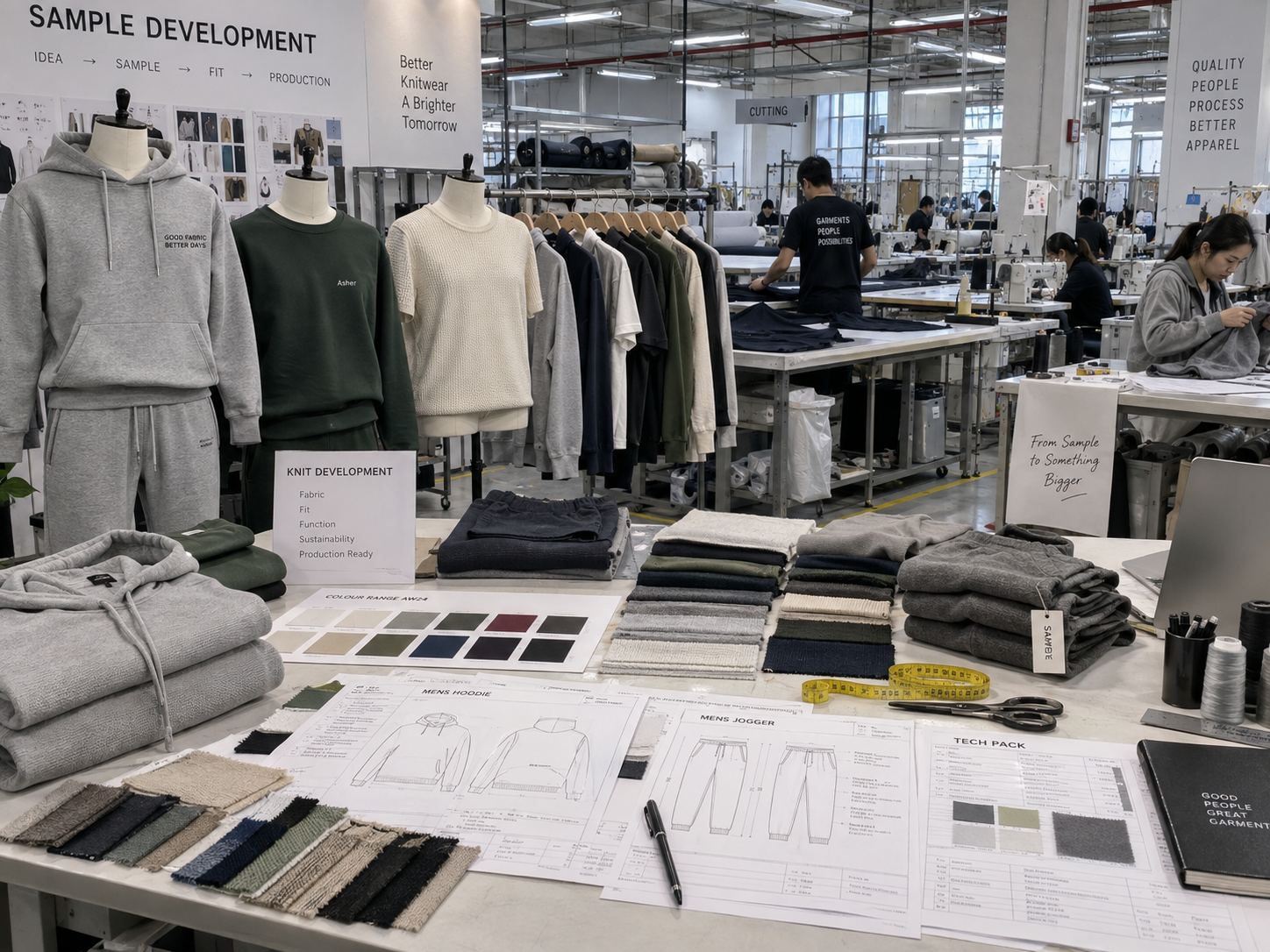
When a buyer starts working with a new clothing factory in China, sample timing often becomes the first real test. A late sample can delay photography, pre-orders, production, and even a full product launch. The problem is that “sample lead time” does not always mean the same thing from one supplier to another.
For most custom knit clothing, I normally tell buyers to expect about 7–14 days for sample production after all details are confirmed. Simple T-shirts may be faster, while heavyweight hoodies, custom-dyed fabrics, embroidery, washing, special trims, or complex construction can push the sample time to 2–4 weeks. International shipping usually adds another 3–7 days.
In my experience, the biggest delays rarely come from sewing itself. They usually happen before sewing starts. A missing Pantone color, unclear logo size, unavailable fabric, or one unanswered construction question can stop a sample for several days. That is why understanding the full sampling process matters much more than asking only, “How many days?”
Table of Contents
- How Long Does a Standard Clothing Sample Usually Take?
- What Actually Happens During the Clothing Sampling Process?
- What Factors Make Clothing Samples Take Longer?
- How Long Do Different Types of Knit Garments Take to Sample?
- Does Custom Fabric Increase the Sample Lead Time?
- How Much Time Do Printing and Embroidery Add?
- How Long Does Shipping a Clothing Sample from China Take?
- How Can Buyers Get Clothing Samples Faster?
- Should Buyers Always Choose the Factory with the Fastest Sample Time?
- What Information Should Buyers Prepare Before Requesting a Sample?
- Conclusion
- Footnotes & References
How Long Does a Standard Clothing Sample Usually Take?
For many buyers, the number they want is simple: how many days should I put into my development schedule? I understand that question because brands often work backward from launch dates, photoshoots, trade shows, or seasonal sales periods.
A standard custom knit clothing sample normally takes about 7–14 days after the factory receives complete specifications, confirms the fabric, receives the sample payment, and approves all artwork. Basic styles can sometimes be completed in 5–7 days. More complicated garments can take 15–30 days, especially when custom fabric, washing, embroidery, or special accessories are involved.
The important phrase here is “after everything is confirmed.”
Many buyers count from the day they first send an inquiry. A factory usually counts from the day all technical information is ready. Those two dates can be very different.
A Typical Sample Timeline
Here is a simple example of how I normally see a knitwear sample project move:
| Sampling Step | Typical Time |
|---|---|
| Tech pack and specification review | 1–2 days |
| Fabric sourcing or confirmation | 1–5 days |
| Pattern making | 1–3 days |
| Fabric cutting | 1 day |
| Printing or embroidery | 2–5 days |
| Sewing | 1–3 days |
| Washing or finishing | 1–3 days |
| Quality inspection | 1 day |
| Packing and courier arrangement | 1 day |
| DHL / UPS / FedEx shipping | 3–7 days |
These steps do not always happen one after another. A good factory can prepare the pattern while waiting for embroidery artwork or arrange trims while fabric is being sourced.
Still, every extra process creates another place where the schedule can move.
Production Time Is Not the Same as Delivery Time
I always separate these two numbers when speaking with buyers.
Sample production time is the time needed inside the supply chain.
Sample delivery time includes production plus international courier shipping.
For example:
Sample production: 10 days
DHL delivery to the United States: 4 days
Total expected time: about 14 days
This sounds simple, but separating these numbers avoids a lot of confusion later.
What Actually Happens During the Clothing Sampling Process?
A finished hoodie may look simple from the outside. Inside the factory, many decisions happen before that hoodie reaches the sewing machine.
The clothing sampling process normally includes specification review, fabric confirmation, pattern making, cutting, decoration, sewing, finishing, quality checking, and packing. Each stage depends on the information from the previous stage. If measurements, materials, colors, logos, or construction details are unclear, the factory may need buyer confirmation before moving forward.
I have seen buyers think that sample production means we simply “make one piece.”
In reality, we are building the production method for a future bulk order.
Step 1: Reviewing the Tech Pack
I first need to understand what the buyer actually wants.
I normally check:
- Garment measurements
- Fabric composition
- Fabric weight
- Pantone colors
- Fit
- Stitching method
- Rib specification
- Logo size
- Logo position
- Printing method
- Embroidery details
- Labels
- Hangtags
- Packaging
- Washing requirements
For apparel development, giving the factory a standardized color reference is much more useful than sending a phone photo and saying “something close to this.” Pantone's official Fashion, Home + Interiors color system[^1] is designed for industries including textiles and apparel, and TCX references are commonly used when communicating fabric colors.
If one of these items is missing, we need to decide whether we can make a reasonable development sample or whether the buyer must confirm the detail first.
Step 2: Finding the Correct Fabric
Fabric is often the most important part of knitwear sampling.
A 500 GSM cotton hoodie and a 320 GSM cotton-polyester hoodie may have the same drawing, but they will feel completely different.
If I already have suitable fabric available, sampling can move quickly.
If the buyer needs a specific composition, weight, finish, knit structure, or Pantone color, fabric sourcing can take longer.
Step 3: Making the Pattern
The pattern maker converts the measurements and design into actual garment pattern pieces.
This part matters a lot.
A factory can use good fabric and good sewing, but if the pattern is wrong, the final sample will still feel wrong.
For oversized streetwear, I pay close attention to areas such as:
- Shoulder drop
- Chest width
- Body length
- Sleeve width
- Sleeve length
- Hood shape
- Rib tension
For activewear, I need to think more about stretch, recovery, movement, and body fit.
Step 4: Decoration and Sewing
Once the pattern and fabric are ready, we can cut the garment.
Then the sample may go through screen printing, DTG, DTF, embroidery, appliqué, puff print, silicone print, washing, or other processes.
The garment then returns to the sewing team for assembly or final finishing.
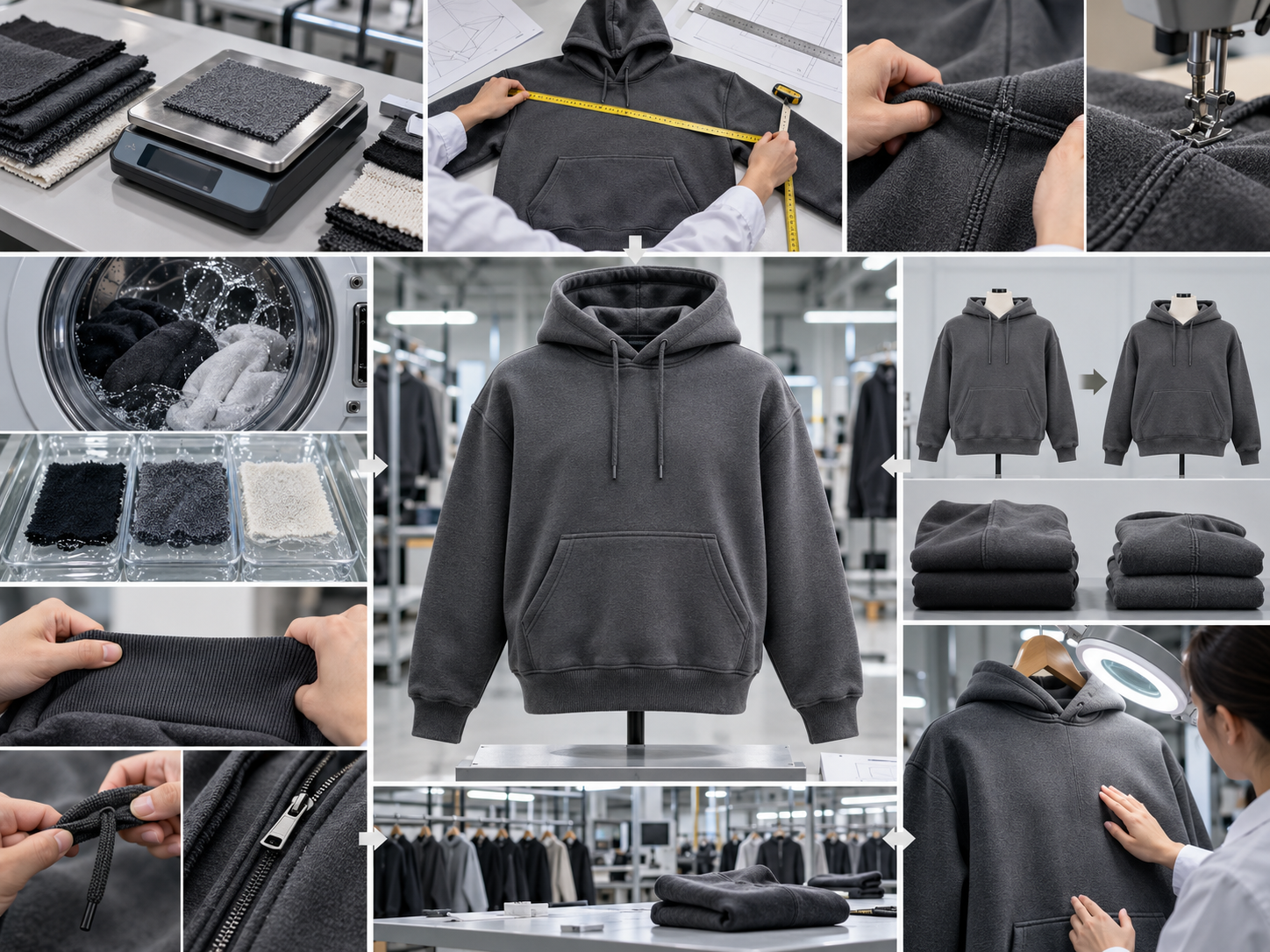
Step 5: Inspection Before Shipping
I do not think a sample should leave the factory just because it is finished.
I want to check:
- Measurements
- Logo placement
- Color
- Stitching
- Fabric surface
- Zippers
- Buttons
- Labels
- Finishing
- Overall appearance
A sample is often the buyer's first physical impression of the factory.
That first impression matters.
What Factors Make Clothing Samples Take Longer?
When someone asks me why one sample takes seven days and another takes three weeks, the answer is usually not the number of garments. The main issue is complexity.
The biggest causes of longer sample lead times are custom fabrics, special dye colors, complicated prints, embroidery, garment washing, custom trims, unclear tech packs, unusual construction, and repeated design changes. A simple garment made from available fabric moves quickly. A highly customized garment depends on several outside processes and therefore needs more development time.
Customization Creates More Steps
A basic black T-shirt with a small chest print may only need:
- Fabric
- Pattern
- Cutting
- Printing
- Sewing
- Inspection
A heavyweight streetwear hoodie may need:
- Custom fabric
- Custom dye color
- Pattern development
- Custom rib
- Screen print
- Appliqué embroidery
- Garment wash
- Custom zipper
- Woven neck label
- Wash label
- Hangtag
- Custom packaging
Both are “one sample.”
But they are not the same development job.
External Suppliers Can Affect the Schedule
Most professional garment factories work with specialist suppliers for some processes.
A factory may handle knitting, cutting, sewing, and finishing internally but still use specialized partners for:
- Embroidery
- Special printing
- Custom zippers
- Metal hardware
- Silicone patches
- Heat-transfer labels
- Garment washing
- Custom packaging
I always try to control the schedule, but each external process adds another production queue.
This is one reason I prefer to give buyers a realistic sample date instead of promising an unrealistic five-day sample for every design.
How Long Do Different Types of Knit Garments Take to Sample?
Different products need different levels of development. I would not give the same sample lead time for a plain T-shirt and a 600 GSM washed hoodie with appliqué embroidery.
Basic T-shirts often take around 5–10 days to sample. Sweatshirts, hoodies, joggers, and knit sets commonly take 7–14 days. Heavyweight streetwear, activewear, washed garments, or products with complex decoration often need 10–20 days. Highly customized developments using custom fabrics or trims can require 3–4 weeks or more.
Here is the range I normally use as a practical reference.
| Product Type | Typical Sample Time |
|---|---|
| Basic T-shirt | 5–10 days |
| Heavyweight T-shirt | 7–12 days |
| Tank top | 5–10 days |
| Sweatshirt | 7–12 days |
| Pullover hoodie | 7–14 days |
| Zip hoodie | 8–15 days |
| Joggers / sweatpants | 7–12 days |
| Hoodie + jogger set | 10–15 days |
| Activewear top | 7–14 days |
| Leggings | 7–14 days |
| Yoga set | 10–15 days |
| Garment-washed streetwear | 10–20 days |
| Complex embroidered hoodie | 12–20 days |
| Fully custom fabric development | 20–30+ days |
These are not guarantees.
They are working ranges.
Why Zip Hoodies Often Take Longer
A zipper looks like a small detail, but it adds several decisions.
The buyer may need to confirm:
- Zipper brand
- Zipper size
- Metal or plastic teeth
- Zipper color
- Tape color
- Slider shape
- Slider finish
- Custom puller
If the buyer requests a standard YKK zipper, the process may be simple. YKK itself offers a wide range of zipper types, sliders, finishes, and other fastening components in its official fastening product catalog[^2], which helps explain why “use a YKK zipper” still leaves several specifications to confirm.
If the buyer wants a custom molded zipper pull with a logo, the factory may need to make a mold first.
That can add both cost and time.
Does Custom Fabric Increase the Sample Lead Time?
Fabric development is one of the most common reasons a sample takes longer than expected.
Yes. Custom fabric can add several days or several weeks to clothing sample development. If a factory can use available stock fabric, sampling can start almost immediately. If the buyer requires a custom GSM, fiber blend, knit structure, Pantone dye, brushing, washing, or other finish, the fabric may need separate development before garment sampling begins.
I usually divide fabric into three situations.
Situation 1: Stock Fabric
This is the fastest option.
The fabric already exists in the supplier's warehouse.
For example:
- Black 100% cotton jersey
- 280 GSM jersey
- 320 GSM French terry
- 400 GSM fleece
- Standard cotton-polyester fleece
We can buy a small amount and begin development.
Situation 2: Similar Available Fabric
Sometimes the exact fabric is not available, but something very close is.
A buyer may request 380 GSM French terry, while the supplier has 400 GSM available.
For an early fit sample, using the 400 GSM fabric may make sense.
I always want the buyer to understand this before we proceed.
The sample can then be used to check:
- Fit
- Construction
- Measurements
- Logo placement
Later, the correct bulk fabric can be developed.
Situation 3: Fully Custom Fabric
This takes the longest.
The mill may need to:
- Source yarn
- Knit greige fabric
- Dye the fabric
- Finish the fabric
- Wash the fabric
- Test shrinkage
- Check weight
- Send the fabric to the garment factory
This can add two to four weeks before garment sampling even starts.
That does not mean custom fabric is a bad choice.
It simply means the development calendar needs to match the product.
How Much Time Do Printing and Embroidery Add?
Decoration can change the sample schedule more than many buyers expect. A logo may look like one small element in a tech pack, but the production method behind that logo can be completely different.
Simple digital printing may add only one or two days, while screen printing, embroidery, appliqué, puff print, chenille embroidery, silicone printing, or mixed techniques can add several days. The supplier may need to make screens, embroidery files, molds, templates, or test pieces before applying the final artwork to the garment.
Simple Logo vs. Complex Logo
Consider two hoodies.
Hoodie A
- Small embroidered chest logo
- One color
- Standard thread
- No special finish
Hoodie B
- Large back appliqué
- Chenille embroidery
- Sleeve embroidery
- Front puff print
- Custom color matching
The second hoodie clearly needs more time.
Artwork Quality Also Matters
Vector artwork makes development easier.
I prefer files such as:
- AI
- EPS
- SVG
These are widely used design formats, and Adobe's official Illustrator supported file format documentation[^3] confirms support for AI, PDF, EPS, and SVG in common Illustrator workflows.
A low-resolution screenshot often creates extra work.
The embroidery factory may need to redraw it.
The printing factory may need to clean the edges.
Then we need buyer approval again.
One poor artwork file can easily cost one or two days.
How Long Does Shipping a Clothing Sample from China Take?
After the sample is finished, buyers often want it immediately. International courier services are normally the fastest option for development samples.
DHL, UPS, and FedEx usually deliver clothing samples from China to major markets such as the United States, United Kingdom, Australia, and much of Europe in about 3–7 business days in many normal sample-shipping situations. Customs checks, remote destinations, holidays, incomplete addresses, or duties can sometimes make delivery longer.
I normally recommend express courier for samples.
A sample shipment is small, and the purpose is speed.
Using sea freight for one or two samples usually does not make sense.
Major express providers also make it clear that actual transit time depends on the service, origin, destination, and customs. Buyers can check DHL's official international shipping information[^4] or compare available services through UPS international shipping services[^5] before building a fixed arrival date into a launch schedule.
Typical Courier Transit Times
| Destination | Typical Express Transit |
|---|---|
| United States | 3–6 business days |
| United Kingdom | 3–6 business days |
| Germany / France / EU | 4–7 business days |
| Australia | 4–7 business days |
| UAE | 4–7 business days |
| Saudi Arabia | 4–7 business days |
The exact delivery time can change.
That is why I do not recommend planning a photoshoot for the exact day a courier estimate says the package will arrive.
Give yourself some room.
How Can Buyers Get Clothing Samples Faster?
Factories can improve production speed, but buyers also have a surprising amount of control over sample lead time.
The best way to get a clothing sample faster is to send complete specifications before sampling starts. Buyers should confirm the tech pack, measurements, fabric, Pantone colors, artwork, logo dimensions, trims, labels, packaging, and shipping details early. Fast feedback also matters because every unanswered question can stop the factory from moving to the next stage.
Send One Clear Tech Pack
I would rather receive one clear PDF than twenty separate WhatsApp messages.
A good tech pack should show:
- Front view
- Back view
- Measurements
- Fabric
- GSM
- Composition
- Color
- Stitching
- Logo size
- Logo position
- Labels
- Accessories
- Packaging
Confirm Logo Sizes
This is a very common issue.
“Large back logo” is not a measurement.
“About this size” is not a measurement.
I prefer something like:
Back print width: 32 cm
Distance from neckline seam: 4 cm
Now my production team has something clear to follow.
Reply Quickly
Sometimes a sample stops because the factory asks one question:
Should the zipper be silver or gunmetal?
The buyer replies three days later.
Those three days become part of the sample timeline.
I tell buyers that fast development needs fast communication from both sides.
Use Available Fabric for the First Fit Sample
For complicated designs, I sometimes recommend separating development into stages.
First sample: fit and construction.
Second sample: exact color and decoration.
This can be much faster than waiting for every custom material before checking the garment pattern.
Should Buyers Always Choose the Factory with the Fastest Sample Time?
I understand why buyers like fast factories. Speed matters, especially when a brand is preparing for a launch. Still, I would never choose a supplier based only on the shortest promised sample date.
No. The fastest quoted sample time does not always mean the best supplier. Buyers should compare speed with communication, fabric accuracy, pattern quality, decoration quality, quality control, certification credibility, production capacity, and the supplier's ability to repeat the approved sample during bulk production. A realistic 10-day sample can be safer than an unrealistic 3-day promise.
Where certifications are important to a sourcing decision, buyers should also verify claims through the organization behind the standard instead of relying only on a logo shown on a supplier's website. For example, buyers working with textile safety requirements can review the official OEKO-TEX® standards and documentation[^6] to understand what a certification actually covers.
This matters even more when you are choosing a long-term manufacturer.
A Sample Is Also a Supplier Test
When I work with a new buyer, the buyer is testing my factory.
At the same time, I am learning how the buyer works.
Sampling shows both sides:
- How quickly questions are answered
- Whether instructions are clear
- Whether problems are communicated
- Whether timelines are realistic
- Whether corrections are handled professionally
A beautiful sample is important.
But a good supplier relationship needs more than a beautiful sample.
Fast Sampling Can Hide Problems
A supplier may rush a sample by using:
- The wrong fabric
- A similar color
- Temporary trims
- Different stitching
- A different print method
This may help them ship quickly.
But the sample may not represent bulk production.
I prefer to tell a buyer when something is temporary.
For example:
We can use this stock fabric for the fit sample, but the bulk fabric will be custom dyed after color approval.
Now everyone understands what the sample is testing.
What Information Should Buyers Prepare Before Requesting a Sample?
The smoothest sample projects usually start before the first payment is made. When the buyer prepares the right information, I can check feasibility and identify risks much earlier.
Before requesting a clothing sample, buyers should prepare the garment design, size chart, fabric composition, GSM, color reference, logo artwork, logo dimensions, printing or embroidery method, labels, trims, packaging requirements, sample size, shipping address, and target bulk quantity. The more complete the information is, the more accurate the sample price and timeline will be.
I recommend preparing this basic checklist:
| Information | Example |
|---|---|
| Product | Oversized pullover hoodie |
| Fabric | 100% cotton French terry |
| Weight | 400 GSM |
| Color | Pantone 19-4006 TCX |
| Sample size | Large |
| Fit | Oversized |
| Front logo | 8 cm embroidery |
| Back logo | 32 cm screen print |
| Neck label | Woven label |
| Wash label | Printed satin |
| Packaging | Individual polybag |
| Bulk quantity | 300 pcs |
| Destination | Los Angeles, USA |
With this information, I can give a much more useful answer than simply saying, “Yes, we can make it.”
One Personal Lesson I Learned
Early in my work with overseas buyers, I used to focus too much on giving the fastest possible answer.
A buyer would ask, “Can you finish the sample in seven days?”
My instinct was to say yes.
Later, I learned that a realistic answer builds more trust than an attractive answer.
If the embroidery alone needs four days and the fabric needs three days, promising a seven-day finished sample leaves no room for correction.
Now I prefer to break the timeline down.
I tell the buyer what we are waiting for, what we can do at the same time, and where the risk is.
That approach may sound less exciting at the beginning.
But it creates much fewer surprises at the end.
Conclusion
A China knit clothing sample usually needs about 7–14 days to produce and another 3–7 days to ship. Simple garments can be faster, while custom fabrics, complex decoration, washing, and special trims take longer.
The biggest lesson I have learned is that sample speed is not only about how fast a factory can sew. It depends on how quickly the fabric, artwork, pattern, trims, decoration, and buyer approvals can all come together.
For buyers, the easiest way to shorten the timeline is simple: prepare clear specifications, provide accurate artwork, confirm colors and measurements early, and reply quickly when the factory has a question.
A realistic sample timeline may not always sound as attractive as a three-day promise, but it gives both the buyer and manufacturer a much better chance of getting the product right before bulk production begins.
Footnotes & References
[^1]: Pantone — Fashion, Home + Interiors (FHI). Official Pantone color system for fashion, textiles, apparel, and soft goods.
https://www.pantone.com/na/en-us/fashion-home-interiors
[^2]: YKK Fastening Products Group — Product Search. Official YKK resource covering zipper types, sliders, finishes, and fastening products.
https://www.ykkfastening.com/products/search/
[^3]: Adobe — Supported File Formats in Illustrator. Official Adobe documentation covering AI, PDF, EPS, SVG, and other artwork formats commonly used in design and production workflows.
https://helpx.adobe.com/illustrator/desktop/get-started/learn-the-basics/supported-file-formats.html
[^4]: DHL Express — International Shipping Information. Official DHL information covering international express shipping and shipment handling.
https://www.dhl.com/cn-en/home/express/shipping-and-tracking/shipping.html
[^5]: UPS — International Shipping Services. Official UPS information covering international shipping options and services.
https://www.ups.com/us/en/support/international-tools-resources/international-shipping-services
[^6]: OEKO-TEX® — Standards and Official Documentation. Official OEKO-TEX® information and documentation covering textile standards including STANDARD 100.
https://www.oeko-tex.com/en/downloads/