
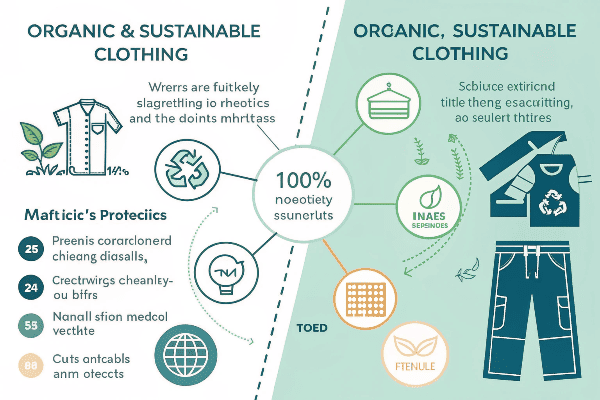
When I first entered the apparel industry, I often saw "organic" and "sustainable" used as if they meant the same thing. But as I worked more closely with fabric sourcing and certifications, I realized they point to different—but sometimes overlapping—concepts.
Organic clothing is made from materials grown without synthetic chemicals, while sustainable clothing focuses on minimizing overall environmental and social impact throughout the product's life cycle.
I learned this the hard way after launching an "organic cotton" line that wasn’t recyclable due to mixed materials in the trims. That’s when I began to understand what true sustainability really involves.
Table of Contents
- What is organic clothing?
- What is sustainable clothing?
- How do they overlap—and how are they different?
- Conclusion
What is organic clothing?
Let’s start with the basics—what makes clothing "organic"?
Organic clothing is made from fibers grown without synthetic pesticides, fertilizers, or genetically modified seeds, usually certified by standards like GOTS or USDA Organic[^1].
Key features of organic clothing:
| Aspect | Details |
|---|---|
| Materials | Organic cotton, hemp, linen |
| Farming Practices | No chemicals, natural pest control |
| Certifications | GOTS, USDA Organic |
| Impact Focus | Soil health, water safety, farmer well-being |
In one of our lines, we switched to organic cotton and noticed less skin sensitivity in customer reviews—proof that better farming can improve user experience. This aligns with data from Textile Exchange, which highlights reduced water pollution and healthier ecosystems[^2].
What is sustainable clothing?
Sustainability looks beyond farming—it considers the garment’s full life cycle.
Sustainable clothing is designed, produced, and distributed with minimal environmental harm and fair social practices, often prioritizing longevity and recyclability.
Key components of sustainability:
- Ethical labor standards
- Efficient water and energy use
- Low-waste manufacturing
- Biodegradable or recyclable packaging
- Garment durability and repairability
For example, Patagonia uses recycled polyester, Fair Trade sewing, and repair services to reduce impact across their product life cycles[^3]. I once worked with a buyer who wanted T-shirts made from recycled polyester. They weren’t organic, but the sustainability impact was strong because they reused waste and required less water than cotton.
How do they overlap—and how are they different?
The terms "organic" and "sustainable" often overlap, but they’re not interchangeable.
Organic focuses on how the raw material is grown. Sustainable considers the full picture—from farming to factory to landfill.
Comparison Table:
| Category | Organic Clothing | Sustainable Clothing |
|---|---|---|
| Focus Area | Farming method | Entire lifecycle |
| Fiber Source | Natural and chemical-free | Natural or recycled, chemical-conscious |
| Certifications | GOTS, USDA Organic | GOTS, OEKO-TEX, Fair Trade, CarbonNeutral |
| Labor Practices | Not always included | Always included |
| End-of-Life | May or may not be recyclable | Often designed for recyclability or biodegradability |
If your brand goal is to reduce chemical exposure—go organic. If you're building for circular fashion—go sustainable. Ideally, do both. Resources like Earth.org’s guide to sustainable fashion are great for understanding how to combine both paths effectively[^4].
Conclusion
Organic clothing is about clean farming. Sustainable clothing is about long-term responsibility. Understanding the difference helps you make better choices for your brand and the planet.
Want to align your sourcing strategy with both organic and sustainable values? Check out Common Objective, a platform that connects ethical fashion businesses and suppliers globally[^5].
[^1]: USDA Blog. "What the USDA Organic Label Means." https://www.usda.gov/media/blog/2012/10/05/organic-101-what-usda-organic-label-means
[^2]: Textile Exchange. "Organic Cotton: Impact and Insights." https://textileexchange.org/organic-cotton/
[^3]: Patagonia. "Our Footprint." https://www.patagonia.com/our-footprint/
[^4]: Earth.org. "A Practical Guide to Sustainable Fashion." https://earth.org/guide-to-sustainable-fashion/
[^5]: Common Objective. "Sustainable Fashion Business Platform." https://www.commonobjective.co/