
Clothing Manufacturing Cost: How Much Does It Cost to Make Custom Clothing?
You send the same hoodie photo to three factories.
Factory A says:
US$9.
Factory B says:
US$16.
Factory C says:
US$24.
Now you have a problem.
Is the US$24 factory expensive?
Is the US$9 factory cutting corners?
Or are the three factories simply quoting three different products?
Very often, it is the third answer.
Clothing manufacturing cost depends on the complete product specification: fabric composition, GSM, fabric consumption, pattern, construction, quantity, colors, trims, printing or embroidery, washing, labels, packaging, quality requirements, and delivery terms. You cannot compare two garment prices properly until you know whether both factories are quoting the same specification and the same Incoterm.
I work with custom clothing production in Dongguan, and I normally do not trust a very precise quotation when the buyer has only sent me one product photo.
There are too many unanswered questions.
Is the hoodie:
- 320 GSM or 500 GSM?
- 100% cotton or cotton/polyester?
- French terry or fleece?
- Standard fit or oversized?
- One-color screen print or dense embroidery?
- Stock black or custom Pantone?
- 50 pieces or 500 pieces?
- Factory price or delivered price?
Change any one of those and the cost can move.
So instead of asking:
How much does a hoodie cost?
a more useful question is:
What is making this hoodie cost what it costs?
Table of Contents
- What Makes Up the Cost of a Garment?
- Is Fabric Always the Biggest Cost?
- How Does GSM Affect Garment Cost?
- Why Does Fabric Composition Change the Price?
- Why Does an Oversized Fit Cost More?
- How Does Order Quantity Change Unit Cost?
- Why Do More Colors Increase Cost?
- How Much Do Printing and Embroidery Affect Cost?
- How Do Pockets and Construction Affect Sewing Cost?
- How Much Do Custom Trims Add?
- Do Washing and Finishing Add Cost?
- Why Does a Sample Cost More Than One Bulk Garment?
- What Is the Difference Between Factory Cost and Landed Cost?
- What Do EXW, FOB, and DDP Actually Mean?
- How Do Import Duty and HS Classification Affect Cost?
- What Other Costs Should You Budget For?
- How Can You Reduce Manufacturing Cost Without Making the Product Cheap?
- What Should You Send to Get an Accurate Quote?
- How Should You Compare Quotes From Different Factories?
- Conclusion
- Footnotes & References
What Makes Up the Cost of a Garment?
A garment price may appear as one number on a quotation.
Behind that number are multiple cost areas.
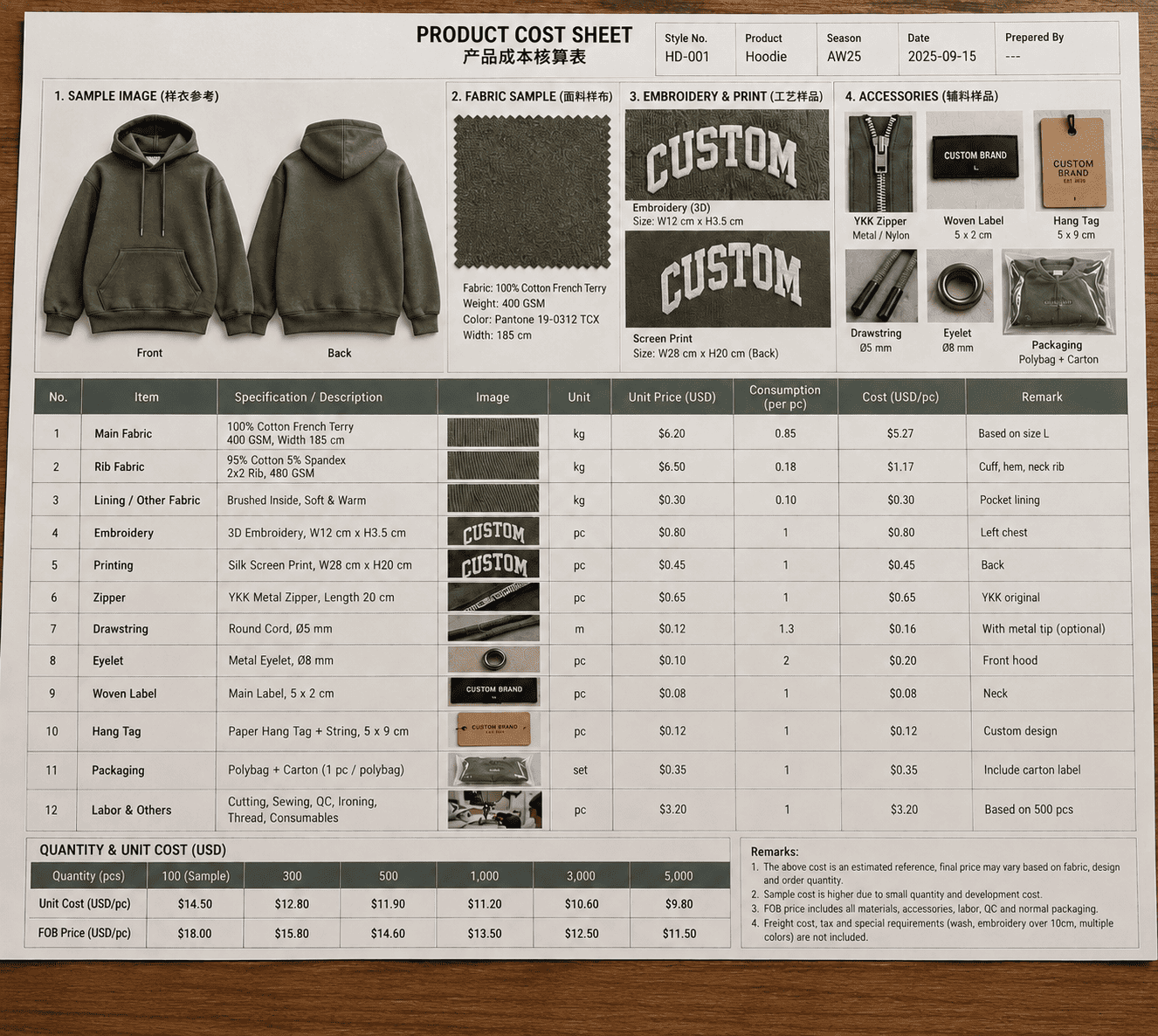
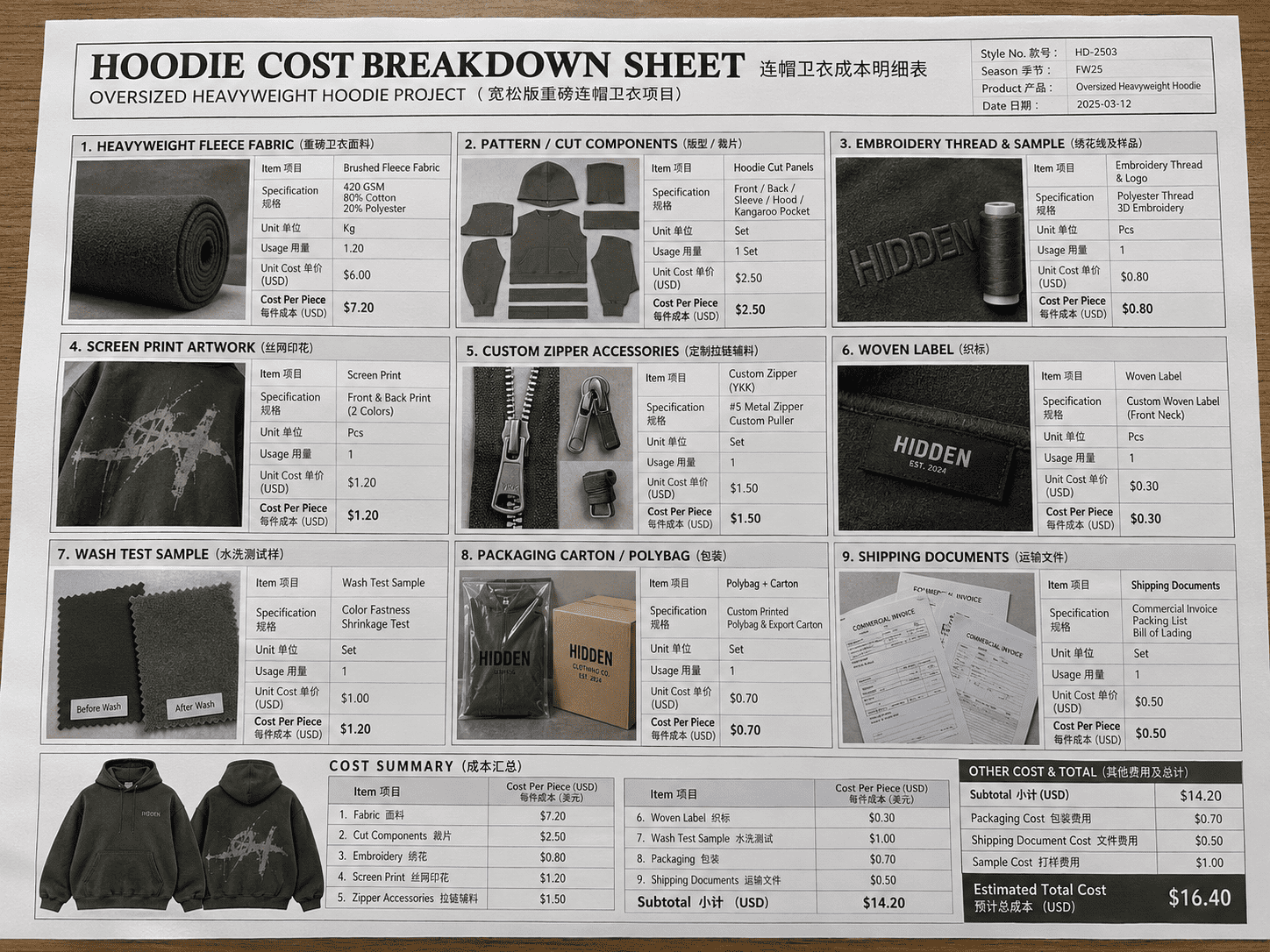
Typical components include:
| Cost Area | What Changes It |
|---|---|
| Fabric | Composition, yarn, GSM, consumption, finish |
| Trims | Zippers, rib, drawcord, buttons, labels |
| Cutting | Pattern complexity, fabric behavior |
| Sewing | Number of operations and construction difficulty |
| Decoration | Print, embroidery, rhinestones, appliqué |
| Washing/finishing | Garment dye, enzyme wash, vintage effects |
| Packaging | Polybags, tags, boxes, stickers |
| Quality control | Inspection requirements and rework risk |
| Factory overhead | Staff, machinery, utilities, administration |
| Margin | Required for the manufacturer to operate sustainably |
The percentage represented by each part changes from style to style.
For a plain T-shirt, fabric may dominate.
For a heavily embroidered hoodie, decoration becomes much more important.
For a six-pocket cargo pant, sewing labor and trims may become a larger share.
For a technical jacket, zippers, membranes, seam tape, lining and insulation can change everything.
So there is no universal garment-cost pie chart that applies to every style.
Is Fabric Always the Biggest Cost?
Fabric is often one of the largest cost components, particularly in knit basics.
CottonWorks notes in its Designing Knit Textiles guide[^1] that fabric can drive around 60% of total garment price in the knit-development context it describes.
But I would not turn that into:
Fabric is always exactly 60% of every garment.
It is a useful illustration, not a universal costing formula.
Fabric Cost Itself Has Several Layers
It depends on:
- Fiber
- Yarn count
- Yarn quality
- Spinning method
- Fabric structure
- GSM
- Finishing
- Color
- Quantity
CottonWorks also notes that finer yarns, longer-staple cotton and more complex yarn or knitting choices can change textile cost.[^1]
That is why two fabrics that both say:
100% cotton
can have very different prices.
How Does GSM Affect Garment Cost?
GSM means:
grams per square meter.
It tells you the mass of one square meter of fabric.
In general, if two fabrics have similar:
- Composition
- Yarn quality
- Construction
- Finishing
the heavier fabric normally requires more fiber per area.
That tends to increase cost.
For example:
180 GSM jersey
and:
500 GSM fleece
are completely different products.
But GSM Alone Does Not Determine Price
A premium 220 GSM long-staple cotton fabric may cost more per kilogram or meter than a basic heavier fabric.
So do not ask only:
How much is 400 GSM?
Also ask:
- Composition?
- Yarn?
- Fabric structure?
- Finish?
- Width?
These variables affect the real consumption and material cost.
Why Does Fabric Composition Change the Price?
Consider these three hoodie fabrics:
100% cotton
80% cotton / 20% polyester
90% cotton / 10% polyester
They may share the same GSM.
They can still differ in:
- Price
- Hand feel
- Shrinkage
- Surface
- Performance
Cotton Quality Matters Too
Not every cotton yarn costs the same.
For example:
- Open-end
- Ring-spun
- Combed
- Long-staple
can have different textile costs.
The buyer should specify the result they need instead of assuming that every fabric labeled:
100% cotton
is equivalent.
Why Does an Oversized Fit Cost More?
Fabric cost depends on consumption, not only GSM.
An oversized hoodie may have:
- Wider chest
- Wider sleeves
- Drop shoulder
- Larger hood
- Longer rib
That means more fabric per garment.
Compare:
Slim M hoodie
with:
Boxy oversized M hoodie.
The size label may be identical.
Fabric consumption is not.
Pattern Efficiency Matters
The cutting room tries to arrange pattern pieces efficiently on the fabric.
This is called marker efficiency.
Large or unusual pattern pieces can create more cutting waste.
So even two garments with similar finished weight may have different fabric consumption.
How Does Order Quantity Change Unit Cost?
Quantity changes cost because some expenses are fixed or semi-fixed.
Suppose a design requires:
- Pattern setup
- Embroidery digitizing
- Screen preparation
- Line setup
- Special trim ordering
Those costs must be absorbed by the order.
If the order is:
50 pieces
each piece carries more of the setup burden.
If the order is:
500 pieces
that setup is spread more widely.
Our Practical Starting MOQs
For many of our current custom projects:
| Product | Practical Starting MOQ |
|---|---|
| Hoodie / sweatshirt | 50 pcs |
| Zip hoodie | 50 pcs |
| Matching set | Around 50 sets |
| T-shirt | 100 pcs |
| Shorts | 100 pcs |
| Kidswear | Around 150 pcs |
Actual MOQ can still change with:
- Fabric
- Color
- Wash
- Hardware
- Decoration
Size Spread Also Matters
For 50 hoodies, we normally want to keep the size spread practical.
For example:
50 pcs across four sizes
is easier than splitting the same quantity across:
seven sizes.
If a buyer needs five or more sizes, increasing total quantity can make production more practical.
Why Do More Colors Increase Cost?
Buyers often think:
100 pieces is 100 pieces.
But:
100 black hoodies
and:
20 black
20 cream
20 brown
20 blue
20 green
are different production plans.
Each color may create separate:
- Fabric requirements
- Cutting setup
- Sorting
- Decoration setup
- QC
Fabric Supplier MOQ Matters
The garment factory may accept a relatively small garment quantity.
The textile mill may not accept:
15 kg of a custom color.
This is why custom colors can create hidden fabric minimums.
Stock Colors Help Small Orders
If the fabric is already available in:
- Black
- Grey
- Navy
small-batch development becomes much easier.
When you request:
Custom Pantone 18-1028 TCX
the mill may need to dye a separate lot.
That changes both cost and lead time.
How Much Do Printing and Embroidery Affect Cost?
Decoration should be priced from the actual artwork.
Not from:
Small logo.
Embroidery
Important cost factors include:
- Stitch count
- Size
- Density
- Number of placements
- Technique
A small chest embroidery might be relatively simple.
A dense full-back embroidery can become one of the most expensive parts of the garment.
Screen Printing
Cost can change with:
- Number of colors
- Print area
- Number of placements
- Ink system
- Garment color
A one-color chest print is not the same as a six-color full-back graphic.
Rhinestones
Cost depends heavily on:
- Stone count
- Size
- Material
- Colors
- Placement
There can also be a separate template/setup charge.
Combine Techniques Strategically
For some streetwear products:
Small chest embroidery
- large back screen print
may make more sense than filling the entire back with dense embroidery.
The best choice depends on the design, not simply which technique sounds more premium.
How Do Pockets and Construction Affect Sewing Cost?
Labor cost follows operations.
A basic T-shirt may require relatively few sewing steps.
A cargo pant may include:
- Front pockets
- Back pockets
- Cargo pockets
- Flaps
- Bartacks
- Fly zipper
- Waistband
- Hem adjusters
Every additional operation adds:
- Time
- Sewing
- Handling
- QC
Jackets Show This Clearly
Compare:
Jacket A
Simple coach jacket
Two pockets
Standard snap closure
with:
Jacket B
Technical shell
Multiple panels
Adjustable hood
Waterproof-style zipper
Pit zips
Seam tape
Five pockets
They cannot cost the same simply because both are called jackets.
How Much Do Custom Trims Add?
Trims are where brands often discover unexpected setup costs.
Examples include:
- Woven labels
- Hangtags
- Zipper pullers
- Buttons
- Drawcord tips
- Boxes
For some of our current projects, supplier setup structures may look like:
- Woven labels: supplier minimum applies
- Hangtags: separate minimum and setup
- Custom zipper puller: mold/tooling charge
- Rhinestone design: template/setup charge
- Appliqué embroidery: template/setup charge
These costs are not necessarily large on a 1,000-piece order.
They become much more noticeable on 50 pieces.
Reuse Helps
If possible, use the same:
- Main label
- Size label
- Hangtag
- Zipper pull
- Packaging
across multiple styles.
That spreads supplier minimums and keeps your collection visually consistent.
Do Washing and Finishing Add Cost?
Yes.
Possible finishes include:
- Enzyme wash
- Pigment wash
- Acid-style wash
- Vintage wash
- Garment dye
- Silicone finish
Each creates another production process.
Some also increase risk because the finish can change:
- Color
- Shrinkage
- Hand feel
- Measurements
Special Washes Need Development
A buyer may show us a washed-black reference.
That look often cannot be priced accurately from a photo alone.
We may need to develop:
- Base fabric
- Base dye
- Wash recipe
- Finishing
before confirming the final result.
Why Does a Sample Cost More Than One Bulk Garment?
Because the sample absorbs development costs almost by itself.
A sample may require:
- Pattern making
- Fabric sourcing
- Individual cutting
- One-piece sewing
- Embroidery digitizing
- Print setup
- Special trim sourcing
- Revision
Bulk production spreads those activities across more pieces.
So:
Sample price ≠ bulk unit price.
Samples are normally paid before development.
If any sample or setup charge will later be credited against bulk, that should be specifically agreed for the project rather than assumed.
What Is the Difference Between Factory Cost and Landed Cost?
This distinction is essential.
The price of the garment at the factory is not necessarily the price of getting the garment into your warehouse.
A buyer may eventually pay for:
- Product
- Sample/development
- Inspection
- Testing
- Export handling
- Freight
- Insurance where applicable
- Import duty
- Tax
- Customs/broker fees
- Final delivery
Together, these form a much more useful view of the landed cost.
Do Not Compare Different Quote Bases
If Supplier A gives:
US$12 factory price
and Supplier B gives:
US$16 delivered price
the US$12 supplier is not automatically cheaper.
First make the quote bases comparable.
What Do EXW, FOB, and DDP Actually Mean?
These are Incoterms® rules published by the International Chamber of Commerce.
The current official rules are ICC Incoterms® 2020[^2].
They define responsibilities for:
- Delivery
- Transport
- Risk
- Export/import formalities
- Certain costs
They do not simply mean:
cheap price
medium price
expensive price.
EXW — Ex Works
Under EXW, the seller generally makes the goods available at the agreed location, often the factory.
The buyer takes on most onward:
- Transport
- Risk
- Export/import arrangements
ICC notes that EXW can create practical difficulties in international exports when the buyer cannot easily complete export formalities in the seller's country; FCA can be more appropriate in such cases.[^2]
FOB — Free on Board
FOB applies to:
sea or inland-waterway transport.
Under FOB, the seller delivers the goods on board the vessel at the named port of shipment.
The buyer then handles the main international freight and subsequent risks/costs according to the rule.
An important detail:
ICC notes that FOB is often not the best choice for typical container shipments where the seller hands the container to a terminal before it is actually loaded on board; FCA may fit that flow better.[^2]
So:
FOB Shenzhen
should not be used just because it sounds familiar.
Use the Incoterm that actually reflects the transaction.
DDP — Delivered Duty Paid
DDP places much more responsibility on the seller.
The seller is generally responsible for:
- Transport to named destination
- Export clearance
- Import clearance
- Applicable import duties/taxes
until delivery at the agreed destination.
But even DDP does not literally mean:
Buyer can never pay another cent.
Under Incoterms® 2020, unloading from the final arriving vehicle is normally the buyer's risk and may also be the buyer's cost unless the seller's transport contract already includes it.[^2]
Also, in some countries a foreign seller may not legally or practically be able to act as importer.
So DDP needs to be structured carefully.
How Do Import Duty and HS Classification Affect Cost?
Duty can materially change landed cost.
For the United States, the U.S. International Trade Commission's Harmonized Tariff Schedule[^3] sets out tariff classifications and applicable duty rates.
Clothing classification can depend on details such as:
- Product type
- Knit or woven
- Fiber composition
- Gender/category
- Construction
That is why:
Hoodie
is not enough information to calculate import duty accurately.
Duty Rates Are Not One Flat Apparel Percentage
U.S. Customs and Border Protection explains that determining the duty rate starts with identifying the product's correct HTS classification.[^4]
So when estimating landed cost, do not simply add:
10% clothing tax.
The real rate depends on the classification and any applicable additional tariff measures or preference programs.
Use the current tariff schedule and qualified customs advice when necessary.
What Other Costs Should You Budget For?
Depending on the project, you may need to include:
Testing
Especially for:
- Children's products
- Performance claims
- Buyer-specific requirements
Inspection
You may choose:
- Factory QC
- Third-party pre-shipment inspection
- Laboratory testing
Labels
For apparel sold in the United States, the FTC Apparel and Labeling guidance[^5] covers required information such as:
- Fiber content
- Country of origin
- Responsible company identity
The FTC Care Labeling Rule[^6] also requires covered garments to carry regular-care instructions supported by a reasonable basis.
Those requirements need to be included in product development, not added at the last second.
Sample Courier
A sample may cost:
US$X to manufacture
plus:
courier cost
to reach the buyer.
Keep those separate in your budget.
How Can You Reduce Manufacturing Cost Without Making the Product Cheap?
Cost reduction does not always mean lowering fabric quality.
Often the smartest savings come from reducing unnecessary complexity.
1. Use Fewer Colors
Instead of:
Five colors × 20 pcs
consider:
Two colors × 50 pcs.
2. Use Stock Fabric Where It Works
Custom knitting and dyeing are useful when the product needs them.
Do not pay for them when an existing fabric already matches your requirement.
3. Concentrate Quantity
One strong style at 300 pieces may have better cost efficiency than three styles at 100 pieces each.
4. Reuse Trims
Use one:
- Main label
- Hangtag
- Drawcord
- Zipper puller
across the collection where appropriate.
5. Use Decoration Where Customers Notice It
Do you really need:
Full-back embroidery
or would:
Screen print + small embroidery
deliver the same design intent?
6. Remove Construction That Adds No Value
A pocket, panel or zipper should have a reason.
If the customer never sees or uses it, decide whether it is worth the cost.
7. Lock Specifications Before Bulk
Late design changes create some of the most avoidable costs in garment production.
What Should You Send to Get an Accurate Quote?
A useful quote request should include:
Product
Oversized pullover hoodie
Quantity
100 pcs
Color Split
50 black / 50 grey
Size Range
S–XL
Fabric
100% cotton fleece
400 GSM
Fit
Oversized / drop shoulder
Decoration
8 cm chest embroidery
30 cm back screen print
Trims
Custom woven neck label
Care label
Packaging
Individual polybag
Destination
Los Angeles, USA
Quote Requirement
For example:
Please quote garment price and DDP separately.
Now the factory can give you a meaningful price.
How Should You Compare Quotes From Different Factories?
Do not compare only the last number.
Build a comparison table.
| Item | Factory A | Factory B | Factory C |
|---|---|---|---|
| Fabric composition | ? | ? | ? |
| GSM | ? | ? | ? |
| Fabric structure | ? | ? | ? |
| Quantity | ? | ? | ? |
| Decoration | ? | ? | ? |
| Labels | ? | ? | ? |
| Packaging | ? | ? | ? |
| Trade term | ? | ? | ? |
| Shipping included | ? | ? | ? |
Then ask:
Are these actually the same product?
A Lower Quote Is Not Automatically Bad
A factory may genuinely have:
- Better fabric purchasing
- More efficient production
- Lower overhead
- Existing materials
A Higher Quote Is Not Automatically Better
Price does not guarantee quality either.
The goal is not:
Find the cheapest factory.
or:
Find the most expensive factory.
The goal is:
Compare the same specification, understand what is included, and decide which supplier can reliably deliver the product you need.
Conclusion
There is no honest universal answer to:
How much does it cost to manufacture custom clothing?
The price comes from the specification.
The most important cost drivers usually include:
- Fabric
- GSM and consumption
- Composition and yarn
- Quantity
- Colors
- Construction
- Printing and embroidery
- Custom trims
- Washing and finishing
- Packaging
Then you still need to understand the cost beyond the garment itself:
- Samples
- Testing
- Inspection
- Freight
- Duty and customs
- Delivery
That is why a US$9 quote and a US$16 quote can both be technically correct.
Maybe the US$9 hoodie is:
280 GSM cotton/poly fleece
Standard fit
One-color print
EXW
and the US$16 hoodie is:
400 GSM 100% cotton fleece
Oversized fit
Embroidery + print
Custom labels
Different delivery term.
Those are not the same garment.
Before asking:
Can you lower the price?
first ask:
What exactly is included in the price?
And before comparing two factories, make sure both factories are quoting:
- The same fabric
- The same GSM
- The same fit
- The same decoration
- The same trims
- The same quantity
- The same packaging
- The same delivery basis
A good clothing manufacturer should be able to explain why a garment costs what it costs.
For me, that is much more useful than giving the lowest number first and changing the price later.
Lock the specification.
Understand the cost drivers.
Compare like with like.
Then you can make a sourcing decision based on a real product instead of three numbers that were never comparable in the first place.
Footnotes & References
[^1]: CottonWorks™ — Designing Knit Textiles. Cotton Incorporated explains how yarn, yarn size, staple length, spinning method, knit construction and fabric design influence textile cost, and notes that fabric can represent a major share of total garment price in knit-product development.
https://cottonworks.com/learning-hub/knitting/designing-knit-textiles/
[^2]: International Chamber of Commerce — Incoterms® 2020. ICC publishes the official Incoterms® rules defining responsibilities, delivery points, costs and risk allocation between buyer and seller. ICC guidance also explains practical distinctions between EXW, FOB, FCA and DDP and notes that FOB is restricted to sea/inland-waterway transport.
https://iccwbo.org/business-solutions/incoterms-rules/incoterms-2020/
https://academy.iccwbo.org/incoterms/article/incoterms-2020-exw-or-ddp/
[^3]: U.S. International Trade Commission — Harmonized Tariff Schedule of the United States. The current HTS provides the legal tariff classifications and duty-rate structure for merchandise imported into the United States.
https://hts.usitc.gov/
[^4]: U.S. Customs and Border Protection — Determining Duty Rates. CBP explains that determining duty starts with correctly identifying the applicable HTS classification and directs importers to the U.S. International Trade Commission tariff database for current tariff information.
https://www.cbp.gov/trade/programs-administration/determining-duty-rates
[^5]: U.S. Federal Trade Commission — Apparel and Labeling. FTC guidance covers textile-apparel requirements including fiber content, country of origin and identification of the manufacturer or responsible marketer for most covered products sold in the United States.
https://www.ftc.gov/news-events/topics/tools-consumers/apparel-labeling
[^6]: U.S. Federal Trade Commission — Care Labeling Rule. The FTC requires manufacturers and importers of covered textile apparel to provide regular-care instructions and to have a reasonable basis for those instructions.
https://www.ftc.gov/legal-library/browse/rules/care-labeling-textile-wearing-apparel-certain-piece-goods