

Clothing Tech Pack: What Should You Send a Manufacturer to Get the Right Sample?
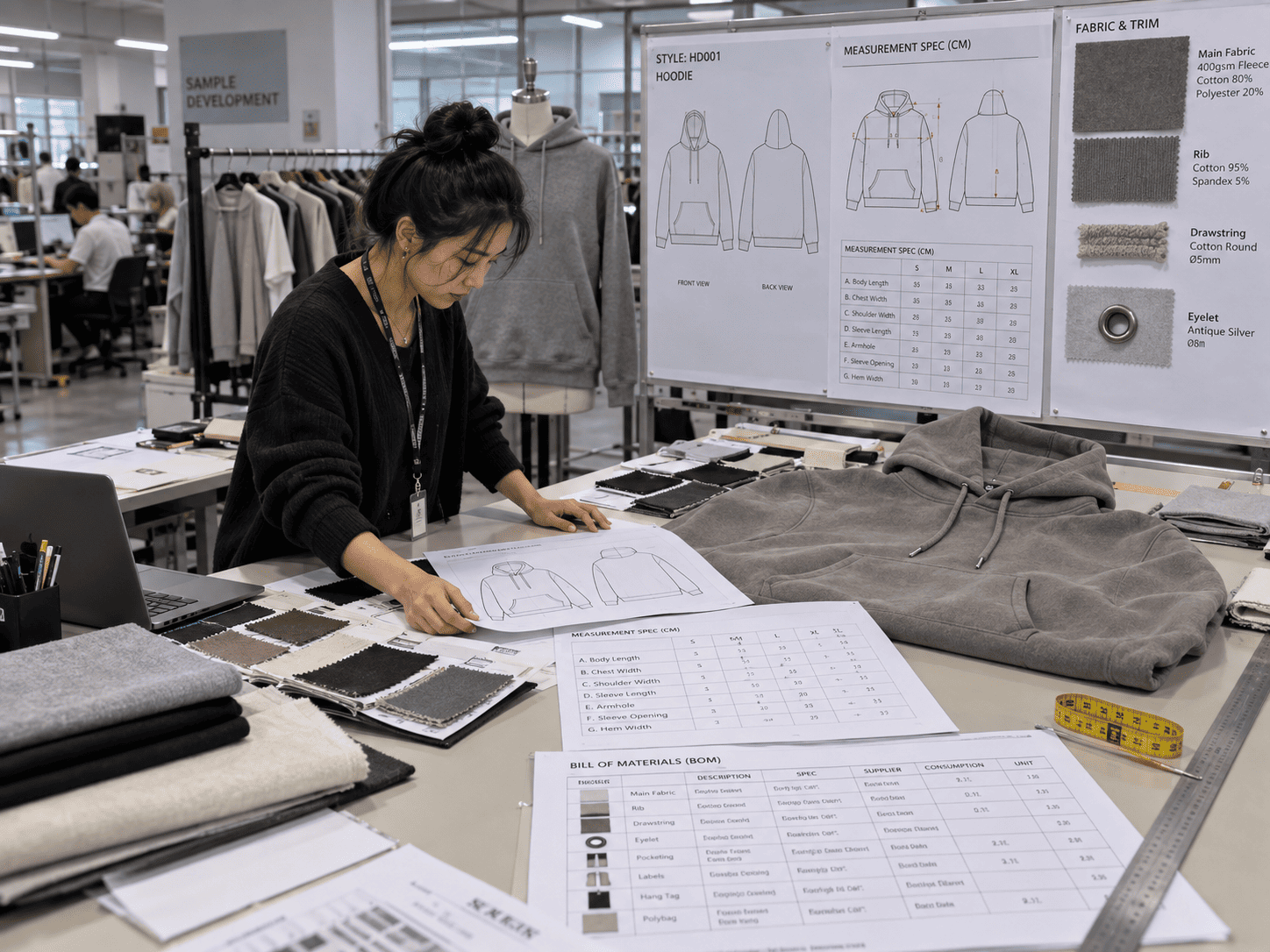
You sent a factory three reference photos and one message:
I want an oversized premium hoodie like this.
Two weeks later, the sample arrives.
The chest is too narrow.
The hood is too small.
The black is not the black you expected.
The embroidery is in the wrong position.
You think the factory made it incorrectly.
The factory thinks it followed the information you sent.
Both sides lose time.
A clothing tech pack is the technical instruction document that tells a manufacturer what garment to make. It should define the design, measurements, measurement methods, fabric, colors, trims, construction, artwork, labels, packaging, tolerances, and revisions so the factory can quote, sample, manufacture, and inspect the same product instead of filling information gaps with assumptions.
I work with custom garment development in Dongguan, and I can usually tell very early whether a sample project will move quickly.
It is not simply about whether the brand is large or small.
It is about how clearly the product has been defined.
A complete tech pack does not guarantee that Sample V1 will be perfect.
But it removes many unnecessary guesses.
And every guess removed before sampling saves time later.
Table of Contents
- What Is a Clothing Tech Pack?
- Why Does a Garment Factory Need a Tech Pack?
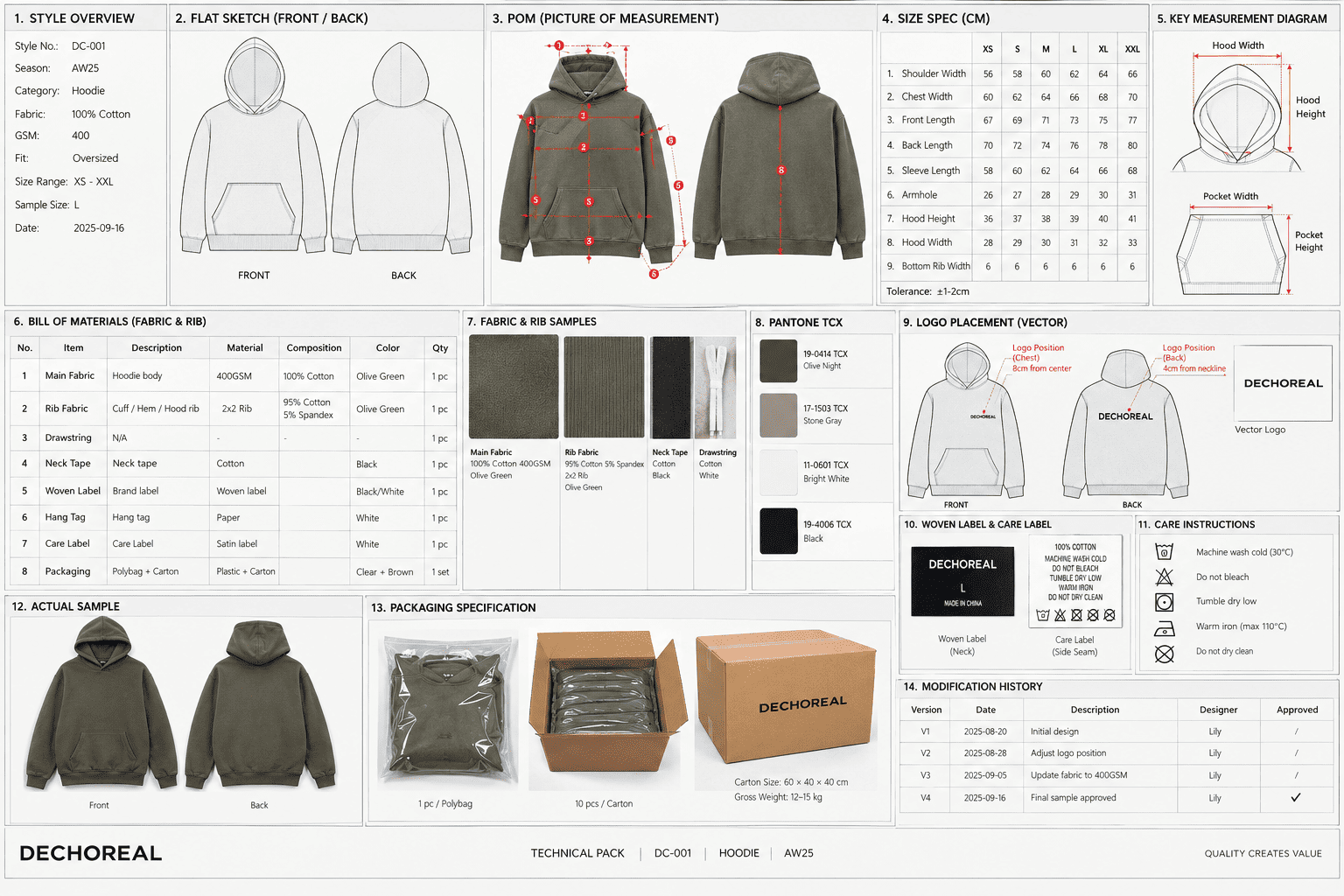
- What Should a Clothing Tech Pack Include?
- What Should Be on the Cover Page?
- How Should You Make Flat Sketches?
- What Is a Bill of Materials?
- How Should You Write a Measurement Chart?
- How Do You Define Points of Measure?
- How Should You Set Garment Tolerances?
- How Should You Handle Size Grading?
- How Do You Specify Fabric Correctly?
- How Should You Specify Color?
- How Should You Specify Trims and Labels?
- How Should You Specify Printing and Embroidery?
- Why Is Version Control So Important?
- Should AQL Be Included in a Tech Pack?
- What If Sample Fabric Is Different From Bulk Fabric?
- What If You Do Not Have a Tech Pack?
- Which Tech Pack Mistakes Cost the Most?
- What Should You Send the Factory With Your Tech Pack?
- Conclusion
- Footnotes & References
What Is a Clothing Tech Pack?
A tech pack is the technical specification for one garment style.
Think about everyone who may touch your product before it ships:
- Merchandiser
- Fabric buyer
- Pattern maker
- Sample sewer
- Cutting department
- Print technician
- Embroidery technician
- Sewing line
- Quality inspector
- Packing team
Most of these people have never spoken with the designer.
They cannot know what is in your head.
The tech pack transfers that information into something production teams can follow.
A useful tech pack answers questions such as:
What should the garment look like?
How big should it be?
How do we measure it?
Which fabric should we buy?
Which color should we match?
What zipper do we use?
Where exactly does the logo go?
Which label goes where?
What changed from the previous version?
That is why I think of the tech pack as the product's common language.
Why Does a Garment Factory Need a Tech Pack?
A tech pack is useful long before bulk production.
Quotation
The factory uses specifications to estimate:
- Fabric consumption
- Trims
- Decoration
- Sewing labor
- Washing
- Packaging
Compare:
Heavyweight hoodie with embroidery
with:
500 GSM 100% cotton fleece oversized hoodie, double-layer hood, rib cuffs, 8 cm chest embroidery and 30 cm back appliqué.
Those are completely different quotation requests.
Pattern Making
Measurements and fit references help the pattern maker establish:
- Chest
- Length
- Shoulder
- Sleeve
- Hood
- Body shape
Material Sourcing
The sourcing team needs actual information about:
- Composition
- GSM
- Color
- Finish
- Rib
- Zipper
- Drawcord
- Labels
Sampling
The sample room needs a clear standard to build Sample V1.
Bulk Production
The production team needs to know which approved version to repeat.
Quality Control
Inspectors need measurable criteria.
Without a specification, QC becomes:
I think this looks okay.
That is not a strong production system.
What Should a Clothing Tech Pack Include?
A good tech pack does not need 50 pages.
It needs the right information.
The core sections normally include:
| Section | Main Information |
|---|---|
| Cover page | Style number, name, date, version |
| Flat sketches | Front, back, side and detail views |
| BOM | Fabric, rib, trims, labels, packaging |
| Measurement spec | POMs, dimensions, grading, tolerances |
| Construction | Seams, stitching, pockets, finishing |
| Color | Fabric and trim color standards |
| Artwork | Print/embroidery files, size and placement |
| Labels | Main label, size label, care label |
| Packaging | Polybag, hangtag, carton instructions |
| Revision log | What changed and when |
For technical garments, you may add more.
For example:
- Seam tape
- Waterproof zipper
- Insulation
- Wash process
- Special testing
The document should reflect the actual product.
What Should Be on the Cover Page?
Start by making the style identifiable.
Useful information includes:
- Brand
- Style name
- Style number
- Product category
- Season
- Base size
- Gender/unisex designation if relevant
- Date
- Version
For example:
Brand: ABC
Style: Heavyweight Pullover Hoodie
Style No.: HD-001
Base Size: M
Version: V3
Date: October 2, 2026
The version number becomes extremely important once revisions start.
How Should You Make Flat Sketches?
A flat sketch is not primarily a fashion illustration.
It should communicate construction.
Normally include:
- Front
- Back
and additional views when necessary.
For a hoodie, I may want to see:
- Hood
- Kangaroo pocket
- Rib
- Shoulder seam
- Side seam
- Cuff
- Back construction
For cargo pants:
- Front pockets
- Back pockets
- Cargo pockets
- Waistband
- Fly
- Hem adjusters
Show Details That Are Easy to Misunderstand
If a pocket opening is hidden in a side seam, show it.
If the hood is double-layered, write it.
If the zipper is covered, draw the flap.
Do not expect the sample room to infer hidden construction from a front photo.
What Is a Bill of Materials?
The Bill of Materials, or BOM, lists the materials and components required to make the garment.
A hoodie BOM might look like this:
| Component | Specification |
|---|---|
| Main fabric | 100% cotton brushed fleece, 400 GSM |
| Rib | Cotton/elastane 2×2 rib |
| Hood lining | Self fabric |
| Drawcord | 10 mm flat cotton |
| Eyelet | Matte black metal |
| Main label | Woven label |
| Size label | Woven |
| Care label | Printed satin |
| Embroidery | Chest logo |
| Packaging | Polybag + size sticker |
Why Does the BOM Matter?
Because the garment is not just:
400 GSM hoodie.
Two factories may use the same body fabric but choose different:
- Rib
- Thread
- Drawcord
- Labels
- Packaging
and quote different prices.
A BOM makes quotation comparison much more meaningful.
How Should You Write a Measurement Chart?
This is one of the most important parts of the document.
Do not write only:
Chest: 60 cm.
Define exactly what 60 cm means.
For example:
Chest width, garment laid flat, measured 2.5 cm below armhole.
But even that 2.5 cm reference is not a universal rule for every company.
The important thing is to establish one measurement method and use it consistently.
Example Hoodie Measurement Chart
| POM | Measurement Method | M | Tolerance |
|---|---|---|---|
| Chest | Flat at specified point below armhole | 60 cm | ±1 cm |
| Body length | HPS to hem | 72 cm | ±1 cm |
| Shoulder | Shoulder seam to seam | 60 cm | ±1 cm |
| Sleeve | Shoulder seam to cuff | 60 cm | ±1 cm |
| Bottom width | Flat across hem | 56 cm | ±1 cm |
These are example tolerances.
They are not universal tolerance standards.
A technical fitted garment may need different tolerances from an oversized sweatshirt.
How Do You Define Points of Measure?
A POM is a Point of Measure.
The name alone is not enough.
For example:
Sleeve length
could mean:
- Shoulder seam to cuff
- Center back neck to cuff
- Raglan neckline to cuff
Those numbers are completely different.
Use Measurement Diagrams
A good measurement page may show:
A – Chest
B – Body length
C – Shoulder
D – Sleeve
with arrows on the garment sketch.
Then the chart uses the same letters.
This reduces interpretation.
Use One Measurement Method
If the factory measures chest:
2.5 cm below armhole
but the buyer measures:
directly at the armhole seam
both may get different numbers from the exact same garment.
So before arguing about a measurement, check whether both sides measured it the same way.
How Should You Set Garment Tolerances?
Textile garments are flexible products.
They are:
- Cut
- Sewn
- Pressed
- Sometimes washed
so production measurements will have normal variation.
Tolerance defines how much variation is acceptable.
For example:
Chest target: 60 cm
Tolerance: ±1 cm
could mean a finished garment measuring:
59–61 cm
is within the agreed measurement tolerance.
Do Not Automatically Put ±1 cm Everywhere
Different POMs may deserve different tolerances.
For example:
- Small collar opening
- Large chest width
- Total garment length
may not require identical tolerance rules.
The tolerance should reflect:
- Product type
- Fabric
- Measurement size
- Construction
- Buyer quality requirements
How Should You Handle Size Grading?
If M is your base size, grading defines what happens in:
S
L
XL
XXL
Do not assume every dimension increases by the same amount.
A hoodie might require different grade rules for:
- Chest
- Length
- Shoulder
- Sleeve
- Bottom
Pants become even more complicated because grading affects:
- Waist
- Hip
- Rise
- Thigh
- Inseam
If You Only Have One Size
A factory with pattern and grading capability may be able to develop the remaining sizes.
But I recommend reviewing the complete graded measurement chart before bulk.
Do not discover the XL measurements after the cutting room has already started.
How Do You Specify Fabric Correctly?
“Premium cotton” is not a usable technical specification.
Neither is:
Heavy fabric.
A better description might be:
100% cotton
French terry
360 GSM
Compact surface
Black
Or:
80% cotton / 20% polyester
Brushed fleece
400 GSM
Garment washed
Include What Matters to the Product
Depending on the style, you may need:
- Composition
- GSM
- Knit/weave
- Stretch
- Finish
- Wash
- Color
Fabric Specification Affects Cost
Changing from:
320 GSM cotton/poly fleece
to:
500 GSM 100% cotton fleece
can change:
- Material consumption
- Sewing difficulty
- Freight
- Price
So fabric information belongs in the tech pack before final costing.
How Should You Specify Color?
Do not rely only on:
Dark green.
For textile products, Pantone Fashion, Home + Interiors[^1] identifies TCX for soft surfaces such as:
- Textiles
- Apparel
- Thread
Pantone also warns that colors displayed digitally are simulations and should not replace physical Pantone standards for visual approval.[^1]
That distinction matters.
For Fabric
You may specify:
Pantone 19-4052 TCX
For Embroidery Thread
Use an approved physical thread match.
For Metal Hardware
A textile TCX reference may be useful as visual direction, but coated metal is a different material.
Pantone itself uses different systems depending on material surface.[^1]
The best production approach is:
Match approved physical standard/sample.
How Should You Specify Trims and Labels?
Do not leave trims until the sample room chooses whatever is available.
For a zipper, specify:
- Type
- Size
- Material
- Color
- Teeth/element
- Puller
For a drawcord:
- Width
- Material
- Shape
- Color
- Tip
For a woven label:
- Dimensions
- Fold type
- Position
Labels Should Be Planned Early
For U.S. textile products, the FTC Textile Fiber Rule and apparel guidance[^2] require most covered textile products to disclose information including:
- Generic fiber names and percentages
- Country of origin
- Manufacturer or responsible marketer identification
So the care/contents label should not be treated as something to design the day before shipment.
Care Instructions Matter Too
The FTC Care Labeling Rule[^3] requires covered textile apparel to have appropriate regular-care instructions.
The manufacturer/importer must also have a reasonable basis for those instructions.
That means care-label content should relate to the actual:
- Fabric
- Wash
- Embroidery
- Trims
How Should You Specify Printing and Embroidery?
Do not put a logo on the flat sketch and assume that is enough.
Specify:
- Artwork file
- Technique
- Finished dimensions
- Color
- Position
For example:
Technique: Flat embroidery
Width: 8 cm
Position: Left chest
Color: Tonal black
Or:
Technique: Screen print
Width: 32 cm
Position: Center back
Top edge: 5 cm below neck seam
Send Clean Artwork
Adobe Illustrator's current file-format documentation[^4] includes common production formats such as:
- AI
- EPS
- SVG
Whenever possible, send editable/vector artwork instead of:
- Screenshots
- Social-media downloads
- Blurry JPEGs
Artwork and Garment Size Are Different Things
A logo may need different placement across sizes.
For example:
32 cm back print
may look proportional on XL but very large on XS.
If placement or artwork size changes by garment size, state that explicitly.
Why Is Version Control So Important?
This is one of the most common causes of repeat samples.
Imagine:
Tech Pack V1
Sleeve = 60 cm
Then WhatsApp says:
Change sleeve to 63 cm.
Then an email says:
Let's use 62 cm.
But nobody updates the tech pack.
The sample room still has V1.
What should they make?
Use a Revision Log
| Version | Date | Change |
|---|---|---|
| V1 | Sep 20 | Initial specification |
| V2 | Sep 25 | Chest +2 cm |
| V3 | Sep 29 | Sleeve +2 cm, logo moved 1 cm |
Then mark clearly:
CURRENT PRODUCTION VERSION: V3
Once a revision is approved, update the master document.
Do not let production specifications live only inside chat messages.
Should AQL Be Included in a Tech Pack?
It can be included in the broader quality requirements, but it needs to be understood correctly.
AQL means:
Acceptance Quality Limit.
The current ISO 2859-1:2026[^5] provides sampling schemes indexed by AQL for lot-by-lot inspection by attributes.
It can be used to determine things such as:
- Sample size
- Acceptance number
- Rejection number
based on the agreed inspection setup.
AQL 2.5 Is Not a Universal Clothing Rule
It is common to hear:
Apparel uses AQL 2.5.
But buyers should not interpret this as:
Every garment factory in the world must use AQL 2.5.
The inspection plan should define items such as:
- Inspection level
- Lot size
- Sampling plan
- AQL values
- Defect classification
A brand may have different requirements for:
- Critical defects
- Major defects
- Minor defects
So QC requirements should be agreed rather than assumed.
Tech Pack vs QC Manual
For a small brand, basic inspection requirements may sit inside the tech pack.
A larger brand may maintain separate:
- Tech pack
- Quality manual
- Defect classification
- Inspection standard
Either structure can work.
What matters is that everybody uses the same approved requirements.
What If Sample Fabric Is Different From Bulk Fabric?
This happens more often than new buyers expect.
For Sample V1, the exact custom fabric may not yet exist.
The factory may use:
Similar stock fabric
to check:
- Pattern
- Fit
- Construction
That can save development time.
But the sample should clearly state:
SUBSTITUTE FABRIC — FOR FIT/CONSTRUCTION ONLY
Do Not Approve Bulk Fabric Accidentally
If Sample V1 uses 350 GSM fleece but bulk will use newly knitted 400 GSM fleece, you still need to review the real bulk material.
Why?
Changing the fabric can change:
- Drape
- Thickness
- Stretch
- Shrinkage
- Sewing
- Fit
Wash Testing Can Help
AATCC TM150[^6] covers dimensional changes in garments after home laundering.
For products where shrinkage matters, bulk fabric or a production-representative garment should be evaluated using an agreed laundering method rather than assuming Sample V1 will behave identically.
What If You Do Not Have a Tech Pack?
This is normal for many startup brands.
You still need enough information to begin development.
Three possible routes are:
1. Build One Yourself
Useful for:
- Simple products
- Buyers comfortable with measurements
Start with:
- Sketch
- Measurements
- Fabric
- Artwork
- Labels
and build from there.
2. Hire a Technical Designer
Useful for more complex collections.
A technical designer can help prepare:
- Flats
- POMs
- Grading
- BOM
- Construction details
3. Develop the Technical Side With the Factory
For our projects, a brand can come to us with:
- Clear sketch
- Reference garment
- Measurement direction
- Finished artwork
and we can work through:
- Pattern
- Grading
- Material specification
- Sampling
- Costing
- Production details
But there is an important difference between:
technical development
and:
creative brand design.
We are a garment manufacturer, not a fashion design studio.
The brand still needs to give us its:
- Design direction
- Artwork
- Product concept
We turn that direction into something manufacturable.
Which Tech Pack Mistakes Cost the Most?
The biggest problems are usually not complicated.
They are missing information.
1. “Oversized” Without Measurements
Oversized is a style direction.
It is not a size chart.
2. “Premium Fabric”
Premium is not a fabric specification.
Give:
- Composition
- GSM
- Structure
- Finish
3. No Measurement Method
“Chest 60 cm” can still be interpreted differently.
4. No Tolerance
Then every small production variation becomes a dispute.
5. Screenshot Artwork
This creates unnecessary decoration problems.
6. No Artwork Dimensions
A factory should not need to guess whether a back logo should be:
20 cm
or:
40 cm.
7. Color Approved From a Screen
Digital displays are not reliable physical textile standards.
8. Missing Trims
Buttons, zippers, drawcords and labels all affect cost and lead time.
9. No Sample-vs-Bulk Material Note
This can create serious misunderstanding.
10. Poor Version Control
Probably one of the easiest mistakes to prevent.
If V4 is approved, stop using V3.
What Should You Send the Factory With Your Tech Pack?
My ideal first-development package would include:
Tech Pack
With:
- Flats
- BOM
- Measurements
- Tolerances
- Construction
Reference Garment
If available.
Original Artwork
Preferably editable/vector.
Color Standards
Pantone TCX or another agreed physical textile standard where appropriate.
Fabric Reference
If you already have a target fabric.
Clear Notes About Priorities
For example:
Fit is the most important part.
or:
Fabric must feel exactly like the supplied reference.
Target Quantity
Because the fabric and trim options available for:
50 pieces
may be different from those available for:
5,000 pieces.
Target Market
This can affect:
- Labels
- Testing
- Packaging
- Compliance
That information lets the manufacturer evaluate the entire project rather than only the sketch.
Conclusion
A clothing tech pack is not just paperwork for large fashion companies.
It is how your idea becomes repeatable manufacturing instructions.
A useful tech pack should tell the factory:
- What the garment looks like
- How it is measured
- What the finished measurements are
- What tolerance is allowed
- Which fabric to use
- Which color to match
- Which trims to source
- How the garment is constructed
- Where the artwork goes
- Which labels and packaging are required
- Which version is current
The goal is not to create the longest PDF possible.
The goal is to remove uncertainty.
Do not write:
Premium heavyweight hoodie.
Write:
100% cotton brushed fleece
400 GSM
Oversized fit
Chest 66 cm in M
Black
Double-layer hood
8 cm tonal embroidery
Custom woven neck label
Do not write:
Logo on chest.
Write:
8 cm wide embroidery
left chest
position measured from defined reference point.
Do not write:
Same color as photo.
Use an approved physical color reference.
And when something changes, update the document.
Do not leave the final specification buried in:
WhatsApp message #47.
A good tech pack will not remove every sample revision.
Product development still requires:
- Fitting
- Fabric evaluation
- Construction checks
- Washing
- Adjustments
But it gives the factory a clear starting point and gives both sides a clear reference for later decisions.
For me, that is the real purpose of a tech pack:
not to make the product look more professional on paper, but to make the instructions clearer on the factory floor.
When the pattern maker, fabric buyer, sample room, decoration department, production line, and QC team are all working from the same current specifications, your chances of getting the sample—and eventually the bulk order—right become much better.
Footnotes & References
[^1]: Pantone — Fashion, Home + Interiors (FHI). Pantone identifies TCX as the system intended for soft textile surfaces including fabric, apparel, stitching, and other textile components. Pantone also advises using physical standards for visual color evaluation rather than relying on screen simulations.
https://www.pantone.com/na/en-us/fashion-home-interiors
[^2]: U.S. Federal Trade Commission — Textile Fiber Rule / Apparel and Labeling. FTC rules and guidance require most covered textile products sold in the United States to disclose generic fiber names and percentages, country of origin, and the identity of the manufacturer or another responsible business.
https://www.ftc.gov/legal-library/browse/rules/textile-fiber-rule
https://www.ftc.gov/news-events/topics/tools-consumers/apparel-labeling
[^3]: U.S. Federal Trade Commission — Care Labeling Rule. The FTC requires covered textile apparel to carry regular-care instructions and requires manufacturers and importers to possess a reasonable basis for the care information provided.
https://www.ftc.gov/legal-library/browse/rules/care-labeling-textile-wearing-apparel-certain-piece-goods
[^4]: Adobe — Supported File Formats in Illustrator. Adobe's current Illustrator documentation covers common production artwork formats including AI, PDF, EPS, and SVG.
https://helpx.adobe.com/uk/illustrator/desktop/get-started/learn-the-basics/supported-file-formats.html
[^5]: International Organization for Standardization — ISO 2859-1:2026. ISO 2859-1 defines sampling schemes indexed by Acceptance Quality Limit (AQL) for lot-by-lot inspection by attributes, including single, double, and multiple sampling approaches.
https://www.iso.org/standard/2859-1
[^6]: AATCC — Standard Test Methods and Procedures. AATCC TM150 covers dimensional changes of finished garments after home laundering under defined procedures and can support evaluation of production-representative garments where dimensional stability is important.
https://www.aatcc.org/testing/standards