 )
)
You're ready to launch your clothing line. Then a Chinese factory asks: "Do you want OEM or ODM?" Suddenly the conversation stalls. Picking the wrong model can lock you into the wrong cost structure, the wrong timeline, and the wrong level of design control — for an entire production cycle.
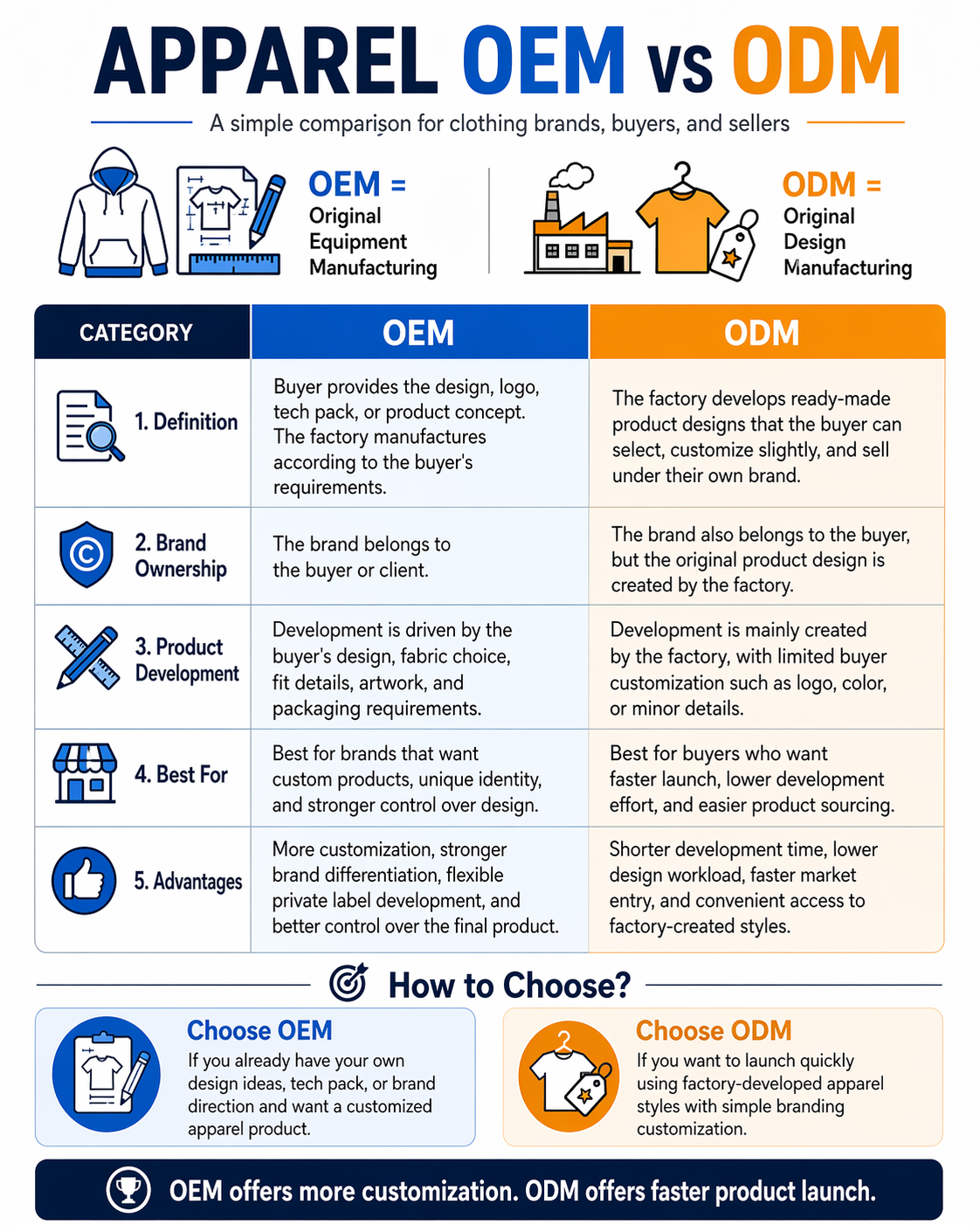
OEM means the factory makes your design exactly to your tech pack. ODM means the factory provides ready-made designs you customize with your logo, colors, or labels. OEM gives full design control but costs more and takes longer. ODM is faster, cheaper, and lower MOQ — but the design isn't truly unique to your brand.
I've been running a hoodie and apparel factory in Dongguan for over 20 years. I've watched brands burn months and tens of thousands of dollars choosing the wrong model for their stage. Here's what I tell every buyer who walks into our office.
Table of Contents
- What Is OEM in Clothing Manufacturing?
- What Is ODM in Clothing Manufacturing?
- What Are the Key Differences Between OEM and ODM?
- Which Model Suits Small and Emerging Brands?
- How to Choose Between OEM and ODM When Working With a Chinese Factory?
- What Questions Should You Ask a Factory Before Deciding?
- Conclusion
What Is OEM in Clothing Manufacturing?
OEM is a term you'll hear constantly in sourcing conversations. Most buyers nod along without fully understanding what they're agreeing to. That misunderstanding shows up later — in unexpected costs, missed deadlines, and design problems no one signed up for.
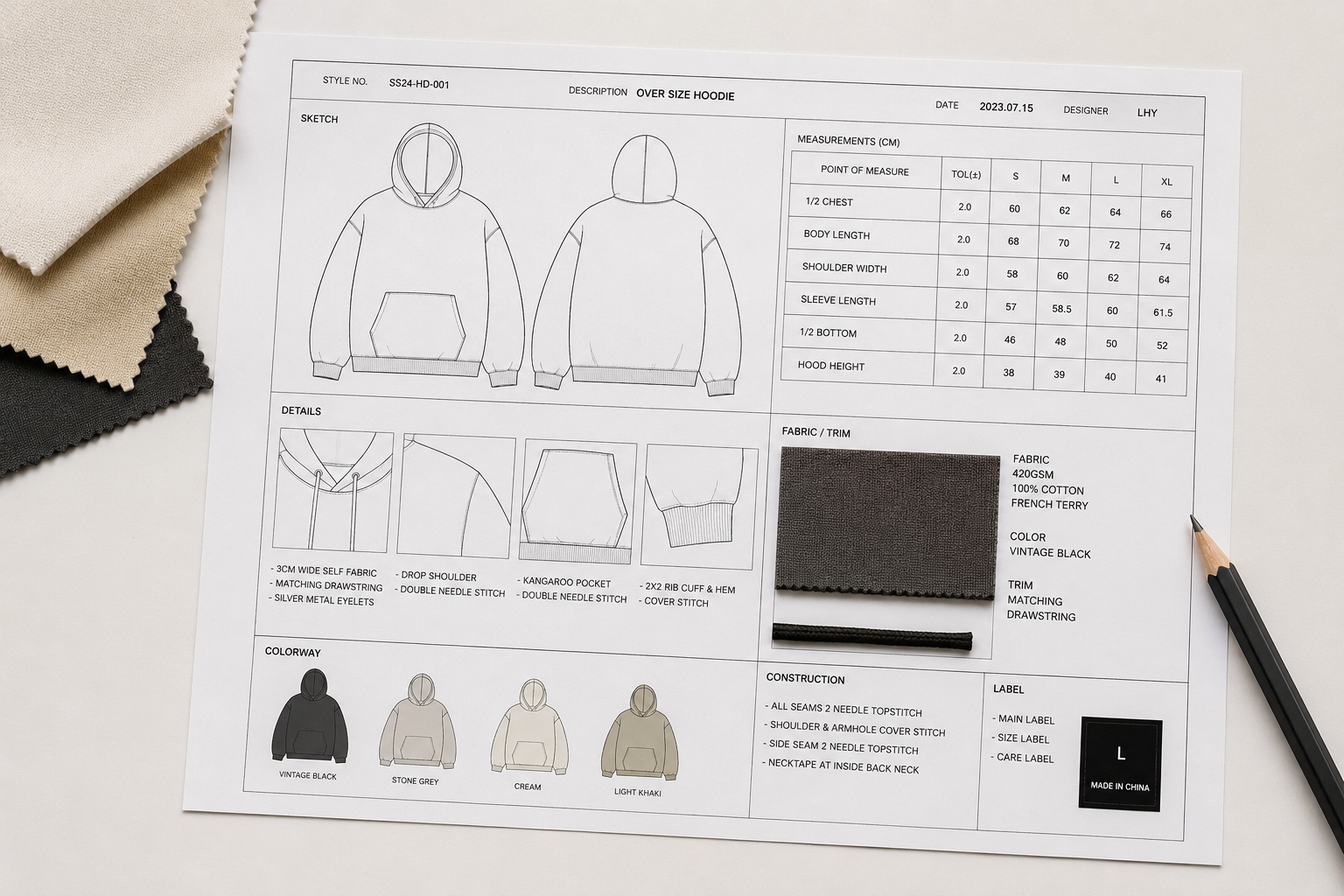
OEM stands for Original Equipment Manufacturer. In clothing, it means the factory produces garments strictly based on your designs, tech packs, fabric choices, and specifications. You own the design and the brand. The factory provides labor, materials, and production expertise — nothing more.
In 2024, a buyer from the US came to us with a tough project — 500 sets of 450gsm hoodie suits with enzyme wash, distressed details, screen printing, and rhinestones, all on the same garment. He needed it in 20 days. He'd already asked several factories. The ones who could handle this kind of mixed-craft work all quoted 35 to 40 days, which would have killed his launch window. The hard part of this kind of order isn't any single technique. It's the sequence. Wash before rhinestones and the stones fall off. Distress before printing and the print sits on torn fabric the wrong way. One wrong step and the whole batch is dead. Our pattern maker and our wash supervisor spent half a day mapping the right order — print first, then enzyme wash for the distressed look, then hand-distressing, then rhinestones last. Bulk finished on day 18. QC on day 19. Shipped on day 20. He sent me a video when he got the goods and said it was the most complex batch he'd ever ordered, and he couldn't believe we hit the deadline. He's been ordering every quarter since.
OEM is the model luxury, technical, and design-driven brands rely on. It's also the model where most communication problems happen — because the factory is following your blueprint, not improvising.
What You Provide in an OEM Arrangement
For OEM to work, you need to bring a complete package to the factory:
| Item | What It Includes |
|---|---|
| Tech pack | Measurements, construction details, stitch types |
| Artwork files | Logos, prints, embroidery designs in vector format |
| Fabric specs | GSM, composition, blend ratio, color reference |
| Trims and labels | Woven labels, hangtags, drawcords, zippers |
| Packaging requirements | Polybag, hangtag placement, folding instructions |
If any of these are missing, the factory has to guess — and guessing leads to samples that don't match your vision.
Who OEM Works Best For
OEM is the right fit when:
- Your brand has a clear design identity that can't be sourced from any factory catalog
- You have an in-house designer or work with a freelance pattern maker
- You're building a long-term brand and want full IP ownership
- You're willing to invest more time and money for unique products
The Hidden Tradeoff in OEM
Most OEM articles online only talk about the upside. Here's the part most factories won't tell you: OEM development takes longer because every detail is being created from zero. A typical OEM hoodie project goes through 2-3 sample rounds before bulk approval. That's normal. If a factory promises a one-shot OEM sample, that's a red flag — not an advantage.
At DeCheng, we run OEM samples in 7 to 14 days, but we tell clients upfront that a full OEM project — including fit revisions and decoration testing — usually takes 3 to 5 weeks before bulk starts.
What Is ODM in Clothing Manufacturing?
ODM is often described as "the easier path." That's only half true. ODM is faster and cheaper at the start, but it comes with limits most buyers don't think about until they're three orders deep and want to differentiate.
ODM stands for Original Design Manufacturer. The factory provides existing designs from its own catalog. You select a style, customize the color, fabric, and logo, and brand it as your own. The factory holds the design IP. You get speed, lower MOQ, and lower upfront cost — but limited exclusivity.[^1]
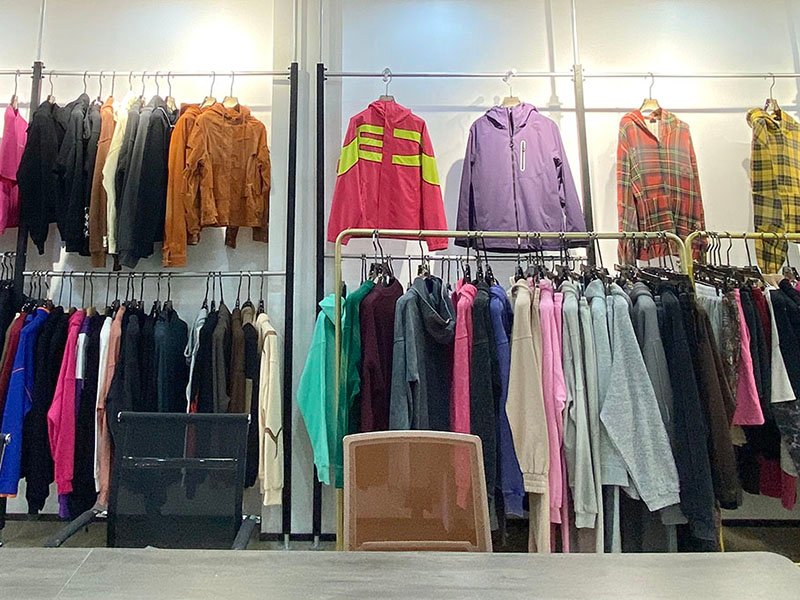
ODM is what powers most fast fashion. Shein, for example, scaled by working through ODM-style relationships with Chinese factories that already had thousands of base designs ready to ship.[^2] The model isn't bad. It's just different.
How ODM Actually Works
The ODM process looks like this:
- The factory shows you a catalog of existing styles
- You pick one or several you like
- You customize the color, fabric weight, logo placement, label, and packaging
- The factory produces under your brand name
- The same base design may be sold to other clients in different markets
That last point is the one most buyers underestimate.
What You Can Customize in ODM
Even in ODM, you usually have meaningful control over:
| Customization Area | Typically Allowed | Limitations |
|---|---|---|
| Brand label | Yes | Standard placement |
| Color and dyeing | Yes | Within factory's color range |
| Fabric upgrade | Sometimes | If factory has alternative options |
| Logo print or embroidery | Yes | Design-dependent |
| Packaging | Yes | Custom hangtags and polybags |
| Pattern modification | Limited | Major fit changes are not allowed |
Who ODM Works Best For
ODM makes sense when:
- You're launching a brand quickly and don't have full designs yet
- You want to test a category before investing in custom development
- You're filling a basic line (plain tees, simple hoodies) where uniqueness matters less
- Your budget can't support full OEM development costs
The Trap Most Buyers Don't See
ODM gives you speed, but not differentiation. If a competitor finds the same factory and orders the same base style, you're both selling the same product with different labels. For commodity items this is fine. For brand-defining pieces, it's a long-term problem.
What Are the Key Differences Between OEM and ODM?
The line between OEM and ODM looks clear on paper. In practice, it gets blurry — especially with Chinese factories that offer both. Knowing the real differences matters more than memorizing the definitions.
OEM differs from ODM in five core areas: who owns the design, who controls customization, MOQ requirements, lead time, and cost structure. OEM gives you full design ownership but requires a complete tech pack, longer development time, and higher unit cost. ODM trades exclusivity for speed and lower MOQ.
Side-by-Side Comparison
| Factor | OEM | ODM |
|---|---|---|
| Design ownership | Buyer | Factory |
| Customization level | Full (every detail) | Partial (color, logo, minor changes) |
| Tech pack required | Yes — detailed | No — factory has base patterns |
| MOQ | Higher (often 100+ pcs) | Lower (often 50+ pcs) |
| Sample lead time | 7–21 days | 3–10 days |
| Bulk lead time | 4–6 weeks | 3–4 weeks |
| Unit cost | Higher | Lower |
| IP and exclusivity | Yours | Shared with other clients |
| Best for | Established brands, unique designs | Startups, fast launches, basics |
Why "OEM Is Better Than ODM" Is Wrong
A lot of online content frames OEM as the superior choice. That's misleading. The right answer depends entirely on your brand stage and product type.
I've worked with brands that started in ODM, made $200K in their first year selling basic hoodies, then graduated to OEM in year two when they had the cash and the market validation. I've also worked with brands that jumped straight to OEM, spent $30K on development, and burned out before launch.
Neither model is "better." The wrong model at the wrong time is what kills brands.
How Chinese Factories Actually Operate
Most Chinese factories — including ours — offer both OEM and ODM under the same roof. We have a base catalog of around 200 styles for ODM clients who want to move fast. We also support full OEM for clients with their own tech packs. The difference isn't the factory. It's how you engage the factory.[^3]
Which Model Suits Small and Emerging Brands?
Small brands hear two contradictory messages. Some sources say "go OEM for brand differentiation." Others say "ODM is the only realistic option for low MOQ." Both are partially right, and choosing wrong wastes money you can't afford to lose.
For most small and emerging brands, ODM is the right starting point. It offers lower MOQ (often 50 pieces per style), faster turnaround, and lower upfront investment — letting you validate demand before committing to custom design. Move to OEM once you have proven sales and a clear design identity.
The Realistic Cash Flow Picture
Let me show you what the numbers actually look like.
| Stage | ODM Order (50 pcs hoodie) | OEM Order (50 pcs hoodie) |
|---|---|---|
| Sample cost | $50–$120 | $200–$400 |
| Pattern development | $0 (already exists) | $300–$800 |
| Tooling for prints | $50–$150 | $50–$150 |
| Unit price | $9–$13 | $13–$18 |
| Total upfront | ~$650–$1,000 | ~$1,500–$2,500 |
For a brand testing the market, ODM costs roughly half what OEM costs to launch. That margin gives you room to fail, learn, and iterate.
A Realistic Path: ODM to OEM
I tell new brand owners the same thing every time. Start with ODM. Pick 2-3 base styles. Customize with your label, your colors, and a strong print or embroidery. Sell through your channels. Once you've moved 500-1,000 units, you have data — what fits work, what colors sell, what price point your customers accept.
Then, and only then, invest in OEM. You'll know what to design, because the market told you.
When Small Brands Should Skip ODM
There are exceptions. If your brand identity is built on something that genuinely doesn't exist in factory catalogs — a specific fit, a unique fabric, a proprietary construction — ODM won't serve you. Going straight to OEM is worth the higher cost.
For most other small brands, this is rare. Most "unique" ideas can be approximated with ODM customization for the first season.
How to Choose Between OEM and ODM When Working With a Chinese Factory?
Choosing the model isn't a one-time decision. It's a conversation that should happen before you sign anything. The factory you pick should help you make this decision — not push you into the model that suits their preference.
To choose between OEM and ODM with a Chinese factory, evaluate four things: your design readiness, your budget, your timeline, and your target volume. If you have a complete tech pack, $5,000+ in development budget, and 6+ weeks of timeline, OEM works. If you're missing any of these, ODM is the smarter starting point.
A Decision Framework
I use this framework with new clients to help them figure out where they actually fit:
Step 1: Audit Your Design Readiness
Do you have a complete tech pack with measurements, fabric specs, construction details, and artwork? If yes, OEM is viable. If no, ODM is the realistic option for your first run.
Step 2: Audit Your Budget
OEM development can cost $1,000-$5,000 before bulk production even starts. ODM development can be under $500. Be honest with yourself about what you can lose if the first launch underperforms.
Step 3: Audit Your Timeline
| Timeline | Recommended Model |
|---|---|
| Need product in 4 weeks | ODM (fastest path) |
| Need product in 6–8 weeks | ODM or hybrid |
| Need product in 10+ weeks | OEM is feasible |
| No fixed deadline | OEM gives best long-term value |
Step 4: Audit Your Target Volume
If you're ordering 50-100 pieces per style for testing, ODM matches that volume better. If you're scaling to 500+ pieces and your design is locked in, OEM unit costs become competitive.
The Hybrid Approach Most Buyers Don't Consider
Most buyers think OEM and ODM are an either-or choice. They're not. Many growing brands run both at the same time:
- ODM for basics: plain hoodies, simple tees, core staples
- OEM for signature pieces: limited drops, technical apparel, brand-defining styles
This hybrid approach is what most successful streetwear brands actually use. They keep margins healthy on basics while protecting brand identity on signature drops.[^4]
At DeCheng we support both under the same roof — same QC team, same lead time standards, same MOQ flexibility starting from 50 pieces.
What Questions Should You Ask a Factory Before Deciding?
The questions you ask a factory before signing reveal more than the answers themselves. A factory that gives vague answers will give vague production. A factory that asks you sharp follow-up questions is one that takes execution seriously.
Before deciding between OEM and ODM with any factory, ask about MOQ flexibility, sample timeline, who owns the design IP, what customization is included in the quoted price, and how revisions are handled. Vague answers on any of these are a signal to look elsewhere.
Questions for OEM Arrangements
If you're considering OEM, ask:
- What's your minimum MOQ for a custom-developed style?
- How many sample rounds are included before bulk production?
- Who owns the pattern after development — me or the factory?
- What happens if the bulk order doesn't match the approved sample?
- Can you provide references from previous OEM clients?
Questions for ODM Arrangements
If you're considering ODM, ask:
- Can I see the full catalog before quoting?
- Are these designs exclusive to me, or are they shared with other brands?
- What customization is included in the base price?
- Can I modify the fit if I need to?
- What's the MOQ per style and per color?
Questions for Both Models
Regardless of model, every serious factory should be able to answer:
| Question Topic | What You're Really Testing |
|---|---|
| Lead time commitment | Whether they overpromise |
| QC process | Whether they actually inspect or just sample |
| Certifications (OEKO-TEX, GOTS) | Whether they have real documentation[^5] |
| Communication frequency | Whether they'll respond when problems happen |
| Payment terms | Whether they protect both sides |
A Red Flag I See Often
If a factory says "yes" to every question without asking you any in return, walk away. Real factories ask about your fabric weight, your target price, your delivery date, your label preference, and your packaging. Silence on these isn't politeness — it's lack of expertise.
Conclusion
OEM gives full design control at higher cost and longer timelines. ODM trades exclusivity for speed, lower MOQ, and faster launches. Most small brands should start with ODM, validate demand, then graduate to OEM. If you're looking for a manufacturing partner that supports both — with low MOQ from 50 pieces and samples in 7 to 14 days — visit www.dechoreal.com or email joe@dc-garment.cn.
References
[^1]: Definitions of OEM and ODM business models in apparel manufacturing — Mingxing Clothing: https://mingxingclothing.com/blog/oem-vs-odm-clothing-difference/
[^2]: Shein's ODM-driven scaling strategy — JF Apparel industry analysis: https://jinfengapparel.com/what-is-the-difference-between-oem-odm-and-obm/
[^3]: How Chinese factories operate dual OEM/ODM models — Groovecolor industry guide: https://www.groovecolor.com/blog/OEM-vs-ODM-Clothing-Manufacturing-The-Ultimate-Guide-for-Premium-Streetwear-Brands_b8740
[^4]: Hybrid OEM-ODM approach used by streetwear brands — Haiyuan apparel guide: https://haiyuanworkclothes.com/blog/what-is-the-difference-between-oem-and-odm-clothing/
[^5]: OEKO-TEX Standard 100 and GOTS as baseline certifications: https://www.oeko-tex.com/en/our-standards/oeko-tex-standard-100